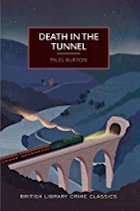
 Miles Burton, Death in the Tunnel
When prominent businessman Sir Wilfred Saxonby is found dead in a first-class train compartment, the local police assume that he must have committed suicide. After all, they found the murder weapon, monogrammed with Sir Wilfred’s initials, in the train compartment, and the train employees swear that no one entered or left the compartment except Sir Wilfred himself. But because of the man’s high social status—and the apparent lack of a motive—Scotland Yard is called in. Inspector Arnold is not quite satisfied with the suicide theory, so he in turn asks for the help of his friend Desmond Merrion, an amateur expert in criminology. Together, Arnold and Merrion consider the possibility that Sir Wilfred was murdered and try to discover how it could be done.
This is one of those Golden Age mystery novels that’s all plot and absolutely no character development. The two principal characters are Arnold and Merrion, and all we ever learn about them is that Merrion is more “imaginative” than Arnold, but both are good detectives. They have literally no other character traits — though I believe there are several other books featuring Merrion, so he may be better defined elsewhere. Sir Wilfred is only fleshed out enough to hint at a possible motive for murder, and the three or four suspects are only vaguely differentiated from each other. That said, the plot is actually very ingenious — one of the best mysteries I’ve read in a while from a pure “puzzle” standpoint! Merrion and Arnold piece together their solution in a very logical way, demonstrating how the seemingly impossible crime could have been accomplished. So in the end, the excellent plot made up for the lackluster characterization, for me; your mileage may vary.

 You Book Me All Night Long