Review: Salt to the Sea

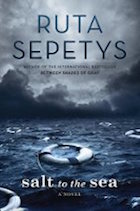
Salt to the SeaRuta Sepetys, Salt to the Sea

“World War II is drawing to a close in East Prussia and thousands of refugees are on a desperate trek toward freedom, many with something to hide. Among them are Joana, Emilia, and Florian, whose paths converge en route to the ship that promises salvation, the Wilhelm Gustloff. Forced by circumstance to unite, the three find their strength, courage, and trust in each other tested with each step closer to safety. Just when it seems freedom is within their grasp, tragedy strikes. Not country, nor culture, nor status matter as all ten thousand people — adults and children alike — aboard must fight for the same thing: survival.” (Summary from Amazon.)

I’m a sucker for a good World War II story, and this one approaches the conflict from a unique (to me) perspective: it focuses on three Eastern European teenagers who are caught between Nazi Germany and the advancing Red Army. My favorite character was Florian, who is carrying out a secret mission while trying very hard not to fall in love with Joana. But I honestly enjoyed all three main characters’ stories, especially after they meet up and continue their westward journey together. There are definitely some heartbreaking events in this book, which is to be expected, but the overall message is one of hope. I’d definitely recommend this book to fans of historical fiction, especially those who don’t mind a narrative geared toward a younger audience.

Review: Interior Freedom

Interior FreedomJacques Philippe, Interior Freedom (trans. Helena Scott)

Interior Freedom leads one to discover that even in the most unfavorable outward circumstances we possess within ourselves a space of freedom that nobody can take away, because God is its source and guarantee. Without this discovery we will always be restricted in some way and will never taste true happiness. Author Jacques Philippe develops a simple but important theme: we gain possession of our interior freedom in exact proportion to our growth in faith, hope, and love. He explains that the dynamism between these three theological virtues is the heart of the spiritual life, and he underlines the key role of the virtue of hope in our inner growth. Written in a simple and inviting style, Interior Freedom seeks to liberate the heart and mind to live the true freedom to which God calls each one.” (Summary from Amazon.)

Every once in a while, a book comes along that tells you exactly what you need to hear in that moment. Interior Freedom was one of those books for me. I was feeling a lot of stress and anxiety for various reasons, and this book spoke pretty directly to my state of mind at the time. It’s written from a Christian (specifically Catholic) perspective, and I don’t think the solutions it offers would be useful for non-Christians. But it really gave me a new perspective on faith in particular: if I really believe in an almighty and all-loving God (as Christians profess to do), then I must have absolute trust in his love for me and his ability to bring good out of even the toughest situations. Definitely recommended for Christians of all denominations, especially those who are feeling weighed down by circumstances in their lives.

Review: The River of No Return

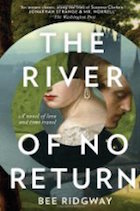
River of No Return, TheBee Ridgway, The River of No Return

Nicholas Falcott, Marquess of Blackdown, is about to die on the battlefield at Salamanca. But instead of being trampled by a French cavalry horse, he suddenly disappears in a blaze of light and reappears in the 21st century. There, Nicholas finds himself under the protection of the Guild, a secret society of individuals with the ability to jump forward in time. The Guild provides Nick with a new identity, plenty of money, and enough information about the modern world for him to survive in the present. Nick believes it’s impossible to go back to his original time — until one day, out of the blue, the Guild leaders order him to do just that. They tell him about a rival group of time travelers whose attempts to change history will result in widespread disaster, unless Nick can go back to 1815 and stop them. But when he jumps back to his own time, he learns that the Guild is keeping secrets from him. He also reconnects with Julia Percy, his beautiful young neighbor who is somehow connected to this feud between time travelers.

This is a book I should have loved: it’s got Regency England, romance, intrigue, and time travel! But sadly, the novel’s underwhelming execution didn’t live up to its great premise. One of the biggest problems for me was the pacing. It took forever to set up the world and introduce Nick and Julia as characters. Once Nick jumps back to 1815 (about 1/4 of the way into the book), things pick up a little, but the pacing still drags. Nothing really important occurs until the last 50 pages or so, when the characters suddenly learn a whole lot of new information at breakneck speed. My other big problem with this novel is that NOTHING IS RESOLVED IN THE END. Nick eventually learns more about the future catastrophe that the time travelers are trying to prevent, but he doesn’t actually do anything about it. So basically, this book is one long setup for a payoff that isn’t going to happen until the sequel — and I don’t think it’s actually been published yet, so it could be a long wait! I’ll admit that I am a bit curious to know how things turn out, but it may not be worth the aggravation this book caused me.

Review: Act Like It

Act Like ItLucy Parker, Act Like It

Actress Lainie Graham is the sweetheart of the London stage, and her wholesome public persona is now especially sympathetic because she’s recently been dumped. In contrast, her co-star Richard Troy is the quintessential bad boy. His Byronic good looks and considerable talent have counterbalanced some of his negative behavior, but the public is no longer willing to overlook his violent temper. Desperate to get public opinion back on their side, the theater manager and Richard’s agent concoct a plan: Richard and Lainie will pretend to be in a relationship so that her positive image will rehabilitate Richard’s negative one. At first, Lainie objects to the plan — she can’t stand Richard’s obnoxious behavior and inflated ego — but she is eventually convinced to play along. As she spends more time with Richard, however, she learns that there’s much more to him than meets the eye. Meanwhile, Richard is surprised to discover that Lainie is intelligent, kind, and more than willing to match him quip for quip. But how can these two actors be confident that their so-called fake relationship has evolved into something real?

After a streak of books that weren’t grabbing my attention, I was delighted to discover this sweet romance! I always enjoy the “fake relationship becomes real” trope, so I was predisposed to like the book anyway. But the adorable banter between Lainie and Richard is what really sealed the deal for me. Their sarcastic jabs at one another soon become playful teasing, and these interactions really made their chemistry believable. I appreciated how their careers as actors added another layer of complexity to the relationship; I especially enjoyed watching Richard seethe as Lainie had to pretend to be in love with her ex, another actor in the same play. The book does contain some of the romance genre’s more annoying clichés, such as a physically perfect hero with piercing blue eyes and a Big Misunderstanding that needlessly threatens the relationship. But overall, this book was a lovely surprise that came along at just the right time for me. Definitely recommended for fans of romantic comedies!

Review: The Day Lasts More Than a Hundred Years

Day Lasts More Than a Hundred Years, TheChingiz Aitmatov, The Day Lasts More Than a Hundred Years (trans. John French)

Set in Kazakhstan in the latter half of the 20th century, this novel centers around Yedigei, a railway worker at the isolated Boranly-Burannyi train station in the middle of the steppe. He has lived with his wife and daughters in the tiny community by this train station for many years, and the other families who live there are practically his family also. When his neighbor and friend Kazangap dies, Yedigei takes responsibility for burying him properly at the ancient Kazakh cemetery of Ana-Beiit, even though it is a long journey from Boranly-Burannyi. Yedigei is able to arrange a small funeral procession that includes several men from the village, a camel, and even a tractor. As the procession makes its way through the steppe, Yedigei reflects on his relationship with Kazangap and on several other significant events in his life. Eventually, his quest collides with a momentous scientific discovery involving contact with intelligent life on another planet.

For me, this book was very put-down-able; I never felt like I simply had to know what was going to happen next. Nonetheless, I was surprised by how much I ultimately enjoyed the story. It certainly took me to an entirely different place and time — I’ve barely read any Soviet literature, and I definitely haven’t read anything set in Kazakhstan before. I think the book wonderfully describes Yedigei’s way of life in a way that is both very specific and somehow accessible to contemporary Western readers. I also loved the meditative quality of the prose, which is enhanced by the frequent repetition of certain phrases and paragraphs throughout the book. The bulk of the novel is told in flashback as Yedigei recalls various incidents, and these flashbacks provide most of the plot. In the book’s present, not much actually happens, but I never felt like things were moving too slowly. The sci-fi aspect of the plot seemed pretty disposable to me, but I was certainly curious while reading to see how it would connect with Yedigei’s story! Overall, even though this book wasn’t a page-turner, I’m really glad I stuck with it.

Review: Read Bottom Up

Read Bottom UpNeel Shah and Skye Chatham, Read Bottom Up

This epistolary novel tells the story of a 21st-century romance solely through emails and texts. Elliot and Madeline meet at a restaurant opening in New York City and slowly begin to communicate through emails, texting, and finally in-person interactions. But they’re not only communicating with each other; they’re also in simultaneous conversations with their best friends, David and Emily respectively, as they frantically over-analyze each interaction down to the very last comma. Elliot and Madeline tentatively embark upon a relationship while navigating modern dating pitfalls such as how to wait the appropriate amount of time before responding to a text, or how to tell the difference between a date and a group hang. But beyond all the angst and analysis, are they actually right for each other?

I picked up this book from the library on a whim and found it a quick, pleasant read. I love a good epistolary novel, and I’m especially interested in modern-day versions that utilize technology like emails and texting. Moreover, the epistolary format emphasizes the paradox that despite all the modes of communication available to Elliot and Madeline, they are actually pretty bad at communicating honestly with each other. This drives the conflict in the book, as well as most of its humor. I have to say, I wasn’t particularly enamored of Elliot or Madeline, especially the former; I’m not quite sure why Madeline is so interested in such a bland guy. The best friends, David and Emily, are actually more interesting characters, but that’s probably because they’re offering genuine opinions, not censoring themselves to please a potential love interest. Overall, I think this novel is a pretty accurate representation of modern dating, and it’s a pleasant way to spend an evening, but there’s nothing particularly deep or emotionally resonant about it.

Review: Step Aside, Pops

Step Aside, PopsKate Beaton, Step Aside, Pops

If you don’t already know Kate Beaton, creator of the delightful webcomic Hark! A Vagrant, you should check out her comics IMMEDIATELY! Not only are they hilarious, but many of them are based on literary works and historical events, so they are educational as well. This book collects some of Beaton’s greatest hits from the website, so some people may be disappointed at the lack of new material (there’s a little bit, but not much). Even so, I’m glad to have a hard copy collecting some of my favorites, from the brazen velocipedestrienne (!) on the front cover to the “straw feminists in the closet” to the classic Gorey and Nancy Drew covers. Definitely recommended for Beaton fans or for those who like their humor to be both smart and silly.

Review: Things I Can’t Explain

Things I Can't ExplainMitchell Kriegman, Things I Can’t Explain

Those who grew up in the ‘90s will likely remember Clarissa Darling, the witty, offbeat heroine of the Nickelodeon sitcom “Clarissa Explains It All.” This novel, written by the creator of the show, follows a grown-up Clarissa trying to navigate life in her late 20s. Although she achieved her childhood goal of becoming a journalist, she’s now unemployed because the newspaper she worked for has gone under. Her family is also in a state of upheaval, as her overachieving mother and impractical father are separating. And most confusing of all is her love life, as she wavers between an old romance and a chance at something new. Clarissa may have been a know-it-all as a teen, but now she’ll have to confront, and maybe even embrace, the fact that she still has a lot to learn.

When I was a kid, “Clarissa Explains It All” was one of my favorite shows, but I definitely overestimated my level of nostalgia for it! First of all, I actually remembered much less about the show than I thought I did. I had no memory of Clarissa’s lists and wacky superstitions, and I didn’t remember her female friends at all. In fact, I think all I really wanted to know was what happened between Clarissa and her best friend Sam. The show kept them platonic throughout, but honestly, my sappy romantic soul wanted them to end up together! And — spoiler alert — they don’t. In fact, Sam is never actually “on page”; Clarissa reminisces about him quite frequently, but we never get his side of the story. That bugged me so much that maybe I’m not being fair about the rest of the book. But overall, I thought it was pretty mediocre chick lit, not really worth reading unless you’re a diehard Clarissa fan.

Review: Belief or Nonbelief?

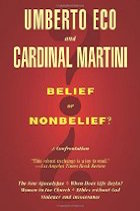
Belief or Nonbelief?Umberto Eco and Cardinal Martini, Belief or Nonbelief?: A Confrontation (trans. Minna Proctor)

This slim volume is a collection of letters written in the 1990s between Umberto Eco, renowned author, scholar, and atheist, and Carlo Maria Martini, a cardinal of the Catholic Church. The letters, which were originally published in an Italian newspaper, present these men’s opposing points of view on a number of philosophical and theological topics, including: secular and religious perspectives on the end of the world, the politically fraught issue of when human life begins, the Catholic Church’s refusal to admit women to the priesthood, and the ultimate source of human ethics. Though Eco and Martini often disagree, their letters maintain a consistent tone of civility and open-mindedness that is all too rare in public discourse nowadays.

I enjoyed this book, and I think it’s somewhat unique in that both believers and nonbelievers could get something out of it. As I mentioned, both Eco and Martini approach the conversation with sincerity and goodwill, never mocking or belittling each other’s positions, but actually having a genuine dialogue and hoping to learn from one another. I wish our public figures in general would take the hint! I will say, though, that I don’t think these letters would actually change anyone’s mind; an atheist wouldn’t suddenly convert to Christianity, nor would a religious person lose his/her faith because of this book. Because the letters were originally written for newspaper publication, they couldn’t be long or in-depth enough to explore the topics thoroughly. Basically, I came away from this book wanting more, but I’d still recommend it if the subject matter appeals to you.

Review: Love in Lowercase

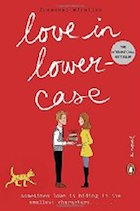
Love in LowercaseFrancesc Miralles, Love in Lowercase (trans. Julie Wark)

Samuel is a thirty-something professor of German living in Barcelona, ringing in the New Year alone with no sense of joy or optimism for the year ahead. But his life suddenly becomes much less lonely with the arrival of a stray cat who immediately demands his attention and affection. The cat leads Samuel to his upstairs neighbor Titus, who is compiling a collection of inspirational stories. Samuel eventually agrees to help the elderly and ailing Titus with his book, which opens up Samuel to a host of new people and experiences. He befriends Valdemar, a possibly homeless conspiracy theorist who philosophizes with him late into the night. He mildly flirts with the veterinarian who comes to give the cat its shots. And by sheer happenstance, he runs into Gabriela, the girl he fell madly in love with as a child but whom he hasn’t seen in decades. But will Samuel be able to transcend his solitary habits and actually act on his feelings?

I should say up front that I didn’t particularly enjoy this book, but I don’t think it’s necessarily the book’s fault. Based on the title and cover, I was expecting a romantic comedy. The cover art looks similar to that on Rainbow Rowell’s books, so I think that made me subconsciously expect a Rowell-esque story. But this book is very different; in fact, the romance is quite weak, which disappointed and sometimes even aggravated me. It’s not that I always need a strong romantic plot in my books, although I admit it’s usually a plus! But if there’s going to be a romance, I’d like for it to be emotionally satisfying…and for me, this one wasn’t. Gabriela is barely a character at all; she’s merely an idealized romantic fantasy for Samuel to moon over. And in fact, the romance isn’t even the main plot. The book mostly just follows Samuel around Barcelona as he philosophizes (in a not particularly deep manner) about life and love. So I wasn’t a fan of this book, but maybe I would have liked it more if I’d gone into it with different expectations.