Review: Siege and Storm

Siege and StormLeigh Bardugo, Siege and Storm

***Warning: SPOILERS for Shadow and Bone!***

After failing to kill the Darkling, Alina and her beloved Mal are on the run. They hope that by staying far away from Ravka, they can escape the Darkling’s wrath; unfortunately, however, he catches up with them almost immediately. Despite the Darkling’s growing power, he wants to bind Alina and her magic more closely to him by searching for a second amplifier, a legendary sea serpent. For this purpose, he hires the notorious pirate Sturmhond to sail them through the northern seas. Alina nearly despairs when the sea serpent is found and the second amplifier placed on her wrist, but she finds unexpected allies in Sturmhond and his crew. After escaping the Darkling’s clutches once again, Alina finds herself at the head of a fragmented Grisha army, whose job is to defend Ravka from a possible invasion. But will her tiny force be enough to withstand the Darkling’s might?

I think I enjoyed this book even more than Shadow and Bone, mostly because Alina is more sure of herself and more determined to take charge of her own destiny. I also absolutely loved Sturmhond! What can I say — I can’t resist a swashbuckling pirate with secrets! The plot twist involving his character was somewhat predictable for me, but I still enjoyed it, and I liked watching Alina react to a new set of problems and expectations. The addition of siblings Tolya and Tamar was also a lot of fun…I liked having more characters to care about than just Alina and Mal. Many second books in a trilogy suffer from “middle book syndrome,” but I think this one is a great read on its own, and it also sets up book three very nicely. Speaking of which, my review of Ruin and Rising is coming soon, after a brief detour or two!

Review: Shadow and Bone

Shadow and BoneLeigh Bardugo, Shadow and Bone

Orphan Alina Starkov has grown up believing she’s completely ordinary. Not particularly pretty or talented, she’s lived in the shadow of her best friend and fellow orphan Mal, who is handsome and popular and a talented tracker for the Ravkan army. But when Alina unexpectedly discovers that she has supernatural powers, her entire life changes in an instant. She is swept up into the world of the Grisha, an elite class of magicians who have the power to control everything from metals to tides to the human body. Alina herself has the ability to control sunlight, a rare and powerful magic that catches the attention of the Grisha’s commander, the mysterious Darkling. The Darkling encourages Alina to harness her power, telling her that she can change Ravka for the better. But in strengthening her magical abilities, will Alina end up losing the most essential part of herself?

After seeing a lot of hype for the Grisha trilogy around the Internet, I was excited to read these books but also nervous that they wouldn’t live up to their reputation. Overall, I enjoyed the trilogy, but I didn’t quite embrace it as wholeheartedly as many others have. This first book does a good job of setting the stage: the world of Ravka is robust and full of interesting details, and the central conflicts of the series are clearly established. I’m not sure how I feel about Alina as a character…she spends a lot of this book questioning herself and moping about her nonexistent love life. And yes, there’s something of a love triangle in the novel, but it’s eventually resolved in a very stark way. (In fact, I wish there had been a bit more ambiguity about it!) Fortunately, Alina does demonstrate some strength as the story progresses, and overall, I liked the book enough to pick up the second installment right away!

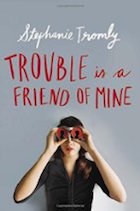
Review: Trouble Is a Friend of Mine

Trouble Is a Friend of MineStephanie Tromly, Trouble Is a Friend of Mine

Zoe Webster is an utterly normal teenage girl who’s just trying to survive her parents’ divorce and her subsequent move to a small town in upstate New York. But her life is turned upside down when she meets her neighbor and classmate Digby, who’s basically the opposite of normal. He’s rude and annoying, he wears suits all the time, and he’s obsessed with the recent disappearance of a local teenage girl. Somehow he ropes Zoe, along with his former best friend Henry, into his plan to investigate the disappearance. Their research leads them to a perverted gynecologist, a drug ring, and a possible cult, as they eventually learn that the girl’s disappearance isn’t quite what it seems. Meanwhile, Zoe tries to sort through her feelings for Digby, who has involuntarily become one of her closest friends, and maybe even something more.

A lot of the hype for this book compared it to “Veronica Mars,” a TV show I really enjoyed, but unfortunately I don’t think such comparisons are particularly accurate. Yes, like VM, this book features a teen detective who solves a mystery with his friends, and there’s even a reference to the VM theme song in the book. But in my opinion, the similarities really end there; VM is much funnier and its mysteries more compelling than the events of the book. I just wasn’t engaged by the novel at all, despite the fact that there’s nothing particularly wrong with it. Maybe my issue is that the characters didn’t seem real to me. Zoe, the narrator, is essentially a blank canvas — she’s so forgettable that I had to look up her name. Digby has more personality, but since we see him through Zoe’s eyes, he remains pretty mysterious throughout the book. I didn’t get much insight into what makes him tick or why he wants to hang out with Zoe. Overall, this is not a bad book, and fans of YA mysteries might like it, but I was hoping for more.

Review: A School for Brides

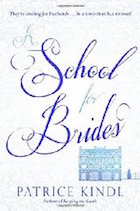
School for Brides, APatrice Kindl, A School for Brides

The students of the Winthrop Hopkins Female Academy all know that their primary goal is not to receive a scholarly education but to learn the ladylike skills necessary to attract a husband. The problem is that the school is located in Lesser Hoo, Yorkshire, a country village with absolutely no eligible men. There are currently six girls of marriageable age at the school, and they are constantly bemoaning the dearth of potential husbands in the area. Fortunately, a chance encounter with some gentlemen who are visiting a nearby estate for hunting season provides them with all the romance and intrigue their hearts desire. Some of the girls fall in love with relative ease, while others find various obstacles in their paths. But when a valuable necklace goes missing and the school’s footman is the chief suspect, the girls and their paramours band together to clear his name and find the real culprit.

I had previously read and enjoyed Patrice Kindl’s [Keeping the Castle], which is set in the same village and features some of the minor characters in this book. So I was predisposed to enjoy this novel, and by and large I found it a pleasant read. The writing is light and brisk, very evocative of Georgette Heyer’s style (though of course not as good). I also liked the fact that the girls’ romances develop in a variety of ways. Some of them are true love stories with a happy ending, but some of them end in heartbreak, while one girl marries a kind man she doesn’t love after being betrayed by another suitor. This variety of outcomes especially makes sense in the Regency era, when marriage was basically the only choice for a gently bred young woman. The one thing I didn’t like was that, because of the sheer number of characters to follow, none of them are given much depth. I wasn’t particularly invested in any of the romances, nor did the mystery of the stolen necklace hold my interest (mostly because it was so easy to figure out). But for those who enjoy witty Regency fluff, I’d recommend this book as a fun read.

Review: The Other Daughter

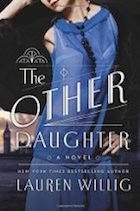
Other Daughter, TheLauren Willig, The Other Daughter

Working-class Rachel Woodley is currently employed as a governess in France, but she must return to England in a hurry when she learns that her mother is ill. By the time she gets back to her native village, her mother has died. As a grieving Rachel sorts through her mother’s possessions, she discovers a shocking secret: her father, whom she believed had died many years ago, is actually alive and well. Moreover, he’s an earl with a wife and daughter — his legitimate family. Shocked and angry, Rachel decides she must confront her father somehow. With the help of Simon Montfort, a young gentleman who is part of the earl’s social circle, Rachel assumes a new identity in order to get closer to her father. As she infiltrates the crowd of Bright Young Things in 1920s London, she manages to meet her half-sister and even obtain an invitation to the earl’s home. But the more she gets to know this side of her family, the more Rachel wavers in her desire for revenge.

While I adore Lauren Willig’s Pink Carnation series, her standalone novels have been a bit less successful, in my opinion. They usually lack the humor that makes the Pink Carnation books so much fun, and Willig’s trademark dual narratives (one historical, one contemporary) would split my focus in a way that I found very distracting. Happily, in this book, there is no contemporary framework narrative; the entire book follows Rachel’s journey in the 1920s. Perhaps for this reason, I ended up really liking the novel! I found Rachel’s motivations and feelings very believable, as she tries to deal with the fact that her entire identity has shifted. I also like that her feelings slowly change as she realizes that neither her father nor her half-sister is the pure villain she imagined at first. Of course, there’s a romance in the book as well, which I enjoyed very much — Simon is a delicious hero with a very interesting backstory. Overall, I liked this book a lot and would definitely recommend it to fans of historical fiction!

Review: First & Then

First & ThenEmma Mills, First & Then

Devon Tennyson is a high school senior who couldn’t be more ordinary. She’s a decent but not exceptional student; she’s an only child with a stable home life; and she has no idea what she wants to do after graduation. For now, she’s happy to ignore the future and concentrate on having fun with her best friend Cas, who she’s hoping will finally notice her as more than just a friend. But when Devon’s freshman cousin Foster moves in with her family, her life slowly begins to change. Foster is strange and socially awkward, but while Devon finds him annoying at first, she eventually becomes very protective of him. Foster also introduces Devon to star quarterback Ezra Lynley, who’s recently transferred to their high school. Ezra is handsome, popular, and a shoo-in for a football scholarship, so Devon immediately assumes he’s an arrogant jerk. But the more she gets to know Ezra, the more she realizes that her first impression may not have been justified.

I’d been dying to read this book ever since I saw it promoted as “Pride and Prejudice meets Friday Night Lights.” I think that’s a fair comparison, in the sense that if you like those two things, you’ll probably like this book as well. Devon is a refreshingly ordinary heroine, and I enjoyed her wry, self-deprecating voice. I also really loved the progression of her relationship with Foster from distant cousins to (essentially) brother and sister. The romance with Ezra was nicely developed (the slowest of slow burns), but for some reason I didn’t find it especially compelling. Maybe that’s the reason I didn’t quite fall in love with this book the way I wanted to. But I do love the fact that Devon’s relationships with Foster and Ezra also open her up to other friendships. Initially, Devon’s only friend is Cas, and she’s so invested in him that she doesn’t really pay attention to anyone else. But throughout the course of the novel, she realizes that she’s been a bit self-absorbed and makes more of an effort to reach out to other people. So overall, I’m glad this book wasn’t just about the romance, but I still wish I’d felt a little more of the connection between Devon and Ezra.

N.B. An ARC of this book was graciously provided by the publisher. Publication date is October 13, 2015.

Review: The Queen of the Tearling

Queen of the Tearling, TheErika Johansen, The Queen of the Tearling

Princess Kelsea Raleigh Glynn has just turned 19, and it’s time for her to ascend the throne of the Tearling. But being the ruler of this kingdom is not exactly an enviable position. Competition for power is fierce — so much so, in fact, that Kelsea has been raised in exile and must be escorted to her palace by the Queen’s Guard, an elite group of warriors, in order to protect her from assassination. Her uncle, the regent, almost certainly wants her dead, and he is far from the only person in the Tearling who doubts Kelsea’s ability to rule. Most threatening of all, however, is the menace of the Red Queen, a powerful sorceress who rules the neighboring kingdom and has begun expanding her empire. Kelsea is shy, bookish, and plain — seemingly the last person in the world to make an effective ruler. But her strong sense of justice and the help of a few loyal allies eventually enable her to claim her throne and even — perhaps — to keep it, as she makes her first move to challenge the Red Queen’s supremacy.

I quite enjoyed this sword-and-sorcery novel, although the plot is certainly far from original. Kelsea is a relatable fantasy heroine, not particularly gifted at swordplay or magic, but grimly determined to hold onto her birthright and (essentially) not mess things up too badly. I also loved the basic premise that she has to win a place for herself in a situation where so many different factions are arrayed against her. I’m a sucker for a good political intrigue, and this book sets up a lot of different possible enemies who I’m sure will become more important in the sequels. The actual plot of this book is a little weak, in my opinion. The Red Queen is so over-the-top evil that I found her more annoying than threatening; I’d much rather see Kelsea deal with her internal foes than focus on defeating this “big bad.” But I want to spend more time in this world, especially to learn more about the Queen’s Guard and the Fetch. So I’ll definitely be picking up the sequel, The Invasion of the Tearling, one of these days!

Review: The Twelfth Enchantment

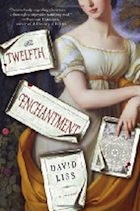
Twelfth Enchantment, TheDavid Liss, The Twelfth Enchantment

As a young woman of no fortune in 19th-century England, Lucy Derrick’s choices are extremely limited. Her parents are dead, so she is forced to live with her odious uncle and his cruel housekeeper. Her only means of escape is to accept the advances of a prosperous local mill owner, but she doesn’t love the man and has delayed making a final decision. But everything changes when Lucy encounters the dashing Lord Byron, the principal landowner in the area. Byron shows up on Lucy’s doorstep with a mysterious illness that is soon revealed to be magical in origin. To Lucy’s surprise, she is actually able to help him through exercising her own magical abilities. This chance encounter leads Lucy into a shadowy world whose existence she had never before suspected — a world of changelings and faeries and soulless beings who cannot die. Assisted by her friend Mary Crawford (of Mansfield Park fame) and by Jonas Morrison, the man who once broke her heart, Lucy must navigate a supernatural power struggle and find an ancient spell book that will vanquish her immortal enemies once and for all.

This was my first encounter with David Liss, and I think it’s probably not the right entry point into his work. My understanding of his other books is that they are serious historical fiction, with plenty of exploration of the gritty realities of life in former eras. This book contains a lot of those same concerns, with Luddites and Rosicrucians both being fairly integral to the plot. But at the same time, this novel also has a lot of Regency romance tropes, like the lovely but impoverished young woman who seeks marriage both for love and for economic stability. As a result, the book felt slightly schizophrenic to me. Personally, I was more interested in Lucy’s individual character development and her romantic relationships than in the broader power struggle, so everything about the aforementioned Luddites and Rosicrucians was a real slog for me. In other words, it’s too heavy for a light, fluffy read; but the Regency-romance elements detract from the serious historical fiction aspects of the book. Some things did work for me, particularly the central romance, but overall I think the book suffers from trying to blend two very different genres.

Review: How My Summer Went Up in Flames

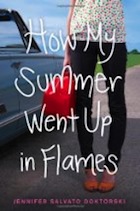
How My Summer Went Up in FlamesJennifer Salvato Doktorski, How My Summer Went Up in Flames

It’s the first day of summer, but Rosie Catalano is feeling anything but excited. Her boyfriend Joey, whom she had thought was the one, recently dumped her. In retaliation, Rosie had the not-so-bright idea of burning his stuff in his driveway, which resulted in an accidental car fire — and a restraining order against her! Now Rosie is dealing with humiliation as well as heartbreak, and her parents are more than a little bit concerned. But Rosie’s next door neighbor and best friend Matty has a solution: he and his two friends, Spencer and Logan, are driving from New Jersey to Arizona, where Logan will be attending college. He invites Rosie to come along, and her parents, worried about the consequences of her remaining in town, encourage her to go. Rosie is very reluctant about the trip at first, and her quick temper results in some very uncomfortable moments, especially with the standoffish Logan. But as she and the guys travel west, stopping at various landmarks around the way, Rosie reflects on the choices she’s made in the past and learns a little bit about herself. She may even find herself getting over Joey and falling for someone new.

This book was a gift, and while I probably wouldn’t have picked it up myself, I love a good road trip story! Overall, though, this book didn’t quite meet my expectations. First of all, it’s much more a coming-of-age story than a romance. While Rosie does eventually end up with one of the guys from the road trip, it’s very unclear whom she’ll choose for most of the book. On the plus side, this means the love story wasn’t predictable; on the minus side, I had absolutely no investment in the outcome of the relationship because I didn’t know whom I was supposed to be rooting for! I also wasn’t a huge fan of Rosie as a character. She makes a lot of bad decisions in this book, especially towards the beginning, and she never really stops to think about the consequences of her actions. Maybe I’m judging her unfairly because I can’t relate to her at all, but I found her antics more annoying than adorable. And finally, I was somewhat disappointed in the road trip aspect of the story. I can’t even remember the places they visited, except they might have gone to Graceland and/or Dollywood. Overall, the book’s not a bad read, but it just didn’t do anything for me.

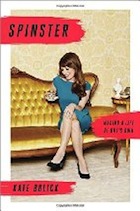
Review: Spinster

SpinsterKate Bolick, Spinster: Making a Life of One’s Own

In this book that’s part literary biography, part memoir, journalist Kate Bolick engages with the notion of “spinsterhood” and claims that, rather than being used pejoratively, it should be seen as a term of female autonomy and empowerment. She notes that contemporary society is full of single women (whether never-married, widowed, or divorced), but “spinsterhood” is still largely viewed as an aberration. In other words, as she states in the first sentence of Chapter 1, “Whom to marry, and when it will happen — these two questions define every woman’s existence…” Bolick talks about her own life as a 40-something, never-married woman and how she was inspired to find her own path by the lives of five literary women: Maeve Brennan, Neith Boyce, Edna St. Vincent Millay, Charlotte Perkins Gilman, and Edith Wharton. She weaves the biographies of these women into her own autobiography as she explores what it means to be a spinster and concludes that it can actually be a good thing.

This book was an odd read for me; some parts of it were very interesting and thought-provoking, while others made me roll my eyes in annoyance. I think its main problem is that it’s trying to be too many different genres; I was hoping for more of a cultural study and often found Bolick’s personal reminiscences tiresome. I also struggled with her definition of spinsterhood. To me, a spinster would be a woman who remains unmarried and uncoupled throughout her life. But Bolick’s literary inspirations, all of whom she styles as “spinsters,” mostly did get married eventually. Some of the marriages were tempestuous, and some of them ended in divorce, but these women did not live their entire lives uncoupled. Bolick herself, though technically never married, talks at length about her previous and current relationships, and she has even cohabited with some of her romantic partners. So I feel like she’s not really writing from the perspective of a spinster, but rather as a woman who is in a long-term, committed relationship — married in all but name. That said, the little biographies of the five “spinsters” who inspired Bolick were interesting, and I’d like to learn more about these writers and/or read some of their works. But overall, this book disappointed me; it just wasn’t what I expected.