Review: Is Everyone Hanging Out Without Me? (And Other Concerns)

Is Everyone Hanging Out Without Me?Mindy Kaling, Is Everyone Hanging Out Without Me? (And Other Concerns)

This book is Mindy Kaling’s memoir of her journey from a chubby, awkward kid who adored SNL and Monty Python to a famous TV writer and actress (and, later, showrunner, although this book came out before “The Mindy Project” got going). She writes about being a relatively unpopular child whose friends’ interests didn’t quite align with her own, about moving to New York City and finding unexpected success with her Off-Broadway play “Matt & Ben,” about meeting Greg Daniels and landing her role as Kelly Kapoor on “The Office,” about her hatred of comedy roasts and her self-described uselessness as a writer (for a brief period) on SNL, and about her funny and frustrating experiences in Hollywood. There’s a little bit about romance, but mostly in the abstract; this book is not a tell-all, by any means. And while Kaling does address her identity as an Indian American, as well as her totally-normal-but-big-for-Hollywood size, these aren’t the focus of her book, and nor should they be. Instead, this memoir offers a fun, lighthearted look at Kaling’s life and career in television.

This book is exactly what you’d expect it to be if you’re familiar with Mindy Kaling’s persona and style of comedy. It’s as if your good friend, the one whose crazy escapades you like to live vicariously though, is chatting to you after a late night of drinking wine and watching romantic comedies. It’s very light and very funny, and I enjoyed it immensely; it would make excellent plane reading. One of my favorite sections was the chapter on “Types of Women in Romantic Comedies Who Are Not Real,” which debunks the myth of the beautiful klutz. (Because seriously, “klutzy” seems to be the go-to flaw for writers who still want their heroines to be cool and witty and gorgeous and without actual flaws. Do any of us really know smart, hot women who fall down the stairs on a regular basis?) I also loved the list of possible Hollywood movies coming to theaters soon, including “Crest Whitestrips,” “Untitled Jennifer Lopez Sonia Sotomayor Project,” “Street Smart,” and “Street Stupid” (“Street Smart” sequel). Some of them do sound frighteningly plausible! So, bottom line: this is a funny, enjoyable book by a woman who is both successful and relatable. If you like Mindy Kaling, you should definitely check it out!

Review: The Boy Next Door

Boy Next Door, TheKatie Van Ark, The Boy Next Door

Maddy and Gabe have been next-door neighbors, best friends, and figure skating partners for basically their entire lives. They’re a talented duo, and Maddy is determined to make it all the way to the Olympics. She’s also determined to make Gabe wake up and realize that they would be perfect partners off the ice as well. But Gabe is a player, hooking up with lots of girls and ditching them after two weeks, often getting Maddy to dump them on his behalf. He cares deeply for Maddy — even more than he wants to admit to himself — but he’s trying to think of her as a sister, because he doesn’t want to mess up the relationship and partnership that they already have. Unfortunately, their skating coach is making them learn a new routine inspired by Romeo and Juliet, which only intensifies their complicated feelings for each other. As Maddy and Gabe struggle with the shifting boundaries of their relationship, they also worry about how a potential romance will affect their chances of success on the ice.

As you’ve probably noticed, I’m not someone who believes that adults should steer clear of young adult books. I read lots of YA, and lots of it is very good. But as I read this book, I couldn’t help feeling that I was a bit too old for this type of romantic angst. Despite Gabe’s initial protests, the romance between him and Maddy heats up very quickly, and by the end of the book, they’re even talking about getting engaged — while still in high school. The novel presents this as romantic, but to me, it made both characters seem so naive and immature. (I apologize if this offends anyone. I certainly do think it’s possible for high-school sweethearts to have healthy, long-lasting marriages. But in this case, let’s just say I wasn’t convinced.) I also think the author missed a few opportunities to add depth to her characters. In particular, it’s clear that Gabe isn’t as motivated to become an Olympic figure skater as Maddy, and at one point he expresses an interest in becoming an architect. Having him struggle more with his life path, and perhaps even having him argue with Maddy about it, would have made his character more interesting. Unfortunately, the book instead reduces both him and Maddy to flat characters who embody all the stereotypes of teen romance. It was a light, fast-moving read, but I was definitely less than impressed.

Review: French Leave

French LeaveAnna Gavalda, French Leave (trans. Alison Anderson)

This book centers around four adult siblings — Simon, Lola, Garance, and Vincent — who don’t see each other as often as they used to. But when the eldest three reunite for a family wedding, they spontaneously decide to visit Vincent, the baby of the family, who has a job in the French countryside. Garance narrates the story and paints vivid pictures of her siblings. Simon, the eldest child, is the family’s golden boy, the responsible one, who grew up to obtain a good job and a suitable wife, Carine, whom Lola and Garance tease mercilessly. Lola and Garance are best friends despite their differences; as Garance notes, “She’s romantic, I’m pragmatic. She got married, I flitter and flirt. She can’t sleep with a guy unless she’s in love, I can’t sleep with a guy unless there’s a condom.” When they abandon their relative’s wedding to visit Vincent, the four siblings have a charmed weekend, reminiscing about the past and reevaluating some of the choices they’ve made in their lives.

This novella is like a bite of some frothy dessert, short and sweet. I don’t often read books where the main focus is on sibling relationships, but I enjoyed reading about Garance and her brothers and sister — especially because their relationships are generally good and pleasant rather than dysfunctional. I can relate to their situation somewhat: I only have one sibling, and we get along great, but because we are both adults who live far from each other, we don’t stay in touch as well as I’d like. I think this book captures that bittersweet aspect of adult sibling relationships very well. I also liked the evolution of Garance and Lola’s relationship with Carine; they sort of villainize her at first, but eventually they begin to see where she’s coming from and tolerate her a little more. There’s not much of a plot in this book, but it’s such a quick read that it doesn’t need many events to propel it forward. Overall, I found this book a pleasant diversion, and I’d recommend both it and Hunting and Gathering, a full-length novel by the same author.

Review: Every Breath

Every BreathEllie Marney, Every Breath

Rachel Watts has recently moved with her family from their farm in rural Australia to the big city of Melbourne. Watts hates almost everything about her new home — everything, that is, except her neighbor and best friend, James Mycroft. Mycroft is brilliant but unstable, often conducting dangerous scientific experiments in his bedroom. He’s also alone nearly all the time, since his parents both died years ago, and the aunt with whom he lives is never around. Nevertheless, despite the concerns of Watts’ parents, she and Mycroft are inseparable. So when someone they know — a homeless man named Dave who hangs out near the local zoo — is brutally murdered, they decide to investigate the case together. The police assume it was a random act of violence, but Watts and Mycroft suspect that there may have been a specific motive behind Dave’s death. As they investigate, Watts and Mycroft also grow closer, but they both fear the consequences of changing their relationship.

As you might have guessed from the characters’ names, this book owes more than a little to Sherlock Holmes, and I have to say, I really enjoyed it! Though the hero’s name is Mycroft, he possesses all of the frenetic energy, vividness, and charisma of Sherlock. Obviously he would be a pain to live with in real life, but on the page, he’s an utterly compelling character — I can totally see why Watts is harboring more-than-friendly feelings towards him! I liked Watts a lot, too; she provides a much-needed voice of reason to reel Mycroft in when he goes off the rails. The mystery aspect of the novel is well done, although I suspected the culprit fairly early in the book. And in another nod to Arthur Conan Doyle, there’s a dog who plays an important role in the solution of the crime. While the book’s major plotlines are all resolved in the end, the door is definitely open for a sequel — which I have already pre-ordered! I’m not sure why this book struck me so positively, except to say that I enjoyed spending time with these characters and look forward to reading about their further adventures.

Review: The Rose Rent

Rose Rent, TheEllis Peters, The Rose Rent

In this 13th installment of the Brother Cadfael series, the Benedictine Abbey of Saints Peter and Paul is disturbed by yet another murder — and this time the victim is one of their own. Judith Perle, a young widow, rents a valuable cottage to the abbey in exchange for a single white rose to be paid from its garden once a year. Brother Eluric is charged with delivering the rose, but a few days before payment is due, he is found dead in the cottage garden. Moreover, the rosebush has been disfigured, its branches hacked off. As the monks mourn Brother Eluric’s death, Cadfael wonders who could have done such a terrible deed. His investigation ultimately centers around Judith Perle, whose wealth and beauty have attracted several new suitors. Because of the cottage’s value, any man who married Judith would want it to be included in her dowry; and if the abbey failed to pay the rose rent, the cottage would return to Judith’s estate without restrictions. As Cadfael searches for Brother Eluric’s killer among the men in Judith’s life, a kidnapping and a second murder ultimately reveal the culprit.

It’s hard to believe that a series could still be good after 13 books, but this latest installment of the Cadfael series was just as enjoyable to me as the first book. There’s a definite formula to this series: there’s almost always a romantic subplot, and the real-life historical events of the era occasionally impinge on Cadfael and the other inhabitants of Shrewsbury. But if you enjoy this formula, which I do, you’ll love the series! I always recommend starting with book one, [A Morbid Taste for Bones], but I think you could read this book without missing any key information and without spoilers for the earlier books. As for this novel in particular, I really don’t have much else to say about it! Simply put, I liked it and will continue with the series. Only seven more books to go!

Review: Here’s Looking at You

Here's Looking at YouMhairi McFarlane, Here’s Looking at You

Aureliana Alessi was never the most popular girl in school. On the contrary, her bushy hair, dumpy figure, and acne-filled complexion ensured that she was frequently teased and bullied. Her worst torment of all came at the hands of James Fraser, the popular boy she had a crush on, who brutally humiliated her at the end-of-year talent show. Now, 10 years later, Aureliana has shed her old persona and her old name: she goes by Anna, and she loves her job as a history professor. But when her department agrees to assist a local museum with an upcoming exhibit, Anna is shocked to run into James Fraser again; he’s part of the publicity firm handling the exhibit. James is as handsome as ever, but he still seems to be the same shallow, self-absorbed person he was in high school. Worst of all, he doesn’t even recognize Anna, much less remember what he did to her. Nevertheless, as Anna and James start to spend more time together, they gradually become friends. She even finds herself harboring romantic feelings for him again. But will their fragile relationship survive when James discovers who Anna really is?

When I first heard about this book, the plot summary intrigued me right away. It seemed like the kind of thing that could be done either very well or VERY badly, depending on how the author handled the situation. I also felt a personal connection to the plot, since I was frequently picked on in school, and those experiences definitely still affect me today. Fortunately, I was pleasantly surprised by this book! I found Anna a very relatable character, and her various emotions toward James — everything from anger to desire to embarrassment — made sense to me. I also think James is portrayed very well. He’s not an admirable character, especially in the beginning of the book; he’s selfish and lost, and the company he keeps isn’t helping. But his backstory is just sympathetic enough that I was rooting for him to change, and I could understand why Anna wanted to be around him. Toward the last third of the book, I realized that this book borrows its basic outline from [Pride and Prejudice], which was a nice bonus for me! But the novel stands very well on its own merits, and I’d recommend it to people who like their chick lit with a little depth.

Review: Murder Underground

Murder UndergroundMavis Doriel Hay, Murder Underground

Miss Euphemia Pongleton is an unpleasant old woman living in a dreary but respectable London boardinghouse. When she is strangled on the steps of the Belsize Park underground station, her fellow boardinghouse residents are surprised rather than saddened; but they soon move past their shock to speculate on who might have done the deed. The police have arrested one suspect, the boyfriend of a maid in the boardinghouse who had been involved with some petty thievery. But the maid is convinced her man is innocent, and the boarders entertain themselves by coming up with alternate theories of the murder. Naturally, Miss Pongleton’s nephew Basil, who always seems to need money and who depends on inheriting his aunt’s fortune, is a prime suspect. But Basil, despite some highly suspicious behavior on the day of the murder, insists that he is innocent. Are his protests a clever ruse, or could someone else in the boardinghouse have wanted Miss Pongleton dead?

This was a very enjoyable Golden Age mystery, although there’s really nothing that makes it stand out from the genre as a whole. But sometimes formulaic plots are comforting, and that’s why I usually enjoy mysteries from this era. There’s the unpleasant murder victim whom we don’t need to mourn; a variety of suspects with a variety of motives, secrets, and questionable alibis; the secondary love story; and the amateur detectives who solve the crime without the involvement or assistance of the police. The mystery is well plotted, and I didn’t guess who the murderer was (although I suspected almost every character at one point or other). There are also some lovely bits of humor, such as when the boardinghouse residents fight tenaciously — but silently — over who gets to sit in Miss Pongleton’s chair. All in all, I’d recommend this to fans of Golden Age mysteries, but it’s definitely not a stellar example of the genre.

Review: The Next Best Thing

Next Best Thing, TheKristan Higgins, The Next Best Thing

After five years, young widow Lucy Lang is ready to start dating again. But she’s not looking for love; her late husband, Jimmy Mirabelli, was the love of her life, and she has no interest in opening her heart to somebody new. But Lucy does want the stability and comfort of marriage, and she’d like to have children someday, so she decides to start looking for a potential husband. Of course, this means she’ll need to stop sleeping with Jimmy’s brother, Ethan, with whom she has shared a secret friends-with-benefits arrangement for the past couple of years. But when Lucy tries to break things off with Ethan, she’s surprised to find that he doesn’t take it very well. In fact, he seems to want to pursue a real relationship with her. But Lucy is afraid of where such a relationship might lead; she’s not ready to get her heart broken again. Plus, there’s the issue of what their families would say…. Will Lucy find the courage to risk her heart, and will she ever be able to see Ethan as Mr. Right rather than just the next-best thing?

This novel is yet another light, romantic read by Kristan Higgins. Her books tend to be quite similar, so if you like one, you’ll probably like them all. This one actually reminded me a lot of Fools Rush In, which I read earlier this year, because of the familial complications to the romance. In Fools Rush In, the heroine ends up with her sister’s ex-husband, while in this book, Lucy ends up with her dead husband’s brother. (I don’t think that’s really a spoiler, is it?) And in both books, I wasn’t entirely satisfied with the resolution of these issues. I especially think that Ethan’s family would have had a much stronger, more lasting reaction to the news that their son’s widow is now dating their other son. At the same time, I was rooting for Ethan from almost the very beginning; it was so obvious that he really loved Lucy all along! In fact, I was pretty irritated with Lucy for not noticing it! That said, I actually did like this book and would recommend it to fans of contemporary romance…it’s just not my favorite offering by Higgins.

Review: Dreamer’s Pool

Dreamer's PoolJuliet Marillier, Dreamer’s Pool

This novel, set in early medieval Ireland, tells the story of Blackthorn, a young woman who has been imprisoned by a cruel chieftain and sentenced to death. But on the eve of her execution, she is saved by one of the Fair Folk, who grants her freedom under two conditions: she must assist anyone who asks for her help, and she cannot seek revenge against her jailer for seven years. Blackthorn reluctantly accepts these terms and escapes from the prison, along with fellow prisoner Grim. At first, the two travel aimlessly, with Blackthorn occasionally using her skills as a wise woman to help those who need medical attention. Eventually, they arrive in the kingdom of Dalriada, where Prince Oran asks Blackthorn for help. He is about to be married to Flidais, the daughter of a neighboring chieftain. He has fallen in love with her because of the letters she has sent him; but when Flidais arrives in person, she seems completely unlike the woman of the letters. Blackthorn and Grim help Oran to investigate his bride’s seemingly changed personality, and their search eventually leads to a shocking discovery about the nearby Dreamer’s Wood.

I’m a big fan of Juliet Marillier’s books, and I’m pleased to say that I liked this one also. The novel is narrated by Blackthorn, Grim, and Oran in turn, and each character’s voice is very specific and distinct from the others. Blackthorn is clearly the book’s true heroine, and I found her an interesting protagonist, especially because most of her motivation at this point stems from her (justifiable) rage at being imprisoned for so long. In other words, she’s not a very nice person, and her traumatic past often leads her to assume the worst of other people. But her flaws make her a compelling character, and I look forward to seeing how she continues to develop as the (planned) series progresses. Grim is also an intriguing character, although not as well fleshed out as Blackthorn; I’m eager to learn more of his backstory. Like most of Marillier’s novels, the pace of this one is quite slow, and I’m not sure the mystery with Flidais needed to be as drawn-out as it was. That said, I did like the book and will plan to continue with the series; I believe book 2 comes out later this year.

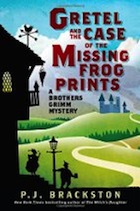
Review: Gretel and the Case of the Missing Frog Prints

Gretel and the Case of the Missing Frog PrintsP.J. Brackston, Gretel and the Case of the Missing Frog Prints

In the small town of Gesternstadt in 18th-century Germany, Gretel is something of a local celebrity. Her first claim to fame is being the Gretel, the one who escaped the clutches of an evil witch along with her gluttonous brother, Hans (a.k.a. Hansel). Now, the 35-year-old woman makes her living as a private investigator, and the biggest case of her life has just fallen into her lap. She has been summoned by Albrecht Durer the Much Much Younger, whose beautiful and beloved frog prints have been stolen. Gretel takes the case and travels to the busy metropolis of Nuremberg, accompanied by Hans, who wants to attend the city’s world-famous sausage festival. She soon stumbles across a variety of surprises, including a housecleaning hobgoblin, a secret brothel in the basement of a fancy hotel, and a veritable mafia of talking mice. And, naturally, her most promising suspect is later murdered at the scene of the crime. Can Gretel discover the thief, return the prints, and catch the murderer, all without being sidetracked by her dimwitted brother?

I got very excited by the premise of this book, which sounds like a delightfully subversive romp through both mystery and fairy-tale tropes. And indeed, there’s lots of fun stuff in this novel. Gretel has some wonderfully entertaining characteristics: she’s determined, confident, and extremely pragmatic. Hans is a good foil for her, reminding me of a Teutonic Bertie Wooster. But at the same time, I never found a reason to care about these characters; they don’t really develop over the course of the novel. Some of the humor also seemed forced, and the mystery itself was nothing special. I did enjoy the weird genre mashup of mystery plus fairy tale, and I would potentially read the sequel when it comes out. But a novel that’s pure spoof has got to be funny enough to justify itself, and I’m not sure that this one is. It certainly never reaches the zany heights of P.G. Wodehouse! Again, this book is an enjoyable read, but I was ultimately underwhelmed by it.