Review: Courtship & Curses

Courtship and CursesMarissa Doyle, Courtship & Curses

Lady Sophie Rosier is about to make her debut during the London Season, but what should be an exciting prospect is sad and scary for her. Her beloved mother has recently passed away, and the illness that claimed her life has also left Sophie with a deformed leg and an unattractive limp. Sophie is painfully aware that the denizens of society will view her differently; she won’t even be able to dance at the Season’s balls and other entertainments. Moreover, Sophie is hiding the fact that she has magical abilities, since witchcraft is feared and frowned upon by society. But when certain members of the War Office begin falling victim to mysterious “accidents,” Sophie is able to perceive that magic is involved. With the help of her best friend Parthenope, as well as a potential suitor, Sophie must discover the culprit and save the Duke of Wellington himself.

This book contains a lot of my favorite things: the Napoleonic era, an underdog heroine, magic, and romance. As such, I found it an enjoyable read, but certain things didn’t quite gel for me. First, I’m a little bit confused about the role of magic in the novel. It seems to be a social taboo — when one character learns of Sophie’s abilities, he is absolutely repulsed by it — but the why is unclear. Plus, Sophie’s own mother taught her to cultivate her abilities, which seems like a bad idea if society shuns practitioners of magic. I also would have liked a little more tension in the romance between Sophie and her paramour. On the other hand, I really enjoyed the more lighthearted moments in the book, especially those involving the mischievous Parthenope! Overall, this was a fun read, and if a sequel appears, I’ll most likely read it as well.

Review: Saga, Volumes 1-2

Saga Volume 1Saga Volume 2

Brian K. Vaughan & Fiona Staples, Saga: Volume One and Saga: Volume Two

This graphic novel tells the story of one family’s struggle to survive in the midst of a brutal interplanetary war. Alana is from Landfall, the largest planet in the galaxy. Marko is from Wreath, its satellite. When they meet, they fall in love almost immediately; but unfortunately for them, Landfall and Wreath have been at war for as long as anyone can remember. Since both Alana’s and Marko’s people disapprove of their marriage, the star-crossed lovers have no choice but to flee. They end up on the remote backwater planet of Cleave, where their daughter Hazel is born. The story is narrated by Hazel as she describes her parents’ escape from the forces seeking to tear them apart. But various parties from both Landfall and Cleave are pursuing this family, and it will take all their courage and ingenuity to survive.

After seeing some positive reviews of Saga, I decided to give the series a try, even though I generally don’t read graphic novels. (I have nothing against them, but I’m not a very visual person, so I generally find the artwork more distracting than helpful for the story.) I’m very glad I gave this series a chance, since I ended up enjoying it quite a bit. The story is very compelling and spans several genres, from romance to survival adventure to space opera. I loved the banter between Alana and Marko, who clearly care a lot about each other and express their love through teasing. I also found Hazel’s voice to be very compelling, and I look forward to seeing how she grows as the series progresses. There’s some colorful language and a few graphic (ha ha) images, so be warned if that bothers you. Overall, I definitely plan to continue with the series, and I already have Volumes 3 and 4 from the library!

Review: The Ruby Red Trilogy

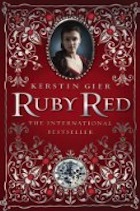
Ruby RedSapphire BlueEmerald Green

Kerstin Gier, Ruby Red, Sapphire Blue, and Emerald Green (trans. Anthea Bell)

Gwyneth Shepherd belongs to an unusual family: every generation, one of its members has the ability to travel through time. Gwyneth has always assumed that her cousin Charlotte has this gift, and Charlotte has spent her entire life preparing for it. But to everyone’s shock, it is Gwyneth who unexpectedly travels through time, revealing herself as the true possessor of the gift. Unfortunately, Gwyneth doesn’t have Charlotte’s extensive training in history and etiquette to help her navigate the past. Moreover, it seems that her family, as well as a secret cabal of fellow time-travelers, is keeping a lot of crucial information from her. For example, what is the meaning of the mysterious prophecy involving “the ruby”? Who is the Count Saint-Germain, and what is his plan for Gwyneth? And most importantly, can Gwyneth trust her partner in time travel, Gideon de Villiers, whose unpredictable behavior both frustrates and attracts her?

First off, I’m very glad that I read all these books at once, because there’s definitely no resolution to the story at the end of Ruby Red or Sapphire Blue. I did enjoy the series overall, but in looking back, I find myself focusing more on its flaws. The plot feels very cluttered to me: Gwyneth and Gideon are constantly jumping back and forth through time to uncover various secrets, yet at the same time, nothing much really happens until about halfway through the second book. The series sets up lots of mysteries, but most of them are fairly easy to solve. It all just felt a little overwrought to me. Also, I was not a fan of the romance; I don’t think Gwyneth should have put up with Gideon’s mixed signals and condescending behavior! I do have to say, I was impressed with how the time travel itself was handled; the timeline of the series makes sense, and I didn’t catch any glaring logical inconsistencies. If you like the genre and don’t mind YA, this series is worth a read, but I’m glad I got the books from the library instead of buying them.

Review: Honeymoon Hotel

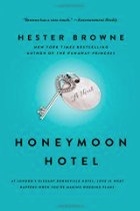
Honeymoon HotelHester Browne, Honeymoon Hotel

Rosie has loved London’s Bonneville Hotel ever since she was a child. In former years it was a destination spot for Hollywood stars who wanted to conduct their affairs discreetly, but now it’s a bit run-down and has lost some of its sparkle and glamor. As the Bonneville’s events manager, Rosie hopes to restore the hotel to its former glory, specifically by turning it into London’s most desirable wedding venue. She pursues this goal with single-minded practicality and a rigid attention to detail, despite the fact that she herself was once left at the altar. But Rosie’s plans encounter a snag when the owner of the Bonneville brings his son Joe onto the hotel staff. Joe has spent the last several months in America, and his laid-back attitude and ignorance of the wedding industry drive Rosie crazy — especially when his thoughtless comments cause one bride to call off her wedding. But when a well-known model expresses interest in booking her wedding at the Bonneville, Rosie and Joe must find a way to work together despite their differences.

I enjoy a good chick lit novel from time to time, and I’ve liked some of Hester Browne’s previous novels, so I was eager to read her latest offering. Unfortunately, I found this to be a very forgettable read. There’s nothing particularly bad about it, that I recall; it just didn’t do anything special for me. The plot is a bit of a cliché — girl is too uptight, boy is too relaxed, how will they ever get along? — and nothing about the details or characters really elevated it above that level, for me. I especially had trouble seeing the appeal of Joe, whose character really isn’t developed beyond being laid-back and carefree. So I didn’t care very much about the romance. Also, the book focuses a LOT on Rosie’s job and the minutiae of wedding planning, which even I found dull, and I’m interested in that kind of thing! It’s certainly a readable book, and I do recommend the author for fans of British chick lit, but I definitely wouldn’t read it again.

Review: Trent’s Last Case

Trent's Last CaseE.C. Bentley, Trent’s Last Case

When internationally renowned financier Sigsbee Manderson is found dead on the grounds outside his home, the news sends shock waves throughout English society. Hoping to learn more about the circumstances of Manderson’s death, a notable newspaper magnate calls upon Philip Trent, journalist and amateur detective, to go into Manderson’s neighborhood and investigate the case. Trent soon discovers that Manderson was almost universally disliked, so there is no shortage of suspects, from either of Manderson’s two secretaries to his estranged wife. The more Trent learns about the case, the more he suspects Mrs. Manderson of being involved in her husband’s death. All too soon, Trent arrives at a theory of the case that heavily implicates Mrs. Manderson — which is unfortunate, because he has fallen head over heels in love with her. Will he do the law-abiding thing and disclose his solution to the police, or will he protect the woman he loves?

Contrary to what the title suggests, this is actually the first book featuring Philip Trent; after a 20-year gap, Bentley eventually wrote two more Trent books. Anyway, I knew I would enjoy this book from the moment I saw the dedication to G.K. Chesterton, whom I love. And indeed, there is a sort of Chestertonian twist to the mystery about halfway through, which I don’t want to spoil but which I really, really enjoyed! The writing style is a bit ponderous and old-fashioned, as you’d expect from a book originally published in 1913, but I soon got used to it. I liked Philip Trent as a character; unlike some of literature’s more famous detectives (ahem, Holmes and Poirot), he’s a fairly normal human being without dramatic idiosyncrasies. The romance is very sweet, and the solution to the mystery is both ingenious and unexpected — or at least it was to me! I would definitely recommend this book to fans of vintage mysteries, especially those who are interested in the history of the detective novel.

Review: Fools Rush In

Fools Rush InKristan Higgins, Fools Rush In

Millie Barnes has been in love with Joe Carpenter since high school, and now that she’s nearly 30 with a promising career as a doctor, she’s decided that it’s finally time to do something about it. When she’s not working at the local clinic, she’s focused on a self-improvement regimen that will surely cause Joe to notice her as something more than just a friend. She begins running, gets a new haircut, and asks her friends for makeup and clothing tips. She even plans out her daily routine so that she can “accidentally” bump into Joe. But Millie also begins spending a lot of time with Sam Nickerson, a local cop who just happens to be her sister’s ex-husband. Although Sam has a good life and a wonderful teenage son, Millie wants him to fall in love again, this time with a woman who’s worthy of him. When Joe finally starts taking notice of Millie, she’s ecstatic; but as the two of them begin dating, she’s shocked to discover that something is missing. And the more time she spends with Sam, the more she realizes that her platonic feelings for him may have developed into something much deeper — and much more complicated.

I always enjoy Kristan Higgins’ books when I’m in the mood for a light contemporary romance. This book has a lot of her trademark qualities, like a neurotic/insecure heroine with a tight-knit family and an adorable dog, but the romance here didn’t work for me as well as in her other books. I just couldn’t get past the fact that Sam was once married to Millie’s sister. The novel goes into a lot of backstory to explain why that marriage fell apart and why they weren’t a good match, but it just wasn’t enough for me. I feel like the book minimizes the difficulties Millie and Sam would actually experience in pursuing a relationship, especially with Millie’s family and Sam’s son. I did like the contrast between Millie’s relationship with Sam and her relationship with Joe, and I also liked the fact that Joe is not a bad guy. Often in love triangles, the third person is portrayed as a horrible human being so that the protagonist’s choice will be obvious; here, Joe is a sweet man with a lot of good qualities, but he’s just not the right guy for Millie. Overall, this was a pretty good read, but the romance is so problematic that I wouldn’t really recommend it. Try some of Higgins’ other books instead!

Review: The Paris Winter

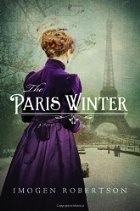
Paris Winter, TheImogen Robertson, The Paris Winter

In November 1909, young Englishwoman Maud Heighton is in Paris pursuing her dream of becoming a painter. She studies at Lafond’s Academie, one of the few respectable art studios that is open to women. However, despite having some talent as an artist, Maud is living in extreme poverty and will soon have to choose between starving or returning to her family in England, which would be an admission of failure. Fortunately, Maud befriends Tatiana Koltsova, a fellow student at the Academie who is friendly, charming, and rich. Tanya takes Maud under her wing and eventually helps her to get a job as an English tutor for the Morel family. Both Sylvie Morel and her older brother Christian seem eager for Maud to accept their job offer, which includes room and board. But while Maud accepts the job gratefully, she can’t help feeling that it’s a little too good to be true. And the more she learns about the Morels, the more sinister they appear, until eventually she must seek out Tanya’s help to extricate herself from an unbearable situation.

I love historical fiction and was intrigued by the premise of this book, but I ended up with mixed feelings about it. First, I did love the setting, especially because it depicts a less glamorous version of Paris than many other books and movies do. Although Maud comes from the English gentry, she is forced to live a much more bohemian life in Paris, befriending people from each extreme of the class spectrum. And because she is not rich, she doesn’t have much opportunity to participate in the exciting, glamorous activities one usually associates with Paris during the Belle Époque. However, I wasn’t particularly invested in Maud as a character or in the plot involving her relationship with the Morels. It moved very slowly and eventually became a psychological thriller, which isn’t quite what I expected when I picked up the book. I thought both Tanya and Yvette, the artists’ model at the Academie, were more interesting characters, and I wish the book had focused more on their stories. That said, I did like the book’s denouement, which takes place during the great Paris flood of 1910. I would recommend this book to fans of historical fiction, but it’s not my favorite offering in the genre.

Review: I’ll Give You the Sun

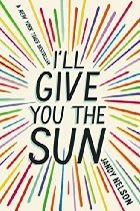
I'll Give You the SunJandy Nelson, I’ll Give You the Sun

This novel is the story of a family tragedy and its aftermath, narrated in alternating chapters by twins Noah and Jude. Noah’s narrative begins when the twins are 13. He’s the quiet one who dodges school bullies and spends all his time painting; Jude’s the outgoing one who is popular and daring. Despite their very different personalities, Noah and Jude are incredibly close. But Jude’s story, which takes place three years later, reveals that something terrible has happened, and she and Noah are no longer speaking. Noah is living in denial, trying to act like a “normal” teenager, and Jude is trying as hard as possible to be invisible. As the novel alternates between Noah’s story and Jude’s, the nature of their tragedy is revealed, and it becomes obvious that each twin only has half the story. In order to move past their family’s secrets, both twins will have to forgive themselves as well as each other. Meanwhile, Noah falls in love with the boy next door and must come to terms with his sexuality, while Jude searches for redemption through art.

You may not be able to tell from my woefully inadequate summary, but I loved, loved, LOVED this book! And I honestly wasn’t expecting to…YA contemporary is a genre that varies widely in quality, and I hadn’t heard much about this author, so I was quite wary going in. But I was almost immediately captivated by the energetic, vivid writing style and unexpected imagery. I usually think that the best writing style is the least obtrusive, but this book made me sit up and take notice, in a good way! I also felt deep sympathy for both Noah and Jude, who are each trying to figure out who they are, while being burdened with a huge weight of guilt. Despite their overly precocious voices, they felt like real human beings to me. I loved the book’s focus on visual art and was fascinated by Jude’s quest to make a sculpture out of stone, something that is apparently a dying art nowadays. There’s even a touch of magical realism, as Jude often talks to her Grandma Sweetwine’s ghost. In short, if the premise of this book seems at all appealing to you, I HIGHLY recommend it!

Review: The Gilded Shroud

Gilded Shroud, TheElizabeth Bailey, The Gilded Shroud

Ottilia Draycott has just accepted a position as companion to the Dowager Lady Polbrook, expecting nothing more adventurous than a change of scenery after her former position as governess to her two young nephews. But on her very first day at her new post, the current Lady Polbrook (the dowager’s daughter-in-law) is found dead in her room, having been strangled sometime during the night. The household immediately falls into a panic, especially when it becomes evident that the master of the house has disappeared. Ottilia knows that suspicion is bound to fall on Randal Polbrook; no one knows where he has gone or why, and it’s common knowledge that he and his wife were estranged. But Ottilia, after examining the scene of the crime, believes the late Lady Polbrook was entertaining a lover on the night she died. She shares her suspicions with the dowager and with Lord Francis Fanshawe, the younger brother of the absent marquis. Together, they try to discover the lover’s identity and clear Randal’s name, while minimizing the scandal as much as possible. Meanwhile, the pragmatic, clear-headed Ottilia finds her objectivity compromised as she grows closer to Lord Francis.

I love a good historical mystery, and this book is a very solid member of the genre. Ottilia (despite her ridiculous name) is a very likable heroine, with a keen intelligence and a mischievous sense of humor. The other major players are also interesting, from the sharp-tongued but kindly dowager to the handsome Lord Francis. At times I felt that the characters were essentially copied from Georgette Heyer, but since I’m a big Heyer fan, I didn’t mind too much! And one big difference between this book and Heyer’s novels is that here, the servants aren’t just window dressing; they actually have some relevance to the plot. The mystery is well done, although I was able to guess the culprit before the solution was revealed in the book. I also liked the writing style, which seemed appropriate to the time period but was still fairly easy to understand. Oddly enough, my least favorite part of this book was the romance, which just seemed a bit stilted. Overall, I liked this book and will certainly read the sequel at some point, but I didn’t love it in the same way I love Kate Ross’s books, for example.

Review: As You Wish

As You WishCary Elwes with Joe Layden, As You Wish: Inconceivable Tales from the Making of “The Princess Bride”

In this book, Cary Elwes shares his memories of making the beloved movie “The Princess Bride.” He talks about reading the book (by William Goldman) as a child, meeting director Rob Reiner for the first time, and being extremely nervous about his audition. He also reminisces fondly about his fellow cast members, particularly the late André the Giant, whom he describes as a true “gentle giant.” The book also spends a lot of time on the sword fight between Westley and Inigo, for which Elwes and Mandy Patinkin spent almost every free moment training. The filmmakers were determined to produce a duel that could hold its own with some of the greatest sword fights in movie history, and Elwes recalls the intensity of his training in detail. Along with Elwes’ own narrative, this book contains anecdotes from many other people involved with the film, including Rob Reiner (director), Robin Wright (Buttercup), Wallace Shawn (Vizzini), Chris Sarandon (Prince Humperdinck), and Billy Crystal (Miracle Max). Overall, the book presents a fond, nostalgic look at the making of this classic film.

“The Princess Bride” is one of my all-time favorite movies, so I was definitely the intended audience for this book! I must say, it’s clear that Cary Elwes is not a writer by nature…the prose is often a bit stilted, especially when he describes his inner thoughts and reactions to what’s going on. However, the book is very readable, and it provides a great window into Elwes’ experiences in making this movie. I like the fact that other actors’ stories are included, so that it’s not just one person’s point of view. I also learned a lot of interesting tidbits about the process: for example, Elwes badly injured his foot during shooting, so there are a few scenes in which (if you’re looking for it) you can see him limping or favoring his bad foot. Wallace Shawn, who played Vizzini, was terrified of being fired because he’d heard that Danny DeVito had originally been considered for the part. And Billy Crystal apparently improvised some of the funniest lines in the Miracle Max scene, including the bit about the mutton, lettuce, and tomato sandwich! Overall, I’d definitely recommend this book to fans of the movie — and then I HIGHLY suggest re-watching the film! 🙂