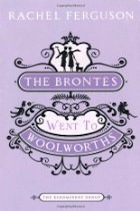
Review: The Brontës Went to Woolworths

Brontes Went to Woolworths, TheRachel Ferguson, The Brontës Went to Woolworths

This book follows the fortunes of three sisters: Katrine is an actress, Deirdre is a journalist, and Sheil is still in the schoolroom. All three girls have very rich imaginations, and they have populated their world with a host of ficitonal friends, some of whom are based on real people. When the girls’ mother acts as a juror in the courtroom of Judge Toddington, the sisters immediately adopt him and his wife into their circle of imaginary friends. They affectionately nickname him “Toddy” and concoct a wealth of details about his life, from the state of his marriage to his favorite foods. But their world of make-believe collides with reality when Deirdre actually meets Judge Toddington’s wife at a charity event. As she and her sisters get to know Toddy in real life, will they be able to cope with the shattering of their illusions? Are they bound to be disappointed by the flesh-and-blood Toddingtons? And what would Toddy and his wife say if they knew the truth?

This is a strange little book, and I’m not quite sure how I feel about it. On the one hand, Deirdre and her sisters are a lot of fun, and their flights of fancy are as entertaining as they are ridiculous. I often got confused about what was actually fantasy versus reality — but then again, I think that’s the point. I also loved the actual characters of Judge Toddington and his wife, as distinct from the girls’ fictional narrative about them. They are both very kind people who actually want to become friends with the girls, and when they realize that they are stepping into a pre-existing narrative, they do their best not to disturb the girls’ fun. On the other hand, I couldn’t help being a little put off by the girls themselves. The reader is clearly supposed to sympathize with their flights of fancy, but I couldn’t help identifying a little bit with Sheil’s governess, who is shocked by the magnitude of their fantasy world. These girls are not practical, and they live a wildly sheltered life; I found them quite irritating at times. Still, the book is very charming overall, and I’d recommend it to anyone who likes the premise.
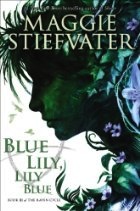
Review: Blue Lily, Lily Blue

Blue Lily, Lily BlueMaggie Stiefvater, Blue Lily, Lily Blue

***Warning: SPOILERS for previous books in the series!***

Blue Sargent and the Raven Boys are approaching the end of their quest to find the long-lost Welsh king Owen Glendower. But as always, there are complications. First of all, Blue’s mother is missing, and the cryptic note she left behind says only that she is “underground.” Is she one step ahead of them in the search for Glendower, or has she gotten involved in something more sinister? Then there’s the fact that Colin Greenmantle, the person who hired the Gray Man to kidnap Ronan in The Dream Thieves, is in town — and he’s the boys’ new Latin teacher. Worst of all, when Blue and the boys finally locate the cave where Glendower rests, they realize that their troubles are only just beginning. For there is more than one entity dwelling in this cave, and some things are better left asleep…

As a fan of the previous books in the Raven Cycle, I pretty much devoured this installment. I think it might be my favorite book yet in the series, because it’s finally starting to pull together the various plot threads and character relationships that have been simmering since the first book. More secrets are revealed, the plot continues to twist and turn, and various characters’ motivations are slowly uncovered. I really like the fact that Blue, Gansey, Ronan, Adam, and Noah have become this inseparable unit now. In the first two books, there was a lot of tension between various members of the group, with everyone trying to figure out whom to trust. But in this book, they have finally accepted each other and decided to work together. I also love how certain characters (Blue and Adam in particular) are thinking about their futures: Even if they do manage to find Glendower, what happens then? So I’m very excited to see how things will turn out, and I can’t wait for the release of the fourth and final book next year!

Review: The Phantom Tollbooth

Phantom Tollbooth, TheNorton Juster, The Phantom Tollbooth

This classic children’s book tells the story of a bored little boy named Milo who comes home one day to find a mysterious package in his bedroom. The package turns out to be a toy tollbooth, and when he assembles it and drives through in his little electric car, he is transported to a new world. Milo visits a variety of unusual places, including the hostile cities of Dictionopolis and Digitopolis and the island of Conclusions (you get there by jumping). He also receives an important mission: to rescue the princesses Rhyme and Reason from where they are imprisoned in a castle in the air. Along the way, Milo encounters many dangers, including the land of Illusion, the Doldrums, and the demons of Ignorance. Luckily, with the help of his friends Tock and Humbug, he is finally able to rescue the princesses and restore them to the Kingdom of Wisdom. Ultimately, he learns that his “boring” life is actually more interesting than he ever imagined.

For some reason, I never read this beloved children’s classic when I was growing up. If I had read it around age 7 or 8, it probably would have been one of my favorite books. But even as an adult reading it for the first time, I found a lot to enjoy and admire. I’m a sucker for puns and wordplay, and this book is chock-full of it, from the watchdog with a clock for a body to King Azaz of Dictionopolis. There’s also a hint of satire, as when the Humbug explains that several family members have occupied prominent positions in history; for example, many kings have been Humbugs. The book is quite didactic, though, which I wasn’t expecting. Nearly every creature and situation Milo encounters is designed to teach him (and the book’s young readers) a lesson. I did find these constant “teaching moments” a little tedious, but luckily the book has a lot of whimsy to make up for them. Overall, I definitely think this is a great book for children, but if you missed it as a kid, it’s not too late to enjoy it as an adult!

Review: Good Omens

Good OmensNeil Gaiman & Terry Pratchett, Good Omens

Since the beginning of the world, the forces of good and evil have been preparing for battle, and now Armageddon is imminent. The Four Horsepersons of the Apocalypse roam the earth, the Antichrist is about to be born, and the end times are at hand. But angel Aziraphale and demon Crowley aren’t terribly enthusiastic about the upcoming war and ensuing destruction of Earth. In fact, they’ve both become rather fond of the planet and the foolish humans who populate it. So unbeknownst to their superiors, they strike a truce: neither one of them will attempt to influence the newborn Antichrist in their favor. Little do they know that, thanks to a mix-up at the hospital, they’ve focused their efforts on the wrong baby! Meanwhile, the Antichrist grows up as a perfectly normal human boy called Adam Young, who knows nothing about his special destiny. But as the signs of the end times become harder to ignore, Aziraphale and Crowley must race against time to prevent Adam from unwittingly using his powers to destroy the world.

This book is a delightful romp through the Book of Revelation and common cultural perceptions regarding the end of the world. It truly has something for everyone, from demons to witchfinders to psychics to aliens, and I lost count of the jokes that made me laugh out loud! I loved the fact that Famine (one of the Horsepersons) was a diet guru, and that one of Crowley’s most notable Hellish accomplishments was the M25 motorway surrounding London. The book’s plot is rather sprawling, and I wasn’t a big fan of every storyline (didn’t care too much about Anathema Device, for example, although I loved Newton Pulsifer — the name alone!). But then again, who cares about plot when there’s such brilliant silliness to enjoy? I do think this book would be best enjoyed by people who are at least somewhat familiar with the Book of Revelation, because otherwise you won’t get all the jokes! But I honestly think that anyone who enjoys British humor will find this book hugely entertaining.

Review: The Beauty Chorus

Beauty Chorus, TheKate Lord Brown, The Beauty Chorus

This novel centers around three female pilots who join the Air Transport Auxiliary, ferrying planes back and forth between Allied bases during World War II. Evie Chase is a headstrong young debutante who enjoys her life of privilege but wants to “do her bit” for the war effort — and escape from her odious stepmother. Stella Grainger is struggling with being separated from her baby boy, whom she’s sent to her husband’s parents in Ireland. And Megan Jones, a 17-year-old Welsh girl, wants nothing more than to keep her family’s farm running and to marry her sweetheart, Bill. These three young women couldn’t be more different, but when they join the ATA and become roommates, they form an extremely close bond. Together they deal with the challenges of flying different aircraft, the discrimination they face for being women in a man’s world, and the joys and sorrows of wartime love affairs. But despite their strength and determination, they can never quite escape the brutal realities of war.

This is a book I really wanted to love. The story has so much going for it — WWII, female pilots, romance, and even a little espionage! — but unfortunately, I was disappointed. The biggest problem for me was the clunky writing style; for example, on one occasion, the author drops a character name into the story before introducing that character. I had to flip backward to make sure I hadn’t somehow missed his entrance, but in fact, it was just a confusing way to introduce the new character. There’s also a lot of head-hopping in the book; not only does the point of view shift between the three girls (which would be understandable), but there are random paragraphs from the perspectives of their suitors and various other minor characters. Finally, while I liked the main characters in theory, they never really rose above clichés. For example, Evie is a typical HF heroine: incredibly beautiful, naturally talented as a flyer, and implausibly far ahead of her time. Overall, while the book certainly wasn’t a slog, I can’t say I’d recommend it either.

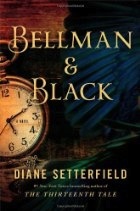
Review: Bellman & Black

Bellman & BlackDiane Setterfield, Bellman & Black

This atmospheric novel tells the story of William Bellman, who makes one decision in childhood that will alter the entire course of his life. When he is ten years old, he and a few friends are playing in the field near their village, and they see a rook on a far-off tree branch. Will bets his friends that he can hit the bird with his slingshot, and to everyone’s astonishment, he actually does it. Will and his friends soon forget the incident, but from then on, rooks become a touchstone and a bad omen for William Bellman. As he gets older, he becomes more and more successful: first he get a job at his uncle’s mill, then rises through the ranks until he eventually runs it. He marries and has children, and he begins to make a very comfortable living. But when an illness sweeps through the village and takes most of William’s family, he will do anything to save his remaining daughter — including making a desperate deal with the mysterious Mr. Black. William’s encounter with Black leads him to an entirely different business venture, one that eventually threatens to consume him.

I absolutely loved Diane Setterfield’s debut novel, The Thirteenth Tale, so I had high expectations for this book. Unfortunately, I’m coming away from it with mixed feelings. The writing style is just as rich and gorgeous as I remember, and I found myself reading very quickly despite the slow-moving plot. I also admire the novel’s atmosphere of suspense; it has a wonderfully autumnal, sinister quality, despite the fact that not a lot of scary stuff actually happens. In fact, that may be my biggest problem with the book: there’s this great buildup of tension throughout the novel, but in the end there’s no payoff. The interludes about rooks — and William’s encounters with them throughout the book — are meant to heighten the suspense, I think, but I didn’t really understand their role in the story. Frankly, I was a bit confused about the story as a whole; I was expecting a Faustian narrative in which William essentially sells his soul for success, but that’s not really what happens. In short, I’m not sure what I’m supposed to be taking away from this book — but I’m definitely not giving up on Setterfield yet!

Review: The Lady Vanishes

Lady Vanishes, TheEthel Lina White, The Lady Vanishes

Iris Carr is a privileged young Englishwoman enjoying a holiday somewhere in Europe with a large group of friends. But when her crowd is ready to leave, Iris decides to stay an extra day and enjoy the beauties of the mountains by herself. When she boards the train to go home, she is immediately isolated from the other passengers because she doesn’t speak the native language. So when a talkative English spinster named Miss Froy introduces herself, Iris is glad to have the company, even though Miss Froy is rather a bore. After a long chat, Iris takes a nap in her compartment; but when she wakes up, Miss Froy is gone! Eventually she begins to worry, so she finds a young Englisman to act as interpreter and ask the other passengers where Miss Froy went. To Iris’ shock, they all claim not to remember Miss Froy and say Iris must be imagining things. Iris knows she didn’t imagine Miss Froy, but without any evidence to the contrary, how can she be sure? And if the lady does exist, why won’t anyone admit to seeing her?

Recently I watched Alfred Hitchcock’s “The Lady Vanishes” and really enjoyed it, but I had no idea it was based on a book! I’m glad I discovered the novel, though, because with all due deference to Hitchcock, the book is better. While the movie is a somewhat straightforward thriller, the book has more psychological tension because it keeps you in the dark about Iris’ mental state for much longer. Are the other passengers involved in some sort of unlikely but sinister conspiracy, meaning that she and Miss Froy are both in danger? Or, perhaps even worse, is Iris having a mental breakdown and imagining the whole thing? Either way, she’s trapped in a nightmarish situation, and the book does an excellent job of heightening this tension. I also think the book’s ending is better than the movie’s; while the film ends with a dramatic shootout, the novel has a much more subtle conclusion. So I would definitely recommend this novel to anyone who likes psychological thrillers, especially if you’ve seen or plan to see the movie!

Review: In Your Dreams

In Your DreamsKristan Higgins, In Your Dreams

Emmaline Neal is one of three police officers in the tiny town of Manningsport, New York. She’s a tough, no-nonsense woman who knows her way around a Taser, but she’s also dealing with the fallout of a broken heart. Her first love is about to marry the shrew he dumped Emmaline for — and even worse, he’s invited her to the wedding! Emmaline knows she can’t go alone, so she reluctantly asks Jack Holland to be her date. Jack is friendly, popular, and drop-dead gorgeous, and he can’t say no to a damsel in distress. Em is aware that she’s definitely not Jack’s type, so she’s determined to keep her distance. But after a little wedding-related humiliation and a few glasses of wine, her practical resolutions fly out the window. After one amazing night together, Em tries to fight her growing feelings for Jack — even though he actually seems to be interested in her, too. But Jack is dealing with his own problems, including the sudden reappearance of his dainty ex-wife, who is not-so-subtly trying to get him back. Will Jack and Em be able to overcome their respective pasts and finally find happiness together?

As a Kristan Higgins fan, I’ve been reading and enjoying each new book that comes out, but I have to say that this is definitely my favorite of her recent books! Jack and Em both feel like real people to me, and they each have very specific baggage that prevents them from immediately falling into each other’s arms. I also — contrary to my expectation! — really liked the presence of the Evil Ex in this book. Having an ex-lover resurface is often a tedious, contrived obstacle to keep the hero and heroine apart; but in this book, the presence of Jack’s ex illuminates certain aspects of his character that show why he works with Emmaline. Here, the Evil Ex isn’t actually evil, but she is very needy and can be selfish. By contrast, Jack and Em are both giving people who are willing to sacrifice a lot for the people they love. I do have a few issues with the ending of the book, though; everything seems to work out a little too perfectly. For example, even Emmaline’s ex is redeemed in the end, which I don’t think was necessary. But even despite the magically perfect ending, I’d definitely recommend this book to fans of contemporary romance!

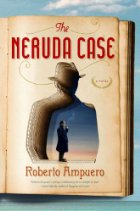
Review: The Neruda Case

Neruda Case, TheRoberto Ampuero, The Neruda Case (trans. Carolina De Robertis)

Cayetano Brulé, one of the most respected private investigators in Valparaíso, is on his way to meet a prospective client when he stops at a restaurant for lunch. When he opens the menu, he sees a photograph of Pablo Neruda and immediately recalls his first case as a detective, in which his client was the Nobel laureate himself. Suddenly it’s 1973, and Cayetano (a Cuban by birth) is somewhat adrift in his adopted homeland of Chile. At a political party with his wife, Cayetano meets Neruda for the first time, and they soon strike up a conversation. Later, Neruda invites Cayetano to his home and makes a surprising request: he wants Cayetano to find a missing person, a doctor whom Neruda knew many years ago. Cayetano’s search takes him to Mexico City, Havana, and even East Berlin, and he eventually learns that Neruda’s desire to find the doctor is not as straightforward as it seems. Meanwhile, Chile is also experiencing a period of upheaval, as Salvador Allende’s Marxist government is succeeded by the dictatorship of Pinochet.

This novel attempts to do many different things, with mixed results. As a mystery, I think it falls flat; there is no real urgency to Cayetano’s search, and the results of his investigation ultimately don’t matter very much to the story. The book is more successful at painting a portrait of Pablo Neruda at the end of his life. I feel like I got a sense of his personality and his importance to Chile as a political figure. Best of all, this book does a wonderful job of depicting the political situation in Chile at the time and relating it to the wider issue of global politics. It’s no coincidence that Cayetano mostly visits Communist countries, in an era dominated by the Cold War and the ideological conflicts between socialism and capitalism. The novel is definitely not neutral on this subject; both Cayetano and Neruda favor Allende’s government, while Cayetano condemns his wife’s more radical Communism. Overall, I was fascinated by the setting much more than I was by the story. So I’m glad I read this book, but I won’t be seeking out any more installments of the series.

Review: The Midnight Queen

Midnight Queen, TheSylvia Izzo Hunter, The Midnight Queen

Gray Marshall is a promising student of magick at Oxford’s prestigious Merlin College, but his life changes instantly when an ill-fated midnight expedition results in the death of one of his classmates. Although Gray had nothing to do with the violence that resulted in this tragedy, he soon learns that everyone is blaming him. His tutor, Professor Appius Callender, whisks him off to the professor’s country house as punishment for his supposed misdeeds. At first Gray is miserable there; his magickal powers seem to have deserted him, and he is forced to work in the professor’s gardens all day. But then he meets Sophie, the professor’s kind and intelligent daughter, and he soon discovers there is more to her than meets the eye. As Gray and Sophie become closer, they begin to uncover shocking secrets about Sophie’s family, as well as a conspiracy that threatens not only Gray but the entire kingdom of Britain.

I hardly ever buy books on impulse anymore; usually I’ll only shell out money for an author or series I already know I like. But this book jumped out at me because of its beautiful cover, and then the lure of a Regency-era fantasy with romance totally sold me! Overall, I’m glad I took the plunge in buying this book, because I really enjoyed it. Gray is a very endearing hero: studious, shy, and hardworking, with a stutter that appears when he’s nervous. He’s well matched in Sophie, a heroine who is strong without being abrasive and forward-thinking without being anachronistic. The book moves fairly slowly, which might bother some readers, and I also felt that the plot was a bit scattered. For example, Gray frequently mentions his various siblings, but only one of them is even “on page” in this book, so I was a bit confused and distracted by the other sibling references. Still, I suppose these loose ends and tangents might be resolved in a sequel; if one should materialize, I’ll definitely be seeking it out!