Review: An Excellent Mystery

An Excellent MysteryEllis Peters, An Excellent Mystery

In the summer of A.D. 1141, two Benedictine brothers seek refuge at the Abbey of Saints Peter and Paul in Shrewsbury. They have fled the city of Winchester, where their former abbey has gone up in flames, a casualty of the civil war between King Stephen and Empress Maud that still rages on. The older of the two refugees, Brother Humilis, is obviously a nobleman — and just as obviously dying from a mortal wound sustained many years ago in the Crusades. The younger man, Brother Fidelis, is mute, but he tends his fellow traveler with astonishing devotion. Brother Cadfael, due to his knowledge of herbs and their healing properties, spends a lot of time with these two brothers and eventually discovers that there is more to their story than meets the eye. Meanwhile, Cadfael also investigates the disappearance of a beautiful young woman who intended to become a nun but never arrived at her convent.

This book is the eleventh installment of the Cadfael series, but I think it can largely function as a stand-alone; newcomers to the series wouldn’t get lost if they jumped in here, though I still recommend starting with A Morbid Taste for Bones. These books are always comfort reads for me. I love the historical setting of a medieval monastery, and I enjoy seeing how Cadfael’s small world is affected by larger historical events. I also like the fact that these mysteries are firmly on the “cozy” end of the spectrum; there is often murder, but it’s never grisly, and there’s also romance and humor and a lot of lovely descriptions of monastic life. As for this book in particular, I definitely enjoyed it, but I’m pretty sure I read something about the solution to the mystery ahead of time, because it definitely didn’t surprise me. In fact, I think the resolution is fairly predictable even if you haven’t been spoiled. However, I still liked this book a lot and look forward to the next installment of the Cadfael series!

Review: Dreamers of the Day

Dreamers of the DayMary Doria Russell, Dreamers of the Day

This novel, set in the early 20th century, is narrated by Agnes Shanklin, a schoolteacher who has spent her entire life caring for her domineering mother. But when the influenza pandemic of 1918 carries off most of her family, including Mumma, Agnes finds herself unexpectedly inheriting a substantial sum of money. Though she is grieved by the multiple deaths in her family, she is also finally free from Mumma’s influence. Impulsively, she decides to see the world and books a trip to Egypt. There she meets several prominent British officers and diplomats, who are in Cairo to come to an agreement on Middle Eastern policy. Agnes is drawn into their social circle and mingles with the likes of Winston Churchill and Thomas Edward Lawrence, now famously known as “Lawrence of Arabia.” She also meets a German called Karl Weilbacher, who is handsome, kind, and attentive, but may not be all that he seems. Ultimately, the people Agnes meets and events she witnesses in Egypt will have a profound effect on the rest of her life.

After finally reading and loving Doc, I was eager to try another book by Mary Doria Russell. This one was very readable, and the insights into the Cairo Conference of 1921 were fascinating. It’s a historical event that still has obvious ramifications for our world today, covering issues such as a Jewish homeland in Palestine, the territorial boundaries of new nations like Iraq, and the amount of influence Western countries should continue to have in the Middle East. I enjoyed Russell’s depictions of real historical figures in this book, particularly Churchill, wo made me laugh even at his most exasperating. I didn’t like this novel nearly as much as Doc, however, mostly because I found it too preachy. Agnes is an extremely opinionated character, and due to a strange framing device in the novel, she narrates from a quasi-omniscient perspective. Because of this, she judges the events of her time from a 21st-century point of view, which I find very irritating in historical novels. And since Western involvement in the Middle East is still a very complex and controversial issue, I didn’t appreciate Agnes’ more simplistic perspective. But even though this aspect of the book rubbed me the wrong way, I think it’s still worth a read for people interested in the time period or in the creation of the modern Middle East.

Review: Curtsies & Conspiracies

Curtsies and ConspiraciesGail Carriger, Curtsies & Conspiracies

After the events of Etiquette & Espionage, Miss Sophronia Temminick is back at Mademoiselle Geraldine’s finishing school, where young ladies learn to finish…anyone or anything. Sophronia learns that she has received top marks in her espionage classes, which causes resentment among the other students, even her close friends. Meanwhile, she discovers more information about the crystalline valve prototype that caused so much trouble in the previous book. While she tries to learn more about the valve’s purpose, it quickly becomes evident that she’s not the only interested party — and that her best friend Dimity might be in danger because of it. While Sophronia attempts to put her clandestine skills to good use, she must also cope with the arrival of boys from a rival academy — including one who flirts with her most scandalously! Will Sophronia be able to protect her friend and solve the mystery, all while trying to listen to her confused heart?

This second book in Carriger’s Finishing School series is another fun Victorian romp with steampunk trappings. The world of these books is fascinating and very entertaining, with its steam-powered “mechanimals” and rules of supernatural etiquette. This book even furnishes a few specific alternate-universe facts, such as that the telegraph was introduced a few years ago but failed dismally. These tidbits help to anchor the novel’s plot a bit more in reality, which is important because most of it is so entirely silly! If you’re not familiar with Carriger’s schtick, be prepared for a lot of riduculous names and pseudo-British witticisms. I personally enjoy the silliness, but your mileage may vary. I also quite like Sophronia, a delightfully practical, self-assured heroine who doesn’t let little things like rules or restrictions prevent her from satisfying her curiosity. My only complaint is that I’m still very confused about the valve and the various parties involved. No one’s motives are clear yet, which makes it hard to know whether Sophronia is doing a good job or not. But I’m still definitely planning to continue with the series to find out!

Review: The Last Enchantment

The Last EnchantmentMary Stewart, The Last Enchantment

This third book in Stewart’s Merlin saga picks up right where The Hollow Hills left off: Arthur has just been crowned High King of Britain, and now he must confront the various threats to his kingdom. He immediately engages in battle with the Saxons and attains victory after victory, but the more serious dangers to Arthur’s kingship come from within. First, Morgause has managed to hide away Mordred, the son she conceived during her incestuous liaison with Arthur, who will ultimately be Arthur’s doom. There’s also the necessity of ensuring the succession, which means Arthur must find a bride. And finally, some of the northern kings are chafing under Arthur’s rule, so he faces internal rebellions as well as external threats. Through all of this, Merlin remains by Arthur’s side to give him advice, friendship, and the occasional prophecy.

My biggest feeling on finishing this book is one of relief — I’m finally done with this trilogy! (Yes, there is a fourth book, The Wicked Day, but I don’t own that one and have no intention of reading it.) It’s not badly written at all, but it moves so slowly that I couldn’t wait to be done! I think the pitfall of telling Arthur’s story from Merlin’s point of view is that (at least in this version of events) Merlin likes to go off by himself to read or tend his garden or visit foreign lands, so he’s not by Arthur’s side during all the interesting parts. There’s almost nothing in this book about Arthur’s knights, or his relationship with Guinevere, or most of the famous legends of Camelot. In short, I found this book — and the series as a whole — pretty boring, although maybe Arthur enthusiasts would enjoy it more. Personally, it’s not something I ever need to read again.

Review: They Found Him Dead

They Found Him DeadGeorgette Heyer, They Found Him Dead

This book begins, as so many classic British mysteries do, with an ill-fated party at an English country house. Silas Kane is celebrating his 60th birthday, but many of his guests aren’t in a particularly happy mood. His heir, Clement, is desperate to get his hands on a piece of the older man’s fortune — especially because his beautiful but materialistic wife, Rosemary, is threatening to leave him. Meanwhile, Silas’ neighbor and business partner is eager to interest him in an investment opportunity, but so far he has stubbornly refused to consider the deal. So when Silas is discovered dead the day after the party — having apparently fallen over the cliff where he habitually took a walk every evening — there is no shortage of suspects to consider. And when Clement is shot in the study shortly afterwards, it seems clear that a murderer is at work. Once again, Inspector Hannasyde of Scotland Yard must untangle the various motives in play and discover the identity of a ruthless killer.

I’ve been steadily working my way through Heyer’s mysteries, and this book is a typical example. I always enjoy Heyer’s witty dialogue and hints of romance, although in this book the love story is very peripheral to the main plot. The mystery itself is fine, though there’s nothing particularly surprising for those who read a lot of detective novels. As always, the strength of Heyer’s books is her characters, and there several great ones here, from the self-absorbed Rosemary Kane to the exuberant young Timothy Harte, who is overly eager to assist the police in solving the murder. I should note, however, that while Inspector Hannasyde is a recurring character in Heyer’s mysteries, he is definitely not the protagonist; each individual book tends to revolve around the victim and the suspects much more than around the detective. Anyway, I definitely liked this book overall, but there’s nothing that makes it particularly stand out to me.

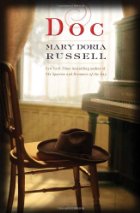
Review: Doc

DocMary Doria Russell, Doc

This is a novel about the legendary Doc Holliday, known to history for his involvement in the infamous Gunfight at the O.K. Corral in Tombstone, Arizona. But this book isn’t about that particular historical event; rather, it’s about who Doc Holliday really was, or at least who he might have been. It starts with John Henry Holliday’s childhood in Georgia: how he survived the aftermath of the Civil War and Sherman’s march; how he loved music and the finer things in life; and how he was profoundly affected by his mother’s death. It describes how he became ill with the disease that eventually killed him, and how his health forced him to seek a more arid climate out West. Finally, it depicts his life in Dodge City, Kansas, and the friendships and relationships he formed there, particularly with Kate Harony — an educated, passionate, and temperamental whore — and with a taciturn lawman named Wyatt Earp.

Historical fiction is one of my favorite genres, and this book is a perfect example of why. It brings the Wild West to life in an extremely vivid way, particularly the struggles of a frontier town in an era where the law offered very little protection to its citizens. I was fascinated by the political machinations at work in Dodge, where social issues like prostitution and Prohibition were intimately entangled with the local economy, and where political elections were often decided over a hand of cards. The characters in this book are as well-depicted as the setting: I felt like I truly got to know Doc and Wyatt, what made them tick, and how they managed to rise above their time while also being defined by it. They are both admirable characters, but Russell doesn’t shy away from describing their very real flaws. Overall, this book transported me to another time, and I absolutely loved it. Definitely one of my top reads of the year!

Review: Something Wicked This Way Comes

Something Wicked This Way ComesRay Bradbury, Something Wicked This Way Comes

A week before Halloween, Cooger & Dark’s Pandemonium Shadow Show creeps silently into Green Town, Illinois, in the middle of the night. To most of the town’s inhabitants, the show is a carnival like any other, with its sideshows, rides, and circus freaks. But 13-year-old best friends Jim Nightshade and Will Halloway suspect that something more sinister is at work. The carnival seems to lure unwary visitors into its depths, and those who fall under its spell will never be the same again. It’s up to Jim and Will — and Will’s father, an unassuming librarian who worries about his age and his relationship with his son — to uncover the dark secret at the heart of the circus and to prevent it from ensnaring more victims.

I don’t usually read horror novels, but I was interested in this book because of its classic status (and, frankly, because of its Shakespearean title). Unfortunately, this novel really didn’t work for me, but the problem wasn’t the story at all — it was the writing style. The prose is gratingly faux-poetic, overblown, and melodramatic. Words are often used in unconventional ways (nouns being used as verbs and the like), which can be an effective stylistic choice, but in this case I found it incredibly distracting. I also found the dialogue completely unrealistic and stilted. It’s a shame, because I actually do think the basic story is fascinating and could have been very effective in the right hands. I’m definitely not enthusiastic about trying more Bradbury after this — and I’m wondering how well Fahrenheit 451 would stand up to a re-read!

Review: No Plot? No Problem!

No Plot? No Problem!Chris Baty, No Plot? No Problem!: A Low-Stress, High-Velocity Guide to Writing a Novel in 30 Days

This book, written by the creator of NaNoWriMo, explains the origin of his crazy idea to write a 50,000-word novel in 30 days. Its target audience is those creative, literature-loving types who often say to themselves, “Someday I’d like to write a novel,” but who haven’t actually done anything to make their dream happen. Baty’s central point is that the best way to write a novel is just to sit down and write it — and to give yourself an impossibly short deadline so that you can’t let procrastination or perfectionism get in the way. This book introduces the concept of NaNoWriMo and offers a guided tour of each week, complete with tips from people who have successfully hit the 50,000-word target in the past. It also offers suggestsions for how to keep motivated, what to do when you get stuck, and how to conquer your pesky Inner Editor.

Not sure if I’ve mentioned this yet, but I am participating in NaNoWriMo this month (and am already falling behind in my word count, due to an incredibly busy first weekend!), so I seized the opportunity to read this book before all the madness began. I really enjoyed Baty’s breezy, tongue-in-cheek tone, which underscores the fact that this is a ridiculous undertaking that is highly unlikely to produce quality work. I also found several of his suggestions helpful, particularly the idea of finding time to write every day by making a schedule and eliminating nonproductive activities. I know I can waste several hours a day doing nothing but watching TV or puttering around the apartment…but now I’m going to spend those hours writing intead! I should say, though, that this is not a good resource for learning about the craft of writing. Other than very basic definitions of plot, setting, and characters, this book doesn’t offer advice about style or improving the quality of your writing. I’d recommend it to people who are interested in doing NaNoWriMo, but those who want a more general writing guide should look elsewhere.

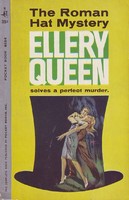
Review: The Roman Hat Mystery

The Roman Hat MysteryEllery Queen, The Roman Hat Mystery

In 1920s New York City, crowds have been thronging to see the latest Broadway hit, a sensationalist gangster play complete with flashing lights and gunfire. But little did the audience members of the Roman theater suspect that a real murder would be committed during the second act! Inspector Richard Queen of the local police is on the scene almost immediately, with his curious son Ellery in tow. In examining the victim’s body, they soon discover an interesting anomaly: despite being dressed in full evening clothes, the dead man wasn’t wearing a top hat. The police scour the Roman theater from top to bottom and search all the audience members as they leave the premises, but the hat is nowhere to be found. While Inspector Queen and his fellow police detectives identify the corpse and discover his involvement in a blackmailing scheme, Ellery applies himself to the mystery of the missing hat — and deduces the identity of the murderer as a result.

I really enjoy classic mysteries from the early 20th century, so I was excited to read this first Ellery Queen novel. Overall, I was very impressed with the mystery plot itself; the solution is tight and hangs together well, although part of the motive is concealed from readers until the very end. (Historical racism is also an aspect of the solution, which can certainly be offputting for contemporary readers.) I also liked the way in which the police were depicted as they investigated the murder: far from being bumbling idiots, they approach their job intelligently and methodically. I was especially tickled by the introduction of the district attorney as a character. Most mystery novels focus solely on catching the killer — never mind if s/he can actually be convicted in a court of law! I wasn’t as impressed with the characterization of the detectives, however. Inspector Queen was more central to this book than Ellery, but he didn’t seem to be consistently depicted, and Ellery was barely fleshed out at all. Presumably, though, more character development occurs in subsequent books, and I’d certainly be willing to read more Ellery Queen novels.

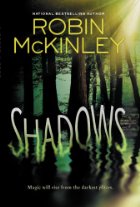
Review: Shadows

ShadowsRobin McKinley, Shadows

At first glance, Maggie seems to be an ordinary teenage girl: she loves animals, hates algebra, and thinks there’s something wrong with her new stepfather, Val. But it’s not just Val’s funny Oldworld accent or terrible taste in shirts that worries Maggie. It’s the fact that he’s always surrounded by shadows that don’t make sense; they’re the wrong shapes, and there are far too many of them to be natural. To make matters worse, Maggie has started to notice some troubling things about her hometown in Newworld — unexplained phenomena that almost look like breaks in reality. Eventually Maggie confronts Val and learns some unpleasant truths about Newworld and its way of dealing with unnatural occurrences.

I’ve been a huge fan of Robin McKinley’s since the first time I read The Hero and the Crown in elementary school, so I was ecstatic to learn that she’d written a new book, even if it wasn’t the long-awaited continuation of Pegasus. However, I’m sorry to say that I was very disappointed in this book. It does contain many of the classic McKinley touches, such as a wonderful canine companion, a no-nonsense heroine with plenty of gumption, and (less happily) a magical system that is never fully explained. But overall, I felt let down by this story; there were a lot of very interesting threads running throughout the novel, but they were never gathered together in the end. I’m not sure whether a sequel is planned or not, but some further resolution of the story definitely seems necessary. I can’t help but wonder if McKinley was attempting to write her version of the dyptopian YA novel that is so popular nowadays. All I can say is, I vastly prefer her older books!