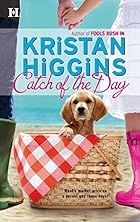
Review: Catch of the Day

Catch of the Day by Kristan HigginsKristan Higgins, Catch of the Day

Maggie Beaumont is incredibly unlucky in love. Her first serious boyfriend dumped her for another girl without even telling her about it, and for the past year or so she’s been carrying a torch for the local priest. Although Maggie has a job she loves (owning and operating the only diner in her tiny town of Gideon’s Cove, Maine) and many friends amongst the townspeople, she can’t help feeling incredibly lonely at  times. In desperation, she agrees to go on several blind dates, but each one is more catastrophic than the last. Just when she’s about to give up hope, however, a surprising kiss from an unexpected source makes Maggie think that maybe she’s finally met her match.

Once again, Kristan Higgins delivers a fun and fast contemporary romance. I found Maggie instantly likeable despite her flaws — and she actually does have real flaws, not the “flaws” that chick-lit heroines often have that are actually adorable quirks in disguise. Her obsession with her priestly friend, Father Tim, is a case in point: she knows he’s off-limits, but she spends an inordinate amount of time obsessing about him anyway. On the other hand, I didn’t get to know and love the taciturn hero, Malone, in the same way. Maggie is utterly bewildered by his behavior for much of the novel, and I can’t really blame her. If Higgins had developed his backstory a bit more and given us some insight into his point of view, I would have enjoyed the romance more than I did. But even though I thought the hero was underdeveloped, I still enjoyed this book! I definitely look forward to reading more of Higgins’ work in 2013.

Review: Speaking from Among the Bones

Speaking From Among the Bones by Alan…Alan Bradley, Speaking from Among the Bones

I received this book through the LibraryThing Early Reviewer program. Its U.S. release date is January 29.

In this fifth Flavia de Luce adventure, the entire town of Bishop’s Lacey is agog at the forthcoming exhumation of St. Tancred from the village church. Of course, Flavia is determined to be present when the saint’s body is uncovered. But in her eagerness to be on the scene when the exhumation takes place, Flavia discovers another body in the church: that of the organist, whose corpse has been hidden in St. Tancred’s crypt. As Flavia investigates the organist’s death, she also stumbles upon several other mysteries. For example, what is wrong with the local magistrate’s son, and why is he kept in a locked room? Where do the tunnels underneath St. Tancred’s churchyard lead? Is Feely actually getting married, and if so, to whom? And of course, will the de Luces have to leave their beloved yet crumbling home at Buckshaw?

Five books in, this series is still going strong. I always enjoy Flavia’s adventures, and I think she’s becoming a bit more human (and less serial-killer-esque) with each new book. I wonder if Alan Bradley will ever let her grow up, or if she’ll always stay a precocious pre-teen. I’m kind of torn about which scenario I’d rather see…but regardless, Flavia is a whole lot of fun to watch as she copes with the pressures of adult life that intrude on her childhood. While corpses and detection are still a game to her, she is remarkably sensitive about her family’s complex emotions as their life at Buckshaw is threatened. I like that her familial relationships seem to be moving forward (albeit at a glacial pace) and that she may now have some competition as a detective in Adam Sowerby, a newcomer who specializes in botany and “inquiries.” There are enough interesting teasers here that I’m really looking forward to the next book!

Review: The Poetics of Aristotle

Aristotle, Poetics (trans. Preston H. Epps)

In this slim treatise, Aristotle shares his philosophy of literature, including both tragedy and epic poetry. (There may at one point have been a section on comedy also, but if so, it has been lost.) He sets forth the various rules governing tragedy in some detail, including what subjects are appropriate for a tragedy, the best plot devices to use, the proper length, the best types of characters, and the primary goal of tragedy. He backs up his assertions with examples from the various poets and playwrights of his day, none of whom measure up to “the divine Homer.” With systematic deliberation (and occasional humor), Aristotle lays out his formula for creating great literature.

The thing about Aristotle is that he is hard — and the Poetics is harder than many of his other works, for several reasons. First of all, there’s no single definitive text, so translations can vary widely. (I read a cheap edition published by UNC Press in the 1940s. It seemed serviceable enough, and there were many footnotes explaining why the translator had chosen one word over another.) Also, many of Aristotle’s literary examples made no sense to me, since I’m not terribly familiar with ancient Greek drama. In fact, I think many of the plays he cites have been lost to the modern world! That said, I did find his general rules about literature to be interesting, and I’m glad I finally read this classic work.

N.B. — The version depicted in the picture is not the same as the version I read. I have no knowledge about the quality of the respective translations.

Review: The Leavenworth Case

The Leavenworth Case: A Lawyer's Story by…Anna Katharine Green, The Leavenworth Case

In this early American detective novel, young lawyer Everett Raymond is shocked to discover that a longtime client of his firm, Horatio Leavenworth, has been shot dead in his New York home. Since the firm’s senior partner is ill, Mr. Raymond takes on the responsibility of visiting the bereaved family, which consists of two beautiful nieces, a private secretary, and the servants. He also attends the inquest, where the evidence points to one of the nieces, Eleanore Leavenworth, as the guilty party. But Mr. Raymond, struck by Eleanore’s beauty and grace, is convinced of her innocence. He decides to clear her name by collaborating with the police detective in charge of the case, Ebenezer Gryce. But his investigation unearths a shocking secret about the Leavenworth family that may have dire consequences for the family as well as for the murder investigation.

This book is a mystery novel written in the 19th century; that’s pretty much all you need to know to decide whether or not you’ll enjoy it. I thought it was an entertaining and quick read. Despite the flowery language, the book moves quite quickly, with the shocking news of Mr. Leavenworth’s murder being revealed on the first page. The plot is engaging and inventive, especially for its time (the book predates Sherlock Holmes by several years). The characters, on the other hand, are a bit dull and ill-formed. Mr. Raymond, the narrator, could basically be anybody; and the Leavenworth women have few characteristics, at least for the first half of the book, other than being extremely beautiful. So if you’re looking for a deep psychological study, this book probably isn’t for you. But I still found it fun and entertaining, and I’d consider reading more of Green’s work.

Review: The Glass Menagerie

The Glass Menagerie by Tennessee WilliamsTennessee Williams, The Glass Menagerie

This classic American play centers around the Wingfields, a lower-middle-class family living in the Midwest. The mother, Amanda, is a former Southern belle who is desperate to prevent the family from sinking into poverty. The daughter, Laura, is a fragile young woman with a slight physical deformity that has made her morbidly self-conscious and shy. The son, Tom, works in a warehouse but dreams of being a poet and living a life of adventure. When a “gentleman caller” comes to dinner, Amanda pressures Laura to make a good impression on him, but the evening doesn’t go according to plan.

I haven’t had much prior experience of Tennessee Williams, but I quite liked this play and can see why it’s considered a classic. I was definitely invested in the story and felt particularly sympathetic toward Laura. Amanda, on the other hand, drove me crazy; she reminded me of Mrs. Bennet in her pushy eagerness for Laura to attract an eligible husband. And Tom was actually the least interesting character for me, because it seemed like he was nothing more than a spokesman for the author. Though he’s fairly artistic about it, Williams definitely uses this play to express his views on the flaws in his society. I would be interested in seeing the work performed, as there are a lot of very specific stage directions, but it also “reads” well. Overall, I’d say it’s worth reading, even if it’s not destined to become one of my favorite plays.

Review: Blackout / All Clear

Blackout by Connie WillisConnie Willis, Blackout and All Clear

In the year 2060, time travel is not only possible, but it’s the preferred method of historical research. Instead of digging through old records to get a sense of a particular time period, why not just go there in person and see for yourself? Mike, Polly, and Eileen are three such historians who have all been assigned to World War II. Mike is going to Dover, where he’ll pose as a journalist and interview the heroes of the evacuation of Dunkirk. Polly will be a London shopgirl in the midst of the Blitz, and Eileen will be observing evacuees in the English countryside. Soon after they arrive at their assignments, however, things begin to go wrong. Minor discrepancies in the historical record start showing up — which ought to be impossible, because everyone knows that historians can’t affect the outcome of events. Then all three of their “drops” (the portals through which they can return to their own time) mysteriously close, leaving them stranded in World War II. As Mike, Polly, and Eileen try every possible method of reopening the drops, they’re forced to conclude that they might be trapped in the wrong time forever.

All Clear by Connie WillisAlthough Blackout and All Clear were published in two volumes, they’re really just one novel, so I’m reviewing them together. My overall feeling about this book is one of awe. This was obviously a labor of love for Connie Willis, and it is truly epic in scope. The time period is meticulously researched, and I really felt like I was there in World War II, seeing how ordinary people reacted to the war and especially to the Blitz. That said, the book is extremely long (over 1,000 pages if you count both volumes), and it probably could have been trimmed substantially. Additionally, there were several confusing plot threads that jumped between different characters and different time periods. These were all resolved by the end of the book, but it made the reading experience a bit difficult at times. On the other hand, there were so many little diversions that I loved — the allusions to Shakespeare and Agatha Christie, for example, as well as the segment where every character was named after someone in The Importance of Being Earnest. So I have mixed feelings about this novel, but overall I have a lot of respect for what Willis accomplished here. Definitely recommended for people interested in  WWII!

Review: Are Women Human?

Are Women Human? by Dorothy L. SayersDorothy L. Sayers, Are Women Human?

Dorothy Sayers is best known for her mystery series featuring Lord Peter Wimsey, but she wrote on a lot of other topics too. This short volume contains two of her essays in which she explicitly talks about the role of women in society and the feminist movement as she perceived it in the early 20th century. Sayers’ central point in these essays is that people should spend less time thinking about “women” as a class and more about each particular woman as an individual. She notes that opinions, beliefs, intellect, and abilities vary among women just as they do among men. She also champions a woman’s right to work outside the home if she wants to; both women and men should be able to do work that they enjoy and at which they excel.

I really enjoyed both of these thoughtful, witty essays. Even though they were written many decades ago and the world has changed a lot since then, I think Sayers’ observations remain relevant and interesting. I especially liked what she says about the idea that a woman’s place is in the home. She points out that in the Middle Ages, a lot of the most interesting and important jobs were done in the home — weaving, dyeing, food production, brewing, estate management, etc. These all used to be women’s jobs, and they didn’t become men’s jobs until after the Industrial Revolution, when they moved into factories. I don’t tend to read a lot of feminist theory, but I’d recommend this book to anyone interested in the history of the feminist movement — or anyone looking for a quick, humorous, and thought-provoking read!

Review: I Am Half-Sick of Shadows

I Am Half-Sick of Shadows by Alan BradleyAlan Bradley, I Am Half-Sick of Shadows

It’s Christmas at Buckshaw, and Flavia de Luce is determined to use her chemical knowledge to capture Father Christmas, proving that he really exists once and for all. But her holiday plans must take a backseat when a film crew arrives at Buckshaw with movie star Phyllis Wyvern in tow. Flavia is fascinated by the spectacle and quickly insinuates herself into the proceedings. She is especially interested in Phyllis Wyvern, who turns out to be hiding several secrets under her glamorous façade. When Phyllis is found strangled by a length of film, Flavia once again investigates in hopes of discovering the killer. But with the entire film crew and half of Bishop’s Lacey snowed in at Buckshaw, everyone is a suspect — which makes this case Flavia’s most difficult and dangerous one yet.

This is yet another enjoyable outing for Flavia de Luce, and the festive Christmas atmosphere is an added bonus. The mystery plot is a bit underdeveloped, in my opinion, with a solution that basically comes out of nowhere. But for me, it was more interesting to read about the film crew and all its internal drama, as well as the townspeople’s response to having celebrities in their midst. I also enjoyed reading more about Flavia’s strained familial relationships, which finally seem to be loosening up a bit. Fans of the series should enjoy this installment despite the weak mystery plot.

Review: The Girl Who Played Go

Shan Sa, The Girl Who Played Go (trans. Adriana Hunter)

This novel is set in a place and time that I have very little knowledge of, Manchuria in the 1930s. The two narrators are a Chinese schoolgirl whose passion for the game of go makes her unique and a Japanese soldier who has come to China with Japan’s invading army. The soldier muses on the nature of war and his victorious country’s relationship with the conquered Chinese. The girl, on the other hand, is more concerned with her widening romantic experience and the problems of daily life. But when the two characters meet over a game of go, the consequences will be far-reaching and devastating for them both.

What I liked most about this book is that it opened a window for me into another culture and way of life. I mistakenly thought the book would be more about Japan’s military movements in World War II, but instead it deals with an earlier conflict that I knew nothing about. But while the setting was unique, the problems the soldier faces in this book are universal: What is courage? What are the possible justifications, if any, for waging war? What are the circumstances under which a soldier can or should disobey orders? I found the soldier a more compelling character overall than the Chinese girl. She’s very shallow and frivolous for much of the novel, and while she does eventually change, it happened too late for me to care much about her. I also didn’t feel the emotional impact of the ending the way I think I was supposed to. Overall, I enjoyed this novel, but I wouldn’t race to pick up another book by this author.

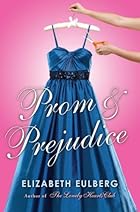
Review: Prom and Prejudice

Prom and Prejudice by Elizabeth EulbergElizabeth Eulberg, Prom and Prejudice

At the prestigious Longbourn Academy for girls, money and status matter more than anything else, so scholarship students are constantly taunted and made to feel like outsiders. Lizzie Bennet is one of only two scholarship students in her class, and while she knows she’s lucky to be getting such a good education, she can’t help feeling miserable due to her low social status. Her only friends are the other scholarship girl, Charlotte Lucas, and her roommate, Jane. Jane has a thing for Charles Bingley, a popular student from nearby Pemberley Academy who’s been studying abroad for the past semester. When he returns, he acts really interested in Jane — but his snobby sister Caroline and moody friend Darcy don’t seem to approve of the relationship. Lizzie is happy about Jane’s romance but takes an immediate dislike to Darcy. However, as she gets to know him and his group better, she realizes that she may be letting her prejudice against rich people blind her to the truth.

As should be obvious, this is a modern-day version of Pride and Prejudice set in a young adult context. Though I’m an ardent fan of Jane Austen, I’ve found that the various Austen-inspired sequels and spinoffs are usually nowhere near as wonderful as the original novels. There are exceptions, of course, but unfortunately this book isn’t one of them. The plot sticks to the original P&P fairly closely but doesn’t add anything new or interesting to the story. None of the characters have any depth — even the protagonists — which made it hard for me to care about them. Even more importantly, I found the world of the novel unbelievable. While I accept that there are high school bullies and snobs and cliques, it seems wildly unlikely that everyone at Longbourn would be actively mean to Lizzie (stealing her stuff, throwing milkshakes on her, etc.) just because she has a scholarship. I understand that the author was trying to re-create the social hierarchy that existed in Austen’s day, but the end result just wasn’t credible. I have read YA Austen spinoffs that work very well — Polly Shulman’s Enthusiasm is a wonderful example! — but this book didn’t do anything for me.