Review: The Raven Boys

The Raven Boys by Maggie StiefvaterMaggie Stiefvater, The Raven Boys

In a household full of witches, psychics, and otherwise supernaturally gifted women, Blue Sargent is the only one with no powers of her own. She does, however, possess a gift for strengthening other people’s magic; so every year on St. Mark’s Eve, she goes with her mother to a certain church to count the dead as they pass by. Blue has never seen the spirits before, so this time she is shocked to notice a boy about her age walking past the church. He’s wearing an Aglionby sweater, which marks him as a student at the local fancy prep school, a Raven boy. Blue is troubled by her vision because the boy’s presence on this path means he’ll die within the year. When she meets the Aglionby boy and his friends in person, she decides to try to prevent the boy’s death and help him on his own magical quest.

I feel like I didn’t do a very good job of explaining this book, because there are a lot of things going on. Blue is one of the main characters, but the book also spends a lot of time with each of the four Raven boys (the one Blue saw and his three best friends). So we learn a lot about the boys’ pasts, their various problems, and their quest to find the lost body of the Welsh king Owen Glendower. As a result of the scattered focus, nothing is covered in very much depth. I learned just enough about the characters to grow attached to them and become curious about their fates, but there’s a lot left to be resolved. The book’s pace is fairly slow, which fits with Stiefvater’s reflective style of writing. The romantic element of this book, though present, is very low-key; I imagine it will be more prevalent in later books in the series. Overall, this book didn’t blow me away like The Scorpio Races did, but I still really enjoyed it and look forward to reading more by Maggie Stiefvater.

Review: My One and Only

My One and Only by Kristan HigginsKristan Higgins, My One and Only

Harper James is a ball-busting divorce attorney who firmly believes in the nobility of her calling. In her words, she helps people’s hearts to accept what their heads already know — that they and their spouses are simply no good for each other. Harper knows the truth of this saying firsthand, as she divorced her college sweetheart, Nick, several years ago. Harper has done her best to move on from Nick and is even contemplating marriage to another man. But when she learns that her younger stepsister is about to get married to Nick’s half-brother, she can’t help but get upset. She’ll have to see Nick again and confront their shared past, from the intensity of their love to the heartbreaking disintegration of their marriage. How can Harper get over Nick when the sight of him unearths feelings she thought she’d buried long ago?

Another winner from Kristan Higgins! This book is a real page-turner, especially after Harper’s past with Nick slowly starts to be revealed. I didn’t particularly like Harper at first — I found her shrill and abrasive — but it gradually becomes clear that she has good reasons for being the way she is. Nick is also a compelling hero, swoonworthy but not flawless, and certainly not blameless in the conflict between him and Harper. I really liked how the obstacles separating the hero and heroine are legitimate and not the result of a silly Big Misunderstanding. Rather, they seem like the kind of problems that many married couples fall prey to: they take each other for granted and are afraid to fully open up to each other. So I think this book has a little more emotional weight than Higgins’ other books, but that’s not a bad thing! I’d definitely recommend this to fans of contemporary romance.

Review: The Westing Game

Ellen Raskin, The Westing Game

At the beginning of this novel, 16 people of all ages and walks of life are invited to live in a fancy new apartment building overlooking Lake Michigan. They all accept due to the luxurious accommodations and affordable rent, but it soon becomes apparent that they have been gathered for a purpose. Old Samuel Westing, who founded the town and employed many of its citizens, has just died. When the apartment dwellers are summoned to the reading of the will under the guise of being his heirs, they are shocked to hear that Mr. Westing has accused one of them of being his murderer. He proposes a game to the 16 heirs: The person who discovers Mr. Westing’s killer will inherit his vast fortune.

This is one of those books that I somehow missed in my childhood, and I decided to pick it up for the read-a-thon since I assumed it would be a fairly effortless read. But while I enjoyed the book a lot, it was definitely more complex than I thought it would be! There are a lot of characters to keep track of, which was hard at first, but they each had such distinctive qualities that I was soon able to tell who was who. The game itself was delightful to puzzle through, and I’ll admit that I didn’t see many of the twists coming! I think this would be a great read for bright children, especially those who love mysteries — but it can definitely be enjoyed by adults as well!

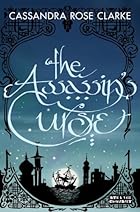
Review: The Assassin’s Curse

The Assassin's Curse (Strange…Cassandra Rose Clarke, The Assassin’s Curse

Ananna is the daughter of a prominent pirate clan, which makes her a valuable matrimonial prize. Yet when her parents arrange an advantageous marriage with a man from another pirate clan, she rebels. Fearing that her parents will force her into the marriage, she runs away — but not before her scorned fiancé threatens to send an assassin after her. Ananna has heard the horror stories about assassins: they lurk in the shadows and use blood magic to curse their doomed victims. But when her assassin catches up with her, Ananna inadvertently saves his life, thus binding them together. Now she needs to find a way to break the curse that ties her to the assassin without getting into even more trouble.

First of all, isn’t that a wonderful, striking cover? It’s definitely appropriate for the novel, which is set in a quasi-Middle Eastern fantasy world — a refreshing change from the faux-medieval backdrop of many fantasy novels. Also, there are pirates, and they’re the fun kind of pirates, roguish yet charming.  I also grew to enjoy both Ananna and Naji (the assassin) as characters, although Ananna’s extremely informal dialect did get on my nerves at first. My biggest gripe with the book is that, after the major characters and conflict are established, nothing happens. And in the end, absolutely nothing is resolved; you have to read the sequel (not yet published) to find out what happens! The book doesn’t technically end on a cliffhanger, but basically it’s only the first part of the story. What’s worse, there is no indication before the ending that this book is part of a series. So if you do decide to read it, be forewarned that you won’t be able to find out what happens until #2 is released! That said, I liked the book and will probably read the next one; I’m just sorry the (non)ending left such a bad taste in my mouth.

Review: The Maltese Falcon

The Maltese Falcon by Dashiell HammettDashiell Hammett, The Maltese Falcon

Sam Spade is a private investigator operating in the seedy underbelly of early 20th-century San Francisco. His clients are usually shady types who don’t want to get mixed up with the police, so he knows right away that the beautiful Miss Wonderly, who comes into his office with a sob story about a missing sister, is trouble. Spade agrees to take the case, and his partner Archer shadows the girl in hopes of discovering more about her. When Archer ends up dead shortly thereafter, Spade must investigate Miss Wonderly (whose real name is Brigid O’Shaughnessy) and the various shady characters with whom she is involved. But the case becomes even more dangerous than he imagined when he discovers a group of criminals on the trail of a priceless historical artifact known as the Maltese falcon.

I hate to say this about such a well-loved classic mystery, but I wasn’t a huge fan of this book. The writing style didn’t do anything for me, and the plot was only so-so. Now, I’m sure it was wildly creative at the time, as I believe Hammett was one of the pioneers of the noir genre. But in this day and age, the twists are all too familiar. I am glad I read the book, since it’s an influential part of pop culture, but it’s not something that I’d read again just for fun. I am curious to see the movie, though; I predict that this is one of those rare cases where the movie is better than the book! All in all, while I quite liked The Thin Man, this book was just not for me.

Review: The Graveyard Book

The Graveyard Book by Neil GaimanNeil Gaiman, The Graveyard Book

“There was a hand in the darkness, and it held a knife.” So begins this novel about an ordinary boy in an extraordinary situation. When the sinister man Jack murders the boy’s family and comes after him, he manages to escape to the local graveyard and evade Jack for the time being. He is taken in by the ghostly inhabitants of the graveyard, who give him the name Nobody Owens. Bod grows up in the graveyard with certain abilities (such as Fading and Haunting) but certain limitations (such as not interacting with living people). He loves his family in the graveyard but is also curious about the outside world. The older Bod gets, the more he is drawn to the world of the living; but the man Jack is still looking for him, and he must confront many dangers before he can truly begin to live his life.

This book is a wonderfully atmospheric tale, perfect for a chilly autumn evening. Gaiman’s descriptions are evocative and often spooky, from the  menace of Jack and his associates to the slavering ghouls to the ancient power of the Sleer. Bod is a grave (pun intended) but likable child, and his adventures both in and out of the graveyard make for entertaining reading. I also loved Silas, Bod’s guardian, and I would have liked to know more about him. The ending is sad in some ways, but it feels absolutely right for the story. My only complaint is that this book is less substantial than Gaiman’s work for adults (Neverwhere is still my favorite), but I definitely enjoyed it nonetheless.

Review: Parnassus on Wheels

Christopher Morley, Parnassus on Wheels

Set in the early 20th century, this short novel tells the story of Helen McGill, a 39-year-old spinster who has spent the last several years living on her brother’s farm and keeping house for him. One day a traveling book salesman named Roger Mifflin shows up at Helen’s door and persuades her to take over the business. She purchases his van, called “the traveling Parnassus,” and sets off with Mifflin to have an adventure. Along the way, she meets several interesting people, discovers the joy of literature, and even finds true love.

I think this novel is a must-read for any book lover. Roger Mifflin’s love of literature is contagious, and he is very eloquent in praise of the written word:

“Lord!” he said, “when you sell a man a book you don’t sell him just twelve ounces of paper and ink and glue — you sell him a whole new life. Love and friendship and humour and ships at sea by night — there’s all heaven and earth in a book, a real book I mean.”

The book isn’t particularly complex or thought-provoking, but it’s sweet and cheerful and a real pleasure to read. I definitely recommend it, and I hope to read the sequel, The Haunted Bookshop, soon.

Review: Mariana

Susanna Kearsley, Mariana

When Julia Beckett was five years old,  she saw a house while traveling with her family and instantly felt drawn to it. Years later, she sees the house again and impulsively decides to buy it. As she settles down in the country village of Exbury, she is fascinated by the history of her house and the surrounding area. She also begins to experience “flashbacks” from the perspective of Mariana Farr, an inhabitant of the house in the 17th century. The more time Julia spends as Mariana, the more she is captivated by the events of the past — especially when the handsome Richard de Mornay, lord of the neighboring manor, shows an interest in Mariana. However, Julia must eventually discover why she shares Mariana’s experiences and what the consequences will be for her own life.

I had heard a lot of wonderful things about Susanna Kearsley, but I ended up being a bit underwhelmed by my first Kearsley novel, The Winter Sea. I enjoyed this book more, probably because I had more moderate expectations going in. Julia is a likable character, and I really enjoyed her relationships with the other present-day characters, especially her brother Tom. I was actually much less interested in the historical plot line, which is unusual for me. I felt like Kearsley wanted me to care more about Mariana’s story, but I honestly cared more about Julia’s. I wasn’t totally satisfied with the present-day romance either, but I can’t explain why without spoiling the book. Overall, I found this book a pleasant read, but unfortunately it didn’t grab me the way I wanted it to.

Review: Alice Adams

Booth Tarkington, Alice Adams

This novel, which won the Pulitzer Prize in 1921, tells the story of Alice Adams, a young woman who is determined to rise in society. Her father is kind-hearted and hardworking but content to be merely an employee at the factory of J.A. Lamb, the (unnamed) city’s most prominent businessman. He makes a decent salary, but it’s not enough for Alice to be able to mix in high society. Alice and her mother therefore continually badger her father to go into business for himself, which he eventually does — with disastrous consequences. Meanwhile, Alice meets the well-to-do Arthur Russell and immediately determines to marry him so that she can finally be the fine lady she’s always wanted to be.

I found this novel fascinating for several reasons. First, the plot manages to be suspenseful despite the ending’s inevitability; you know things are not going to end well for Alice, but you can’t help turning the pages in horrified fascination. Especially toward the end, when I could really see where things were heading, every terrible decision the Adamses made caused me to squirm. At the same time, I couldn’t help pitying Alice, her father and even her mother. They’re not bad people; they just think they’re entitled to a better lifestyle than they’re used to, and they don’t quite know how to get there. Alice is an especially interesting character. On the one hand, she’s basically a gold-digger, but she at least has enough self-awareness to realize that she’s being shallow. So I did enjoy this book, although in my opinion it’s not as good as Tarkington’s other Pulitzer-winning novel, The Magnificent Ambersons.

Review: The Unfinished Clue

Georgette Heyer, The Unfinished Clue

This novel begins, as so many British cozy mysteries do, with an awkward weekend at an English country house. Sir Arthur Billington-Smith is a tyrannical husband and father with a terrible temper; therefore, he is less than thrilled when several unexpected guests arrive for the weekend. All the guests dislike Sir Arthur, but since he also happens to be quite wealthy, they are hoping to manipulate him into giving them money. Naturally, Sir Arthur is murdered during the course of the house party, and Inspector Harding of Scotland Yard is called in to investigate. He soon finds that nearly everyone has a motive, but there is a dismaying lack of evidence that any one suspect committed the crime.

I absolutely love Georgette Heyer! I’ve read all her Regency-era romances and am now making my way through her mysteries. As a mystery, I have to say that this book is fairly average. Many of the characters seem two-dimensional and could be found in any number of mysteries from this period: the long-suffering wife, the lively young sister-in-law, the disappointing son, the unworldly vicar, and the sharp-tongued vicar’s wife. Still, Georgette Heyer’s snappy dialogue and characteristic hint of romance made this a fun read for me. I even appreciated the meticulous nature of Inspector Harding’s investigation; I never found myself thinking that the police were jumping to conclusions or overlooking evidence, they way they so often seem to do in mystery novels. All in all, if you’re a fan of Golden Age mysteries, I definitely recommend Heyer’s books.