Review: The Enchanted Forest Chronicles

Enchanted Forest ChroniclesPatricia C. Wrede, The Enchanted Forest Chronicles

These four stories take place in a fractured-fairytale setting and center around Cimorene, a princess who refuses to be proper. In Dealing with Dragons, Cimorene wants to escape marriage to a handsome but dull prince, so she runs away and offers to become the princess of the dragon Kazul. She has many adventures in her new life, most importantly thwarting some meddlesome wizards who hope to steal the dragons’ magic. In Searching for Dragons, Mendanbar, the king of the Enchanted Forest, needs to find out who is stealing magic from the forest, so he teams up with Cimorene to discover that those pesky wizards are at it again. Calling on Dragons follows the witch Morwen, who discovers yet another wizard plot and must alert Cimorene and Mendanbar, with the help of her nine cats and a magician named Telemain. Finally, in Talking to Dragons, Cimorene’s son Daystar has his own adventure and learns about his past as a result.

What a delight these books are! They’re marketed for children, but they contain so much sly humor that they can definitely be enjoyed by adults as well. It’s fun to catch all the references to, and subversions of, fairytale tropes: for example, in the first book, Cimorene is perpetually annoyed by knights and princes who keep trying to “rescue” her.   I also really loved all the main characters in these books, especially the women. Cimorene is a delightful heroine, strong-minded and pragmatic, who can solve any problem that comes her way, including melting a troublesome wizard. And the witch Morwen reminds me a great deal of Professor McGonagall — stern, but with a heart of gold underneath. I unapologetically shipped her and Telemain! Some things didn’t quite work for me, such as the rabbit-turned-donkey in the third book; he’s meant to be comic relief, but I found him a little much. And Shiara, a main character in the fourth book, seems a little bit too much like Cimorene. But all in all, I really enjoyed these books and am frankly annoyed that I don’t know any eight- or nine-year-old children to share them with!

Review: Duels & Deception

Duels & DeceptionCindy Anstey, Duels & Deception

After the death of her beloved father, Lydia Whitfield is determined to keep her family’s estate up and running, but her hot-tempered, alcoholic uncle thwarts her at every turn. Lydia’s only solution is to marry a suitable man who will allow her to run things as she chooses. She already has an unofficial understanding with her neighbor, Lord Aldershot, so all she has to do is draw up the marriage contract. Her plan hits a snag, however, when she meets her lawyer — or rather, her lawyer’s clerk, a handsome young man named Robert Newton. He seems to understand Lydia in a way that no one else does, and she finds herself getting distracted by his broad shoulders and kind brown eyes. Complications ensue when Lydia and Robert are abducted by persons unknown, and they must work together to discover who engineered the kidnapping and why.

I’d previously read another book by this author, Love, Lies and Spies, and while I wasn’t crazy about it, the adorable cover of this novel convinced me to try again. Unfortunately, I enjoyed the cover much more than the book! Even as someone who enjoys a light and fluffy Regency romance, I found this novel utterly insubstantial. The attempts at humor are grating, and the setting is nothing more than window-dressing. The mystery of who kidnapped Lydia and Robert isn’t compelling enough to carry the plot, and a separate storyline involving Robert’s best friend and a duel seems to be completely shoehorned in, with no relevance to the A-story. However, that side story does contain the only marginally interesting character in the book, Robert’s best friend Vincent Cassidy. Perhaps it’s just as well that the author hasn’t written a full novel featuring him, because I’m sure I’d be doomed to disappointment if I read it!

Review: The Golden City

Golden CityJ. Kathleen Cheney, The Golden City

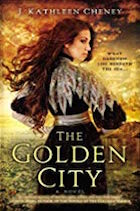
In an alternate-history version of 1902 Portugal, the country has been divided in half because of differing attitudes to the nonhuman creatures living within its borders. In Northern Portugal, the nonhumans are banned from the Golden City and must remain in their own island territories. Oriana Paredes is a sereia (siren), and she is in the Golden City illegally to spy for her people. As a cover, she works as a companion to Lady Isabel Amaral. When she and Isabel are both kidnapped and trapped underwater to die, Oriana’s heritage allows her to survive. She vows to avenge Isabel’s death and teams up with Duilio Ferreira, an aristocrat with selkie blood and ties to the police. As they investigate the kidnapping, they uncover a much larger conspiracy involving government corruption and dark magic. They also begin to fall in love, but many obstacles stand in the way of their relationship.

I enjoy the historical fantasy genre, and the somewhat unusual setting of early-20th-century Portugal inspired me to pick up this book. I liked the book overall, but the world-building is not particularly strong. There are a few passages of exposition near the beginning, in which the author tries to explain the alternate history, the nonhuman races, and the social structure of the Golden City, but it’s all a little confusing and muddled. People who pick up this book because they want to read about selkies and sirens will likely be disappointed, because the novel doesn’t explore the nonhuman cultures in any real depth. On the other hand, people who like “fantasies of manners” will probably enjoy the book overall, as I did. I found the plot a bit overwhelming, but I liked the interactions between Oriana and Duilio, and I look forward to reading more about them in the sequels.

Review: The Flatshare

FlatshareBeth O’Leary, The Flatshare

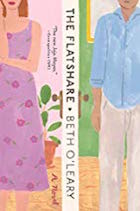
When Tiffy Moore is dumped by her boyfriend, she needs a new place to live right away. So when she spots an ad for an inexpensive flatshare, she jumps at it, despite the unconventional terms of the agreement. Leon Twomey, the current renter of the flat, works nights and weekends as a palliative care nurse. So he only needs the flat from 9am to 6pm, while Tiffy is at work; meanwhile, she can use the flat while he’s gone. They’ll never even have to meet each other. But then Tiffy leaves a note and some leftover baked goods for Leon, and he leaves a thank-you note in response, and soon they’re corresponding via Post-It notes left all over the flat. And while they seem to have little in common—Tiffy is gregarious and messy, while Leon is quiet and self-contained—their correspondence deepens into a close friendship, and maybe even more. But their complicated lives threaten to derail their fledgling romance: Leon’s brother is in jail fighting a wrongful conviction, and Tiffy’s ex doesn’t want to let her move on.

Despite the somewhat contrived premise, this book is an adorable rom-com that I would wholeheartedly recommend! The story is told in alternating chapters from Tiffy’s and Leon’s points of view. While some reviewers had trouble getting into Leon’s clipped, stilted narrative style, I thought it made for a great contrast to Tiffy’s bubbly voice. The notes between Tiffy and Leon are a joy to read, making the relationship between the characters believable despite their not meeting in person until halfway through the book. I also liked that they both seem like real people: they have jobs (and we actually see them doing those jobs!) and friends and family members whom they care about. The secondary characters are a bit less dynamic—Tiffy’s scary lawyer best friend, Leon’s bitchy girlfriend—but I didn’t mind because I enjoyed the main story so much! The book does deal with some serious issues, but it remains light and optimistic overall. In other words, it’s a perfect summer read!

Review: Duplicate Death

Duplicate DeathGeorgette Heyer, Duplicate Death

Young barrister and future baronet Timothy Harte is in love with Beulah Birtley, but his family fears she’s an unsuitable match. She works as a secretary for Mrs. Haddington, a widow with shady origins who has somehow found a way into London society. When a man is murdered at Mrs. Haddington’s bridge party, suspicion falls on Beulah, and Timothy is determined to prove her innocence. But Beulah is clearly hiding something, and she had both motive and opportunity to commit the murder. Luckily, the policeman in charge of the case is Chief Inspector Hemingway, who remembers Timothy from an earlier encounter (detailed in They Found Him Dead). As Hemingway and his assistant investigate the case, they discover not only Beulah’s secret but a host of others. They develop what seems to be a convincing theory of the crime — until a second murder throws all their conclusions into doubt.

Once again, Heyer delivers a mystery in which the plot is a lot less interesting than the characters. But her sparkling dialogue and incisive social commentary make up for any weaknesses in the mystery itself. I enjoyed Timothy’s interactions with Beulah, which strongly reminded me of Heyer’s romances. I also liked the fact that, for the first time in a Heyer mystery, the policemen are actual characters! Hemingway gets a lot more time on page than he has done in previous mysteries, and his exchanges with the Scottish Inspector Grant are some of the funniest in the book. But as I mentioned earlier, the mystery plot isn’t particularly strong, particularly when it comes to the second murder. The book also describes a homosexual character in very derogatory terms by today’s standards. Overall, I did enjoy this book and would recommend it to people who like Heyer and/or vintage mysteries, but it’s not a keeper for me.

Review: Washington Black

Washington BlackEsi Edugyan, Washington Black

George Washington Black is an 11-year-old slave, born on a sugar plantation in Barbados and doomed to a grueling life working in the cane fields. But when the master’s brother arrives at the plantation, he changes the course of Wash’s destiny. Christopher “Titch” Wilde is a scientist, and he enlists Wash’s help in building and testing a flying machine of his own invention. Titch also teaches Wash to read and encourages his talent for drawing. Eventually, a tragedy at the plantation forces Wash and Titch to flee, and their subsequent adventures take them as far as the Arctic and beyond. As Wash faces an uncertain future, he also ponders his identity as a black man in a hostile world and questions the significance of various relationships in his life.

I enjoyed this book and found it much more of a page-turner than I expected. Wash is a compelling narrator, and I was invested in his fate from the very beginning. His relationship with Titch is the central relationship in the book, and Edugyan does an excellent job of showing its complexity and ambiguity: Titch is kind to Wash and staunchly anti-slavery, yet their interactions are always complicated by their very different social status. However, I found the first half of the book more interesting than the second half; the plot seems to run out of steam, and the ending doesn’t really resolve anything. Which I think is intentional — after all, Wash grows from a boy of 11 to a young man of 18, but at the end of the novel he is just entering into his adult life. But I personally enjoy novels with a bit more resolution and emotional payoff. That said, I still liked the book and would recommend it to anyone who is interested in the premise.

Review: A Counterfeit Betrothal / The Notorious Rake

Counterfeit Betrothal : Notorious RakeMary Balogh, A Counterfeit Betrothal / The Notorious Rake

This volume contains two Regency romance novels, each on the shorter side. In A Counterfeit Betrothal, debutante Lady Sophia is upset that her parents, Marcus and Olivia, have been estranged for 14 years, though they were once desperately in love. She concocts a ridiculous scheme to reunite them: by betrothing herself to an unsuitable man, she hopes her parents will unite to find a society-approved way of breaking the engagement. But Sophia gets more than she bargained for with her incorrigible fiancé; meanwhile, Marcus and Olivia must move past an old argument to repair their relationship. In The Notorious Rake, a chance encounter brings the respectable Mary, Lady Mornington, together with the dissipated Lord Edmond Waite. He soon begins to pursue her, hoping to make her his mistress. Mary resists but is confused by her attraction to him. The more she gets to know him, the more she begins to hope that he will reform his rakish ways.

So, I started this volume last night, intending to read just a few chapters — and stayed up until 3 a.m. to finish both novels! Mary Balogh isn’t Georgette Heyer; her style isn’t as light and witty, and she certainly writes more sexual content (though it’s not on the super explicit end of the spectrum). But she may be the next best thing! I very much enjoy reading about her complex characters, most of whom have experienced significant troubles in their lives and need healing as well as love. I will say, I was a bit disappointed in A Counterfeit Betrothal, which sounded like a fake relationship story (my favorite!) but turned out to be a second-chance romance (not my favorite), focusing much more on Marcus and Olivia’s story than on Sophia’s. It was still well-written and entertaining, though! And I was very pleasantly surprised by The Notorious Rake, because I usually don’t find reformed-rake stories very appealing or convincing. But in this case, while Edmond starts out as a truly despicable character, he genuinely does grow and change throughout the book. All in all, I really enjoyed both books and look forward to my next Balogh!

Review: Field Notes on Love

Field Notes on LoveJennifer E. Smith, Field Notes on Love

Hugo Wilkinson is feeling trapped. He loves his parents and his five siblings, but he’s never particularly enjoyed the notoriety that comes with being a sextuplet. Now all six of them are heading off to their hometown university in the fall, but Hugo is beginning to wonder if it’s truly the right path for him. On top of everything else, he was supposed to be going on a romantic train trip across America with his girlfriend this summer, but she’s just dumped him, and all the tickets and hotels are in her name. Now Hugo is stuck — unless he can find another girl named Margaret Campbell who’d be willing to go with him. Meanwhile, Mae (full name Margaret) Campbell is an aspiring filmmaker in need of a little adventure. She decides to take Hugo up on his offer, and as they travel across the country together, their immediate connection deepens into something that surprises them both.

As someone who finds the idea of traveling across America by train both appealing and romantic, of course I couldn’t resist this book! And as I expected, it was a fun and charming read, although not particularly substantial. I think the book spends a little too much time setting up the plot, trying to make the whole scenario plausible, when in reality we all know it’s implausible and are perfectly willing to suspend our disbelief — otherwise we wouldn’t have picked up the book in the first place! I also didn’t quite buy into Mae’s internal conflict, which is about learning to let her guard down and be vulnerable — but the book never explains why she’s so guarded to begin with. Hugo’s conflict, about balancing his family’s expectations with his own wants and needs, was much more believable for me. I did like the sweet romance and the uniqueness of the road trip, but ultimately this isn’t a book I will ever revisit.

Review: My Sister, the Serial Killer

My Sister, the Serial KillerOyinkan Braithwaite, My Sister, the Serial Killer

Have you heard this one before? Two girls walk into a room. The room is in a flat. The flat is on the third floor. In the room is the dead body of an adult male. How do they get the body to the ground floor without being seen?” This quote from early in the novel basically sums up its premise: Korede’s little sister, Ayoola, has been killing her boyfriends, and Korede protects her by scrubbing the crime scenes and disposing of the evidence. Ayoola claims she’s justified in her killings — that the men attacked her, and she was just defending herself. But Korede is beginning to have doubts; and when Ayoola starts flirting with the object of Korede’s desire, Korede must decide whether to reveal Ayoola’s secrets or remain loyal to her sister at all costs.

This book certainly has an eye-catching title and hook, but it’s not really a serial killer book at all. We get very little insight into Ayoola’s motives or feelings about what is happening. Rather, this is a book about sisters, and it’s a fascinating study of Korede’s complex relationship with Ayoola. I completely understood Korede’s feelings: her frustration at not understanding her sister; her jealousy that Ayoola is beautiful and desired by men, even the man Korede herself loves; her protectiveness and loyalty despite the monstrosity of Ayoola’s actions. I also enjoyed the writing style; Korede’s deadpan narration gives a lightness to the grim subject matter. I don’t think plot is this novel’s strong point. Despite the high body count, nothing really happens. But overall, this was a fun and thought-provoking read for me, and I would definitely try another book by this author.

Review: Good Riddance

Good RiddanceElinor Lipman, Good Riddance

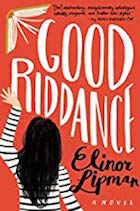
“Daphne Maritch doesn’t quite know what to make of the heavily annotated high school yearbook she inherits from her mother, who held this relic dear. Too dear. The late June Winter Maritch was the teacher to whom the class of ’68 had dedicated its yearbook, and in turn she went on to attend every reunion, scribbling notes and observations after each one—not always charitably—and noting who overstepped boundaries of many kinds. In a fit of decluttering (the yearbook did not, Daphne concluded, “spark joy”), she discards it when she moves to a small New York City apartment. But when it’s found in the recycling bin by a busybody neighbor/documentary filmmaker, the yearbook’s mysteries—not to mention her own family’s—take on a whole new urgency, and Daphne finds herself entangled in a series of events both poignant and absurd.” (Summary from Amazon.com.)

I’d never read anything by Elinor Lipman before, but a combination of the plot summary and cute cover interested me enough to pick it up. Unfortunately, I didn’t find it very enjoyable, mainly because I didn’t connect with any of the characters or understand the decisions they made. For example, why does Daphne go along with Geneva’s filmmaking plan sometimes and resist at other times? Also, the characters all seem very two-dimensional. Geneva is presented as a talentless nightmare (which is how Daphne sees her), and that characterization is never given more nuance. Daphne’s father is “the nicest guy in the world,” and that statement is never questioned. I kept wanting some depth, some irony, some surprise, but none ever came. As for the “mystery” of the yearbook, in one sense the solution is incredibly predictable, but in another sense June’s obsession with the class of ’68 is never actually explained. I did breeze through the book in about three hours, but that’s really the only positive thing I have to say about it.