Review: Fools Rush In

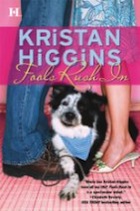
Fools Rush InKristan Higgins, Fools Rush In

Millie Barnes has been in love with Joe Carpenter since high school, and now that she’s nearly 30 with a promising career as a doctor, she’s decided that it’s finally time to do something about it. When she’s not working at the local clinic, she’s focused on a self-improvement regimen that will surely cause Joe to notice her as something more than just a friend. She begins running, gets a new haircut, and asks her friends for makeup and clothing tips. She even plans out her daily routine so that she can “accidentally” bump into Joe. But Millie also begins spending a lot of time with Sam Nickerson, a local cop who just happens to be her sister’s ex-husband. Although Sam has a good life and a wonderful teenage son, Millie wants him to fall in love again, this time with a woman who’s worthy of him. When Joe finally starts taking notice of Millie, she’s ecstatic; but as the two of them begin dating, she’s shocked to discover that something is missing. And the more time she spends with Sam, the more she realizes that her platonic feelings for him may have developed into something much deeper — and much more complicated.

I always enjoy Kristan Higgins’ books when I’m in the mood for a light contemporary romance. This book has a lot of her trademark qualities, like a neurotic/insecure heroine with a tight-knit family and an adorable dog, but the romance here didn’t work for me as well as in her other books. I just couldn’t get past the fact that Sam was once married to Millie’s sister. The novel goes into a lot of backstory to explain why that marriage fell apart and why they weren’t a good match, but it just wasn’t enough for me. I feel like the book minimizes the difficulties Millie and Sam would actually experience in pursuing a relationship, especially with Millie’s family and Sam’s son. I did like the contrast between Millie’s relationship with Sam and her relationship with Joe, and I also liked the fact that Joe is not a bad guy. Often in love triangles, the third person is portrayed as a horrible human being so that the protagonist’s choice will be obvious; here, Joe is a sweet man with a lot of good qualities, but he’s just not the right guy for Millie. Overall, this was a pretty good read, but the romance is so problematic that I wouldn’t really recommend it. Try some of Higgins’ other books instead!

Farewell, “Parks and Recreation”

Parks and RecreationTonight one of my favorite shows of all time, “Parks and Recreation,” will air its series finale. I was a relative latecomer to the show, binge-watching the first few seasons on Netflix to catch up, but I quickly fell in love with the show’s quirky characters, talented cast, and hilarious jokes. But I think my favorite thing about “Parks” is its irrepressible optimism about human nature. In a TV landscape that seems to be getting more and more cynical, this show stands out as a beacon of joy and hope. Even though Leslie and her friends frequently make mistakes, they’re almost always motivated by the best intentions. The show celebrates love, friendship, chasing your dreams, and working together for a common goal — even with people who are your ideological opposite, as Ron is for Leslie. So, to pay tribute to this fantastic show, I’ve decided to list some of my favorite episodes from the series. Here they are, in the order in which they aired:

“The Stakeout” (2×02) — Leslie discovers that someone planted marijuana in a community garden, so she and Tom go on a stakeout to catch the perpetrator. While that scenario leads to some fun moments (including Leslie mistakenly assuming that Tom is from Libya), the real gold of this episode is the B story, in which Ron is immobilized by a hernia. Watching him and April interact as expressionlessly as possible is a hilarious delight.

“Hunting Trip” (2×10) — The parks department goes hunting at a cabin in the woods, where Leslie awkwardly attempts to be “one of the guys,” but events take a mysterious turn when Ron is shot by one of the gang. I love the jump-cut where Leslie is confessing her guilt to the park ranger, all while expressing her disapproval of his sexism: “All I want to do is have babies!” Also, this is the first episode that shows a glimpse of the April/Andy romance, as they are stuck in the office while everyone else is on the trip.

“Telethon” (2×22) — Leslie signs up the entire department for the 2:00-6:00 a.m. shift of a telethon. I love that this episode served the entire cast and provided some wonderful character details, like Jerry’s talented (yet mercilessly mocked) piano playing and Ron’s ability to cane a chair. My favorite line in the episode is this gem delivered by Ron Swanson: “What the f*** are you doing, Perd Hapley?”

“Flu Season” (3×02) — Several characters come down with the flu, including Leslie, who nevertheless refuses to stop working on plans for the Harvest Festival. First of all, Amy Poehler pretending to be high on flu medicine is a gift that keeps on giving. Then there’s Chris Traeger’s spiral into despair, as he tries to avoid catching the flu (“My body is a microchip!”) but ends up telling his reflection in the mirror to “Stop. Pooping!” This was also the real start of the Ben/Leslie romance, of which I am an unapologetic shipper.

“Media Blitz” (3×05) — Leslie, Tom, and Ben use Pawnee’s media channels to promote the Harvest Festival, but everyone is more concerned about Ben’s past as a failed mayor. Everything Adam Scott does in this episode is pure brilliance. The meltdown of Ben Wyatt, Human Disaster, on Crazy Ira and The Douche’s radio show (and then on “Ya’ Heard? with Perd” and “Pawnee Today” with Joan Calamezzo) is one of the funniest performances on this show. Also, Andy and April finally get back together!

“Andy and April’s Fancy Party” (3×09) — Andy and April throw a dinner party and surprise everyone by spontaneously getting married. This is one of the sweetest episodes of the series, but it’s also filled with funny moments, from Leslie’s horrified reaction (“Why are you doing this? Why is this…great thing happening?”) to April’s creepy friend Orin to Jean-Ralphio’s advice about the best man speech. But honestly, every time I watch this episode, especially when Simon and Garfunkel’s “April Come She Will” starts playing, I well up a little bit. April and Andy are polar opposites, but somehow her apathetic cynicism is the perfect complement to his puppy-dog enthusiasm. Putting those crazy kids together was one of the show’s smartest decisions.

“The Fight” (3×13) — Leslie pressures Ann to apply for a job at city hall, which leads to their first fight; Tom tries to promote an alcoholic beverage he’s invented. My favorite thing about this episode is the hilarious jump-cut in which every character talks to the camera while wasted on Snake Juice. Ron Swanson’s 3-second dance wearing April’s hat is just the greatest thing in the universe. I also loved the role-playing between Janet Snakehole and Burt Macklin, FBI. Macklin, you sonuvabitch.

So, who else is sorry to say goodbye to “Parks”? What are your favorite episodes, characters, moments? And if you never watched the show, what are you waiting for? Seasons 1-6 are available on Netflix streaming, so get going! 🙂

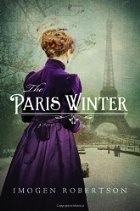
Review: The Paris Winter

Paris Winter, TheImogen Robertson, The Paris Winter

In November 1909, young Englishwoman Maud Heighton is in Paris pursuing her dream of becoming a painter. She studies at Lafond’s Academie, one of the few respectable art studios that is open to women. However, despite having some talent as an artist, Maud is living in extreme poverty and will soon have to choose between starving or returning to her family in England, which would be an admission of failure. Fortunately, Maud befriends Tatiana Koltsova, a fellow student at the Academie who is friendly, charming, and rich. Tanya takes Maud under her wing and eventually helps her to get a job as an English tutor for the Morel family. Both Sylvie Morel and her older brother Christian seem eager for Maud to accept their job offer, which includes room and board. But while Maud accepts the job gratefully, she can’t help feeling that it’s a little too good to be true. And the more she learns about the Morels, the more sinister they appear, until eventually she must seek out Tanya’s help to extricate herself from an unbearable situation.

I love historical fiction and was intrigued by the premise of this book, but I ended up with mixed feelings about it. First, I did love the setting, especially because it depicts a less glamorous version of Paris than many other books and movies do. Although Maud comes from the English gentry, she is forced to live a much more bohemian life in Paris, befriending people from each extreme of the class spectrum. And because she is not rich, she doesn’t have much opportunity to participate in the exciting, glamorous activities one usually associates with Paris during the Belle Époque. However, I wasn’t particularly invested in Maud as a character or in the plot involving her relationship with the Morels. It moved very slowly and eventually became a psychological thriller, which isn’t quite what I expected when I picked up the book. I thought both Tanya and Yvette, the artists’ model at the Academie, were more interesting characters, and I wish the book had focused more on their stories. That said, I did like the book’s denouement, which takes place during the great Paris flood of 1910. I would recommend this book to fans of historical fiction, but it’s not my favorite offering in the genre.

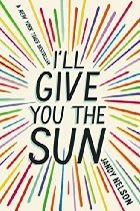
Review: I’ll Give You the Sun

I'll Give You the SunJandy Nelson, I’ll Give You the Sun

This novel is the story of a family tragedy and its aftermath, narrated in alternating chapters by twins Noah and Jude. Noah’s narrative begins when the twins are 13. He’s the quiet one who dodges school bullies and spends all his time painting; Jude’s the outgoing one who is popular and daring. Despite their very different personalities, Noah and Jude are incredibly close. But Jude’s story, which takes place three years later, reveals that something terrible has happened, and she and Noah are no longer speaking. Noah is living in denial, trying to act like a “normal” teenager, and Jude is trying as hard as possible to be invisible. As the novel alternates between Noah’s story and Jude’s, the nature of their tragedy is revealed, and it becomes obvious that each twin only has half the story. In order to move past their family’s secrets, both twins will have to forgive themselves as well as each other. Meanwhile, Noah falls in love with the boy next door and must come to terms with his sexuality, while Jude searches for redemption through art.

You may not be able to tell from my woefully inadequate summary, but I loved, loved, LOVED this book! And I honestly wasn’t expecting to…YA contemporary is a genre that varies widely in quality, and I hadn’t heard much about this author, so I was quite wary going in. But I was almost immediately captivated by the energetic, vivid writing style and unexpected imagery. I usually think that the best writing style is the least obtrusive, but this book made me sit up and take notice, in a good way! I also felt deep sympathy for both Noah and Jude, who are each trying to figure out who they are, while being burdened with a huge weight of guilt. Despite their overly precocious voices, they felt like real human beings to me. I loved the book’s focus on visual art and was fascinated by Jude’s quest to make a sculpture out of stone, something that is apparently a dying art nowadays. There’s even a touch of magical realism, as Jude often talks to her Grandma Sweetwine’s ghost. In short, if the premise of this book seems at all appealing to you, I HIGHLY recommend it!

Top Ten Tuesday: Kissing books

Top 10 TuesdaySince Valentine’s Day is nearly upon us, it makes sense that this week’s Top Ten Tuesday is asking about things we love (and hate) when it comes to romances in books. I’m a sucker for love stories, so I had a lot of fun coming up with my list! I’ve listed five things I really enjoy in a fictional romance, followed by five things I hate. Here they are, in no particular order…

Things I Love:

1. Marriage of convenience — For some reason I really like this trope, which generally occurs in historical fiction: hero and heroine marry for money (or some other non-romantic reason), then slowly grow to love each other. I enjoy this type of story because the obstacles are built into the plot. Both parties entered into the marriage with a common understanding of the rules (it’s about convenience, not love); but as their feelings begin to change and deepen, they’re unsure if their spouse feels the same way. So this trope is a great way to introduce conflict that doesn’t feel silly or manufactured.

2. Friends become lovers — I’ve always loved stories where a girl and guy are longtime friends, but eventually romantic tension evolves between them. I think it’s a satisfying story because we already know the protagonists get along well and have things in common, so their love is based on a solid foundation. Whenever there’s a love triangle between the heroine, her best male friend, and the hot new guy, I always root for the best friend!

3. The slow burn — There’s nothing better than watching a couple’s relationship evolve slowly, tentatively, excruciatingly towards romance! To me, the slow burn is much more realistic than a relationship where the characters fall in love, or in bed, instantaneously (see insta-love, below). It’s also a better move from a writing standpoint: building a romance slowly increases the dramatic tension and makes the resolution all the more satisfying!

4. Beta heroes — Sure, I’ll admit that there’s something appealing about strong-willed, take-charge alpha heroes who know what they want and aren’t afraid to go after it. But these heroes also tend to steamroll over anyone who disagrees with them — including the heroine! I prefer love stories where the hero listens to and respects the heroine, even when they disagree. Plus, beta heroes tend to be brainy rather than brawny, and I’m definitely of the opinion that smart = sexy!

5. Banter — My absolute favorite romances are the ones where the hero and heroine tease each other, exchanging witty banter and jokey one-liners with reckless abandon. Humor is such an important component of romance, to me; I think it’s really important that couples make each other laugh, are amused by the same things, and can deal with life’s problems with humor and positivity. In short, I’m a rom-com girl at heart, and I’m not ashamed to admit it!

Things I Hate:

6. Love triangles — Okay, I don’t hate every love triangle, but I think it’s really hard for authors to write them well. Usually it’s a situation where one person is clearly right for the protagonist, and the other person is clearly wrong — in which case the protagonist comes off as stupid for not immediately recognizing who the right person is, and the wrong person feels like a pointless distraction. And if the protagonist is trying to choose between two equally right people, then regardless of which person s/he picks, the outcome won’t be satisfying, because the odd man out will be too sympathetic.

7. Insta-love — I’ve already mentioned that I prefer slow-burning romances, and the flip side is that I hate romances where the hero and heroine fall in love too quickly. In these cases, it seems like the couple’s “love” is based almost entirely on looks and sexual chemistry, rather than on more substantial foundations like shared values or similar interests. Not to pick on Twilight, but this was my main problem with that book: Edward and Bella fell in love right away, for no discernible reason, and as a result, neither character was really developed very well. (To be fair, I didn’t read the sequels, so maybe that happens in later installments?) I never figured out why they loved each other, besides Edward being super hot and Bella having great-smelling blood.

8. Weird euphemisms — I tend to shy away from very explicit romance novels, but in my limited experience, there are some freaking weird euphemisms being used for male and female reproductive organs. And they can be extremely distracting in the midst of a love scene!

9. Big Misunderstandings — I understand that it can be hard for authors to maintain dramatic tension when they’ve created two characters who are obviously perfect for each other. Conflict has to come from somewhere, and I get that. But I hate when the only obstacle facing the characters is a silly misunderstanding that could have been avoided, if only they had actually talked to each other like human beings. If the hero and heroine are having trouble communicating, there should at least be some kind of basis for that (trauma from a past relationship, etc).

10. Sad endings — I know some people enjoy tearjerkers where the hero and heroine fall in love, and then one of them dies in a car accident or gets a terminal disease or marries somebody else. I am not one of them! I want my hero and heroine to end up together! Maybe that makes me a sap, but I don’t care: I want the happily-ever-after, dammit!
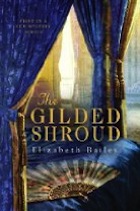
Review: The Gilded Shroud

Gilded Shroud, TheElizabeth Bailey, The Gilded Shroud

Ottilia Draycott has just accepted a position as companion to the Dowager Lady Polbrook, expecting nothing more adventurous than a change of scenery after her former position as governess to her two young nephews. But on her very first day at her new post, the current Lady Polbrook (the dowager’s daughter-in-law) is found dead in her room, having been strangled sometime during the night. The household immediately falls into a panic, especially when it becomes evident that the master of the house has disappeared. Ottilia knows that suspicion is bound to fall on Randal Polbrook; no one knows where he has gone or why, and it’s common knowledge that he and his wife were estranged. But Ottilia, after examining the scene of the crime, believes the late Lady Polbrook was entertaining a lover on the night she died. She shares her suspicions with the dowager and with Lord Francis Fanshawe, the younger brother of the absent marquis. Together, they try to discover the lover’s identity and clear Randal’s name, while minimizing the scandal as much as possible. Meanwhile, the pragmatic, clear-headed Ottilia finds her objectivity compromised as she grows closer to Lord Francis.

I love a good historical mystery, and this book is a very solid member of the genre. Ottilia (despite her ridiculous name) is a very likable heroine, with a keen intelligence and a mischievous sense of humor. The other major players are also interesting, from the sharp-tongued but kindly dowager to the handsome Lord Francis. At times I felt that the characters were essentially copied from Georgette Heyer, but since I’m a big Heyer fan, I didn’t mind too much! And one big difference between this book and Heyer’s novels is that here, the servants aren’t just window dressing; they actually have some relevance to the plot. The mystery is well done, although I was able to guess the culprit before the solution was revealed in the book. I also liked the writing style, which seemed appropriate to the time period but was still fairly easy to understand. Oddly enough, my least favorite part of this book was the romance, which just seemed a bit stilted. Overall, I liked this book and will certainly read the sequel at some point, but I didn’t love it in the same way I love Kate Ross’s books, for example.

Review: As You Wish

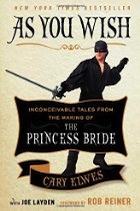
As You WishCary Elwes with Joe Layden, As You Wish: Inconceivable Tales from the Making of “The Princess Bride”

In this book, Cary Elwes shares his memories of making the beloved movie “The Princess Bride.” He talks about reading the book (by William Goldman) as a child, meeting director Rob Reiner for the first time, and being extremely nervous about his audition. He also reminisces fondly about his fellow cast members, particularly the late André the Giant, whom he describes as a true “gentle giant.” The book also spends a lot of time on the sword fight between Westley and Inigo, for which Elwes and Mandy Patinkin spent almost every free moment training. The filmmakers were determined to produce a duel that could hold its own with some of the greatest sword fights in movie history, and Elwes recalls the intensity of his training in detail. Along with Elwes’ own narrative, this book contains anecdotes from many other people involved with the film, including Rob Reiner (director), Robin Wright (Buttercup), Wallace Shawn (Vizzini), Chris Sarandon (Prince Humperdinck), and Billy Crystal (Miracle Max). Overall, the book presents a fond, nostalgic look at the making of this classic film.

“The Princess Bride” is one of my all-time favorite movies, so I was definitely the intended audience for this book! I must say, it’s clear that Cary Elwes is not a writer by nature…the prose is often a bit stilted, especially when he describes his inner thoughts and reactions to what’s going on. However, the book is very readable, and it provides a great window into Elwes’ experiences in making this movie. I like the fact that other actors’ stories are included, so that it’s not just one person’s point of view. I also learned a lot of interesting tidbits about the process: for example, Elwes badly injured his foot during shooting, so there are a few scenes in which (if you’re looking for it) you can see him limping or favoring his bad foot. Wallace Shawn, who played Vizzini, was terrified of being fired because he’d heard that Danny DeVito had originally been considered for the part. And Billy Crystal apparently improvised some of the funniest lines in the Miracle Max scene, including the bit about the mutton, lettuce, and tomato sandwich! Overall, I’d definitely recommend this book to fans of the movie — and then I HIGHLY suggest re-watching the film! 🙂

Jazz Age January Wrap-up

2015 jazz age januaryWow, this first month of 2015 has just flown by! And with the end of the month comes the end of Jazz Age January, a challenge hosted by Books Speak Volumes in which participants were asked to read at least one book about or set during the 1920s. I only managed to read one book for this challenge — The Girls at the Kingfisher Club by Genevieve Valentine — but I really enjoyed it! I also obtained a copy of F. Scott Fitzgerald’s Flappers and Philosophers, which I unfortunately didn’t get around to reading. But maybe now I’ll save it for next year’s challenge! 🙂 Did you participate in Jazz Age January? If so, what did you read?

Review and GIVEAWAY: The Gracekeepers

Gracekeepers, TheKirsty Logan, The Gracekeepers

This novel is set in a post-apocalyptic universe where almost the entire world is covered in ocean; the land has been reduced to a few small, isolated groups of islands. In this world, people are divided into “landlockers” and “damplings,” with the landlockers generally being richer and more powerful — though no one is truly rich anymore. But Callanish Sand has a unique status: though she lives on her own tiny island, she is a gracekeeper, one who performs the necessary burial rituals for damplings who have died. Her life is a solitary one, a self-imposed punishment for a mistake she made long ago — until she meets North, a dampling circus performer whose act involves dancing with a semi-trained bear. Both Callanish and North are lonely individuals trying to escape their unwanted destinies; but only when their lives collide do they dare to imagine a different life.

I have to say, I have mixed feelings about this book, and I think it’s because I was expecting a different kind of story. The back cover doesn’t reveal North’s gender, so I was assuming that the character was male and that there would be a romance with Callanish. But in fact, North is a woman, and her relationship with Callanish is somewhat ambiguous (possibly romantic, but not necessarily). I also assumed that the characters would interact far more than they actually do in the book. While there is some overlap, most of their stories take place in their own separate worlds. Personally, I found North’s story much more interesting, and I was fascinated by the description of the floating circus and its various performers. Callanish’s story is more subdued, and the stakes seem lower. Also, something about the writing style kept me a distance, so I didn’t feel very invested in the plot or characters. Overall, I think this book would appeal to people who love settings and strong world-building, but it didn’t do anything special for me.

**********

Win This Book!

If you’d like to win an ARC of this book, simply comment on this post by midnight on February 6, 2015 (EST). The giveaway is open to US residents only (sorry, international folks!). A winner will be chosen randomly, and results will be announced sometime on February 7. I’ll also try to contact the winner personally, but that only works if I can find contact info for you somewhere. 🙂 Good luck!

Review: First Frost

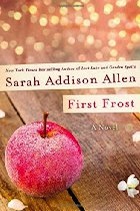
First FrostSarah Addison Allen, First Frost

***Warning: Spoilers for Garden Spells.***

It’s been ten years since the events of Garden Spells, and the Waverley clan has changed in unexpected ways. Claire has given up her catering business to run a much more profitable and far-reaching candy company. But while the candy company keeps her busy and brings in good money, Claire finds herself anxious and uneasy most of the time. Meanwhile, Sydney is married to Henry and desperately wants to give him a son, but so far she’s been unable to conceive a child. Meanwhile, her daughter Bay is now a teenager balancing her desire to fit in with her unique Waverley gifts. She has also fallen in love with local golden boy Josh Matteson, whose parents have big plans for him — plans that certainly don’t include Bay. As the Waverley women prepare for their annual celebration of the first frost, all these tensions continue to rise; and the arrival of a traveling magician with a sinister secret may break apart their family forever.

I love all of Sarah Addison Allen’s books, so it’s no surprise that I really enjoyed this one! Part of me wishes she hadn’t written a sequel to Garden Spells, which I think stands very well on its own. But on the other hand, it was nice to follow up with the Waverleys and see what happened after the happily-ever-after. One thing I really liked was that SAA doesn’t rehash the conflicts from the first book. Garden Spells mainly dealt with the development of Claire and Sydney’s relationship from near-strangers to close sisters, and in this book, that relationship remains solid. At the same time, the past definitely informs the present — for example, Bay’s relationship with Josh is certainly affected by Sydney’s prior relationship with Josh’s father. So in my opinion, this book is a really good sequel: it has certain themes in common with its predecessor, but it doesn’t tell the same story. I wasn’t a big fan of the traveling magician, who didn’t really add very much to the novel. But overall, I liked this book and would definitely recommend it to fans of Garden Spells!