Mini-Reviews: Messenger, Crazy, Gothic

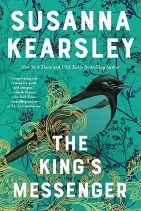
Susanna Kearsley, The King’s Messenger

It’s 1613, and King James I sits on the throne of England. His son, Prince Henry, has recently died, and rumors suggest that he was poisoned. To investigate (or possibly to set up a scapegoat), the king sends one of his messengers, Andrew Logan, to arrest the prince’s mentor and close companion, Sir David Moray. Traveling with Andrew are a scrivener and his daughter, Phoebe Westaway, who will record any statements made by Sir David. Andrew and Phoebe have a contentious history, but their proximity on this journey leads to very different feelings. Meanwhile, their perspective on Sir David also begins to change. Susanna Kearsley is a top-notch writer of historical fiction, and while I don’t know much about this time period, her depiction feels believable and authentic. I found the present-day adventure and romance more interesting than Sir David’s history with the prince, which is interspersed in the narrative via flashbacks. But overall, I really liked this one, though A Desperate Fortune remains my favorite Kearsley novel.

Annie Darling, Crazy in Love at the Lonely Hearts Bookshop

Nina, who works with her two BFFs at a bookstore specializing in romantic fiction, prides herself on being unconventional, from her vintage-pinup-girl style to her sleeves of tattoos. Her romantic ideal is Heathcliff from Wuthering Heights. Noah, a consultant who’s evaluating the bookstore’s finances, couldn’t be farther from Nina’s usual type—yet she feels a surprising attraction to him. But as they get to know each other, they discover an unpleasant shared history that may drive them apart. I remember enjoying the previous book in this series, True Love at the Lonely Hearts Bookshop, but this one didn’t do much for me. I think it’s because I can’t really relate to Nina at all (again, her romantic ideal is Heathcliff). The book also feels pretty dated in its approach to friendships and relationships, despite being published in 2018—it seems a bit like a Bridget Jones’s Diary copycat. Overall, not a horrible book, but not one I’d recommend either.

Silvia Moreno-Garcia, Mexican Gothic

It’s 1950, and Noemí Taboada is a glamorous socialite in Mexico City. But when she receives a disturbing letter from her cousin Catalina, who has recently married and moved to her husband’s remote mountaintop estate, she decides to visit and find out what’s going on. Noemí is repulsed by the decaying estate and its hostile inhabitants. She’s also alarmed by Catalina’s seeming insanity, and becomes even more so when she too starts having strange dreams. She eventually uncovers a complex and horrific history that’s holding her cousin captive—and is now attempting to ensnare her as well. I’ve enjoyed every Moreno-Garcia book I’ve read so far, and this is no exception, though it’s way closer to horror than I normally go! It’s definitely not for the faint of heart—there’s violence (including sexual violence), body horror, and all manner of creepy goings-on. But I really liked this take on the gothic genre and how it explores power dynamics, particularly conquerors vs. conquered and men vs. women. I also loved Noemí as a heroine; she’s got quite a bit more intelligence and spunk than some of her predecessors in this genre. It’s not quite my kind of book, but if this premise interests you, I’d highly recommend it!

Mini-Reviews: Rules, Witch, Bride

Sinéad Murphy, The Jane Austen Rules: A Classic Guide to Modern Love

This short book positions itself as a dating guide based on the timeless wisdom of Jane Austen. As a diehard Austen fan, I loved the premise, but I have mixed feelings on the execution. I do think the advice, both about dating and how to be a woman in the modern world, is largely good. The Austen analysis is also interesting; it’s not super deep literary criticism, but some of Murphy’s interpretations are ideas I hadn’t considered before. However, I wasn’t a fan of the writing style, which is trying—and mostly failing—to imitate Austen. Plus, Murphy misquotes the first sentence of Pride and Prejudice, which is frankly inexcusable! So, while I didn’t hate the book, I wouldn’t recommend it either, even for Austen fanatics.

Elizabeth George Speare, The Witch of Blackbird Pond

In 1687, orphan Kit Tyler experiences severe culture shock when she leaves her life of luxury on a Barbados plantation and moves in with her aunt’s family in Connecticut Colony. At first Kit hates her new life: Her uncle is strict, she’s forced to help with the unending household chores, and the broader Puritan community is suspicious and unwelcoming. Gradually she comes to appreciate her new situation, particularly after she befriends an old woman widely reputed to be a witch. But when the town’s hostility toward the “witch” turns ugly, Kit’s own safety is threatened. This was my favorite book for a while growing up, and upon rereading, I was surprised by just how many scenes I remembered. I found it a very enjoyable read that paints a vivid picture of colonial New England, both good and bad. I also loved Kit’s character development, as well as the multiple satisfying love stories. I’m glad I decided to revisit this one!

Cornell Woolrich, The Bride Wore Black

This thriller features a mysterious woman who is systematically murdering men throughout New York City. Her motive is unclear, as she doesn’t seem to know any of the men personally. Beautiful and clever, she’s easily able to gain access to her victims, and she always vanishes directly after the murder without a trace. Eventually, a policeman notices a pattern among the killings and makes it his mission to bring this femme fatale to justice. This is a fascinating, suspenseful novel with a clever structure, following the woman and each of her male victims in turn. As a result, I felt some measure of empathy for every character and was eager to discover the woman’s motive. The ending is both satisfying and heartbreaking—everything is resolved, but none of the characters get what they want. I’d definitely recommend this one to fans of suspense and noir, and I’m interested in reading more by Woolrich.

Review: Silence

SilenceShusaku Endo, Silence (trans. William Johnston)

This novel is set in 17th-century Japan, at a time when Christianity has been outlawed, and Christians are imprisoned and tortured so that they will renounce their faith. Nevertheless, various missionary groups from Europe, both Catholic and Protestant, continue to arrive in Japan in hopes of spreading the Christian religion there. One such missionary is Sebastian Rodrigues, a Portuguese priest who believes that God is calling him to minister to His church in Japan. Rodrigues also hopes to find his former teacher and mentor, Father Ferreira, who is rumored to have renounced Christianity and adopted a traditional Japanese lifestyle. When Rodrigues arrives in Japan, his enthusiasm for his mission slowly declines as he sees Christian peasants being tortured and executed for their faith. For the first time, he experiences serious doubts in the face of God’s silence: if He exists, why does He allow his faithful disciples to suffer? As Rodrigues struggles with this question, he must eventually decide whether his faith is truly worth defending at any cost.

This book is laser-focused on a single issue: God’s silence in the face of suffering, and the implications of that for a person of faith. If this is an issue that interests you at all, I would definitely recommend this book! The writing style is sparse and direct, enhancing the nature of the stark choice that confronts Sebastian Rodrigues. The character’s struggle really rang true for me, and there are certainly no easy answers in this book. For me the most compelling character was Kichijiro, the Japanese guide who shelters Father Rodrigues and his companions but later betrays them. He is a weak, pathetic, utterly despicable character, yet Rodrigues comments that “Christ did not die for the good and beautiful. It is easy enough to die for the good and beautiful; the hard thing is to die for the miserable and corrupt….” In sum, this book isn’t a particularly fun or quick read, but I think it’s an important one for anyone interested in questions of faith or in the clash between Western religion and Eastern culture.

Review: The Three Musketeers

The Three MusketeersAlexandre Dumas, The Three Musketeers (trans. Richard Pevear)

This classic novel, whose title is somewhat misleading, follows a young solider named D’Artagnan who travels from his native Gascony to Paris in order to join the musketeers, an elite military force that serves the king. D’Artagnan naively believes that he will swiftly realize his dream and make his fortune, but his simple goal soon becomes much more complicated. Through a series of accidents he befriends the three most prestigious musketeers, Athos, Porthos, and Aramis. He also becomes involved in the struggle between King Louis XIII and Cardinal Richelieu, the two most powerful men in France. As a would-be musketeer, D’Artagnan is the king’s man, but his loyalty wavers when he meets the beautiful Milady, one of the cardinal’s most influential spies. With the help of his three friends, D’Artagnan must foil Milady’s sinister plot while fighting his own attraction for her.

I actually read this book when I was 12 or so, but I’m very glad I read it again now that I have at least some knowledge of the historical context! I find it very interesting that Dumas, who was writing in the 19th century (shortly after the Napoleonic era), chose to set this story during the 17th-century wars of religion, a similarly tumultuous time for France. But even without the bigger picture, this book is quite simply a rollicking good read! It’s a long book, but the story is gripping and seems to fly by. The strength of the book is definitely its plot; by contrast, the characters aren’t developed very well. It’s fun to watch D’Artagnan and the musketeers interact with each other, but they’re essentially stock characters (Athos is the noble one, Porthos is the buffoon, etc.). And Milady is an extremely flat villain who is Pure Evil ™ through and through. In my opinion, the scheming cardinal is by far the most interesting character! Regardless, I really enjoyed this book and would love to read the rest of the series…one of these years!