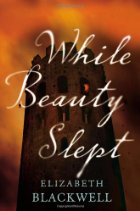
Review: While Beauty Slept

While Beauty SleptElizabeth Blackwell, While Beauty Slept

This loose retelling of Sleeping Beauty follows the fortunes of Elise, a peasant who dreams of a better life. Growing up, she listened to her mother’s stories about working at the king’s palace and fantasized about going there herself one day. When a tragic outbreak of the pox kills most of her family, Elise decides she has nothing to lose and sets out to follow her dream. But working at the palace turns out to be more complicated than Elise anticipated. She sees that the king and queen, though apparently blessed with both love and riches, are devastated by their childless state — especially because the king’s brother has a jealous eye on the throne. She also observes the complicated relationship between the queen and Millicent, a relative of the king’s who lives in the palace and has a reputation for witchcraft. When an heir to the throne is born at last, Elise is caught up in the turmoil that ensues; eventually, she is the only person who can ensure the future of the kingdom.

I’m a big fan of fairy tale retellings, so I was excited to find a copy of this book at the library. Overall, I really enjoyed it, but I would caution fantasy lovers that it’s much more of a historical novel than a fairy tale. There’s hardly anything supernatural in the book; although Millicent plays the part of the evil fairy in the Sleeping Beauty tale (and even curses the newborn princess), her ultimate strike against the royal family has nothing to do with magic or sorcery. But I love historical fiction, so I very much enjoyed this magic-less tale. And many elements of the Sleeping Beauty story were still incorporated into this book; I especially liked the burning of the spinning wheels. Elise got on my nerves sometimes — she’s a bit too judgmental and superior for my liking — but ultimately I was interested in the story she told. The ending, in particular, packs a real punch! So all in all, I’d recommend this book to fans of historical fiction or fairy tale retellings.

Review: The Raven in the Foregate

Raven in the Foregate, TheEllis Peters, The Raven in the Foregate

In December of A.D. 1141, the Benedictine Abbey of Sts. Peter and Paul in Shrewsbury welcomes a new parish priest to Holy Cross Church in the Abbey Foregate. The former priest was a kindly old man much beloved by his parishioners, so everyone is nervous about what to expect from the newcomer. Father Ainoth soon confirms the monks’ worst fears: although he is a scholar and a scrupulously holy man, he is extremely harsh with his congregation and soon stirs up bad feeling in Shrewsbury. When his drowned corpse is found in the river near the mill, it’s up to Brother Cadfael, herbalist and amateur detective, to solve the mystery. Cadfael also acquires a new assistant, supposedly the nephew of Father Ainoth’s houskeeper, but it soon becomes obvious that the boy is more than he seems. Meanwhile, both the abbey and the town continue to be affected by the ongoing civil war between King Stephen and Empress Maud.

This book is the 12th installment of the Cadfael series, and anyone who likes the series will enjoy this book as well. Once again Cadfael finds himself in the position of having to solve a murder, aid a pair of young lovers, uncover a political secret, and hide that secret from the local authorities in the interest of a higher justice. As a longtime fan of the series, I can’t help but love every Cadfael book, but I must admit that the prose does occasionally veer toward the purple end of the spectrum. Also, because Peters sticks to almost the same formula in every book, I found the plot pretty predictable. I was a bit disappointed that the murder and the political intrigue weren’t more closely connected; I thought more could have been done with certain aspects of the story to make the plot more exciting. Still, I love the series and definitely plan to read the remaining eight books. They’re wonderfully relaxing reads if you enjoy a medieval setting!

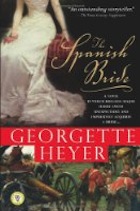
Review: The Spanish Bride

Spanish Bride, TheGeorgette Heyer, The Spanish Bride

Brigade-Major Harry Smith is a Rifleman in Wellington’s army, fighting Napoleon’s forces in Spain and Portugal. He participates in the Siege of Badajos, a long and drawn-out battle that results in plunder, rape, and violence when the allied British and Portuguese soldiers finally conquer the town. As Harry tries to maintain order and discipline, he is approached by two Spanish women who are seeking protection from the carnage within the city. As soon as he lays eyes on the younger of the women, Juana, he falls instantly in love with her, and she with him. Against the advice of Harry’s comrades, they marry immediately, and Juana accompanies her husband throughout the rest of the Peninsular campaign. As she “follows the drum” and experiences life as a soldier, she demonstrates the courage and fiery temperament that make her a perfect match for Harry. Together, the Smiths witness history as they eventually see Napoleon’s final defeat at Waterloo.

I am a huge fan of Georgette Heyer’s Regency romances, but I found that I had to approach this book with entirely different expectations. Although the novel features two young, passionate lovers, it is much more about military history than it is about romance. Harry and Juana Smith were actual historical figures, and Heyer got most of her information from Harry’s journals, as well as from other comtemporary accounts including Wellington’s own dispatches. As a result, there is a lot of great historical detail in the book, but not a lot of plot or character development. While Harry and Juana are very vivid characters, their journey is not the focus of the book. I think the trick to enjoying The Spanish Bride is viewing it as a work of military history with a few romantic touches. If you approach it that way, you’ll find it very readable and entertaining. But if you go into it expecting a tale of romance and suspense with the Napoleonic Wars as a backdrop, you’ll find it extremely dull! So overall, I’d recommend this book if you’re interested in the time period, but you have to adjust your expectations.

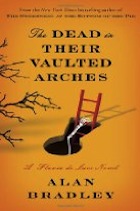
Review: The Dead in Their Vaulted Arches

Dead in Their Vaulted Arches, TheAlan Bradley, The Dead in Their Vaulted Arches

***Warning: MAJOR SPOILERS for previous books in this series!***

At the end of Speaking from Among the Bones, Flavia and her family received the shocking news that her mother, who disappeared many years ago somewhere in Tibet, had been found. This book begins with the de Luce family waiting at the train station for Harriet’s body to come home. Though Flavia is shocked and grieving, she can’t help wondering why Winston Churchill himself has come to pay his respects. Then there’s the man on the platform who whispers a mysterious message into Flavia’s ear and falls to his death on the tracks minutes later. Or was he pushed? As Flavia tries to sort out her feelings about her mother’s death, she can’t help but dig into the secrets of her family’s past — which, of course, turn out to be much bigger and more important than she ever imagined. Not only does she eventually solve the case of the man who died at the train station, but she discovers shocking information about Harriet’s death — and about her own future destiny.

I’ve enjoyed the Flavia de Luce series from the start, but this book is definitely my new favorite. The mystery plot is only so-so; the backstory of Flavia’s mother is rather predictable, and the villain of the book doesn’t have a terribly coherent motivation for some of the events that take place. Still, there is definitely more to be learned about the de Luce family’s past, and I’m sure additional solutions will be revealed in future books! I also think some of the secondary characters got short shrift in this installment; I wanted more of the vicar, the inspector, Adam Sowerby, and the other denizens of Bishop’s Lacey. But despite these nitpicks, I think this book got the most important thing exactly right: the reactions of Flavia and her father and sisters to Harriet’s death. This novel is a story of bereavement and grief much more than a mystery story, and in that light I think it’s fantastic. If you’re a fan of this series, you definitely won’t want to miss this installment! I can’t wait to see what’s next for Flavia and the rest of the de Luces.

Review: Late Nights on Air

Late Nights on AirElizabeth Hay, Late Nights on Air

This novel centers around a small group of people working at a radio station in Yellowknife, Northwest Territories, Canada. Harry is a once-promising radio man who has returned to Yellowknife after a disastrous attempt at television. Eleanor, the station’s receptionist, has no life of her own but is keenly observant of the lives of others. Gwen has recently moved to town and is hoping to learn radio production at the station. And newcomer Dido is a natural on-air talent who catalyzes various shifts in the station’s social atmosphere. All these characters have been drawn to Yellowknife for different reasons, but they are united in their fascination and love for the austere beauty of northern Canada. As they develop new friendships, romances, and animosities, they also discuss the history, mythology, and current concerns of the Canadian frontier — especially as a proposed transnational pipeline threatens its very identity.

I picked up this book for its setting, and I think it does a wonderful job of immersing readers in the unique world of the Canadian North. There are lovingly detailed descriptions of weather, scenery, and wildlife; digressive anecdotes about Canadian history, especially the many European explorers who attempted to survive the brutal winters; discussions about the relationship between white settlers and native peoples; and nostalgia for a fading way of life. Hay cleverly uses the debates and hearings surrounding the Mackenzie Valley Pipeline as a framework for her story; the possible destruction of the northern ecosystem parallels the slow destruction of radio as the primary medium for storytelling due to the arrival of television. The novel is somber and contemplative in tone, and the focus is on character and setting much more than on plot. But for anyone interested in books with a unique and vividly described setting, I would definitely recommend this!

Review: Just Like Heaven

Just Like HeavenJulia Quinn, Just Like Heaven

Lady Honoria Smythe-Smith is desperate to be married. Though she is part of a large, affectionate family, things have been very quiet in her parents’ house ever since her brother Daniel fled England after seriously wounding a man in a duel. Honoria longs to start her own family and once again feel surrounded by love; and as an added bonus, once she is married, she’ll no longer have to perform at the Smythe-Smiths’ infamous musicales. Meanwhile, Marcus Holroyd, the Earl of Chatteris, is Daniel’s best friend and has always felt more at home with the Smythe-Smiths than with his own distant family. Marcus and Honoria have always been friendly, but when a sprained ankle and a dangerous illness throw them together, they both begin to suspect that their relationship is deepening into something more.

I basically picked up this book for two reasons: 1) It shares a title with a really great Cure song, and 2) I’m a sucker for ridiculous British surnames. Fortunately, I ended up enjoying it quite a bit! Marcus is a delightful hero; he comes across as proud and brooding, but only because he feels shy and socially awkward (shades of Mr. Darcy!). And Honoria is a sweet girl with just enough humor to keep her from being insipid. Somewhat unusually for a Regency romance, most of this book doesn’t take place during the London Season; rather, Honoria spends a good portion of it nursing Marcus back to health from a life-threatening fever. Some might find the sickroom scenes tedious, but to me they underscored why Marcus and Honoria make such a great pair. All in all, I’d definitely recommend this light, quick read to fans of Regency romances, and I’ll probably pick up something else by Julia Quinn in the future.

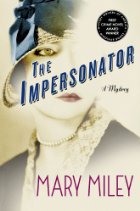
Review: The Impersonator

Impersonator, TheMary Miley, The Impersonator

Leah Randall is a talented but impoverished actress who has worked on the vaudeville circuit her whole life. During the course of one performance, she notices a strange man watching her intently. Eventually this man, Oliver Beckett, approaches her with an astonishing proposal. He tells Leah the story of his niece, Jessie Carr, heiress to a substantial fortune, who vanished from her home several years ago without a trace. Leah bears a striking resemblance to Jessie, so Oliver proposes a scheme: Leah will pose as Jessie and return “home” to claim her inheritance, which she will then split with Oliver. At first Leah wants nothing to do with it, but when she is fired from her vaudeville act and can’t get other work, she eventually reconsiders. With Oliver’s help, she assumes Jessie Carr’s identity and travels to the Carrs’ home in Oregon. But the more time she spends with the Carrs, the more she becomes determined to discover what really happened to Jessie all those years ago.

If you read that plot summary and thought, “That sounds an awful lot like Brat Farrar by Josephine Tey,” well, you’d be right. The premise is exactly the same — Miley even acknowledges that Tey’s novel was the main inspiration for her own — but I enjoyed Miley’s novel in its own right. I especially liked the period details about vaudeville, speakeasies, and other highlights of life in the 1920s. There were even references to some Supreme Court cases of the era, which I appreciated as a law school survivor. I also liked Leah’s narrative voice: she’s plain-spoken, independent, and very aware of both her talents and her flaws. The thing is, though, Brat Farrar is still by far the superior book. Miley’s novel is a bit disorganized at times, including several subplots that are more distracting than intriguing. I also hated the romantic aspect of this book; it was unbelievable and underdeveloped. I did enjoy the book overall and found it very readable, but if the premise sounds interesting to you, you should really just read the original instead!