Review: A Blunt Instrument

Blunt Instrument, AGeorgette Heyer, A Blunt Instrument

When wealthy Englishman Ernest Fletcher is found in his study with his head bashed in, his relatives and neighbors are shocked. Ernest was well-liked and seemingly had no enemies, so why would anyone want to kill him? But as Superintendent Hannasyde and Sergeant Hemingway investigate the case, they soon uncover several motives. First there’s Neville Fletcher, the dead man’s nephew and heir to his fairly large fortune. Then there is Helen North, who has a secret involving Ernest that she doesn’t want anybody — especially her husband — to know about. Or the culprit could be Abraham Budd, a businessman who was complicit in some of Ernest’s shady financial dealings. But as the police collect motives and unearth secrets, they become more and more puzzled by the conflciting testimony about what actually happened on the night of the murder. And when a second victim appears, Hannasyde and Hemingway know they will have to act fast to catch a partiuclarly elusive killer.

In general I prefer Heyer’s romances to her mysteries, but I really enjoyed this book! There are some wonderful characters in this one: the vague, mischievous Neville, who is much sharper than he appears; the blunt, monocle-wearing Sally Drew, who writes detective novels; Constable Glass, the Bible-quoting policeman; and the impatient, down-to-earth Sergeant Hemingway. The dialogue is witty and sparkling, as usual, and I loved the romance(s) that emerged throughout the course of the book. The mystery itself is also a bit more substantial than in some of Heyer’s other books, and I was surprised by the Christie-esque twist that revealed the murderer’s identity. Overall, if you’re interested in trying Heyer’s mysteries, I think this is a really good place to start! (Hannasyde and Hemingway are recurring characters in her mysteries, but the books absolutely do not have to be read in order.) I’m reading these mysteries in chronological order, so I’ll be interested to see whether they get even better as they go on!

Review: In the Woods

In the WoodsTana French, In the Woods

Detective Rob Ryan and his partner, Cassie Maddox, are two up-and-coming detectives on the Dublin Murder Squad. But Ryan is hiding a secret about his past: his real name is Adam Ryan, and when he was 12 years old, his two best friends vanished in the woods of Knocknaree without a trace. Ryan was even with them at the time, but he has no memory of what happened to them — or why they disappeared while he was found. Ryan has apparently done a good job of recovering from this trauma and moving on with his life, but he is deeply shaken when he and Cassie are assigned to another case in Knocknaree, where a young girl has been murdered. As Ryan returns to his hometown and is confronted with memories he didn’t even know he had, he wonders whether the girl’s murder is connected to his own past. Ultimately, Ryan knows that this case will have deep personal importance for him — but will it make his career or destroy it?

I’m having a hard time collecting my thoughts on this book. At first I thought I wasn’t going to like it at all — in fact, I almost gave up after the flowery prologue — but eventually I got completely sucked in. The strongest aspect of the book, for me, was the relationship between Ryan and Cassie. Ryan isn’t a particularly likable character, but the bond between him and Cassie is so strong that you can’t help feeling he must be a pretty good guy after all. The way this relationship evolves and changes throughout the book kept me riveted. The novel’s narrative structure also creates a lot of suspense: Ryan is the narrator, and he says right from the start that he tells lies. So I was constantly wondering whether he was lying about certain things, and I became really invested in both mysteries as a result. That said, the book’s ending drove me a little crazy: some things made me sad, others frustrated me, and others I actually liked a lot. So I’m still undecided about this book; but I am glad I read it, and I will certainly be reading The Likeness at some point as well!

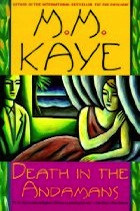
Review: Death in the Andamans

Death in the AndamansM.M. Kaye, Death in the Andamans

Caroline Ophelia Phoebe Elizabeth Randal, known to her friends as Copper, is staying with school chum Valerie on the tiny island of Ross in the Andaman Islands. The vast majority of the population is Burmese, but there is a small British community on the island as well, and Copper and Val naturally form part of this society. At first Copper views the island as a paradise, especially when compared to her rather dreary life in London; and the most upsetting aspect of her visit so far is her feelings for Nick Tarrent, a visiting naval officer who is friends with Valerie’s fiancé. But everything changes one fateful day when a terrible storm leads to widespread destruction on the island, and one of the British plantation owners is found dead. His death is assumed to be accidental until another visiting officer, who happens to be a doctor, suspects foul play. Then the doctor himself is murdered, and it slowly dawns on Copper and the others that the murderer has to be one of them — the storm has cut off all access from the outside world. Can Copper and her friends unmask the murderer before he or she kills again?

I’ve finally read the last of M.M. Kaye’s “Death in…” books, and I’m sorry to have reached the end of them. They all essentially follow the same formula — young woman visits exotic location, falls in love, and becomes involved with a murder — but it’s a formula that appeals to me, so I don’t mind! This book did a wonderful job describing the setting, which is unsurprising, since Kaye actually lived in the Andamans for a while and even experienced a storm like the one in the book! The fact that Copper and her friends were completely cut off from the outside world produced the proper atmosphere of creepy suspense; I was reminded at times of Agatha Christie’s And Then There Were None. I didn’t particularly like the fact that there was a lot of head-hopping in the book, from Copper to Val to Nick to various other characters. I also thought the solution of the mystery came out of nowhere. While the plot does hang together, I wasn’t terribly satisfied by the revelation of the murderer, as many other suspects could just as easily have committed the murders for the same reason. Overall, though, I enjoyed this book and am sad that I don’t have any more M.M. Kaye mysteries to look forward to!

Review: Double Cross

Double CrossBen Macintyre, Double Cross: The True Story of the D-Day Spies

Seventy years ago, the Allies stormed the beaches of Normandy and began the campaign to liberate Nazi-occupied Europe. Many circumstances contributed to the success of the D-Day invasion, but one of the most important factors was the campaign of disinformation being fed to the Germans by a network of double agents whose sole purpose was to convince the Abwehr that the Allies would be landing at Calais rather than Normandy. Had these agents failed, the Germans would have concentrated their forces at Normandy, most likely stopping the Allied invasion in its tracks. This book tells the stories of the individual double agents involved in this task, including Serbian playboy Dusko Popov (“Tricycle”), Peruvian socialite Elvira Chaudoir (“Bronx”), and Polish nationalist Roman Czerniawski (“Valentine”). Ultimately, Macintyre makes a convincing case for the proposition that the Allies would never have won the war on the battlefields had they not already won the intelligence war.

This book gives a wealth of fascinating detail about the six men and women who acted as double agents in Britain, allegedly spying for Germany but really working for the Allies. I was shocked to learn that British intelligence had actually discovered and turned every German agent in Britain at the time! Because of this, the Allies were able to present a unified message to the Germans, subtlely directing their attention away from Normandy and toward other possible invasion sites. Some of the specific stories in the book prove once again that truth is stranger than fiction: for example, Dusko Popov thrived on creating networks of sub-agents that were entirely fictional, yet he retained the Abwehr’s complete trust. I also loved the fact that these double agents were handled in Britain by the Twenty Committee, so named because the Roman numeral for 20 is XX, or “double cross.” In short, if you’re interested in true stories of WWII-era espionage, Ben Macintyre is your man!

Review: Mrs. Ames

Mrs. AmesE.F. Benson, Mrs. Ames

This novel is a precisely drawn satire of life in an English village in the early 20th century. Mrs. Ames has been the leader of society in Riseborough for many years, due partly to her commanding presence and partly to her distant familial connection with a nobleman. The other residents of Riseborough both admire and resent her for her position, and many of the local gossips would be glad to see her fail in some way. So when a (relatively speaking) new arrival, Mrs. Evans, begins to set herself up as Mrs. Ames’ social rival, the entire town waits with bated breath to see whether their queen will be dethroned. Meanwhile, both Mrs. Ames and Mrs. Evans dimly begin to realize that their lives are unfulfilling, but their search for deeper meaning takes them down drastically different paths, one of which may lead to scandal and heartbreak.

I expected this book to be nothing more than a light, witty comedy of manners — which it is, but it also took a more serious turn than I anticipated. The various social machinations of the ladies of Riseborough are very funny; there’s a particularly wonderful scene in which Mrs. Evans hosts a masquerade ball and several ladies (tragically, yet hilariously) show up wearing the same costume. But for me, the more compelling story was Mrs. Ames’ slow realization that her dreary, respectable life isn’t making her happy. It’s only when she begins to identify with a cause greater than herself that she actually finds contentment — even at the moment when all her respectability and social standing is taken away. So oddly enough, this comedy of manners turns into a coming-of-age story, and I found it a surprisingly thought-provoking read.

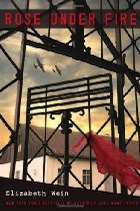
Review: Rose Under Fire

Rose Under FireElizabeth Wein, Rose Under Fire

Rose Justice is an American pilot who has just come to England to help with the war effort. Though women aren’t allowed to fly planes in combat, she is able to get a job with the Women’s Air Transport Auxiliary ferrying planes back and forth within Allied territory. At first Rose sees her work as a grand adventure, a fascinating change from her sheltered upbringing. But her life is instantly, horribly changed when she is captured by the Germans in the middle of a routine flight from France to England. She is immediately arrested and transported to the women’s concentration camp at Ravensbrück. There Rose confronts the hideous realities of this war for the first time, including the brutal scientific experiments performed on a group of young women known as “rabbits.” But depsite the horrific treatment Rose endures, she forges close bonds with a small group of fellow prisoners and somehow manages to hold onto hope.

This companion novel to Code Name Verity is equally powerful and moving, although it struck me in a very different way. I loved CNV for its suspense, its elements of espionage, and its intense portrayal of friendship. This book is not as suspenseful; we know from the start of Rose’s narrative about Ravensbrück that she is remembering her experiences after she has escaped. It’s also not as personal (if that’s the word I want) because while Rose forms incredibly close bonds with her fellow prisoners, the emphasis is less on individual relationships and more on the experience of Ravensbrück as a whole. Neverthless, this book did strike me on a very deep personal level. It’s easy to become a little desensitized to the atrocities committed by the Nazis, simply because we’ve heard about them so many times, but this book certainly made them vivid for me. The most horrifying thing is that similar atrocities are still occurring in parts of the world today. So this is not an easy read, but I think it’s a very important one.

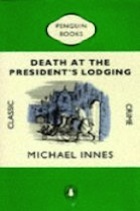
Review: Death at the President’s Lodging

Death at the President's LodgingMichael Innes, Death at the President’s Lodging

This first installment of the Inspector Appleby series is a classic locked-room mystery set in the fictional St. Anthony’s college, where its president, Dr. Umpleby, has just been murdered. Because of the prominence of the victim, Inspector Appleby is summoned from Scotland Yard to assist the local police. He soon learns that the layout of the college would have made it impossible for someone without a key to access the scene of the crime. Therefore, suspicion centers around the other fellows of the college, most of whom either had a key or could easily obtain one. As Appleby begins his investigation, he notices strong tensions among these men and uncovers various professional rivalries. He also begins to realize that the case is cluttered with many side issues and diversions. But as he sifts the relevant facts from the distractions, Appleby eventually reaches a conclusion as bizarre as it is shocking.

I’ve now read two mysteries by Michael Innes, and what I’ve learned is that I love his solutions, but I’m not terribly fond of how he gets there! In most mysteries that I read, there’s not a lot of irrelevant information; every fact the detective discovers is a clue. In this book, on the other hand, much of what Appleby discovers isn’t relevant to the solution of the murder. This is certainly more realistic than, say, a Poirot mystery, but it made the reading experience more difficult for me. I also didn’t like the relative lack of character delineation. It’s been less than a month since I read this book, and already I couldn’t tell you the main suspects’ names! Nobody (including Appleby) has much personality, so the murder is more like a logic puzzle than a dramatic event involving actual human beings. All that said, I really did love the solution to this one, which got downright farcical in places! So overall, I’m glad I read this book, but I doubt I’ll get sucked into the rest of the series — which is probably a good thing!

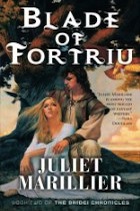
Review: Blade of Fortriu

Blade of FortriuJuliet Marillier, Blade of Fortriu

In this sequel to The Dark Mirror, King Bridei of the Priteni believes his mission is to eradicate the Gaels and their Christian religion from his lands. He is a strong king, brave in battle and devout in his allegiance to the old gods, so he’s the ideal person to unite the Priteni against this outside threat. Bridei is planning a big move against the Gaels, but in order to succeed, he needs the help of a foreign chieftain named Alpin. Bridei therefore proposes to offer his royal hostage, Ana, to Alpin as a bride, hoping this will ensure his loyalty. Ana longs to marry for love, but she knows she has no choice in the matter. She sets out for Alpin’s lands in the company of Faolan, Bridei’s most trusted bodyguard, spy, and assassin. As Ana and Faolan travel together, their relationship deepens, but she is already promised to Alpin. And when she finally arrives at Alpin’s court, Ana discovers a shocking secret that will have drastic implications for both Bridei’s campaign and her own heart.

Much like its predecessor, The Dark Mirror, this book is very slow-paced, and I had trouble getting into it as a result. I find the world of this series fascinating; it’s based on historical facts (the Priteni were real, and Bridei really was their king for a time), but Marillier weaves many fantastical elements into the setting. Half the novel focuses on Ana’s story, while the other half follows Bridei’s campaign against the Gaels. Personally, I was much more interested in Ana’s story, especially since I always enjoy a little romance with my fantasy! Interestingly, the story seems very predictable at first, but it eventually veers into an unexpected direction. I wasn’t entirely pleased with the resolution of Ana’s story, but it does provide some interesting avenues to explore in the final book of the trilogy. I’ll definitely be reading The Well of Shades to see how everything turns out, but I don’t think this series is Marillier’s best work. Try her Sevenwaters books instead!

Review: The Sunne in Splendour

Sunne in Splendour, TheSharon Kay Penman, The Sunne in Splendour

When most people think of Richard III, they picture a hunchbacked villain who was obsessed with being king and who murdered the princes in the Tower as a result. But in this novel, the last Plantagenet king is portrayed in a very different light: Richard (or Dickon, as most characters call him) is noble and loyal to a fault, and these good traits are ultimately what cause his downfall. The novel begins with Dickon’s childhood, when his father, the Duke of York, is killed in the war against the Lancastrian Henry VI. Dickon’s oldest brother Edward subsequently takes his father’s place in leading the Yorkist faction against Henry; eventually, he is crowned as Edward IV, and Dickon becomes one of his most trusted advisers and most skilled battle commanders. But as Edward obtains more and more power, Dickon becomes disillusioned with his brother’s morally questionable choices, and the struggle of brother against brother mirrors the broader conflict between York and Lancaster.

As always, in this book Sharon Kay Penman manages to bring the Middle Ages to life. I always enjoy her vivid descriptions of daily life during this period, as well as her depictions of medieval religion, warfare, and politics. This book in particular is a fascinating political study, showing that the cutthroat nature of modern politics is rooted in a long tradition. I also like the fact that this novel approaches Richard III from a countercultural perspective. While I don’t know enough about the subject to judge whether Penman’s interpretation is justified, it makes sense to me that Henry Tudor (who acceded to the throne after Richard’s death) would want to do everything in his power to discredit his predecessor. It’s always important to remember that history is written by the victors! All in all, I heartily recommend this book to anyone who is interested in Richard III, the War of the Roses, or the Middle Ages in general.

Review: Transformations

TransformationsAnne Sexton, Transformations

This book is a collection of poetry, and I don’t really know how to review it, or even whether “reviewing” is appropriate for something that is supposed to strike you in a fundamental, visceral way. The poems are all re-imaginings of fairy tales as told by the Brothers Grimm, and Sexton uses the old stories to shed light on modern themes and concerns. For example, here’s the end of “Cinderella”:

Cinderella and the prince
lived, they say, happily ever after,
like two dolls in a museum case
never bothered by diapers or dust,
never arguing over the timing of an egg,
never telling the same story twice,
never getting a middle-aged spread,
their darling smiles pasted on for eternity.
Regular Bobbsey Twins.
That story.

The stories are all set in that quasi-medieval fairytale past, which is interestingly juxtaposed with some very modern language. When the witch in “Hansel and Gretel” is cooked in the oven, “Her blood began to boil up / like Coca-Cola.” When the prince in “Cinderella” tries the glass slipper on every maiden in the kingdom, the narrator observes, “The prince was getting tired. / He began to feel like a shoe salesman.”

All in all, this collection didn’t make a huge impact on me, but I would recommend it to people who like poetry and fairy tales. I’d definitely like to read more of Anne Sexton’s work!