Review: The Grimm Legacy

Grimm Legacy, ThePolly Shulman, The Grimm Legacy

High-school student Elizabeth Rew is feeling lonely: her new stepmother is taking up most of her father’s time, and she’s just transferred to a new school where she doesn’t have any friends. So when her history teacher suggests that she get a job with the New York Circulating Material Repository, she looks forward to the new experience. The Repository is a lending library for objects, including famous historical artifacts like Marie Antoinette’s wig; but Elizabeth soon discovers that there are even more important objects to be found. Specifically, the Grimm Collection houses fairytale items with magical properties, including flying carpets and seven-league boots. As Elizabeth explores the wonders of the Grimm Collection, she also befriends her fellow employees, including popular Marc, beautiful Anjali, and standoffish Aaron. When some of the magical items go missing, it’s up to Elizabeth and her newfound friends to discover who is stealing from the Grimm Collection — before they become the thief’s next victims.

A few years ago I read Polly Shulman’s other book, Enthusiasm, and really enjoyed it. Unfortunately, this book didn’t work for me quite as well. I absolutely loved the premise — what if you could actually borrow the magic mirror from Snow White or Aladdin’s lamp? — and many of the details related to this concept worked very well. I especially liked the idea that borrowers had to leave a “deposit” for the items, which could be something like their sense of direction, their singing voice, or their firstborn child. The problem with the book is that it’s geared toward a very young audience. I don’t have a problem with YA in general, and I’ve read many excellent books in the genre, but this one really felt like YA or even juvenile fiction. If I’d read the book at age 11, I probably would have loved it, but as an adult, I found it far too simplistic. There were also a few plot points that weren’t fully fleshed out, such as Elizabeth’s relationships with her dad and stepmom. Overall, the book is a decent read, but I wouldn’t recommend it unless you’re really OK with juvenile or YA fiction.
Review: Miss Hargreaves

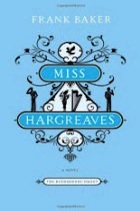
Miss HargreavesFrank Baker, Miss Hargreaves

When Norman Huntley and his friend Henry are on holiday in Ireland, they decide on a whim to visit the exceedingly ugly church of the village of Lusk. As their tour guide rhapsodizes about the church’s history, he mentions one of its former clerics. Intending to make a joke at the tour guide’s expense, Norman pretends to have heard of this cleric from a (fictional) common acquaintance, Miss Constance Hargreaves. He immediately — with assistance from Henry, who plays along — invents an entire personality and history for Miss Hargreaves, and after a while, the two young men almost believe she is real. But nothing can prepare Norman for the shock of discovering that a woman calling herself Miss Hargreaves is coming to visit him, and she is completely identical to the made-up description he and Henry had concocted! Miss Hargreaves soon embarrasses Norman with her eccentricities, and he begins to wish he could get rid of her — but how can he do so? And if he is really responsible for her existence, should he?

When I first picked up this book, I expected it to be a light, fluffy comedic tale, similar to most of the other early-20th-century British fiction I’ve read. I mean, the synopsis almost sounds like something out of P.G. Wodehouse! But while this book does have its comic moments — like everything that comes out of Norman’s father’s mouth! — it’s actually much more serious than it sounds. Norman’s reaction to learning that he has (presumably) created another human being runs the gamut from shock to amusement to horror. He’s often quite cruel to Miss Hargreaves when she doesn’t show him the love and respect he feels are his due. In this sense, I think Baker was making a point about the dangers of playing God: Norman created Miss Hargreaves and is therefore in some sense responsible for her, but he is too proud and impatient and flawed to fulfill his responsbilities. Overall, this is an odd little book that raises some fairly serious philosophical questions. Recommended if the premise sounds interesting to you!

Review: The Complaint of the Dove

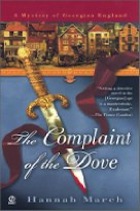
Complaint of the Dove, TheHannah March, The Complaint of the Dove

In 1760s England, private tutor Robert Fairfax is charged with escorting his pupil, Matthew Hemsley, to London for a bit of town polish. But Fairfax is apprehensive: how can he introduce Matthew to the worldly, sophisticated atmosphere of London while at the same time protecting him from bad influences? Unfortunately, during their very first trip to the theater, Matthew instantly falls in love with the beautiful and popular actress Lucy Dove. Though she is a sweet and talented girl, her profession is most unsuitable, so Fairfax hopes that Matthew’s infatuation is only temporary. But Matthew gets into even bigger trouble when Lucy is murdered shortly afterwards, and he is found at the crime scene under very suspicious circumstances. When Matthew is actually arrested for the murder, Fairfax knows it is his duty to clear his pupil’s name — which means launching an investigation to discover the real killer.

I discovered this series by accident at a library book sale where the second and third books were available for 25 cents each, so of course I had to track down the first book as well! I was intrigued by the concept of a Georgian mystery, since I haven’t seen many novels set in that era (especially compared to the much more popular 19th century!). Fortunately (or perhaps unfortunately, given the magnitude of my TBR list already), I’ve discovered a new mystery series to enjoy! I loved the period detail: the crush of theatergoers more interested in each other than in what’s happening onstage; the elaborate wigs, patches, and high heels worn by aristocratic men and women alike; the rudimentary knowledge of medicine, including the ingestion of mercury as a cure for venereal disease. It’s a fascinating time period, and March really brings the era to life. I also liked Robert Fairfax as a sleuth, and I look forward to seeing how his complex character will develop in subsequent books. Overall, I’d definitely recommend this book to fans of historical mysteries!

Review: With a Little Luck

With a Little LuckCaprice Crane, With a Little Luck

Classic rock DJ Beryl “Berry” Lambert claims she doesn’t believe in luck; but thanks to her gambling-addict father, she has a superstition for almost every occasion. She wears a horseshoe necklace at all times, is appalled when someone opens an umbrella indoors, and believes bad luck comes in threes. So when perpetually single Berry goes on two promising first dates that both end in disaster, she’s convinced that her next boyfriend will be equally unlucky. But then she meets Ryan Riley, a successful “relationship expert” who works at her radio station, and their on-air squabbling soon takes a flirtatious turn. Ryan seems like the perfect guy — witty, handsome, and tolerant of Berry’s superstitious quirks — but she is convinced that he’ll eventually reveal himself as bad-luck boyfriend number three. Is Berry doomed to be perpetually unlucky in love, or will she meet her match at last?

Ever since I read and really liked Crane’s first novel, Stupid and Contagious, I’ve been hoping to enjoy her subsequent books just as much, but I’ve always been disappointed. Sadly, With a Little Luck is no exception; it’s a decently-written chick lit novel, but that’s about all I can say for it. Maybe part of the problem was that I couldn’t relate to Berry at all. Her belief in random superstitions is just so extreme, and while it’s understandable that she would have baggage given her past, she seems determined to sabotage every good thing in her life. I also didn’t particularly warm to Ryan, who is a fairly two-dimensional character throughout the book. I couldn’t figure out what makes him tick or why he’s interested in Berry at all. Even as a person who loves fluffy romance, I still have to believe that the hero and heroine would fall for each other, and that just wasn’t the case here. If you’re a chick lit fan, you could do worse, but you could also do a lot better.

Review: The World of Jeeves

World of Jeeves, TheP.G. Wodehouse, The World of Jeeves

This book is an omnibus of short stories describing the adventures of Bertie Wooster, an amiable but dim aristocrat in early 20th-century England, and Jeeves, the consummate gentleman’s gentleman. Bertie is a friendly soul who just wants to be left alone to enjoy himself. Unfortunately, he has plenty of friends and relatives who are continually making demands on him, both financially and emotionally. His terrifying Aunt Agatha holds him in contempt, yet she is constantly trying to “improve” him and set him up with equally terrifying young females. His friend Bingo Little is always falling desperately in love with some girl or other, and for some reason he always approaches Bertie for help. Though Bertie is not overburdened with brains, he has a generous heart and usually wants to help. Good thing he has Jeeves, whose gravity and intelligence always manage to get Bertie and his friends out of whatever scrapes they’re in.

What can I say about Jeeves and Wooster that the entire world hasn’t said already? Wodehouse has a very specific style and brand of humor, and literally nobody does it better than he does. Bertie’s narrative voice is an utter joy to read, showcasing his own lack of intelligence but also satirizing the pretentious language of some popular fiction at the time. Strangely enough, his friends and family all think of him as the village idiot, but he’s probably smarter than most of his friends — definitely wiser than poor Bingo, for example! And the interplay between Bertie and Jeeves is wonderful; Jeeves always appears completely respectful and subservient, yet he dominates Bertie mercilessly (for his own good, of course!). I definitely recommend the story “Bertie Changes His Mind,” which is narrated by Jeeves and demonstrates how skillfully he is able to manipulate his employer. My one caveat is that you should pace yourself while reading this book, because the stories are all very similar and could become tedious after a while. But I loved it and would recommend it to anyone who enjoys British humor and wants a good belly laugh!

Review: The Spanish Bride

Spanish Bride, TheGeorgette Heyer, The Spanish Bride

Brigade-Major Harry Smith is a Rifleman in Wellington’s army, fighting Napoleon’s forces in Spain and Portugal. He participates in the Siege of Badajos, a long and drawn-out battle that results in plunder, rape, and violence when the allied British and Portuguese soldiers finally conquer the town. As Harry tries to maintain order and discipline, he is approached by two Spanish women who are seeking protection from the carnage within the city. As soon as he lays eyes on the younger of the women, Juana, he falls instantly in love with her, and she with him. Against the advice of Harry’s comrades, they marry immediately, and Juana accompanies her husband throughout the rest of the Peninsular campaign. As she “follows the drum” and experiences life as a soldier, she demonstrates the courage and fiery temperament that make her a perfect match for Harry. Together, the Smiths witness history as they eventually see Napoleon’s final defeat at Waterloo.

I am a huge fan of Georgette Heyer’s Regency romances, but I found that I had to approach this book with entirely different expectations. Although the novel features two young, passionate lovers, it is much more about military history than it is about romance. Harry and Juana Smith were actual historical figures, and Heyer got most of her information from Harry’s journals, as well as from other comtemporary accounts including Wellington’s own dispatches. As a result, there is a lot of great historical detail in the book, but not a lot of plot or character development. While Harry and Juana are very vivid characters, their journey is not the focus of the book. I think the trick to enjoying The Spanish Bride is viewing it as a work of military history with a few romantic touches. If you approach it that way, you’ll find it very readable and entertaining. But if you go into it expecting a tale of romance and suspense with the Napoleonic Wars as a backdrop, you’ll find it extremely dull! So overall, I’d recommend this book if you’re interested in the time period, but you have to adjust your expectations.

Review: Young Miles

Young MilesLois McMaster Bujold, Young Miles

This omnibus of two novels and a novella tells the story of Miles Vorkosigan’s first adventures. In The Warrior’s Apprentice, Miles has just flunked out of the Imperial Academy, where he’d hoped to distinguish himself like his father, the Prime Minister of Barrayar. Instead, he consoles himself by going on a mission to help his bodyguard’s daughter (and secret love), Elena. Of course, things quickly go wrong, and he finds himself at the head of a troop of space mercenaries. In The Mountains of Mourning, Miles is sent to a remote Barrayaran village to investigate the murder of a deformed child, a case that has special meaning for him. And in The Vor Game, Miles rejoins his army of mercenaries after a simple intelligence-gathering mission goes awry — with Gregor, the Emperor of Barrayar, in tow. Miles just can’t seem to stay out of trouble; but his brilliant strategic mind always keeps him one step ahead of his enemies.

I read the two books about Miles’ parents, Shards of Honor and Barrayar, several years ago and really liked them. So I’m glad I finally picked up these next books about the beginning of Miles’ career. I liked all three stories a lot, mostly because Miles is such a wonderfully entertaining character. In these books he’s often immature, and he still has a lot of growing up to do; but he does start to change for the better when he encounters some of the harsh realities of being a commander. Miles has a tendency to bluff his way from one situaton to the next, and he eventually learns that this approach often has dangerous consequences for his subordinates. I think the weak link in this omnibus is the first half of The Vor Game; not much happens that’s relevant to the later plot, and there is also a loose end with a corpse in a drainpipe that I wish had been more developed. But overall, I really enjoyed these books and would recommend them to anyone who likes space opera. I look forward to reading more about Miles and his adventures!

Review: Unsticky

UnstickySarra Manning, Unsticky

Grace Reeves has always known that she wanted to work in fashion, but her big dreams have been replaced by bitter reality. At 23 years old, all she has to show for herself is an unfinished degree, a terrible job that barely pays enough to live on, an abusive boss, and a mountain of credit card debt. In short, Grace is stuck and can’t seem to find a way to change things. But that all changes when a wealthy older man named Vaughn presents her with a shocking offer: He wants her to become his mistress. He will give her a monthly sum and an additional clothing allowance; in return, she must be at his beck and call, accompanying him to various social events and making herself available…in every way. At first Grace is shocked and repulsed, but eventually she rationalizes that she can’t turn down so much money, especially when she already finds Vaughn attractive. But as they embark on their “arrangement,” Grace and Vaughn both find themselves changing in ways they never thought possible.

I finished this book several days ago, but I still find myself processing it, which is not something that usually happens to me with chick lit! At first glance, this is a Cinderella story, but it’s a very dark, complex take on that idea. I’m still not sure how I feel about Grace and Vaughn’s relationship. It can certainly be seen as unhealthy or even abusive: Vaughn is very controlling, and while he is never physically violent with Grace, he tends to treat her as an object he’s bought and paid for. On the other hand, as we learn later in the novel, Vaughn does have reasons for being the way he is. Both he and Grace are very flawed characters who have extremely low self-worth. I admire what Manning did here, which was take two damaged, unlovable people and show them learning to love each other. This is definitely not a feel-good romance, but it feels more realistic than many books in the genre. It’s also a very addictive read! So I’d definitely recommend it as a thought-provoking look at love and romance, but be aware that many aspects of this novel are uncomfortable, to say the least.

Review: The Letters of Nancy Mitford and Evelyn Waugh

Letters of Nancy Mitford and Evelyn Waugh, TheCharlotte Mosley, ed., The Letters of Nancy Mitford and Evelyn Waugh

“I want to write a sad story of a man who gave up drink and hated all his chums. It is me.” — Evelyn Waugh, 12 November 1944.

Nancy Mitford and Evelyn Waugh were two of the most popular and respected authors of the early and mid-20th century; they were also lifelong friends who kept up a correspondence lasting more than two decades. This book is a collection of their letters to each other, which are full of jokes, literary allusions, and most of all gossip. They each had a very pointed, satirical sense of humor that was frequently directed at members of their own social set — and quite often at each other. In many ways they couldn’t be more different: Waugh was very conservative, old-fashioned, and staunchly Roman Catholic, while Mitford was a spiritually indifferent socialist living as an expatriate in Paris. But their correspondence reveals that they understood one another and shared a deep, affectionate friendship. Through their discussions of current events, important people, and of course books (both their own and other people’s), Mitford and Waugh’s letters provide a unique window into their age.

It’s taken me a long time to write this review, because how can one “review” a collection of letters that weren’t (necessarily) meant to be public? All I can say is that I enjoyed reading them. I’ve read a few books by each of these authors — Mitford’s The Pursuit of Love and Love in a Cold Climate, Waugh’s Brideshead Revisited and A Handful of Dust — but otherwise I didn’t know much about either of them. I do think some level of familiarity with their work is helpful, but you definitely don’t have to be an expert in order to enjoy these letters. They’re often hilarious (how I shrieked, as Nancy would say) and also have some interesting discussions about literature. I want to read more of their books now! Of course, their chatter about mutual friends and acquaintances was hard to follow, although the editor did a fairly good job of identifying people in footnotes; but I still enjoyed this collection overall. If you’re interested in early- and mid-20th-century literature, this might be a good book to seek out.

Review: The Shadowy Horses

The Shadowy HorsesSusanna Kearsley, The Shadowy Horses

Verity Grey is a young archaeologist who has recently quit her job at the British Museum and is looking for freelance work. Her former colleague (and ex-boyfriend) Adrian tells her about a potential job in the coastal town of Eyemouth, Scotland, but he is vague about the details. Nevertheless, Verity is intrigued enough to travel to Eyemouth for an interview. There she learns that the head of the expedition, wealthy archaeologist Peter Quinnell, is hoping to find traces of the Ninth Roman Legion, which appeared in Britain in the second century A.D. and then vanished from history. Verity is excited to be part of such a potentially major find — until she learns that Quinnell has no tangible evidence that the Ninth ever passed through Eyemouth. Rather, he is basing his expedition on the word of an eight-year-old boy who is said to have the second sight. Verity is extremely skeptical at first; but the longer she spends in Eyemouth, the more she becomes convinced that something supernatural is at work.

I was surprised to discover that, unlike many of Susanna Kearsley’s other novels, this book is not a work of historical fiction; all the action takes place in the present day. Aside from that, however, The Shadowy Horses definitely has a similar feel to Kearsley’s other books. There is a young, intellectual heroine who is fascinated by history; a story in the present that closely parallels a story in the past; various supernatural elements (in this case, a ghost!); and a romance. These are all things that generally appeal to me in books, but once again, I found myself unable to get emotionally involved with this novel. There is just something about Kearsley’s writing that keeps me at a distance; though her books (including this one) are very readable, I’m never on the edge of my seat, dying to know what will happen next. A lack of dramatic tension, perhaps? Anyway, I did enjoy this book — the bits about archaeology were especially fascinating, though probably a bit outdated now — but it wasn’t anything more than a pleasant read for me.