Review: Between Two Thorns

Between Two ThornsEmma Newman, Between Two Thorns

This novel follows three different characters as their stories intertwine in a fantastical world. First there’s Sam, a middle-aged drunkard with marital problems who find himself running afoul of powerful creatures that he never knew existed. Then there’s Cathy, the daughter of a noble family in the Nether, a world that mirrors our own world (known to those in the Nether as Mundanus). Folk in the Nether are patronized by various Fae overlords, so they have access to magic — but they are also beholden to the dangerous, capricious Fae. Cathy desperately wants to escape her life in the Nether and has been studying at Cambridge in Mundanus, but eventually her family and her Fae patron catch up with her. And finally, there is Max, an Arbiter whose job is to protect mundanes from Fae interference. But something is wrong with the Arbiters in Bath and London, and it just might be connected to a Fae-based power struggle in the Nether.

I think my summary of the plot is pretty confusing; but to be fair, the book itself is pretty confusing too! If you like a lot of world-building, though, you’ll probably find a lot to enjoy. The Nether is essentially a world that is connected to the Fae (although its inhabitants are all humans), and it has the general atmosphere of 18th- or 19th-century England. Cathy is desperate to escape to Mundanus because she doesn’t want to be forced into an arranged marriage and become some man’s property. I found her story easiest to follow, and therefore I enjoyed it the most, although I think Cathy is a bit of a Mary Sue. Max is a more interesting character — I liked the idea that Arbiters’ souls are disconnected from their bodies so that they can remain emotionless and therefore uncorruptible. Nonetheless, I’m still not entirely clear on what Arbiters do, and obviously there is much more to be revealed in the sequels. In fact, my biggest complaint with the book is that it’s really just a setup for the subsequent books; none of the storylines are really resolved. Still, I liked the world-building enough that I will probably give the next book a chance.
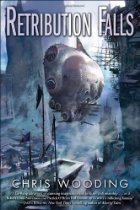
Review: Retribution Falls

Retribution FallsChris Wooding, Retribution Falls

Darian Frey is a freebooter and small-time criminal whose most treasured possession is his airship, the Ketty Jay. His so-called “crew” is disorganized and questionably competent, and they all have something to hide. Crake, a daemonist whose magical skills have made him an outcast, is crumbling under the weight of a guilty consience. Jez, the new navigator, can’t let anyone know about her mysterious secret abilities. The ship’s doctor, Malvery, is a drunk, and outflier pilot Harkins has been completely traumatized by the Aerium Wars. Frey and his motley collection of renegades travel around taking odd jobs, but they barely make enough money to live on. That is, until Frey is presented with the opportunity of a lifetime: steal the cargo of a particular airship and receive fifty thousand ducats as payment. The offer seems too good to be true, and it is — the target airship turns out to be carrying the heir to the Archduchy, who is killed when the Ketty Jay attacks. Now Frey and his crew are on the run, but Frey is determined to discover who set him up and why — even if it means losing the freedom and detachment that are so precious to him.

This book, quite simply, was a ton of fun! I picked it up at a Borders going-out-of-business sale because the premise reminded me of “Firefly,” and if you enjoy that type of space Western with a healthy dose of grim humor, I think you’ll really enjoy this book! The plot is predictable but packed with action, and the pacing is great, but my favorite part of the book was definitely the characters. I really liked the way Frey was portrayed; he’s definitely no hero — selfish, misogynistic, irresponsible, and entitled — but he does grow and change throughout the course of the novel. I loved the other characters too, particularly Crake and Jez, both of whom I’d like to learn a lot more about! I think one weakness of sci fi/fantasy/adventure novels is that they tend to make the characters too heroic or powerful right from the start. But in this book, nobody is a hero until (arguably) the very end; the characters actually develop throughout the book. For this reason, the book really exceeded my expectations, and I’m thrilled to discover that it’s actually the first book in a series! It can be read as a stand-alone, but I will definitely be continuing to read about the Ketty Jay and its swashbuckling crew!

Review: Just Like Heaven

Just Like HeavenJulia Quinn, Just Like Heaven

Lady Honoria Smythe-Smith is desperate to be married. Though she is part of a large, affectionate family, things have been very quiet in her parents’ house ever since her brother Daniel fled England after seriously wounding a man in a duel. Honoria longs to start her own family and once again feel surrounded by love; and as an added bonus, once she is married, she’ll no longer have to perform at the Smythe-Smiths’ infamous musicales. Meanwhile, Marcus Holroyd, the Earl of Chatteris, is Daniel’s best friend and has always felt more at home with the Smythe-Smiths than with his own distant family. Marcus and Honoria have always been friendly, but when a sprained ankle and a dangerous illness throw them together, they both begin to suspect that their relationship is deepening into something more.

I basically picked up this book for two reasons: 1) It shares a title with a really great Cure song, and 2) I’m a sucker for ridiculous British surnames. Fortunately, I ended up enjoying it quite a bit! Marcus is a delightful hero; he comes across as proud and brooding, but only because he feels shy and socially awkward (shades of Mr. Darcy!). And Honoria is a sweet girl with just enough humor to keep her from being insipid. Somewhat unusually for a Regency romance, most of this book doesn’t take place during the London Season; rather, Honoria spends a good portion of it nursing Marcus back to health from a life-threatening fever. Some might find the sickroom scenes tedious, but to me they underscored why Marcus and Honoria make such a great pair. All in all, I’d definitely recommend this light, quick read to fans of Regency romances, and I’ll probably pick up something else by Julia Quinn in the future.

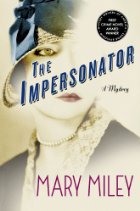
Review: The Impersonator

Impersonator, TheMary Miley, The Impersonator

Leah Randall is a talented but impoverished actress who has worked on the vaudeville circuit her whole life. During the course of one performance, she notices a strange man watching her intently. Eventually this man, Oliver Beckett, approaches her with an astonishing proposal. He tells Leah the story of his niece, Jessie Carr, heiress to a substantial fortune, who vanished from her home several years ago without a trace. Leah bears a striking resemblance to Jessie, so Oliver proposes a scheme: Leah will pose as Jessie and return “home” to claim her inheritance, which she will then split with Oliver. At first Leah wants nothing to do with it, but when she is fired from her vaudeville act and can’t get other work, she eventually reconsiders. With Oliver’s help, she assumes Jessie Carr’s identity and travels to the Carrs’ home in Oregon. But the more time she spends with the Carrs, the more she becomes determined to discover what really happened to Jessie all those years ago.

If you read that plot summary and thought, “That sounds an awful lot like Brat Farrar by Josephine Tey,” well, you’d be right. The premise is exactly the same — Miley even acknowledges that Tey’s novel was the main inspiration for her own — but I enjoyed Miley’s novel in its own right. I especially liked the period details about vaudeville, speakeasies, and other highlights of life in the 1920s. There were even references to some Supreme Court cases of the era, which I appreciated as a law school survivor. I also liked Leah’s narrative voice: she’s plain-spoken, independent, and very aware of both her talents and her flaws. The thing is, though, Brat Farrar is still by far the superior book. Miley’s novel is a bit disorganized at times, including several subplots that are more distracting than intriguing. I also hated the romantic aspect of this book; it was unbelievable and underdeveloped. I did enjoy the book overall and found it very readable, but if the premise sounds interesting to you, you should really just read the original instead!