Review: The Day Lasts More Than a Hundred Years

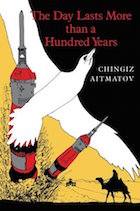
Day Lasts More Than a Hundred Years, TheChingiz Aitmatov, The Day Lasts More Than a Hundred Years (trans. John French)

Set in Kazakhstan in the latter half of the 20th century, this novel centers around Yedigei, a railway worker at the isolated Boranly-Burannyi train station in the middle of the steppe. He has lived with his wife and daughters in the tiny community by this train station for many years, and the other families who live there are practically his family also. When his neighbor and friend Kazangap dies, Yedigei takes responsibility for burying him properly at the ancient Kazakh cemetery of Ana-Beiit, even though it is a long journey from Boranly-Burannyi. Yedigei is able to arrange a small funeral procession that includes several men from the village, a camel, and even a tractor. As the procession makes its way through the steppe, Yedigei reflects on his relationship with Kazangap and on several other significant events in his life. Eventually, his quest collides with a momentous scientific discovery involving contact with intelligent life on another planet.

For me, this book was very put-down-able; I never felt like I simply had to know what was going to happen next. Nonetheless, I was surprised by how much I ultimately enjoyed the story. It certainly took me to an entirely different place and time — I’ve barely read any Soviet literature, and I definitely haven’t read anything set in Kazakhstan before. I think the book wonderfully describes Yedigei’s way of life in a way that is both very specific and somehow accessible to contemporary Western readers. I also loved the meditative quality of the prose, which is enhanced by the frequent repetition of certain phrases and paragraphs throughout the book. The bulk of the novel is told in flashback as Yedigei recalls various incidents, and these flashbacks provide most of the plot. In the book’s present, not much actually happens, but I never felt like things were moving too slowly. The sci-fi aspect of the plot seemed pretty disposable to me, but I was certainly curious while reading to see how it would connect with Yedigei’s story! Overall, even though this book wasn’t a page-turner, I’m really glad I stuck with it.

Review: Uncharted Territory

Uncharted TerritoryConnie Willis, Uncharted Territory

Renowned planetary explorers Findriddy and Carson have a simple mission: to investigate and map out the alien planet they’re currently surveying. But their task is fraught with several complications. Their alien guide, Bult, is hellbent on extorting every last possible penny from Earth by fining Fin and Carson for everything from “destroying indigenous flora” (stepping on the grass) to “disturbing the land surface” (leaving footprints). Earth is also watching Fin and Carson with an eagle eye, theoretically to prevent them from destroying the indigenous environment and customs, but actually to evaluate what natural resources might be worth exploiting. Then a visiting scientist, Evelyn Parker, arrives to tag along on Fin and Carson’s cartographical expeditions, complicating the already volatile relationship between them. Evelyn’s speciality is the mating customs of various species, both human and alien; and it’s no coincidence that as the expedition continues, all parties find themselves exploring the uncharted territory within their own hearts as well.

I’m such a huge Connie Willis fan, so I was very glad to finally read this short novel. It’s one of her comedic offerings (think Bellwether, not Doomsday Book), and I loved her satire on political correctness and the “noble savage” myth. (Not that she paints the aliens as villains, either; they’re just regular people, no better or worse than the visiting Earthers.) There’s also a lot of playfulness surrounding gender: Evelyn turns out to be a man, and Fin’s gender isn’t revealed until quite a ways into the story. Of course, this all foreshadows the eventual emergence of the romantic plot, and I really enjoyed the resolution of that as well. It’s a bit predictable but also quite funny. Overall, I’d say this book is a pleasant diversion, although it lacks the thoughtfulness and depth of Willis’ longer novels. I wouldn’t necessarily recommend it for newcomers to this author, but her fans should definitely enjoy it!

Review: Quick Curtain

Quick CurtainAlan Melville, Quick Curtain

Crowds flock to the London premiere of Douglas B. Douglas’ sensational new musical comedy, hoping to catch a glimpse of stage idols Brandon Baker and Gwen Astle. But they get even more sensation than they bargained for when leading man Baker is shot dead in the middle of Act 2. Fortunately, Inspector Wilson of Scotland Yard is in the audience, along with his son Derek, an enterprising young journalist. When another cast member is found hanged in his dressing room, the obvious conclusion is that he murdered Baker, then committed suicide. But Inspector Wilson isn’t convinced, especially when he finds a bullet hole in a place that would be impossible under that theory of the crime. He and Derek jointly investigate the mystery, which leads them to a remote village, several salacious secrets, and an altogether unexpected solution to the mystery.

I absolutely love Golden Age mysteries, and this one was a very enjoyable read, unique in its lighthearted tone and somewhat breezy attitude to police procedure. (For instance, does Inspector Wilson even have jurisdiction over the case? In this book, it doesn’t matter: he’s first on the scene, so he simply commandeers the investigation.) I loved the humorous running commentary on show business of the era; apparently the author himself had a long career in the industry. And I laughed out loud at various silly jokes, particularly an exchange where the play’s director is impatiently waiting for the doctor to examine the corpse. Finally fed up, the director asks, “Well?” “Not at all; in fact, he’s dead,” the doctor replies. The mystery plot isn’t particularly original, and a twist in the last chapter may irritate readers who want their mystery authors to play fair. But I really enjoyed the book’s tongue-in-cheek style and would definitely recommend it to fans of the genre!

Review: The Seamstress

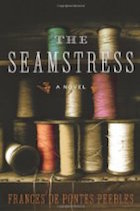
Seamstress, TheFrances de Pontes Peebles, The Seamstress

This historical epic set in 1920s and ’30s Brazil tells the story of two sisters, Emília and Luzia, and the bond they share despite the very different directions in which life takes them. They grow up in a small mountain town, where they eke out a living as seamstresses. Emília dreams of someday moving to a big city, dressing in fine clothes, and leaving poverty behind forever. Luzia, whose arm was deformed after a childhood accident, simply wants to escape her cruel nickname of “Victrola.” Emília eventually achieves her goals by marrying the rich Degas Coelho, but she find herself unprepared both for Degas’ family and for the strict rules of Brazilian high society. Meanwhile, Luzia is abducted by a gang of bandits led by the notorious Hawk, but she eventually discovers a certain aptitude for their way of life.

I have mixed feelings about this book. On the one hand, it paints an extremely vivid picture of Brazilian life during this time period, encompassing wealthy city dwellers, powerful country landowners known as “colonels,” and the impoverished rural folk who equally fear the colonels and the bandits as they constantly prey upon each other. I know basically nothing about Brazilian history, so it was fascinating to immerse myself in this unfamiliar setting. I also really liked the central relationship between Emília and Luzia; even though they are very different people, and they don’t spend much time together in the novel, they still share an obvious bond. On the other hand, the book is very slow-paced, and I honestly found it a slog a lot of the time. It’s definitely worth reading if the setting interests you, but I must admit, I’m just relieved to have finished it!

Review: No Wind of Blame

No Wind of BlameGeorgette Heyer, No Wind of Blame

Plenty of people wanted to murder the shiftless, good-for-nothing Wally Carter. His rich wife, Ermyntrude, was tired of giving him money that he only drank or gambled away. Ermyntrude’s daughter, Vicky, thought her mother would be happier with another man. The slick “Prince” Alexis Varasashvili, had his eye on Ermyntrude’s fortune. And several other characters had equally strong movies for wanting Wally out of the way. But when he actually is shot, it seems that no one could possibly have fired the gun without being immediately discovered. As suspicion rests on each of the characters in turn, it’s up to Scotland Yard’s Inspector Hemingway to discover the truth. Along the way, a sordid scandal comes to light, a crooked business deal is unearthed, and romances end and begin.

I’m glad I chose this book to kick off my 2016 reading, since it contains both an ingenious mystery plot and a wonderful assortment of classic Heyer characters. I loved the histrionic Ermyntrude, who is certainly vulgar but also extremely kind-hearted. And Vicky, who delights in playing a variety of different roles (such as Sports Girl and Dutiful Daughter), annoyed me at first, but eventually I began to enjoy her antics in spite of myself. The main characters are so well-drawn that the mystery is a bit sidelined, but I do think the solution is very clever. I guessed the murderer but not the “how” or the “why,” although Heyer plants a few clues throughout the novel. The romances are a bit undercooked, especially the one involving Wally’s ward, Mary Cliffe. I don’t know whether I’d consider it one of my favorite Heyer mysteries, but it was still a fun read and a great start to the year!

Review: An English Murder

English Murder, AnCyril Hare, An English Murder

The setting of An English Murder seems, at first, to be a very conventional one. A group of family and friends come together for Christmas at a country house, Warbeck Hall. The house is owned by Lord Warbeck, a dying and impoverished peer who wants to be among loved ones for what he thinks will be his last Christmas. The holiday decorations are up and snow is falling fast outside. The guests range from the Lord’s difficult son to a visiting Czech historian. There is, of course, a faithful butler and his ambitious daughter. But when the murders begin, there is nothing at all conventional about them – or the manner of their detection. This ingenious detective story gleefully plays with all of our expectations about what an ‘English murder’ might be and offers enough twists and turns to keep us reading into the night. (Summary from Amazon.com.)

This was my first Cyril Hare mystery, but hopefully it won’t be my last! This is a quintessential English country house mystery, and I really enjoyed it. Most of the characters aren’t particularly likable, but the amateur sleuth, Dr. Wenceslaus Bottwink, makes up for all the others. Not only does he have a great name, but his somewhat detached “observer” status allows him to see the situation clearly and even find some humor in the various nasty interactions among other characters. The book is also interesting as a historical artifact: it was published just after World War II (1951, I believe) and contains characters whose views span the whole political spectrum, from socialism to fascism. The solution to the mystery, which also explains the book’s title, is one of the most delightful resolutions to a murder mystery that I’ve read in a while. Definitely recommended for vintage mystery lovers!

Review: The Unpleasantness at the Bellona Club

Unpleasantness at the Bellona Club, TheDorothy L. Sayers, The Unpleasantness at the Bellona Club

On November 11, ninety-year-old General Fentiman is found dead in an armchair at the Bellona Club. No one knows exactly when his death occurred—information essential in determining the recipient of a substantial inheritance. But that is only one of the mysteries vexing Lord Peter Wimsey. The aristocratic sleuth needs every bit of his amazing skills to discover why the proud officer’s lapel was missing the requisite red poppy on Armistice Day, how the Bellona Club’s telephone was fixed without a repairman, and, most puzzling of all, why the great man’s knee swung freely when the rest of him was stiff with rigor mortis. (Summary from Amazon.com.)

I think this is my favorite Lord Peter Wimsey book so far. The mystery plot is ingenious and provides an intellectually satisfying solution. I also appreciate how character-driven Sayers’ mysteries are in comparison to, say, Agatha Christie’s. (Not to bash Dame Agatha, but I think her books are far more plot-driven, with the characters rarely being very three-dimensional.) I was especially fascinated by Ann Dorland, one of the potential heirs to the general’s fortune. Her behavior is suspicious throughout the novel, but is she guilty? And if not, why does she act the way she does? The one jarring note to this mystery is the ending, where Lord Peter unmasks the killer and essentially suggests that, instead of going through the humiliation of an arrest and trial, the person should just commit suicide. I guess this attitude makes sense for the time, when people set more store by their honor than they do today…and of course, a convicted murderer would face the death penalty anyway…but I was still taken aback by Lord Peter’s suggestion! Still, I enjoyed the book and look forward to continuing with the series.

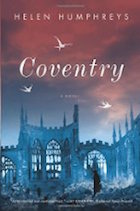
Review: Coventry

CoventryHelen Humphreys, Coventry

On the evening of November 14, 1940, Harriet Marsh stands on the roof of the historic Coventry cathedral and marvels at the frost glittering beneath a full moon. But it is a bomber’s moon, and the Luftwaffe is coming to unleash destruction on the city. For Harriet; for the young fire watcher, Jeremy, standing beside her; and for his artist mother, Maeve, hiding in a cellar, this single night of horror will resonate for the rest of their lives. Coventry is a testament to the power of the human spirit, an honest and ultimately uplifting account of heartache transformed into compassion and love. (Summary from Amazon.com.)

Many World War II novels are sprawling epics that reflect the enormity of the tragedy, death, and suffering caused by the war. By contrast, this is a lovely little book that focuses on one specific event, the bombing of Coventry in 1940, and on three people whom the bombing affects in various ways. Harriet is the most fleshed-out (and therefore most sympathetic) character, but I was interested in all three stories and how they intersect. The novel is very understated in its description of the fear and pain the characters experience, which makes these emotions seem all the more vivid and raw. I was reminded of a quote by a musician I like: “Sometimes a sketch says more than a mural” (Grant-Lee Phillips on his album Ladies’ Love Oracle). This book is a sketch, but an effective one. I’d definitely recommend it to fans of World War II novels or historical fiction in general.

Review: The Gabriel Hounds

Gabriel Hounds, TheMary Stewart, The Gabriel Hounds

It’s all a grand adventure when Christy Mansel unexpectedly runs into her cousin Charles in Damascus. And being young, rich, impetuous, and used to doing whatever they please, they decide to barge in uninvited on their eccentric Great-Aunt Harriet—despite a long-standing family rule strictly forbidding unannounced visits. A strange new world awaits Charles and Christy beyond the gates of Dar Ibrahim—”Lady Harriet’s” ancient, crumbling palace in High Lebanon—where a physician is always in residence and a handful of Arab servants attends to the odd old woman’s every need.

But there is a very good—very sinister—reason why guests are not welcome at Dar Ibrahim. And the young cousins are about to discover that, as difficult as it is to break into the dark, imposing edifice, it may prove even harder still to escape… (Summary from Amazon.com.)

I always enjoy Mary Stewart’s novels of romantic suspense, and The Gabriel Hounds is no exception. I liked Christy’s lively and slightly self-absorbed nature; she seemed real and relatable, if not always admirable. But the Amazon summary makes her sound a lot more irritating and privileged than she is! And the novel is great at creating a subtly sinister atmosphere once Christy enters Dar Ibrahim. The place seems to be nothing more than an old, run-down estate, and its inhabitants all treat Christy kindly, at least at first. Yet the book manages to convey an escalating sense of menace until Christy, with Charles’ help, must flee for her life. The novel’s central mystery, which involves drug trafficking, is both amusingly dated and surprisingly relevant today. I enjoyed the romance and the exotic setting as well, both hallmarks of Mary Stewart’s writing style. This book doesn’t rank among my favorites by Stewart, but it’s still a very solid read if you like the author or old-fashioned novels of romantic suspense.

Review: Girl Waits with Gun

Girl Waits with GunAmy Stewart, Girl Waits with Gun

Constance Kopp doesn’t quite fit the mold. She towers over most men, has no interest in marriage or domestic affairs, and has been isolated from the world since a family secret sent her and her sisters into hiding fifteen years ago. One day a belligerent and powerful silk factory owner runs down their buggy, and a dispute over damages turns into a war of bricks, bullets, and threats as he unleashes his gang on their family farm. When the sheriff enlists her help in convicting the men, Constance is forced to confront her past and defend her family — and she does it in a way that few women of 1914 would have dared. (Summary from Amazon.com.)

For some reason, I had a couple of erroneous expectations coming into this book. I thought it was a Western and pictured Constance Kopp as a sort of hotheaded, guns-blazing, Annie Oakley figure. In fact, the book is set in New Jersey, and Constance is definitely not the aggressive cowgirl I had imagined. She is certainly a strong woman, but her strength isn’t demonstrated by violence. Rather, she is strong in her sense of justice and in her determination not to be browbeaten by the factory owner just because he is rich and male. I really admired Constance and enjoyed her relationship with her sisters; it’s obvious that they get on each others nerves occasionally, but it’s equally obvious that they are very close. I also liked the book’s historical setting and how it showcased (in a non-preachy way) some of the difficulties women faced in the early 20th century. The “family secret” referenced in the summary was fairly easy to guess, but I didn’t mind it because it’s really not the focus of the novel. The book’s ending seems to leave room for a sequel, and I would definitely read one if it ever materializes!