Review: Darkness at Pemberley

Darkness at PemberleyT.H. White, Darkness at Pemberley

This mystery novel begins at Cambridge, where a history don and an undergraduate are nearly simultaneously found shot in their rooms. The local police are called, and Inspector Buller is assigned to investigate. At first it appears that the don murdered the student and then killed himself, but Buller notices a few oddities in the don’s rooms that contradict this murder-suicide theory. He subsequently uncovers a drug scandal in the college and eventually discovers the real murderer’s identity. Unfortunately, the murderer has a cast-iron alibi, so Buller is forced to let the man go free. Buller then goes to visit his friend Charles Darcy at Pemberley and tells him about the murders. Charles, enraged by this injustice, goes to Cambridge to threaten the murderer. When Buller discovers this, he is terrified, knowing that the murderer will now come after Charles in retaliation. Almost immediately, strange things begin to happen at Pemberley, and Buller is convinced that the murderer is hiding somewhere in the house or grounds. Can he catch the murderer before his friend becomes the next victim?

Obviously, I was drawn to this book because of the title; any Austen fan will immediately recognize Pemberley as the name of Mr. Darcy’s grand estate in Pride and Prejudice. Sadly, from my point of view, there’s very little connection to Austen’s novel in this book, except that the current inhabitants of the house are still called Darcy. But this is still a very interesting and suspenseful book, despite the fact that it’s a bit schizophrenic. The first part of the book seems like a traditional locked-room mystery, and the solution is both complicated and ingenious. But as I mentioned, the murderer’s identity is discovered fairly early in the book. The novel then shifts to more of a suspense/thriller, as the inhabitants of Pemberley wait for the murderer to make his move so that they can catch him. The novel genuinely creeped me out in places; the idea of being trapped in a maze of a house, with someone pursuing you whom you can’t see, is absolutely claustrophobic and terrifying to me! So if you enjoy that kind of thing, I definitely recommend this book!

Review: Snobbery with Violence

Snobbery with ViolenceMarion Chesney, Snobbery with Violence

Captain Harry Cathcart has recently been invalided out of the army and is looking for something to do with himself. Since he is a gentleman, he is not expected to work for a living; yet, although he is the younger son of a baron, the upper classes don’t entirely accept him as one of their own. Putting his ambiguous social standing to use, Harry becomes a discreet fixer for members of the upper class with problems that they’d like to keep quiet. In this capacity, he is hired to investigate Sir Geoffrey Blandon, a suitor of Lady Rose Summer, because Lady Rose’s father is unsure of the man’s intentions. Harry quickly discovers that Sir Geoffrey intends nothing honorable, but when Rose learns of Harry’s activities, she is furious with him. Unfortunately, Rose and Harry soon meet again at the Marquess of Hedley’s house party; but their constant bickering must take a backseat when one of the guests is found dead. Harry suspects murder and begins to investigate quietly. But when Rose insists on getting involved, her interference could prove deadly.

I’ve had a streak of disappointing books lately, and unfortunately, this one is no exception. I loved the idea of this book — mystery and romance in Edwardian England — but the execution fell sadly flat. Every character was a cardboard cutout, including the two protagonists. Harry is a dour alpha male type, while Rose is a feisty 21st-century heroine in period costume. She befriends her maid (a former actress), is active in the suffragette movement, and doesn’t enjoy the Season’s balls and parties like other girls do. Such characters could be interesting, if they ever rose above caricatures, but they never spoke or behaved like real human beings. The book occasionally attempts to comment on the social inequities of the era, but even its depiction of class struggles is superficial, not thought-provoking. As for the mystery, I can’t remember a thing about it, so I guess it was fine, but certainly nothing extraordinary. Marion Chesney is an extremely prolific author — she also writes as M.C. Beaton — so maybe her other books and series are better. But I have no hesitation in recommending others to skip this one!

Review: High Rising

High RisingAngela Thirkell, High Rising

This gentle novel chronicles daily life in an English village between the wars. The protagonist is Laura Morland, a widowed mother of four sons, who earns a living by writing popular but insubstantial novels. Though three of her boys are grown up, she has her hands full with the youngest, Tony, who is currently obsessed with toy trains. She also observes the follies and foibles of her neighbors and friends, and she is not above interfering when the situation warrants it. For example, wealthy widower George Knox has just hired a conniving secretary who bullies his daughter and appears determined to become his wife; since George is oblivious, Laura takes it upon herself to get rid of the odious woman. Then there’s Sibyl Knox, a sweet young girl with no matrimonial prospects as yet, but Laura has a particular match in mind. And finally, there’s loyal Anne Todd, who has sacrificed everything to care for her sick mother but who still longs for a little romance. Can Laura surmount these various obstacles and ensure happy endings for all involved?

This is my first encounter with Angela Thirkell, but it definitely won’t be my last! In the past few years, I’ve discovered that I really love the types of books published by Persephone, Virago, and Bloomsbury. They’re usually written by women, usually in the 20th century prior to World War II, and they usually deal with the quiet, domestic problems of village life. For me, these books are a form of escapism to a (supposedly) simpler time, but they are also wonderful character studies that explore various forms of human weakness with humor and compassion. In this book, for example, there are no real heroes or villains; even Miss Grey, the objectionable secretary, is ultimately more pathetic than evil. The book is sweet and often quite funny, especially in its descriptions of Tony. I was a little disappointed that Laura herself didn’t end up finding a suitable match, but I suppose that only adds to the realism of the book. Overall, I’m not sure I’ll be re-reading this particular book, but I’ll definitely be continuing with the Barsetshire series!

N.B. I should add that the edition I read (pictured) is full of typos, misspellings and other errors. I’d suggest finding a different version if you can!

Review: Missing Reels

Missing ReelsFarran Smith Nehme, Missing Reels

This novel, set in New York in the late 1980s, follows the plucky young Ceinwen (pronounced KINE-wen) Reilly as she attempts to pursue her dreams in the big city. Unfortunately, she’s completely broke, so she lives with two roommates and works for a terrible boss at a vintage clothing store. But Ceinwen remains dedicated to her love of vintage clothes and classic movies — the older the better. She is also fascinated by her downstairs neighbor, Miriam, an older woman who is always poised, reserved, and impeccably dressed. Little by little, Ceinwen strikes up an acquaintance with Miriam and learns that she once starred in a silent movie that has since been lost. Ceinwen immediately becomes obsessed with the idea of finding the lost film, and with the help of a handsome British professor, she searches for anyone who might have a connection to the missing reels. In the course of her investigation, Ceinwen finds a community of fellow film nuts, a new romance, and possibly even a future career for herself.

I hate to say it, but this was one of my most disappointing reads of the year so far. The cover blurb makes the novel sound like a screwball romantic comedy, somewhat in the vein of “Bringing Up Baby” (which I love!). Suffice it to say, the book is nothing like that. There is very little humor in it, and Ceinwen is definitely not the effervescent, witty heroine I wanted her to be. Instead, she comes across as pushy and obsessive, practically stalking Miriam in order to get the inside scoop on her past life. I didn’t like her or her love interest, who is insufferably smug and patronizing, so I definitely wasn’t satisfied by the romance. And even as a fan of classic movies, I didn’t find anything interesting about Ceinwen’s quest to find the lost film. She goes around interviewing every person with even a remote connection to the film, asking questions she really has no business asking, and eventually the answer just plops into her lap. There’s no tension, no real stakes to the investigation. Overall, this book was disappointing to me on many levels — especially because I was hoping for something quite different.

Review: Trent’s Last Case

Trent's Last CaseE.C. Bentley, Trent’s Last Case

When internationally renowned financier Sigsbee Manderson is found dead on the grounds outside his home, the news sends shock waves throughout English society. Hoping to learn more about the circumstances of Manderson’s death, a notable newspaper magnate calls upon Philip Trent, journalist and amateur detective, to go into Manderson’s neighborhood and investigate the case. Trent soon discovers that Manderson was almost universally disliked, so there is no shortage of suspects, from either of Manderson’s two secretaries to his estranged wife. The more Trent learns about the case, the more he suspects Mrs. Manderson of being involved in her husband’s death. All too soon, Trent arrives at a theory of the case that heavily implicates Mrs. Manderson — which is unfortunate, because he has fallen head over heels in love with her. Will he do the law-abiding thing and disclose his solution to the police, or will he protect the woman he loves?

Contrary to what the title suggests, this is actually the first book featuring Philip Trent; after a 20-year gap, Bentley eventually wrote two more Trent books. Anyway, I knew I would enjoy this book from the moment I saw the dedication to G.K. Chesterton, whom I love. And indeed, there is a sort of Chestertonian twist to the mystery about halfway through, which I don’t want to spoil but which I really, really enjoyed! The writing style is a bit ponderous and old-fashioned, as you’d expect from a book originally published in 1913, but I soon got used to it. I liked Philip Trent as a character; unlike some of literature’s more famous detectives (ahem, Holmes and Poirot), he’s a fairly normal human being without dramatic idiosyncrasies. The romance is very sweet, and the solution to the mystery is both ingenious and unexpected — or at least it was to me! I would definitely recommend this book to fans of vintage mysteries, especially those who are interested in the history of the detective novel.

Review: The Paris Winter

Paris Winter, TheImogen Robertson, The Paris Winter

In November 1909, young Englishwoman Maud Heighton is in Paris pursuing her dream of becoming a painter. She studies at Lafond’s Academie, one of the few respectable art studios that is open to women. However, despite having some talent as an artist, Maud is living in extreme poverty and will soon have to choose between starving or returning to her family in England, which would be an admission of failure. Fortunately, Maud befriends Tatiana Koltsova, a fellow student at the Academie who is friendly, charming, and rich. Tanya takes Maud under her wing and eventually helps her to get a job as an English tutor for the Morel family. Both Sylvie Morel and her older brother Christian seem eager for Maud to accept their job offer, which includes room and board. But while Maud accepts the job gratefully, she can’t help feeling that it’s a little too good to be true. And the more she learns about the Morels, the more sinister they appear, until eventually she must seek out Tanya’s help to extricate herself from an unbearable situation.

I love historical fiction and was intrigued by the premise of this book, but I ended up with mixed feelings about it. First, I did love the setting, especially because it depicts a less glamorous version of Paris than many other books and movies do. Although Maud comes from the English gentry, she is forced to live a much more bohemian life in Paris, befriending people from each extreme of the class spectrum. And because she is not rich, she doesn’t have much opportunity to participate in the exciting, glamorous activities one usually associates with Paris during the Belle Époque. However, I wasn’t particularly invested in Maud as a character or in the plot involving her relationship with the Morels. It moved very slowly and eventually became a psychological thriller, which isn’t quite what I expected when I picked up the book. I thought both Tanya and Yvette, the artists’ model at the Academie, were more interesting characters, and I wish the book had focused more on their stories. That said, I did like the book’s denouement, which takes place during the great Paris flood of 1910. I would recommend this book to fans of historical fiction, but it’s not my favorite offering in the genre.

Review: Don’t Point That Thing at Me

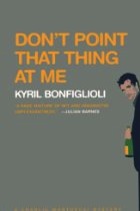
Don't Point That Thing at MeKyril Bonfiglioli, Don’t Point That Thing at Me

This picaresque novel is narrated by the Hon. Charlie Mortdecai, an art dealer who usually operates on the shady side of the law. In the opening scene he is visited by Inspector Martland (of a secret branch of the British police) in connection with a stolen Goya. Mortdecai claims to know nothing of the matter, but he cheekily admits to the reader that it is hidden under the floorboards. After Martland’s visit, Mortdecai knows he must unload the painting, but his mission is complicated by the murder of one of his associates. Even worse, someone seems to want Mortdecai dead as well — so he strikes a bargain with Martland to get diplomatic passage to America, where he hopes to make good his escape. There he encounters a variety of adventures, from constant surveillance by men in blue Buicks to the sexual aggressiveness of a rich American widow. Through it all, Mortdecai maintains a cheerful unconcern as he matches wits with several dangerous opponents.

I have very conflicting feelings about this book. On the one hand, I don’t think I understood the plot at all; there’s definitely a painting involved, and a valuable antique Rolls Royce, and various people who want Mortdecai dead, but I was always a bit confused about what was actually going on. On the other hand, Mortdecai has a delightful narrative voice — very reminiscent of Bertie Wooster, if Bertie were an art thief with a crasser mode of expression. (For example, Mortdecai’s valet/bodyguard is called Jock Strapp, which is either funny to you or it isn’t.) So the book does provide a lot of laughs, but in the end I’m not really sure what to think of it. The novel is first in a series, and I may check out the others at some point. The movie “Mortdecai,” which comes out today in the U.S., is also based on this series, and I’m interested to see how it deviates from the book. Johnny Depp seems like a very odd casting choice, for starters, but I’m nevertheless intrigued!

Review: The Girls at the Kingfisher Club

Girls at the Kingfisher Club, TheGenevieve Valentine, The Girls at the Kingfisher Club

The Hamilton sisters have been trapped all their lives. Their father is a harsh, cruel man who desperately wanted a son but got twelve daughters instead. He keeps them locked in the house at all times, never allowing them to catch a glimpse of the outside world. As the girls grow up, the eldest, Jo, finds a way to make their lives bearable: they sneak out of the house every night and go dancing. In the murky underworld of 1920s New York, it’s easy to blend in with the crowd, to trade a dance for some champagne or gin, to stay out all night just to feel young and alive. But Jo knows that her sisters’ freedom is incredibly fragile, and she is always watching to make sure that no girl reveals her true identity, gets caught in a police raid, or (worst of all) falls in love. When her father announces that he wants to marry off the girls to various business associates, Jo must take desperate action. She reaches out to a man from her past, a bootlegger who almost stole her heart. But her need to protect her sisters may cost Jo her own chance at happiness.

The premise of this book intrigued me immediately — a retelling of The Twelve Dancing Princesses set during the Roaring Twenties? Sign me up! And thankfully, the novel more than lived up to my expectations. One of my favorite things about it is the setting; New York City in the 1920s really came alive for me. The book captures the glamor and freedom and excitement of dancing all night in a smoky club, listening to a hot jazz band, and drinking exotic cocktails. But it also evokes the dangers of the era, where alcohol was illegal and nightclub raids were commonplace (unless you paid off the right cops). This setting is perfect for the Hamilton sisters’ story, as they are trying to break free but also to stay safe. I was also impressed by the characterization of the sisters; there are twelve of them, so obviously some are more fully developed than others, but they all have at least one unique quality. I also enjoyed the romance in the book, which was bittersweet but ultimately satisfying. I would definitely recommend this book to anyone who enjoys historical fiction or fairy tale retellings!

Review: Miracle and Other Christmas Stories

Miracle and Other Christmas StoriesConnie Willis, Miracle and Other Christmas Stories

This collection of holiday-themed short stories is, in essence, Connie Willis’ love letter to Christmas. In the introduction she professes her great love for all aspects of the season, and that love is very evident in the eight stories collected here. In “Miracle,” a young woman discovers her heart’s true desire with the help of “Miracle on 34th Street,” “It’s a Wonderful Life,” and the Spirit of Christmas Present. In “Newsletter,” a woman notices that everyone around her is suddenly acting kind and polite. Is it because of the Christmas spirit, or something more sinister? (Hint: the latter.) And in my personal favorite story, “Inn,” an alto in the church choir lets a homeless couple into the church, only to discover that it’s Mary and Joseph, lost in space and time on their way to Bethlehem. The genres in this collection range from romantic comedy to murder mystery, but each story deals with expectations that are turned upside-down, unexplained mysteries, and more than a few miracles.

I’m a big fan of Connie Willis, so I had high expectations for this collection, but I was still pleasantly surprised by how much I loved these stories. I knew I was in for a fun ride when Willis contended that “Miracle on 34th Street” is the best Christmas movie ever made, in defiance of the many lovers of “It’s a Wonderful Life.” I also loved the speculative edge to these stories, which really emphasized the wonder of Christmas to me. I mentioned that “Inn” is my favorite story in the bunch, and it’s because Willis managed to re-present the first Christmas story in a new way. It’s easy for that story to become familiar, comfortable, and even dull; but “Inn” reminded me that it’s actually a shocking tale in many ways. My one quibble with the collection is that Willis claimed all her stories would have happy endings, but at least two of them (“In Coppelius’s Toyshop” and “Cat’s Paw”) are quite dark! Nevertheless, I loved this book and think it’s a perfect December read!

Review: No Longer at Ease

No Longer at EaseChinua Achebe, No Longer at Ease

This novel, published in 1960, follows the fortunes of Obi Okonkwo, a young Nigerian man who was educated in England and has now returned to work in the Nigerian civil service. In the first chapter, it is revealed that Obi is on trial for accepting a bribe; subsequent chapters go back in time to explain how this situation came about. When Obi first comes back from England, he is idealistic and relatively innocent. When he sees the widespread bribery and corruption in the Nigerian government, he is disgusted and indignantly refuses the first bribe offered to him. However, he soon finds himself caught between several conflicting responsibilities. A group of prominent members of his hometown financed his education, and he is obligated to pay back the money they invested in him. His impoverished family also needs money, especially when his mother falls ill. And all of Nigerian society expects him to maintain a certain standard of living now that he has a profitable government job. Obi’s predicament mirrors the problems of Nigeria as a whole, as it struggles to achieve independence and find its own identity.

I had to read Achebe’s Things Fall Apart several times in school, and while I started out disliking it, I eventually warmed up to it. This book is a sequel of sorts, as Obi is the grandson of Okonkwo from Things Fall Apart, and some of the same themes are present. Both books deal with the interaction of European and Nigerian culture in a very nuanced way, showing both the positive and negative consequences of such interaction. And in both books, the protagonist is caught in an untenable position between the old ways and the new. Obi is a Nigerian through and through, but his English education makes him something of an alien among his own people. He deplores the Nigerian custom of bribing government officials but recognizes the role the British ruling class has played in this corruption. The novel is ultimately about Nigeria’s identity crisis as well as Obi’s, as the country moves toward independence. The novel’s ending leaves the question open: how can Nigeria move forward from the negative aspects of its past while still retaining what is good?