Review: The Thirty-Nine Steps

39 Steps, TheJohn Buchan, The Thirty-Nine Steps

Richard Hannay is fed up. He has just returned to London after several years in South Africa, where he’s led an adventurous life and made a modest fortune. His current life of leisure in England seems incredibly dull by comparison — that is, until his neighbor knocks on his door one day with an amazing story about international conspiracies, assassination plots, and his own very important mission. Hannay isn’t sure what to make of the story at first but agrees to keep his neighbor’s secret. When the man is murdered shortly thereafter, Hannay concludes that his farfetched story must actually be true, and he decides to take over the dead man’s mission to deliver some secret documents to a highly important member of the British government. He immediately finds himself on the run, as the people who murdered his neighbor are now on his trail. Hannay encounters a variety of people on his journey, both friend and foe, and he relies on his instincts to tell him whom he can trust with his story. In some cases these instincts are right, while in others, they are very, very wrong. But somehow, he always manages to stay one step ahead of his pursuers as he searches for the mysterious location with the 39 steps, where the evildoers can all be captured in one fell swoop.

This is one of those books that’s fun to read as a historical artifact, but I feel like it would never be published today. Spy thrillers are so popular in book, TV, and movie formats that audiences have become very sophisticated. The plot of this book may have been cutting-edge when it was published in 1915, but for a modern reader, it’s pretty predictable and really strains credulity at times. Hannay’s actual mission isn’t important; the dramatic tension in the book comes from the fact that he’s being followed, as well as the fact that some pursuers are actually lying in wait for him. There is one pretty suspenseful scene near the end where Hannay is in a room with the suspected evildoers, and he’s suddenly struck with self-doubt: are these people actually the bad guys, or has he been imagining the whole thing? But I did mentally roll my eyes at Hannay several times, as he basically blurts out the entire story to everyone he meets without once stopping to wonder, “Should I actually trust this person?” Still, despite its flaws, I did find the book entertaining and would consider reading more of Hannay’s adventures. I also need to check out the Hitchcock movie now!

Review: Circling the Sun

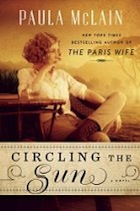
Circling the SunPaula McLain, Circling the Sun

Beryl Markham is known to history as one of the pioneers of aviation: she was the first woman to fly solo across the Atlantic from east to west. But this novelized version of her life focuses on her childhood and youth on an African farm in what is now Kenya. Beryl’s family moved to Kenya when she was four years old, but her mother had trouble adapting to African life and soon returned to England. As a result, Beryl’s upbringing was unconventional, and her education was sporadic at best. She grew up with a deep love of the land and creatures surrounding her, and she loved to ride, shoot, and train horses. But as she approached adulthood, her father’s farm fell on hard times, and he eventually decided to sell the property and relocate to Nairobi. Distraught at the thought of leaving her home, and unwilling to be a burden on her father (with whom she was not close), Beryl married a neighboring farmer. But the marriage was not a happy one, and Beryl soon left him to become a horse trainer in her own right. The novel follows Beryl’s attempts to stand on her own against the odds, and it also chronicles her friendship with Karen Blixen — better known as Isak Dinesen, the author of Out of Africa — and her love affair with Denys Finch Hatton, whom the book portrays as the great love of Beryl’s life.

This book initially caught my interest because I find the early days of flight fascinating. It’s amazing to me that traveling by plane is so common now, when back then it was terribly dangerous, and only the most daring adventurers were brave enough to attempt it. Unfortunately, this novel has almost nothing to do with Beryl Markham’s career as an aviatrix; but I still ended up enjoying it a lot for the setting and characters. I don’t know much about Beryl’s life, so I can’t say how accurate the book is in its details, but it certainly paints a vivid and compelling picture of her character and of life in British East Africa at that time. The Beryl of this book was certainly ahead of her time in many ways. She married and divorced multiple times, and she had several extramarital affairs, including one with Prince Henry, Duke of Gloucester. She pursued a career at a time when most women were still relegated to the home. Such characteristics make her a compelling heroine, and I enjoyed reading about her adventures — although this book focuses a lot on her various romances, when I really wanted to know more about her professional life and aspirations. But I did enjoy the novel and would like to learn more about this era. I’ll have to read Out of Africa and Beryl’s own memoir, West with the Night!

Review: Funny Girl

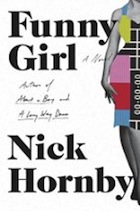
Funny GirlNick Hornby, Funny Girl

This novel, set in the 1960s, tells the story of Barbara, a girl whose only dream growing up was to go on television and make people laugh. When she wins a local beauty pageant and realizes that she’s about to become stuck in a small-town rut forever, she moves to London to pursue her goal. Her good looks attract the attention of an agent, but all he wants is for her to stand there and look pretty in various insipid commercials. Eventually, however, by sheer luck she teams up with a group of comedy writers who are trying to develop a new show for the BBC. There are Tony Holmes and Bill Gardiner, who have been writing partners for years; there’s Dennis Maxwell Bishop, the meek producer who’s trapped in an unhappy marriage; and there’s Clive Richardson, the handsome, arrogant actor who will be playing the male lead in the show. Against all odds, Barbara — now using her stage name of Sophie Straw — lands the part, and the show becomes an unexpected hit. Throughout its run, Sophie and her colleagues must deal with love affairs, identity crises, divorces, and changing artistic visions; but in the end, they are inextricably linked by the shared bond of creating a show that changed all their lives.

I’m a big fan of Nick Hornby’s books, so I was excited to read this latest release. It’s a bit different from his earlier works — still very funny, but in a subtler way. My favorite parts of the book are when the four main characters are just sitting around, discussing the show and trying to break new stories. It’s a pleasure to watch them all interact and tease each other. It’s obvious that, regardless of the personal issues these characters might have with each other (or in their lives outside of work), they are all genuinely fond of each other. Because of this focus on the characters, there’s not a whole lot of plot in the book; it covers the show from beginning to end, then goes forward in time to explore what happens to Sophie and the other characters. To be honest, I wasn’t a big fan of the time jump; it made the book drag on and minimized the various setbacks and triumphs that occurred during the show’s run. Nevertheless, I enjoyed this book overall and would recommend it to people who like character-driven books, as well as people who are nostalgic for ’60s-era television.

Review: The Truth According to Us

Truth According to Us, TheAnnie Barrows, The Truth According to Us

Though the U.S. in the 1930s is sunk in a depression, senator’s daughter Layla Beck doesn’t have much firsthand experience of deprivation — until she refuses to marry the man her parents have picked out for her, and they cut her off, forcing her to get a job. Her father’s connections get her a position with the Federal Writers’ Project, which gives her the assignment of writing a local history for the town of Macedonia, West Virginia. At first, Layla is extremely resistant to the idea of burying herself in such a tiny town, and she tries to get out of the assignment, but since there’s no other work to be had, she must eventually give in. When she arrives in Macedonia, she stays with the eccentric Romeyn family, which includes the dashing Felix, his strong-minded sister Jottie, and his precocious daughter Willa. Layla can’t help but be drawn to Felix, but the closer she becomes to him, the more she realizes that the Romeyns are hiding a decades-old secret that could shake Macedonia to its core. Meanwhile, 12-year-old Willa is just beginning to observe the strange behavior of the adults around her — and to take the first steps towards growing up herself.

Since Annie Barrows co-authored one of my favorite books, The Guernsey Literary and Potato Peel Pie Society, I had high hopes for this new novel, and I’m happy to say I enjoyed it very much. First of all, I loved the depiction of Macedonia, West Virginia, and its inhabitants. I honestly felt like I was living in this book — I could almost feel the summer heat bearing down on me. I also especially enjoyed the chapters written from Willa’s point of view. I loved her sharp yet childlike observations of the people around her, and how she slowly changes as she begins to realize that the adults in her life have interior lives and secrets of their own. It’s been a long time since I read To Kill a Mockingbird, but her voice made me think of Scout Finch quite a bit. I also loved Jottie, an intelligent, loving woman who has experienced tragedy but hasn’t let it break her. And although Layla is a bit snooty in the beginning of the book, her experiences in Macedonia definitely change her for the better as well. My one complaint is that the book is a little long; I think it probably could have been edited a bit more thoroughly. But overall, I liked this book a lot and would definitely recommend it to fans of historical fiction and/or literature about the South.

Review: Murder Underground

Murder UndergroundMavis Doriel Hay, Murder Underground

Miss Euphemia Pongleton is an unpleasant old woman living in a dreary but respectable London boardinghouse. When she is strangled on the steps of the Belsize Park underground station, her fellow boardinghouse residents are surprised rather than saddened; but they soon move past their shock to speculate on who might have done the deed. The police have arrested one suspect, the boyfriend of a maid in the boardinghouse who had been involved with some petty thievery. But the maid is convinced her man is innocent, and the boarders entertain themselves by coming up with alternate theories of the murder. Naturally, Miss Pongleton’s nephew Basil, who always seems to need money and who depends on inheriting his aunt’s fortune, is a prime suspect. But Basil, despite some highly suspicious behavior on the day of the murder, insists that he is innocent. Are his protests a clever ruse, or could someone else in the boardinghouse have wanted Miss Pongleton dead?

This was a very enjoyable Golden Age mystery, although there’s really nothing that makes it stand out from the genre as a whole. But sometimes formulaic plots are comforting, and that’s why I usually enjoy mysteries from this era. There’s the unpleasant murder victim whom we don’t need to mourn; a variety of suspects with a variety of motives, secrets, and questionable alibis; the secondary love story; and the amateur detectives who solve the crime without the involvement or assistance of the police. The mystery is well plotted, and I didn’t guess who the murderer was (although I suspected almost every character at one point or other). There are also some lovely bits of humor, such as when the boardinghouse residents fight tenaciously — but silently — over who gets to sit in Miss Pongleton’s chair. All in all, I’d recommend this to fans of Golden Age mysteries, but it’s definitely not a stellar example of the genre.

Review: As Chimney Sweepers Come to Dust

As Chimney Sweepers Come to DustAlan Bradley, As Chimney Sweepers Come to Dust

***Warning: SPOILERS for previous books in the series!***

Flavia de Luce’s life has been turned upside-down by the shocking revelation that her mother, Harriet, worked as a spy for England before her death. What’s more, Harriet was groomed for this work at an elite Canadian boarding school, where she belonged to a secret society called the Nide. Now the twelve-year-old Flavia must follow in her mother’s footsteps all the way to Miss Bodycote’s Female Academy, so that she can carry on the family’s legacy of covert service to England. But Flavia is less than thrilled about leaving Buckshaw and all her family and friends behind. Still, Miss Bodycote’s proves more interesting than Flavia expected when a dead body falls down the chimney into her bedroom on her very first night at the school. But whose body is it, and who would have placed the remains there? Was it a fellow student? The science teacher who was once tried for murder? Perhaps even the stern headmistress herself? Once again, Flavia uses her insatiable curiosity and her passion for chemistry to discover how, why, and by whom the victim was murdered. She also struggles to fit in at Miss Bodycote’s and eventually makes an important decision about her future.

This book marks a significant change in the direction of the series, as Flavia is uprooted from Bishop’s Lacey and placed in different surroundings with an entirely new cast of characters. Some people were skeptical about this change, but I was optimistic going in; if series aren’t willing to shake things up sometimes, they risk becoming stale. Unfortunately, I don’t think this particular change was terribly successful. The idea of Flavia trying to fit in at a strict boarding school filled me with glee, but this book doesn’t spend much time on her interactions with the other students, except as necessary for her investigation. And the book really suffers for not having Father, Feely, Daffy, and Dogger to be Flavia’s confidantes, friends, and sometimes enemies. I don’t read this series predominantly for the mysteries; while these are usually fine, the books’ charm lies in Flavia and her unique reactions to the people around her. And sadly, in this book, her social interactions just weren’t as funny, interesting, or poignant as they usually are. The end of this novel promises another change for Flavia, and I hope that the next book will take things in a more satisfying direction.

Review: Darkness at Pemberley

Darkness at PemberleyT.H. White, Darkness at Pemberley

This mystery novel begins at Cambridge, where a history don and an undergraduate are nearly simultaneously found shot in their rooms. The local police are called, and Inspector Buller is assigned to investigate. At first it appears that the don murdered the student and then killed himself, but Buller notices a few oddities in the don’s rooms that contradict this murder-suicide theory. He subsequently uncovers a drug scandal in the college and eventually discovers the real murderer’s identity. Unfortunately, the murderer has a cast-iron alibi, so Buller is forced to let the man go free. Buller then goes to visit his friend Charles Darcy at Pemberley and tells him about the murders. Charles, enraged by this injustice, goes to Cambridge to threaten the murderer. When Buller discovers this, he is terrified, knowing that the murderer will now come after Charles in retaliation. Almost immediately, strange things begin to happen at Pemberley, and Buller is convinced that the murderer is hiding somewhere in the house or grounds. Can he catch the murderer before his friend becomes the next victim?

Obviously, I was drawn to this book because of the title; any Austen fan will immediately recognize Pemberley as the name of Mr. Darcy’s grand estate in Pride and Prejudice. Sadly, from my point of view, there’s very little connection to Austen’s novel in this book, except that the current inhabitants of the house are still called Darcy. But this is still a very interesting and suspenseful book, despite the fact that it’s a bit schizophrenic. The first part of the book seems like a traditional locked-room mystery, and the solution is both complicated and ingenious. But as I mentioned, the murderer’s identity is discovered fairly early in the book. The novel then shifts to more of a suspense/thriller, as the inhabitants of Pemberley wait for the murderer to make his move so that they can catch him. The novel genuinely creeped me out in places; the idea of being trapped in a maze of a house, with someone pursuing you whom you can’t see, is absolutely claustrophobic and terrifying to me! So if you enjoy that kind of thing, I definitely recommend this book!

Review: Snobbery with Violence

Snobbery with ViolenceMarion Chesney, Snobbery with Violence

Captain Harry Cathcart has recently been invalided out of the army and is looking for something to do with himself. Since he is a gentleman, he is not expected to work for a living; yet, although he is the younger son of a baron, the upper classes don’t entirely accept him as one of their own. Putting his ambiguous social standing to use, Harry becomes a discreet fixer for members of the upper class with problems that they’d like to keep quiet. In this capacity, he is hired to investigate Sir Geoffrey Blandon, a suitor of Lady Rose Summer, because Lady Rose’s father is unsure of the man’s intentions. Harry quickly discovers that Sir Geoffrey intends nothing honorable, but when Rose learns of Harry’s activities, she is furious with him. Unfortunately, Rose and Harry soon meet again at the Marquess of Hedley’s house party; but their constant bickering must take a backseat when one of the guests is found dead. Harry suspects murder and begins to investigate quietly. But when Rose insists on getting involved, her interference could prove deadly.

I’ve had a streak of disappointing books lately, and unfortunately, this one is no exception. I loved the idea of this book — mystery and romance in Edwardian England — but the execution fell sadly flat. Every character was a cardboard cutout, including the two protagonists. Harry is a dour alpha male type, while Rose is a feisty 21st-century heroine in period costume. She befriends her maid (a former actress), is active in the suffragette movement, and doesn’t enjoy the Season’s balls and parties like other girls do. Such characters could be interesting, if they ever rose above caricatures, but they never spoke or behaved like real human beings. The book occasionally attempts to comment on the social inequities of the era, but even its depiction of class struggles is superficial, not thought-provoking. As for the mystery, I can’t remember a thing about it, so I guess it was fine, but certainly nothing extraordinary. Marion Chesney is an extremely prolific author — she also writes as M.C. Beaton — so maybe her other books and series are better. But I have no hesitation in recommending others to skip this one!

Review: High Rising

High RisingAngela Thirkell, High Rising

This gentle novel chronicles daily life in an English village between the wars. The protagonist is Laura Morland, a widowed mother of four sons, who earns a living by writing popular but insubstantial novels. Though three of her boys are grown up, she has her hands full with the youngest, Tony, who is currently obsessed with toy trains. She also observes the follies and foibles of her neighbors and friends, and she is not above interfering when the situation warrants it. For example, wealthy widower George Knox has just hired a conniving secretary who bullies his daughter and appears determined to become his wife; since George is oblivious, Laura takes it upon herself to get rid of the odious woman. Then there’s Sibyl Knox, a sweet young girl with no matrimonial prospects as yet, but Laura has a particular match in mind. And finally, there’s loyal Anne Todd, who has sacrificed everything to care for her sick mother but who still longs for a little romance. Can Laura surmount these various obstacles and ensure happy endings for all involved?

This is my first encounter with Angela Thirkell, but it definitely won’t be my last! In the past few years, I’ve discovered that I really love the types of books published by Persephone, Virago, and Bloomsbury. They’re usually written by women, usually in the 20th century prior to World War II, and they usually deal with the quiet, domestic problems of village life. For me, these books are a form of escapism to a (supposedly) simpler time, but they are also wonderful character studies that explore various forms of human weakness with humor and compassion. In this book, for example, there are no real heroes or villains; even Miss Grey, the objectionable secretary, is ultimately more pathetic than evil. The book is sweet and often quite funny, especially in its descriptions of Tony. I was a little disappointed that Laura herself didn’t end up finding a suitable match, but I suppose that only adds to the realism of the book. Overall, I’m not sure I’ll be re-reading this particular book, but I’ll definitely be continuing with the Barsetshire series!

N.B. I should add that the edition I read (pictured) is full of typos, misspellings and other errors. I’d suggest finding a different version if you can!

Review: Missing Reels

Missing ReelsFarran Smith Nehme, Missing Reels

This novel, set in New York in the late 1980s, follows the plucky young Ceinwen (pronounced KINE-wen) Reilly as she attempts to pursue her dreams in the big city. Unfortunately, she’s completely broke, so she lives with two roommates and works for a terrible boss at a vintage clothing store. But Ceinwen remains dedicated to her love of vintage clothes and classic movies — the older the better. She is also fascinated by her downstairs neighbor, Miriam, an older woman who is always poised, reserved, and impeccably dressed. Little by little, Ceinwen strikes up an acquaintance with Miriam and learns that she once starred in a silent movie that has since been lost. Ceinwen immediately becomes obsessed with the idea of finding the lost film, and with the help of a handsome British professor, she searches for anyone who might have a connection to the missing reels. In the course of her investigation, Ceinwen finds a community of fellow film nuts, a new romance, and possibly even a future career for herself.

I hate to say it, but this was one of my most disappointing reads of the year so far. The cover blurb makes the novel sound like a screwball romantic comedy, somewhat in the vein of “Bringing Up Baby” (which I love!). Suffice it to say, the book is nothing like that. There is very little humor in it, and Ceinwen is definitely not the effervescent, witty heroine I wanted her to be. Instead, she comes across as pushy and obsessive, practically stalking Miriam in order to get the inside scoop on her past life. I didn’t like her or her love interest, who is insufferably smug and patronizing, so I definitely wasn’t satisfied by the romance. And even as a fan of classic movies, I didn’t find anything interesting about Ceinwen’s quest to find the lost film. She goes around interviewing every person with even a remote connection to the film, asking questions she really has no business asking, and eventually the answer just plops into her lap. There’s no tension, no real stakes to the investigation. Overall, this book was disappointing to me on many levels — especially because I was hoping for something quite different.