Review: The Young Clementina

Young Clementina, TheD.E. Stevenson, The Young Clementina

Charlotte Dean can’t remember a time when she wasn’t in love with Garth Wisdon, her childhood playmate and next-door neighbor. Although Charlotte is merely the daughter of the local vicar, while Garth is the heir to a large estate, she grows up confident that they will marry someday. As they reach adulthood, Garth seems to reciprocate her feelings, but their love is arrested by the outbreak of World War I. Garth goes off to fight in the war, and when he returns, Charlotte no longer recognizes the man she once knew. The new Garth is angry and cynical and seems to hold her in contempt. Nevertheless, she is still overwhelmed with shock when he quickly becomes engaged to her younger sister, Kitty. Now Charlotte is living in a shabby flat in London, where she has little contact with Garth and Kitty. But a tragic turn of events brings them both back into her life — along with their strange, shy daughter, Clementina — and Charlotte must make a decision that could alter the entire course of her life.

I’m so glad Sourcebooks is reprinting the novels of D.E. Stevenson, because I’ve really enjoyed all the ones I’ve read so far! This book is a bit more somber than her Miss Buncle series, but it’s still a nice, leisurely, and ultimately sweet read. I was expecting the central storyline to be a romance, but really the book is much more about Charlotte’s growth as she is forced out of her comfort zone. In the beginning, it’s a bit difficult to feel much sympathy for her because she accepts her sister’s betrayal so passively. But as she emerges from her solitary cocoon and starts to cultivate friendships, she becomes a much stronger person who is capable of standing on her own two feet. On the other hand, I never felt much sympathy for Garth, even after he explained his actions; in my opinion, everything he suffered throughout the novel was his own stupid fault! But overall, I’d definitely recommend this book to people who like slower-paced, old-fashioned books with a contemplative feel.

Review: The Haunted Bookshop

Haunted Bookshop, TheChristopher Morley, The Haunted Bookshop

In this sequel to Parnassus on Wheels, bibliophile Roger Mifflin has temporarily abandoned his traveling bookstore for a more permanent location on Gissing Street in Brooklyn. He calls his store the Haunted Bookshop, claiming that it is “haunted” by the ghosts of great literature. One day a young salesman named Aubrey Gilbert enters the store, hoping to persuade Roger to advertise with his firm; instead, the two men have an intense discussion that leaves Aubrey with a newfound appreciation for literature. When Aubrey returns to the shop a few days later, he is immediately smitten with Titania Chapman, the beguiling new shopgirl. But as he starts to visit the store more regularly, he notices something strange: an old and rather obscure volume keeps disappearing from the Haunted Bookshop and then re-appearing without warning. Is there a literary-minded thief frequenting the bookstore, or is something more sinister at work?

This is one of those cozy little books that take you back to a simpler time, and I found it absolutely charming! Roger Mifflin’s enthusiasm for books is infectious, and the novel is full of his musings on literature, both in general and about specific books. Unfortunately, I didn’t recognize most of the titles he mentioned, presumably because they’ve gone out of fashion (and print!) since the book was published in 1919. But this is definitely the type of book that reminds me of the huge number of books in the world that I still haven’t read! The mystery plot is clever, though very slight and easy to guess (and very much a product of its time). I also liked the central characters, especially Aubrey, who makes a lot of endearing mistakes in his quest to solve the mystery and win Titania’s heart. All in all, I finished this book wishing that I could stop by the Haunted Bookshop for dinner and a literary discussion with these characters.

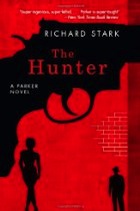
Review: The Hunter

Hunter, TheRichard Stark, The Hunter

This book introduces Parker, a criminal whose combination of street smarts and brute force has enabled him to live comfortably on the proceeds from his thefts. But his life is fundamentally disrupted when a job goes awry and one of his partners double-crosses him. Now Parker is consumed with thoughts of revenge, and he’ll do anything to catch up with Mal Resnick, the man who stole both his money and his wife. Parker uses a variety of tactics, including intimidation and murder, to track Mal down; meanwhile, Mal learns that Parker is on his trail and tries desperately to escape his clutches. Parker’s task is made more complicated by the fact that Mal is a memeber of an extremely influential crime syndicate called the Outfit, and the Outfit isn’t inclined to let Parker have his way. In order to exact his revenge, Parker must eventually go up against the whole organization; but will killing Mal sign his own death warrant?

While I enjoy the occasional film noir or con movie, I don’t tend to like the noir genre in book form. I tend to prefer my mysteries a little less violent, with a more clearly defined moral code (i.e., the killer is the bad guy). This book has a very cynical tone and a protagonist with few, if any, redeeming qualities. Frankly, I found Parker horrifying, especially in his violent treatment of women and his casual approach to killing anyone who gets in his way. Yet I actually ended up enjoying this book! I liked the writing style, which doesn’t waste any words and gets straight to the point. I also really enjoyed watching the story unfold: the book alternates from Parker’s story in the present to the story of the job that went wrong. Additionally, it was fascinating to see how Parker’s situation changes throughout the novel, as his quest for vengeance against one man turns into a war against the entire Outfit. If I’m ever in the mood for a darker mystery, I may even continue with this series!

There are also two film adaptations of the book, “Point Blank” (1967, starring Lee Marvin) and “Payback” (1999, starring Mel Gibson). I haven’t seen either of them, but I think this story would translate really well to film! Has anyone seen either of these movies, and if so, would you recommend them?

Review: A Blunt Instrument

Blunt Instrument, AGeorgette Heyer, A Blunt Instrument

When wealthy Englishman Ernest Fletcher is found in his study with his head bashed in, his relatives and neighbors are shocked. Ernest was well-liked and seemingly had no enemies, so why would anyone want to kill him? But as Superintendent Hannasyde and Sergeant Hemingway investigate the case, they soon uncover several motives. First there’s Neville Fletcher, the dead man’s nephew and heir to his fairly large fortune. Then there is Helen North, who has a secret involving Ernest that she doesn’t want anybody — especially her husband — to know about. Or the culprit could be Abraham Budd, a businessman who was complicit in some of Ernest’s shady financial dealings. But as the police collect motives and unearth secrets, they become more and more puzzled by the conflciting testimony about what actually happened on the night of the murder. And when a second victim appears, Hannasyde and Hemingway know they will have to act fast to catch a partiuclarly elusive killer.

In general I prefer Heyer’s romances to her mysteries, but I really enjoyed this book! There are some wonderful characters in this one: the vague, mischievous Neville, who is much sharper than he appears; the blunt, monocle-wearing Sally Drew, who writes detective novels; Constable Glass, the Bible-quoting policeman; and the impatient, down-to-earth Sergeant Hemingway. The dialogue is witty and sparkling, as usual, and I loved the romance(s) that emerged throughout the course of the book. The mystery itself is also a bit more substantial than in some of Heyer’s other books, and I was surprised by the Christie-esque twist that revealed the murderer’s identity. Overall, if you’re interested in trying Heyer’s mysteries, I think this is a really good place to start! (Hannasyde and Hemingway are recurring characters in her mysteries, but the books absolutely do not have to be read in order.) I’m reading these mysteries in chronological order, so I’ll be interested to see whether they get even better as they go on!

Review: Double Cross

Double CrossBen Macintyre, Double Cross: The True Story of the D-Day Spies

Seventy years ago, the Allies stormed the beaches of Normandy and began the campaign to liberate Nazi-occupied Europe. Many circumstances contributed to the success of the D-Day invasion, but one of the most important factors was the campaign of disinformation being fed to the Germans by a network of double agents whose sole purpose was to convince the Abwehr that the Allies would be landing at Calais rather than Normandy. Had these agents failed, the Germans would have concentrated their forces at Normandy, most likely stopping the Allied invasion in its tracks. This book tells the stories of the individual double agents involved in this task, including Serbian playboy Dusko Popov (“Tricycle”), Peruvian socialite Elvira Chaudoir (“Bronx”), and Polish nationalist Roman Czerniawski (“Valentine”). Ultimately, Macintyre makes a convincing case for the proposition that the Allies would never have won the war on the battlefields had they not already won the intelligence war.

This book gives a wealth of fascinating detail about the six men and women who acted as double agents in Britain, allegedly spying for Germany but really working for the Allies. I was shocked to learn that British intelligence had actually discovered and turned every German agent in Britain at the time! Because of this, the Allies were able to present a unified message to the Germans, subtlely directing their attention away from Normandy and toward other possible invasion sites. Some of the specific stories in the book prove once again that truth is stranger than fiction: for example, Dusko Popov thrived on creating networks of sub-agents that were entirely fictional, yet he retained the Abwehr’s complete trust. I also loved the fact that these double agents were handled in Britain by the Twenty Committee, so named because the Roman numeral for 20 is XX, or “double cross.” In short, if you’re interested in true stories of WWII-era espionage, Ben Macintyre is your man!

Review: Mrs. Ames

Mrs. AmesE.F. Benson, Mrs. Ames

This novel is a precisely drawn satire of life in an English village in the early 20th century. Mrs. Ames has been the leader of society in Riseborough for many years, due partly to her commanding presence and partly to her distant familial connection with a nobleman. The other residents of Riseborough both admire and resent her for her position, and many of the local gossips would be glad to see her fail in some way. So when a (relatively speaking) new arrival, Mrs. Evans, begins to set herself up as Mrs. Ames’ social rival, the entire town waits with bated breath to see whether their queen will be dethroned. Meanwhile, both Mrs. Ames and Mrs. Evans dimly begin to realize that their lives are unfulfilling, but their search for deeper meaning takes them down drastically different paths, one of which may lead to scandal and heartbreak.

I expected this book to be nothing more than a light, witty comedy of manners — which it is, but it also took a more serious turn than I anticipated. The various social machinations of the ladies of Riseborough are very funny; there’s a particularly wonderful scene in which Mrs. Evans hosts a masquerade ball and several ladies (tragically, yet hilariously) show up wearing the same costume. But for me, the more compelling story was Mrs. Ames’ slow realization that her dreary, respectable life isn’t making her happy. It’s only when she begins to identify with a cause greater than herself that she actually finds contentment — even at the moment when all her respectability and social standing is taken away. So oddly enough, this comedy of manners turns into a coming-of-age story, and I found it a surprisingly thought-provoking read.

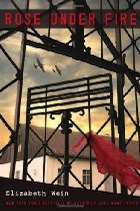
Review: Rose Under Fire

Rose Under FireElizabeth Wein, Rose Under Fire

Rose Justice is an American pilot who has just come to England to help with the war effort. Though women aren’t allowed to fly planes in combat, she is able to get a job with the Women’s Air Transport Auxiliary ferrying planes back and forth within Allied territory. At first Rose sees her work as a grand adventure, a fascinating change from her sheltered upbringing. But her life is instantly, horribly changed when she is captured by the Germans in the middle of a routine flight from France to England. She is immediately arrested and transported to the women’s concentration camp at Ravensbrück. There Rose confronts the hideous realities of this war for the first time, including the brutal scientific experiments performed on a group of young women known as “rabbits.” But depsite the horrific treatment Rose endures, she forges close bonds with a small group of fellow prisoners and somehow manages to hold onto hope.

This companion novel to Code Name Verity is equally powerful and moving, although it struck me in a very different way. I loved CNV for its suspense, its elements of espionage, and its intense portrayal of friendship. This book is not as suspenseful; we know from the start of Rose’s narrative about Ravensbrück that she is remembering her experiences after she has escaped. It’s also not as personal (if that’s the word I want) because while Rose forms incredibly close bonds with her fellow prisoners, the emphasis is less on individual relationships and more on the experience of Ravensbrück as a whole. Neverthless, this book did strike me on a very deep personal level. It’s easy to become a little desensitized to the atrocities committed by the Nazis, simply because we’ve heard about them so many times, but this book certainly made them vivid for me. The most horrifying thing is that similar atrocities are still occurring in parts of the world today. So this is not an easy read, but I think it’s a very important one.

Review: Death at the President’s Lodging

Death at the President's LodgingMichael Innes, Death at the President’s Lodging

This first installment of the Inspector Appleby series is a classic locked-room mystery set in the fictional St. Anthony’s college, where its president, Dr. Umpleby, has just been murdered. Because of the prominence of the victim, Inspector Appleby is summoned from Scotland Yard to assist the local police. He soon learns that the layout of the college would have made it impossible for someone without a key to access the scene of the crime. Therefore, suspicion centers around the other fellows of the college, most of whom either had a key or could easily obtain one. As Appleby begins his investigation, he notices strong tensions among these men and uncovers various professional rivalries. He also begins to realize that the case is cluttered with many side issues and diversions. But as he sifts the relevant facts from the distractions, Appleby eventually reaches a conclusion as bizarre as it is shocking.

I’ve now read two mysteries by Michael Innes, and what I’ve learned is that I love his solutions, but I’m not terribly fond of how he gets there! In most mysteries that I read, there’s not a lot of irrelevant information; every fact the detective discovers is a clue. In this book, on the other hand, much of what Appleby discovers isn’t relevant to the solution of the murder. This is certainly more realistic than, say, a Poirot mystery, but it made the reading experience more difficult for me. I also didn’t like the relative lack of character delineation. It’s been less than a month since I read this book, and already I couldn’t tell you the main suspects’ names! Nobody (including Appleby) has much personality, so the murder is more like a logic puzzle than a dramatic event involving actual human beings. All that said, I really did love the solution to this one, which got downright farcical in places! So overall, I’m glad I read this book, but I doubt I’ll get sucked into the rest of the series — which is probably a good thing!

Review: Borrower of the Night

Borrower of the NightElizabeth Peters, Borrower of the Night

This novel introduces Vicky Bliss, a confident, no-nonsense art historian and professor at a small Midwestern university. She and her colleague/boyfriend Tony stumble across a clue to a lost work by Tilman Riemenschneider, a 16th-century German woodcarver. They decide to embark on a friendly competition to see who can discover the artifact first — a competition Vicky is determined to win. She sets off immediately for the supposed location of the artifact, Castle Drachenstein in Rothenburg, Germany. Unfortunately, Tony is hot on her trail, along with several other parties interested in recovering the lost masterwork. As Vicky and her competitors begin their search, they soon realize that something is amiss at Castle Drachenstein, and the root of the trouble lies in the distant past. Is the castle being haunted by the ghost of a former countess, or is there a less supernatural explanation for the danger Vicky finds herself in?

I’ve read and enjoyed the first few books in the Amelia Peabody series, so I was interested to try this series as well. Overall, I thought it was a fun read and a pretty decent mystery. The emphasis wasn’t so much on the “whodunit” aspect of things; rather, the novel focuses on the suspense and danger evoked by the gothic setting. In that respect, I was reminded a lot of Mary Stewart’s novels (which I also really enjoy), and the archaelogical aspect of the plot called to mind “Indiana Jones.” I also liked reading about Vicky, whose sassy comments and progressive (in the 1970s) views always seemed to stir up trouble. I didn’t always like or agree with her, but she was consistently amusing! Overall, I found this book a fun read and will definitely be picking up the sequels at some point.

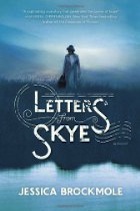
Review: Letters from Skye

Letters from SkyeJessica Brockmole, Letters from Skye

This epistolary novel tells two parallel love stories, each set against the backdrop of a world war. In 1912, Scottish poet Elspeth Dunn receives a fan letter from David Graham, an exuberant young American. Elspeth replies to the letter, and she and Davey soon strike up a regular correspondence. At first they discuss literature and their favorite books, but soon they’re exchanging ideas about everything under the sun, including their most secret dreams. Unsurprisingly, Elspeth and Davey fall in love, but their romance is fraught with complications. When America enters World War I, Davey enlists immediately as an ambulance driver on the battlefields of France. Additionally, Elspeth is already married, so her stolen moments with Davey are as fleeting as they are precious. Meanwhile, in 1940, Elspeth’s daughter Margaret — also involved in a wartime romance — stumbles upon one of Davey’s letters and decides to search for the secrets in her mother’s past.

In theory, I should love this book, since it combines a lot of my favorite things: epistolary novel, WWI and WWII setting, love stories, family secrets. But while I found it an entertaining read, my overall experience was somewhat disappointing. First of all, the story is really about Elspeth and Davey, so the parts about Margaret felt very cursory and not fleshed out at all. I would have liked to know a lot more about her reactions to her mother’s secret, as well as the details of her own romance. Also, the story itself seems very superficial, given the gravity of the WWI backdrop. Even though I enjoy light romances with happy endings, I felt like this book lacked emotional stakes. Elspeth and Davey are likeable characters, and their letters are often very charming, but I was never in any real doubt about the end result of their story. Maybe part of my problem is that this book seems like a copycat of The Guernsey Literary and Potato Peel Pie Society, only not nearly as good! Overall, this book is a nice, quick read, but it won’t stay with me the way Guernsey has.