Talented pastry chefs Sylvie Fairchild and Dominic De Vere have been professional rivals ever since their stint on Operation Cake four years ago. Sylvie was a contestant, Dominic was a judge, and her robotic unicorn cake creation may have gone rogue and hit him in the face. Now they’re competing for the most important job of their careers — a cake for an upcoming royal wedding. Their baking styles (and personalities) couldn’t be more different: Sylvie is all about whimsy and creativity, while Dominic sticks to classic perfection. But as they spend more time together, they discover a surprising mutual attraction and must figure out how to reconcile their romance with their career ambitions.
Lucy Parker is an auto-buy author for me, and I always worry that her latest book won’t live up to my sky-high expectations. Fortunately, in this case the worry was unfounded because I loved this book! While I don’t particularly care about baking shows or British royals, I do adore a grumpy/sunshine pairing, and the relationship between Sylvie and Dominic is every bit as swoony and satisfying as I’d hoped. The first few chapters are a little confusing — lots of characters and backstory to establish — and there’s perhaps a bit too much going on throughout the book. But that’s a tiny quibble that in no way diminishes my overall love for this novel. I already can’t wait for the next one!
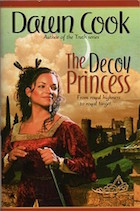
Tess has grown up believing she’s the crown princess of Constenopolie. But on the eve of her betrothal to a neighboring prince, she learns that she’s actually a decoy, installed at the palace to ensure that the true princess (who has grown up in hiding) won’t be assassinated. No sooner has she learned this shocking news than there’s a palace coup, in which the king and queen are killed and Tess must flee to avoid the same fate. Pursuing her is Jeck, a captain of the guard in the new regime, who has plans for her back at the palace. And then there’s Duncan, an attractive card sharp who wants her to team up with him and leave Constenopolie to its fate. I really liked the premise of this book and found it a fun, action-packed read. But while the main plot of this book is resolved, there are an awful lot of loose ends, from Tess’s surprising magical abilities to her romantic destiny. There is a sequel, Princess at Sea, and I’m eager to read it so that I can find out what happens! But on its own, this book isn’t totally satisfying, so I wouldn’t recommend it as a stand-alone.
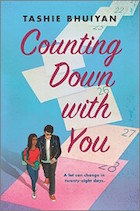
Tashie Bhuiyan, Counting Down with You
High school junior Karina Ahmed is under a lot of pressure. Her Bangladeshi parents are strict and focused on her academic achievements, expecting that she’ll become a doctor one day. Karina is more interested in English than STEM, but she’s afraid to admit this to her parents. She’s also a bit of a nonentity at school, but that all changes when her English teacher asks her to tutor the most notorious and good-looking boy in her grade, Ace Clyde. Ace turns out to be different from what Karina expected: he’s thoughtful and sensitive and dealing with his own family issues. As their relationship deepens, will Karina find the courage to go after what she really wants? This book was a cute, fast read, but I must admit I didn’t love it. I think Ace is just too good to be true; I can’t imagine an actual teenage boy being that sweet and emotionally fluent. Also, I couldn’t figure out what made him interested in Karina initially; she’s smart and funny and kind, but how would he know any of those things based on her mousy public persona? It seemed unrealistic and more like a wish-fulfillment trope. But fans of teen romance may like this one more than I did; maybe I’m just getting crotchety in my old age!
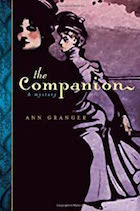
Ann Granger, The Companion
Left penniless when her father dies, Elizabeth Martin takes a job in London as companion to her late godfather’s wife, Mrs. Parry. Lizzie soon learns that Mrs. Parry’s previous companion, Madeleine Hexham, recently left without warning and hasn’t been seen since. Mrs. Parry and her friends think Madeleine ran off with a man, but Lizzie worries that something more sinister has happened. Meanwhile, Scotland Yard Inspector Ben Ross is investigating the murder of an unknown young woman who turns out to be Madeleine. When he and Lizzie meet in the course of the investigation, they team up to discover the killer. I quite enjoyed this Victorian mystery. There are times when the author’s research shows a little too much, but the wealth of detail also contributes to a believable setting. Lizzie is an outspoken, independent woman, but not implausibly so for her time. The book strikes a good balance between the mystery plot and social commentary, and there’s a hint of romance as well. I’ll look out for subsequent books in this series.
Cath and Paul have been best friends since college, and they also work together: Paul is a regional theater director, and Cath is a stage manager. Cath has been in love with Paul for years, but she’s never made a move for fear of ruining their friendship and professional relationship. Now they’re putting on a new play, and Cath’s nemesis Susan has been cast as the lead actress. Susan’s spiteful behavior irritates everyone but also forces some long-buried feelings into the open. I really wanted to love this book — I do community theater myself, so I was hoping for a lot of behind-the-scenes drama and hijinks. But the book focuses much more on Cath’s and Paul’s inner turmoil, and I found their conflict frustrating. One honest conversation could have solved everything! And I couldn’t figure out why Cath was so reluctant to share her feelings…it seemed like she should have had some traumatic backstory to explain the extent of her fear, but she didn’t (at least not on page). Overall, this book was OK but not what I wanted it to be.
Beth O’Leary, The Road Trip
Addie and Dylan used to be in love, but they broke up two years ago and haven’t spoken since. Now they’re both going to a mutual friend’s wedding, and when Dylan wrecks the car he’s driving, he and his best friend Marcus hitch a ride with Addie, her sister Deb, and another random wedding guest who needed a ride. The book jumps between the present-day road trip and the story of Addie and Dylan’s relationship in the past. I couldn’t put this book down, and I was surprised by how much it affected me emotionally. At the same time, though, I wasn’t necessarily rooting for Dylan and Addie to work things out! Their relationship seems based primarily (solely?) on physical attraction, and they don’t function particularly well as a couple. I also couldn’t relate to Dylan and Marcus, who are basically “poor little rich boys” distracting themselves from real life with sex, drugs, and their parents’ money. The book attempts to make them sympathetic by giving them some shallow backstory and (in Dylan’s case) a cartoonishly villainous father, but it doesn’t quite work. I did like the book overall, but I’m still deciding whether it’s a keeper for me. Oh, and notwithstanding the cover, it’s definitely more of a drama than a comedy.
India Holton, The Wisteria Society of Lady Scoundrels
Miss Cecilia Bassingthwaite is a proper young Victorian lady, and also a pirate. In fact, she’s a junior member of the Wisteria Society, England’s most prestigious and fearsome league of piratical ladies. When another Society member hires an assassin to kill her, Cecilia thinks she’s finally made it: now the Society will have to take her seriously and promote her to senior membership. But things start to go wrong when the assassin, Ned Lightbourne, turns out to be dangerously attractive and charming. Then the villainous Captain Morvath, an evil pirate and even worse poet, kidnaps the rest of the Society, leaving only Cecilia to save the day. Hijinks ensue, complete with flying houses, literary allusions, ghosts, thievery, and a touch of romance. This book won’t be for everyone; it’s a ridiculous romp in which the rules don’t make sense, there’s very little character development, and the tone is gleefully ahistorical. To enjoy it, you have to let the silliness wash over you — and be someone who appreciates Brontë references and dick jokes in equal measure. Honestly, I loved it! Can’t wait for the sequel next year!
This YA historical novel is a spin on Pride and Prejudice: Lizzie Bennet dreams of being a barrister, but since such a career is unheard of for a woman, she’s currently an unpaid assistant at her father’s law firm. She hopes that scoring a big client for the firm will convince Mr. Bennet to hire her; when the rich and socially prominent Mr. Bingley is accused of murdering his brother-in-law Mr. Hurst, Lizzie hopes Bingley will be that client. Unfortunately, Bingley is already represented by the arrogant Mr. Darcy, but that won’t stop Lizzie from doing some investigating of her own. The writing style is a bit clunky (too modern, too American), and Lizzie annoyed me sometimes — she’s much more headstrong and obnoxious than the original Elizabeth Bennet. But I did enjoy the book’s creative way of integrating P&P’s characters into a murder mystery plot. It’s a fun, fast read, so I’d recommend it if the premise interests you. I think a series is planned, so I may check out the sequels too.
Christina Pishiris, Love Songs for Skeptics
Zoë Frixos has what many people would consider a dream job: she’s a music journalist at a respected London magazine. But the magazine is in trouble, and the only hope of saving it is to score an interview with famous yet reclusive rock star Marcie Tyler. In her quest to get the interview, Zoë keeps butting heads with Marcie’s publicist, Nick Jones, who is as arrogant and hostile as he is (frustratingly) attractive. Meanwhile, Zoë also has to sort out her personal life, as her childhood best friend and first love, Simon, has just moved back to town. This book was published in January 2021, but it feels like a throwback to the chick-lit heyday of the ‘90s. That’s not necessarily a bad thing — I enjoyed Zoë’s first-person POV, the predictable career and relationship angst, and the musical references peppered throughout. I didn’t particularly buy the romance, though. Because we never get the hero’s POV, he remains pretty opaque, and I couldn’t figure out what drew him to Zoë. Overall, not bad but not great — it was worth the $2.99 sale price I paid for the e-book, but I’m glad I didn’t pay full price.
Jessica Brockmole, At the Edge of Summer
When 15-year-old Clare Ross’s father dies, she is taken in by her parents’ old friends in France, Monsieur and Madame Crépet. At first she’s shy, grief-stricken, and lonely; but when the Crépets’ son Luc comes home from university for the weekend, Clare finds an unexpected friend. Their relationship deepens over the course of the summer, but eventually Clare moves out to live with her grandfather, and she and Luc can only be close via letters. Then World War I intervenes, but of course they are destined to meet again. I liked this book; it’s sweet and a little sad but ultimately hopeful. The main characters are endearing, particularly Luc. But the love story was almost too romantic for me, verging on the sappy. And I would have liked a little more plot; despite Luc’s wartime experiences and Clare’s travels, not a lot actually happens. Overall, this is an enjoyable read, but like Brockmole’s previous book, Letters from Skye, I didn’t love it.
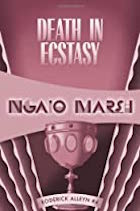
This fourth installment of the Inspector Roderick Alleyn series centers around the members of a neopagan religion, the House of the Sacred Flame. During one of its rituals, devout initiate Cara Quayne drinks from a ceremonial goblet and immediately collapses — not from spiritual ecstasy, as some of the worshippers believe, but from cyanide poisoning. Alleyn is on the case, assisted by his colleague Inspector Fox and his journalist friend Nigel Bathgate. Their investigation uncovers various dirty little secrets about the cult and eventually leads them to the murderer. The mystery plot was clever and fairly clued (though I didn’t guess the killer’s identity), and I enjoy Marsh’s writing style, especially the banter between the investigators. But I wasn’t a huge fan of the cult setting — the novel paints it as completely sordid and unpleasant, and I felt that way while reading. Nevertheless, I’ll definitely continue with the series at some point.
Uzma Jalaluddin, Hana Khan Carries On
Hana Khan is the 24-year-old daughter of Indian Muslim immigrants to Toronto. Her family is having a rough time: her father is recovering from a car accident, her older sister is having a difficult pregnancy, and the family’s halal restaurant is struggling. When a rival halal restaurant threatens to move into the neighborhood, Hana is horrified and determined to stop it — never mind that the owner’s son, Aydin, is surprisingly cute and fun to talk to. Hana is also struggling at work; she dreams of producing her own radio show, but for now she’s an unpaid intern, and her (white) boss isn’t interested in her ideas unless they’re stereotypical stories about Muslims. Will Hana be able to follow her dreams, help her family, and maybe even find love? I really enjoyed this light, fun novel, although there is quite a lot going on (I didn’t even mention the small You’ve Got Mail subplot!). Hana is a relatable character whose voice I really enjoyed, and it was nice to see her grow throughout the novel. I should note that the plot does include an Islamophobic attack on Hana and her friends, which is tough to read. But the book is ultimately joyful and uplifting, and I would definitely recommend it to fans of romantic comedies!
Maggie Stiefvater, Mister Impossible
After the events of Call Down the Hawk, Ronan, Hennessy, and Bryde are running from the Moderators and making a plan to strengthen the power of the ley lines. Jordan has discovered the existence of sweetmetals, artifacts that can keep dreams awake even if their dreamers die; Declan joins her in her quest to create one. Matthew is processing the fact that he’s a dream and not a “real” person. Carmen has been working with the Moderators but eventually comes to a crossroads. OK, so none of that summary will make sense unless you’ve read Call Down the Hawk, and possibly the Raven Cycle as well. It’s book 2 of a planned trilogy, and storylines are not resolved; rather, the book ends by setting up the final conflict that will play out in book 3. I’ll admit, much as I love Ronan, I found his story the least compelling; I was much more interested in Declan (my unexpected favorite!), Jordan, and Matthew. But I’m a big fan of Stiefvater’s writing and general vibe, so I enjoyed this book and can’t wait to see how everything turns out!
Don’t let the bright colors and cartoonish art fool you: this is primarily a book about grief. Thirty-something Eve and her three best friends have been inseparable since college; they know, love, and understand each other in a way that no one else can. At the beginning of the novel, one of them dies, and Eve spends most of the book trying to cope with her grief and process the aftermath. She also uncovers a devastating secret that profoundly affects her life, as well as the dynamic of the friend group. There is, in fact, a love story that I quite enjoyed, but it doesn’t really get going until the last third of the book or so, and it seems a bit incongruous with what came before. Nevertheless, I devoured the book in one sitting and stayed up far too late to finish it! So I did like the book overall, although I think I still prefer If I Never Met You.
Robin McKinley, ed., Imaginary Lands
I picked up this short story collection based solely on Robin McKinley’s name, but unfortunately, as with most short story collections, I found it a mixed bag. Below are my thoughts on the individual stories, but my overall opinion is that even if you’re a fantasy lover, you can skip this one.
James P. Blaylock, “Paper Dragons” – This story won the 1986 World Fantasy Award for short fiction, and I have no idea why. Nothing happens! And we’re introduced to a lot of characters and bits of history and mythology that are never fully explained or given context. A frustrating read, for me.
Patricia A. McKillip, “The Old Woman and the Storm” – This one is set at the dawn of time, and it has a very elevated, myth-like style that got on my nerves. I did like the resolution to the story, but overall it just wasn’t my jam.
Robert Westall, “The Big Rock Candy Mountain” – In the early 20th century, a family of American tourists is forced to stay overnight in an English salt-mining town that is slowly sinking into the earth. Probably my favorite story in the bunch, perhaps because of its lively, comedic tone.
Peter Dickinson, “Flight” – A “history” of a fictional empire that repeatedly tries and fails to conquer a stubborn territory whose residents use hang glider-esque devices to fly. The narrative device was my favorite part of this one; it allowed for some fun satire about real-life history and government policy.
Jane Yolen, “Evian Steel” – Sort of a prequel to Arthurian legends. Well-written, but I think I’d have gotten more out of it if I knew more about Arthuriana.
P.C. Hodgell, “Stranger Blood” – Probably the most traditional “high fantasy” story in the collection, set on the borderland of a Great Evil that is going to kill everyone unless our heroes can stop it. I liked this story, but it felt unfinished; if it were expanded into a novel, I’d be curious to read it.
Michael de Larrabeiti, “The Curse of Igamor” – A short fable-like tale with a killer horse and rich bad guys who get their comeuppance. I liked this one.
Joan D. Vinge, “Tam Lin” – A Tam Lin retelling, as the title indicates, and one with a somewhat unsettling ending. I prefer The Perilous Gard by Elizabeth Marie Pope or Fire and Hemlock by Diana Wynne Jones.
Robin McKinley, “The Stone Fey” – This story has a lot of the things I love about McKinley’s writing — a sympathetic heroine, lovable secondary characters, great animals — but I wanted to know a lot more about the titular stone fey. He’s a catalyst for the story’s action rather than a character in his own right, and I wanted to know what his deal was. I feel like this story is only for McKinley completists like me…and even then, maybe not.
Kate Noble, The Dress of the Season
Harris Dane, Viscount Osterley, is known to Society as “Austere Osterley” for his serious, some might say rigid, demeanor. But that doesn’t stop him from pursuing a lovely widow as his mistress. He purchases a scandalous gown for her, and at the same shop he also buys a pair of gloves for his ward, Felicity Grove. When the packages are sent to the wrong women and Felicity mistakenly receives the dress, scandal erupts, leading to a chain of events neither Harris nor Felicity could have anticipated. I read this cute Regency romance novella in an afternoon. It’s not particularly authentic in terms of writing style, and the short length prevented me from getting very emotionally invested in the characters. But I found it a fun read and would definitely try more by this author.
In 1922, Count Alexander Ilyich Rostov is arrested and tried for the crime of being an aristocrat. But because he once wrote a poem with a revolutionary message, he isn’t immediately killed; instead, he is sentenced to house arrest for life in Moscow’s Metropol Hotel. As Alexander lives out his days in the Metropol, he befriends a variety of people, including hotel employees, Party officials, a beautiful actress, and (most significantly) a solemn young girl named Nina. Despite the turbulent political situation in the country as a whole, this novel focuses on one man’s life as he adapts to extraordinary circumstances. Like everyone else, I loved this book! The pace is slow, and there aren’t many dramatic events, but it felt like real life to me. There are some delicious satirical jabs at the broader political situation in Russia/the USSR, but the novel focuses primarily on Alexander’s own experiences. I would definitely recommend this to anyone who enjoys historical fiction!
Beatriz Williams, Lauren Willig, and Karen White, All the Ways We Said Goodbye
This is one of those historical novels with multiple storylines set in three different time periods. In 1914, Aurélie de Courcelles abandons her luxurious life with her mother at the Paris Ritz and runs to her father’s ancestral home, which is later invaded by German soldiers. In 1942, Daisy Villon is primarily concerned with keeping herself and her children safe in occupied France, but she is eventually drawn into the resistance effort and an illicit love affair. And in 1964, Babs Langford travels from England to Paris in search of information about her deceased husband’s war years. Overall, I liked this book and found it entertaining; there’s a lot of drama and excitement to keep the pages turning, and I do love a good WW2 spy plot. On the other hand, the plot twists and “reveals” are quite predictable. And while I liked all three stories, I think they were a little much for one book; perhaps the authors should have eliminated the 1964 story and focused on the other two in greater depth. As I said, I enjoyed the book overall, but I didn’t like it as much as these authors’ previous book, The Glass Ocean.
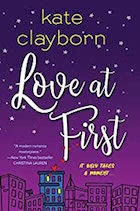
Kate Clayborn, Love at First
Nora Clarke loves her Chicago apartment building; her happiest childhood memories were spent there with her grandmother, and she’s known and loved her neighbors all her life. So when the building’s owner dies and his nephew, Will Sterling, inherits it, Nora is terrified that things will change. In fact, Will has no interest in owning or living in the building, so he decides to rent out his uncle’s unit to short-term tenants. Aghast, Nora is determined to stop him; but the more time she spends trying to persuade Will, the more she is attracted to him. I was a bit nervous about this book since I enjoyed Love Lettering so much, but thankfully I ended up loving this one too! I liked that the characters actually move on from the apartment conflict pretty quickly; they each come to understand the other’s position and are both willing to compromise. The real obstacles to their relationship are their fears and insecurities, which I found very realistic. I was rooting so hard for Will and Nora, and I enjoyed the quirky secondary characters as well (Will’s buttoned-up boss might be my favorite). And as with Love Lettering, I adored Kate Clayborn’s writing style. Fans of contemporary romance with minimal drama, where people actually deal with their problems like adults, should definitely check out this author!
Grieving the untimely death of her sister, Eva Ward decides to scatter her sister’s ashes at Trelowarth House in Cornwall, where they’d spent many happy summers as children. When she gets there, Eva is pleased to reconnect with the Trelowarth family and help them maintain the estate by setting up some new tourist attractions. But she also has some strange experiences and eventually discovers that she’s been going back in time, seeing Trelowarth as it was in the early 1700s. She also meets the house’s former inhabitants, one of whom, Daniel, soon captures her heart. But Daniel’s world is dangerous, especially because of his illicit smuggling career and his Jacobite sympathies. Eventually Eva must decide where she truly belongs. I enjoyed this novel but didn’t love it as much as I loved A Desperate Fortune. I wasn’t particularly interested in the time-travel element or the contemporary storyline; I would have preferred a straightforward historical novel. Maybe that’s why it took me several days to finish the book, even though I liked the overall story, characters, and writing style. It was just missing that spark for me.
Richard Osman, The Thursday Murder Club
The Thursday Murder Club is a group of four residents of a senior living facility, who meet once a week to discuss — and hopefully solve — various cold cases. So when a present-day murder lands on their doorstep (literally; the victim is the boorish owner of the senior living facility), they’re eager to get involved. But as the bodies continue to pile up, the investigation becomes more dangerous, and one of the club members might even be the next victim. I really enjoyed this mystery novel; it’s clever and funny, and I liked all the main characters, pensioners and police alike. I do feel like the plot falls apart a little bit toward the end. But ultimately, it was just a pleasure to read, and isn’t that all you can really ask of a book? There’s at least one sequel planned (coming out this fall in the US), and it’s definitely on my TBR list.
Marisa de los Santos, Love Walked In
Cornelia Brown is a 30-something barista in a Philadelphia café, trying to figure out what to do with her life. Then one day, a Cary Grant look-alike walks into the café and changes everything. Meanwhile, an 11-year-old girl named Clare is having problems at home: her father is absent, and her mother is behaving strangely. As her mother’s condition worsens, Clare becomes increasingly terrified that something awful will happen and she’ll be separated from her mom. When Cornelia’s and Clare’s paths converge, they transform each other in surprising ways. I loved this book and stayed up way too late to finish it! But despite the romantic title and chick-lit-esque marketing, it’s a tough read at times. Clare’s situation with her mother is heartbreaking and difficult, so if you’re not up for reading about mental illness and child neglect/abandonment, maybe skip this one. But the book is certainly hopeful and uplifting overall, and there is even a romance, though it’s not my favorite part of the story. I’m eager to read more by this author!
Cassie Hanwell loves being a firefighter in Austin, Texas; she’s extremely good at her job and is happy to devote her whole life to it. So she’s not thrilled when she is forced to transfer to a small town in Massachusetts to care for her estranged mother during a health crisis. The local fire department is old, outdated, and all male, so Cassie knows she’ll have to struggle to be accepted. As Cassie battles her colleagues’ hostility and resists her mother’s attempts at reconciliation, she grows as a person and decides who she really wants to be. I really liked this book and stayed up far too late to finish it! I found Cassie extremely sympathetic, and I loved how tough and competent she was. There’s also a sweet romance that I was completely on board for. I did feel the ending was a bit too neatly tied up in a bow — and this is coming from someone who likes tidy endings! — but aside from that, I enjoyed this book and look forward to reading more by Katherine Center.
Sherry Thomas, The Hollow of Fear
***Warning: SPOILERS for previous books in the series!***
In this third installment of the Lady Sherlock series, Charlotte Holmes faces her most difficult case yet. Lady Ingram, who disappeared after the events of A Conspiracy in Belgravia, has now been found — dead, in the icehouse on Lord Ingram’s country estate. Of course, Lord Ingram is the prime suspect; everyone knew that he and his wife were estranged, and rumors are swirling about a romance between him and Charlotte. As Scotland Yard builds its case against Lord Ingram, Charlotte works incognito to discover what really happened. I’m very much enjoying this series, and this book is no exception. Though I guessed some elements of the mystery, other plot twists were genuinely shocking. There is a point at which the narrative doubles back to fill in some blanks about earlier events, which I found irritating — it’s the kind of gimmick that would work better in a movie, I think. But otherwise, I liked this book a lot and look forward to seeing what happens next with Charlotte and her friends!
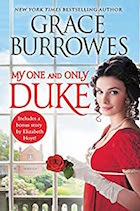
Grace Burrowes, My One and Only Duke
Quinn Wentworth is a convicted murderer awaiting execution. Jane Winston is a minister’s daughter visiting Newgate prison. She’s widowed, pregnant, and desperate to get away from her sanctimonious father, so Quinn proposes marriage. He can provide money for her and the child to live on, and because he’s soon to die, she won’t be stuck with him for long. Jane agrees to the deal, only to be shocked when Quinn is discovered to be the heir to a dukedom and pardoned at the last minute. Now Quinn and Jane must decide whether and how to make their marriage work; but Quinn is determined to find whoever framed him for murder and take his revenge. I found this book mildly enjoyable, but the stakes are pretty low. There aren’t really any obstacles to Quinn and Jane’s romance, and the mystery plot of who framed Quinn doesn’t get a lot of time “on page” either. Basically, I never got emotionally invested in the story or characters. This is the first book in a series, and I am mildly interested in a few of the secondary characters, so I may continue with the series at some point — but I’m not in a big hurry to do so.
This novel follows the lives of four women who all work at Goode’s department store in 1950s Sydney, Australia. Patty, in her mid-30s, is married but unhappily childless, and her husband Frank is oblivious to her emotional turmoil. Fay is around 30 and has been going out with men for years, but somehow none of them seem to want to marry her. Lisa, a temporary hire for the Christmas season, dreams of going to university and becoming a poet, but her strict father won’t hear of it. And Magda, a glamorous Slovenian immigrant, is adjusting to a culture very different from her own. I loved this book and devoured it in a single sitting. It’s light and charming and slyly funny, and I became invested in the stories of all four women. I especially loved Magda, who enjoys the finer things in life and is generous in sharing them. There’s a bit of romance, but the main focus is on women’s experiences and relationships. The book reminds me a bit of Miss Pettigrew Lives for a Day, but with a slightly more satirical edge. I expect to revisit it often and would recommend it as a great comfort read!
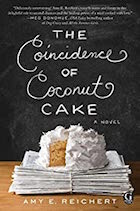
Amy E. Reichert, The Coincidence of Coconut Cake
Milwaukee restaurateur Lou Johnson is having a run of terrible luck. First her fiancé cheats on her; then, that very night, food critic Al Waters samples her cooking — which is subpar because of her distress over the breakup — and writes a scathing review. The day the review comes out, Lou goes to a bar to drown her sorrows and meets Al. They’re attracted to each other and soon strike up a romance. The only problem is, he doesn’t realize she owns the restaurant he panned, and she doesn’t know he’s the hostile reviewer because he writes under a pen name. I’m a sucker for a You’ve Got Mail story, and this is a fun one that made me want to visit Milwaukee and eat some fried cheese curds immediately. I never quite believed in Lou and Al as characters; they seemed like stock types rather than real people to me. But I liked the setting and the overall cheerful, Hallmark-esque vibe of this novel, so I’d consider trying more by this author.
Paula Byrne, Belle: The Slave Daughter and the Lord Chief Justice
The idea for this book came from an 18th-century English portrait of two young women — one white, one black — who are portrayed as equals, almost as sisters. The black woman was Dido Elizabeth Belle, the illegitimate daughter of an English naval captain and an African slave. She grew up in the house of her great-uncle, the Earl of Mansfield, who happened to be the Lord Chief Justice and who decided several cases that would be crucial to the antislavery movement in Britain. It’s a fascinating story, but unfortunately, there’s very little about Dido in the historical record, and consequently very little in the book! Instead, Byrne focuses on the English slave trade, the status of black individuals in London, the Earl of Mansfield’s legal career, etc. It’s all interesting, but I was hoping for more biography, less history. The book does have numbered endnotes, many of which cite primary sources, yet Byrne also editorializes a fair amount. I’d say it’s more of a popular history than a scholarly one. Overall, I’d recommend it for people who are interested in the period. Apparently there’s also a movie about Dido, called Belle, which I’m interested in watching now.
Here is the portrait of Dido and her cousin, Elizabeth Murray:










 You Book Me All Night Long