Review: A Proper Companion

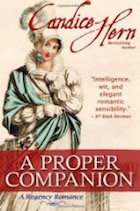
Proper Companion, ACandice Hern, A Proper Companion

Robert, Lord Bradleigh, is a rakish earl with a recently arranged betrothal to a lovely young girl he barely knows. Emily Townsend is an impoverished spinster employed as a companion to his grandmother, the formidable dowager countess. Robert agrees to help his grandmother find a husband for the beautiful Emily. But once he comes to know the charms of his grandmother’s companion, he begins to regret his hasty engagement.

This sparkling tale will take you from the Pump Room at Bath to the ballrooms of London as the unexpected and undeniable attraction between Robert and Emily blossoms into something more … something that could put one of them in danger. (Summary from Amazon.com.)

I’m going to be honest: I read this book about two months ago, and I truly don’t remember a thing about the plot. I think maybe Emily had another suitor who turned out to be evil in some way, but I’m not sure. And maybe Robert’s fiancée ended up falling in love with someone else? Like I said, the details have completely gone out of my head. So, obviously, this was not a particularly great read for me…but it wasn’t particularly awful either, or I would have remembered it! From what little I recall, the writing style was fine but not great; but after all, only a few authors can flawlessly imitate that Regency voice. I’m sure I did enjoy the book while I was reading it, because I remember looking up the sequels on Amazon (although I didn’t actually purchase them). I suppose lovers of non-bodice-ripping Regency romances would enjoy this book, but I can’t really recommend something that I can’t remember!

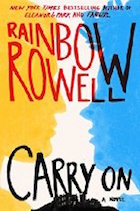
Review: Carry On

Carry OnRainbow Rowell, Carry On

Simon Snow is the worst Chosen One who’s ever been chosen.

That’s what his roommate, Baz, says. And Baz might be evil and a vampire and a complete git, but he’s probably right.

Half the time, Simon can’t even make his wand work, and the other half, he starts something on fire. His mentor’s avoiding him, his girlfriend broke up with him, and there’s a magic-eating monster running around, wearing Simon’s face. Baz would be having a field day with all this, if he were here–it’s their last year at the Watford School of Magicks, and Simon’s infuriating nemesis didn’t even bother to show up. (Summary from Amazon.com.)

As you can see, I had A LOT of feelings about this book! So if you just want the short version, skip to the last paragraph!*

Fellow lovers of Rainbow Rowell will remember her novel Fangirl, in which protagonist Cath is obsessed with the Simon Snow series and is writing fanfiction about two of its principal characters, Simon and Baz. While I really liked Fangirl overall, I noted that the “excerpts” from the Simon Snow books and from Cath’s fanfic were my least favorite parts of that novel. So, I was less than enthused when I learned that Carry On would be Rowell’s own version of the Simon/Baz romance.

I had other issues with the concept of Carry On as well. In Fangirl, it’s obvious that Simon Snow is meant to be a stand-in for Harry Potter (which makes the single HP reference in Fangirl extremely jarring!), so Carry On is, in a sense, HP fanfic. That made me feel apprehensive and a little icky, like Rowell was essentially ripping off J.K. Rowling and taking advantage of the devotion of the HP fandom. I don’t attribute any malicious motives to Rowell — I’m sure she would view Carry On as more of an homage than a copy — but the world of Simon Snow is uncomfortably similar to the world of HP.

Then there’s my own stance on fanfiction, which is that I don’t really get it. Not to take away from anyone else’s pleasure in reading or writing it, but I’ve never personally been that interested in it. I do understand the desire to remain in a beloved world and explore it further, especially if the original author left certain stories hanging and you need some closure for them. But I tend to believe the author wrote the stories s/he intended to write, and it’s not my job as a reader to “fix” storylines that didn’t turn out the way I wanted them to. So, to take the most relevant example, I know there’s a lot of Harry/Draco fanfic out there. But in the actual HP series, it’s obvious that Harry is heterosexual, and (spoilers) he eventually marries and procreates with Ginny. So I honestly don’t understand the impulse to pair Harry and Draco in fanfiction. I don’t mean to insult anyone who enjoys fanfic or who ships Harry/Draco, but I would not personally be interested in reading a slash fanfic about those characters — which is essentially the plot of Carry On, just with different character names.

AND YET.

I actually ended up liking Carry On a lot more than I expected to! Yes, the setting and principal characters are all very reminiscent of HP, and that still does bother me. I also wasn’t particularly invested in the monster plot and all the backstory about where the monster came from and all of that. It was predictable and rather generic for a fantasy novel. But one of Jenny’s (of Reading the End) comments really resonated with me: “I think Rainbow Rowell maybe just is not that good at plot.” YES. This is true of all her novels, which generally don’t have much plot to speak of. Where Rowell shines is her characters, who are flawed and struggling but also hopeful and determined to find a happy ending. I sympathized with Simon, who feels crushed by the weight of his “chosen” status and his inability to live up to everyone’s expectations. Penelope was a great friend, practical and loyal, even though she was a bit too Hermione-ish. And I adored Baz, as I always adore disdainful, elitist, painfully elegant antagonists who turn out to be not-so-secret heroes.

*The short version: I was nervous about Carry On, and if anyone other than Rainbow Rowell had written it, I definitely wouldn’t have read it. But I decided to trust Rowell, and I’m glad I did. For me, the positives (great characters and dialogue) outweighed the negatives (most notably, the extensive similarities to HP). If you’re on the fence about this book, I would encourage you to give it a try! And I’ll note that you definitely do NOT have to read Fangirl first, although you should read it anyway because it’s really good. 🙂

Review: A Curious Beginning

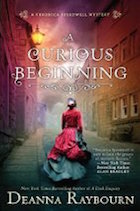
Curious Beginning, ADeanna Raybourn, A Curious Beginning

London, 1887. As the city prepares to celebrate Queen Victoria’s golden jubilee, Veronica Speedwell is marking a milestone of her own. After burying her spinster aunt, the orphaned Veronica is free to resume her world travels in pursuit of scientific inquiry—and the occasional romantic dalliance. As familiar with hunting butterflies as she is fending off admirers, Veronica wields her butterfly net and a sharpened hatpin with equal aplomb, and with her last connection to England now gone, she intends to embark upon the journey of a lifetime.

But fate has other plans, as Veronica discovers when she thwarts her own abduction with the help of an enigmatic German baron with ties to her mysterious past. Promising to reveal in time what he knows of the plot against her, the baron offers her temporary sanctuary in the care of his friend Stoker—a reclusive natural historian as intriguing as he is bad-tempered. But before the baron can deliver on his tantalizing vow to reveal the secrets he has concealed for decades, he is found murdered. Suddenly Veronica and Stoker are forced to go on the run from an elusive assailant, wary partners in search of the villainous truth. (Summary from Amazon.com.)

I’ve read and enjoyed the first few Lady Julia Grey books, so I was excited to learn that Raybourn has begun a new mystery series featuring intrepid lepidopterist Veronica Speedwell. Unfortunately, this book really didn’t work for me. It’s a good read in the sense that it’s well written and moves quickly, but I couldn’t get over my dislike of both Veronica and her partner/love interest, Stoker. Historical fiction can be difficult because the protagonists should be realistic for their time period but also sympathetic to modern readers. Veronica errs on the side of being far too modern for her era. She pursues a scientific career by traveling all over the world without a chaperone, and she engages in a variety of sexual affairs, apparently without any consequences to her reputation as a gentlewoman. I simply didn’t find her believable. As for Stoker, he’s a generic brooding alpha male type, and that’s basically all you need to know. It’s not a bad book, by any means, but it didn’t deliver what I look for in historical fiction.

Review: Unnatural Death

Unnatural DeathDorothy L. Sayers, Unnatural Death

While dining out one day, Lord Peter Wimsey and his friend Inspector Parker are discussing so-called accidental deaths that might actually be murders. A young doctor overhears them and joins their conversation. He shares the story of a former patient, an elderly woman with cancer who died rather suddenly. She was terminally ill, and no signs of foul play were found on the body, so everyone believed her death was natural; but the doctor was nevertheless suspicious because she had seemed to be improving lately. The woman’s great-niece and presumed heiress was living with her at the time, so she had opportunity, but her motive was questionable because the old lady would die soon enough from natural causes. Lord Peter is intrigued by the case and decides to investigate. He employs Miss Climpson, a chatty but intelligent spinster, to temporarily relocate to the dead woman’s village and do some discreet investigating. Meanwhile, he and Parker search for other suspects, motives, and possible methods of the murder.

After rediscovering Dorothy Sayers earlier this year, I’ve embarked on a project to read all her Lord Peter Wimsey books in publication order. This is book #3 in the series, but if I recall correctly, it can be read as a standalone. I enjoyed this book a lot, but I feel like it’s a very unusual detective story. Despite a high body count, it doesn’t feel very action-packed or plot-driven. The main mystery is not whodunnit, but why and how. One of the biggest clues to the motive is a tiny change in an obscure property statute. Nevertheless, I found the mystery compelling and was eager to solve the complete puzzle of how and why the murder took place. Also, Miss Climpson is delightful; this is her first appearance in the series, but I believe she’ll be a recurring character in future books. She reminds me somewhat of a Jane Austen character — one of the good-hearted chatterboxes, like a more intelligent Miss Bates. I wasn’t completely on board with the characterization of the villain, whose psychology didn’t ring true for me. I doubt this will be my favorite Sayers mystery, but I did enjoy it and look forward to reading the rest of the series.

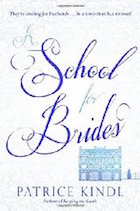
Review: A School for Brides

School for Brides, APatrice Kindl, A School for Brides

The students of the Winthrop Hopkins Female Academy all know that their primary goal is not to receive a scholarly education but to learn the ladylike skills necessary to attract a husband. The problem is that the school is located in Lesser Hoo, Yorkshire, a country village with absolutely no eligible men. There are currently six girls of marriageable age at the school, and they are constantly bemoaning the dearth of potential husbands in the area. Fortunately, a chance encounter with some gentlemen who are visiting a nearby estate for hunting season provides them with all the romance and intrigue their hearts desire. Some of the girls fall in love with relative ease, while others find various obstacles in their paths. But when a valuable necklace goes missing and the school’s footman is the chief suspect, the girls and their paramours band together to clear his name and find the real culprit.

I had previously read and enjoyed Patrice Kindl’s [Keeping the Castle], which is set in the same village and features some of the minor characters in this book. So I was predisposed to enjoy this novel, and by and large I found it a pleasant read. The writing is light and brisk, very evocative of Georgette Heyer’s style (though of course not as good). I also liked the fact that the girls’ romances develop in a variety of ways. Some of them are true love stories with a happy ending, but some of them end in heartbreak, while one girl marries a kind man she doesn’t love after being betrayed by another suitor. This variety of outcomes especially makes sense in the Regency era, when marriage was basically the only choice for a gently bred young woman. The one thing I didn’t like was that, because of the sheer number of characters to follow, none of them are given much depth. I wasn’t particularly invested in any of the romances, nor did the mystery of the stolen necklace hold my interest (mostly because it was so easy to figure out). But for those who enjoy witty Regency fluff, I’d recommend this book as a fun read.

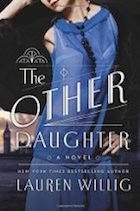
Review: The Other Daughter

Other Daughter, TheLauren Willig, The Other Daughter

Working-class Rachel Woodley is currently employed as a governess in France, but she must return to England in a hurry when she learns that her mother is ill. By the time she gets back to her native village, her mother has died. As a grieving Rachel sorts through her mother’s possessions, she discovers a shocking secret: her father, whom she believed had died many years ago, is actually alive and well. Moreover, he’s an earl with a wife and daughter — his legitimate family. Shocked and angry, Rachel decides she must confront her father somehow. With the help of Simon Montfort, a young gentleman who is part of the earl’s social circle, Rachel assumes a new identity in order to get closer to her father. As she infiltrates the crowd of Bright Young Things in 1920s London, she manages to meet her half-sister and even obtain an invitation to the earl’s home. But the more she gets to know this side of her family, the more Rachel wavers in her desire for revenge.

While I adore Lauren Willig’s Pink Carnation series, her standalone novels have been a bit less successful, in my opinion. They usually lack the humor that makes the Pink Carnation books so much fun, and Willig’s trademark dual narratives (one historical, one contemporary) would split my focus in a way that I found very distracting. Happily, in this book, there is no contemporary framework narrative; the entire book follows Rachel’s journey in the 1920s. Perhaps for this reason, I ended up really liking the novel! I found Rachel’s motivations and feelings very believable, as she tries to deal with the fact that her entire identity has shifted. I also like that her feelings slowly change as she realizes that neither her father nor her half-sister is the pure villain she imagined at first. Of course, there’s a romance in the book as well, which I enjoyed very much — Simon is a delicious hero with a very interesting backstory. Overall, I liked this book a lot and would definitely recommend it to fans of historical fiction!

Review: The Twelfth Enchantment

Twelfth Enchantment, TheDavid Liss, The Twelfth Enchantment

As a young woman of no fortune in 19th-century England, Lucy Derrick’s choices are extremely limited. Her parents are dead, so she is forced to live with her odious uncle and his cruel housekeeper. Her only means of escape is to accept the advances of a prosperous local mill owner, but she doesn’t love the man and has delayed making a final decision. But everything changes when Lucy encounters the dashing Lord Byron, the principal landowner in the area. Byron shows up on Lucy’s doorstep with a mysterious illness that is soon revealed to be magical in origin. To Lucy’s surprise, she is actually able to help him through exercising her own magical abilities. This chance encounter leads Lucy into a shadowy world whose existence she had never before suspected — a world of changelings and faeries and soulless beings who cannot die. Assisted by her friend Mary Crawford (of Mansfield Park fame) and by Jonas Morrison, the man who once broke her heart, Lucy must navigate a supernatural power struggle and find an ancient spell book that will vanquish her immortal enemies once and for all.

This was my first encounter with David Liss, and I think it’s probably not the right entry point into his work. My understanding of his other books is that they are serious historical fiction, with plenty of exploration of the gritty realities of life in former eras. This book contains a lot of those same concerns, with Luddites and Rosicrucians both being fairly integral to the plot. But at the same time, this novel also has a lot of Regency romance tropes, like the lovely but impoverished young woman who seeks marriage both for love and for economic stability. As a result, the book felt slightly schizophrenic to me. Personally, I was more interested in Lucy’s individual character development and her romantic relationships than in the broader power struggle, so everything about the aforementioned Luddites and Rosicrucians was a real slog for me. In other words, it’s too heavy for a light, fluffy read; but the Regency-romance elements detract from the serious historical fiction aspects of the book. Some things did work for me, particularly the central romance, but overall I think the book suffers from trying to blend two very different genres.

Review: Illusionarium

IllusionariumHeather Dixon, Illusionarium

Jonathan has always viewed himself as a completely ordinary young man. He works as an apprentice to his father, one of the foremost scientists in the city, but he is preparing to go to university in a few months. However, all his plans are derailed when the king tasks his father with an important assignment. All throughout the country, a terrible illness is gripping its women, and now the queen has succumbed. Jonathan and his father have only a few days to find the cure before she dies. Their only hope seems to lie with Lady Florel, the most famous scientist in the country. She suggests using a drug called fantillium, which causes shared hallucinations and can thus be used to speed up the apparent passage of time. This will effectively give Jonathan and his father more time to experiment with a cure. Jonathan soon discovers that he is skilled at using fantillium to create hallucinations, or illusions, to impress his audience. But his use of the drug has a dark side, as well as the potential for a shockingly drastic effect on his entire society.

This is a book with a lot of interesting ideas, but it all felt a little half-baked to me. I think the problem is that there are too many plotlines for this relatively short novel, and I wasn’t sure where I was supposed to focus my attention. There’s the “race against time to find a cure for the disease” story, which does get resolved in the end, but we still don’t know much about what caused the disease or why it only affects women (at least, not that I can remember). There’s the “look at this cool drug that causes illusions, but what about the possible negative consequences?” story, which is probably the most developed plot. But to me, it seemed a bit inconsequential in the end…while the illusions would probably be great to watch on the big screen, they’re not particularly exciting in book form. And then there’s some business with parallel universes, but those are never really explained or explored either. I did like Jonathan as a character, and I loved his enemy-turned-ally Lockwood. But unfortunately, character development definitely takes a backseat to plot in this book. Overall, it’s not a bad read, but I wasn’t particularly engaged by it.

Review: Funny Girl

Funny GirlNick Hornby, Funny Girl

This novel, set in the 1960s, tells the story of Barbara, a girl whose only dream growing up was to go on television and make people laugh. When she wins a local beauty pageant and realizes that she’s about to become stuck in a small-town rut forever, she moves to London to pursue her goal. Her good looks attract the attention of an agent, but all he wants is for her to stand there and look pretty in various insipid commercials. Eventually, however, by sheer luck she teams up with a group of comedy writers who are trying to develop a new show for the BBC. There are Tony Holmes and Bill Gardiner, who have been writing partners for years; there’s Dennis Maxwell Bishop, the meek producer who’s trapped in an unhappy marriage; and there’s Clive Richardson, the handsome, arrogant actor who will be playing the male lead in the show. Against all odds, Barbara — now using her stage name of Sophie Straw — lands the part, and the show becomes an unexpected hit. Throughout its run, Sophie and her colleagues must deal with love affairs, identity crises, divorces, and changing artistic visions; but in the end, they are inextricably linked by the shared bond of creating a show that changed all their lives.

I’m a big fan of Nick Hornby’s books, so I was excited to read this latest release. It’s a bit different from his earlier works — still very funny, but in a subtler way. My favorite parts of the book are when the four main characters are just sitting around, discussing the show and trying to break new stories. It’s a pleasure to watch them all interact and tease each other. It’s obvious that, regardless of the personal issues these characters might have with each other (or in their lives outside of work), they are all genuinely fond of each other. Because of this focus on the characters, there’s not a whole lot of plot in the book; it covers the show from beginning to end, then goes forward in time to explore what happens to Sophie and the other characters. To be honest, I wasn’t a big fan of the time jump; it made the book drag on and minimized the various setbacks and triumphs that occurred during the show’s run. Nevertheless, I enjoyed this book overall and would recommend it to people who like character-driven books, as well as people who are nostalgic for ’60s-era television.

Review: Rook

RookSharon Cameron, Rook

Centuries after a shift in the Earth’s magnetic poles triggered an apocalyptic event, civilization has been rebuilt, but almost every form of technology is regarded with grave suspicion. In the Sunken City (formerly known as Paris), a revolution has established an oppressive new regime, and everyone who opposes it is ruthlessly executed. But one person dares to flout the authority of this new regime by stealing political prisoners away from their very jail cells: the Red Rook, who boldly leaves a crow’s feather tipped in red in the place of each escapee. No one suspects that the Red Rook is a teenage girl, Sophia Bellamy, who lives in the neighboring Commonwealth. With the help of her brother Tom, her friend Spear, and a small band of loyal friends, Sophia hopes to rescue as many doomed people from the Sunken City as she can. But her plans are complicated by her betrothal to the empty-headed social butterfly René Hasard. Despite her distrust of him, however, Sophia can’t help being attracted — especially when she discovers that his foppish persona might be an act. When a mission goes awry and Tom is captured, Sophia is forced to ask for René’s help, but can she really trust him?

Obviously, this book is an homage to one of my very favorite books, The Scarlet Pimpernel, but I was pleased to discover that it’s very much its own story. The basic idea of a daring rescuer with a secret identity is the same, but the plot diverges very significantly from the original story. I wouldn’t have minded a stricter retelling, but I’m glad this book was able to be inspired by the Pimpernel without simply copying it. I’m not sure how I feel about the science fiction elements; technically we’re in a post-apocalyptic world, but that doesn’t really seem to be necessary to the story, and it sometimes felt distracting. On the other hand, there are a few fun moments where the characters speak reverently about little bits of neon plastic, which are great treasures in this anti-technological world. Overall, I enjoyed both the action-filled plot and the romance, although the latter was a bit TOO romance-y for me (a little too much russet hair and piercing blue eyes and whatnot). I also think René’s true nature could have been left in a little more doubt, which would have increased the dramatic tension. But I did like this book a lot, and Pimpernel fans should definitely check it out!