Mini-Reviews #6: Dog days

I can see the light at the end of the tunnel for these mini-reviews! I’ll do this post and one more, and then I should finally be caught up! *sobs with relief*
Murder on the LusitaniaSingle Girl's To-Do List, The

Conrad Allen, Murder on the Lusitania — This is a fairly pedestrian mystery novel set during the Lusitania’s maiden voyage, where ship’s detective George Porter Dillman thinks he’ll have to deal with nothing more exciting than a few thefts. Of course, when an unpopular journalist is murdered on board, Dillman has to investigate–and choose between two women, the beautiful but aloof Genevieve and the happy-go-lucky Ellen. I didn’t particularly like this book, mostly because the characters annoyed me. Dillman is too smug and superior, and Genevieve seems more like a male fantasy than an actual person. The solution to the mystery was fine but seemed to come out of nowhere–or perhaps I just stopped paying attention too soon. Overall, a very “meh” read, and I feel no desire to continue with the series.

Lindsey Kelk, The Single Girl’s To-Do List — After enjoying Always the Bridesmaid, I had to track down another Lindsey Kelk novel, and this one did not disappoint! Rachel has just been dumped by her long-term boyfriend and has basically forgotten how to be single, so her two best friends create “the single girl’s to-do list” to force her out of her comfort zone. I really liked that Rachel’s friendships were so central in the novel, remaining constant throughout her tumultuous love life. Of course, the ultimate romance comes as no surprise, and I would have liked the hero to be a little more fleshed out. Nonetheless, I liked this book a lot and will continue to read more by Kelk.

CotillionBetween Shades of Gray Blackmoore

Georgette Heyer, Cotillion — One of my very favorite Heyer novels, mainly thanks to its delightful hero, Freddy! He is a wonderfully unconventional leading man: not particularly handsome, not a ladies’ man, not overly burdened with brains. In fact, he reminds me of a slightly more functional Bertie Wooster. But of course, his “street smarts” and kind heart ultimately win the day!

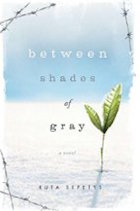
Ruta Sepetys, Between Shades of Gray — This World War II novel centers around an aspect of the war that is sadly often forgotten. The narrator, Lina, is a 15-year-old Lithuanian girl who is abducted one night, along with her mother and brother, by the NKVD. Lina describes the horrible tortures and indignities she and her fellow prisoners suffer, as well as the desperate hope that somehow her father will find her. My favorite thing about this book is that many of the characters are portrayed with some complexity. For example, one of Lina’s fellow prisoners is a cranky old man who constantly complains, yet in the end he manages to do something heroic. Similarly, one of the Soviet guards is deeply conflicted about his cruel actions. But some of the other characters–particularly Lina’s saintly mother–remain annoyingly simplistic. I also wasn’t a fan of the flashbacks to Lina’s carefree earlier life; they were too jarring for me. Still, I liked the book overall, and I think it tells a story that needs to be told.

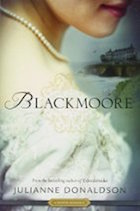
Julianne Donaldson, Blackmoore — Kate Worthington wants nothing more than to escape her horrible family and go to live in India with her aunt. But her mother refuses to let her go, finally delivering an ultimatum: if Kate wants to go to India, she must first receive–and reject–three marriage proposals. Since Kate is not beautiful and flirtatious like her sister, she despairs at first. But when she is invited to the estate of her old friends, Sylvia and Henry Delafield, she reasons that she can at least try. Of course, she doesn’t expect to fall in love along the way. While this book is extremely predictable, I have to say that I enjoyed it anyway! My biggest complaint is that it takes Kate far too long to realize that her ideal mate is right in front of her, head over heels in love. The Big Misunderstanding could easily have been solved with a little rational communication! I should also note that the book is subtitled “A Proper Romance,” which essentially just means it’s rated PG; there’s nothing explicitly religious or preachy about it. All in all, this was a pleasant read that satisfied my craving for a Regency romance.

Mini-Reviews #5: Summer Reading

All right, time to post some mini-reviews of books I read way back in July! Will I ever catch up with all my reviews? Only time will tell, so stay tuned! 🙂

Death of an AirmanSong for Summer, A

Christopher St. John Sprigg, Death of an Airman — In this mystery centered around an English aviation club, one of its best flyers perishes in a tragic plane crash. Most people assume it’s an accident, but the victim was a first-class pilot, and the inquest revealed nothing wrong with the plane. A few of the club members suggest suicide, but a visiting Australian bishop suspects murder. When the police get involved, they realize the victim’s death may be connected to a much larger criminal organization. I liked this mystery well enough, but I think the strength was definitely in the plot rather than in the characters. For example, for the first several chapters, it looks like the Australian bishop is going to be the sleuth, but suddenly everything switches to the police inspector’s point of view. Still, this was a fun variation on the “impossible crime” mystery with a truly ingenious solution.

Eva Ibbotson, A Song for Summer — Ibbotson’s novels are the ultimate comfort reads! I’d never reread this one before, and I think it’s because the plot moves a bit more slowly than in Ibbotson’s other novels, and the atmosphere is bleaker. It’s still a lovely book, but I definitely find myself returning to A Countess Below Stairs and The Morning Gift much more often.

It Happened One WeddingSpear of Summer Grass, ACrown's Game, The

Julie James, It Happened One Wedding — Julie James was my first contemporary romance author, and she pretty much single-handedly convinced me that not all romance novels are poorly written trash. This is another fun, banter-filled romance between hedge fund manager (?) Sidney and FBI agent Vaughn. They initially dislike each other but are forced to play nice when her sister and his brother get engaged. I think we all know where this is going.

Deanna Raybourn, A Spear of Summer Grass — After scandalizing English society with her outrageous behavior, Delilah Drummond is packed off to British East Africa so she won’t further damage her family’s reputation. Although Delilah is the consummate city girl, with her fashionable dresses and daring bob, she soon falls in love with the African landscape. She also encounters various dangers, from marauding lions to outright murder — and possibly finds love as well. I didn’t particularly like this book, and I’m not sure why. I didn’t dislike it either…I just felt indifferent to it. Delilah reminded me a lot of Phryne Fisher, but while I love Phryne, I didn’t have the same enthusiasm for Delilah. Maybe she was too similar (since I encountered Phryne first)? The romance also made me roll my eyes a bit; the hero is very much an alpha-male caveman type, and he just seemed like a stereotype to me. Overall, a “meh” read.

Evelyn Skye, The Crown’s Game — In an alternate Imperial Russia where magic exists but only a few have the power to wield it, Vika knows she is destined to become the Imperial Enchanter and take her place at the emperor’s side. But then she learns that there is another powerful enchanter in Russia — and that she must defeat him in the Crown’s Game, a magical duel in which the winner becomes Imperial Enchanter and the loser is condemned to death. Little does she know that the other enchanter is Nikolai, whose magic (and handsome face) intrigues her. As Vika and Nikolai get to know each other, they realize they don’t want the Crown’s Game to end in death. But will they be able to find a better solution? I have to admit, this book sort of lost me early on, when Vika is described as having wild red hair with a black streak down the middle. I immediately had a knee-jerk Mary Sue reaction, and I never quite warmed to Vika after that. I did end up somewhat liking the book, particularly for the Russian setting and the lovely descriptions of the magic. I also liked the fact that the stakes are real, and not everybody gets a happy ending. I’ll probably look for the sequel when it comes out. Nevertheless, I was definitely underwhelmed by this one, especially given the amount of hype I’d seen about it.

Mini-Reviews #4: June Books, Part 2

More mini-reviews! Just when I think I’m getting to the end of my backlog, I go and read more books. Will I never learn?

Only Thing Worse Than Me Is You, TheSchool for Unusual Girls, A

Lily Anderson, The Only Thing Worse Than Me Is You — Oof. I really wanted to like this one — it’s a modern retelling of Much Ado About Nothing! But I was very underwhelmed, and the main reason is that I couldn’t stand the protagonist, Trixie. She’s incredibly self-absorbed and utterly convinced of her own righteousness at all times, which makes her downright mean to the people around her. She’s also a proud geek girl, obsessed with comic books and “Doctor Who.” Don’t get me wrong — I have nothing against these things! But Trixie’s constant references to geek culture didn’t feel real to me. Instead, I felt like the book was trying to pander to a specific audience and going way over the top. In short, I just wasn’t a fan.

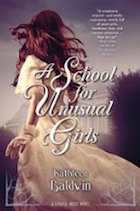
Kathleen Baldwin,  A School for Unusual Girls — This one’s about — you guessed it — a school for unusual girls. Sixteen-year-old Georgiana Fitzpatrick doesn’t behave as a proper young lady should; and when one of her scientific experiments nearly burns down the stables, her parents pack her off to a school whose reputation for strictness is legendary. Of course, Georgie soon realizes that the school is not what it seems and that her fellow students all have unique, mysterious abilities. There’s also romance, kidnapping, and a touch of espionage. All in all, a fun read, although not particularly groundbreaking in the genre. I’d like to read the sequel at some point.

Tell Me Three ThingsStrong PoisonDecent Proposal, The

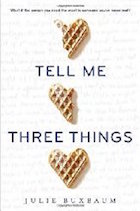
Julie Buxbaum, Tell Me Three Things — I enjoyed this novel despite its ridiculous premise: Jessie Holmes moves across the country when her dad remarries, and she is forced to attend a pretentious private school where she doesn’t know anyone — that is, until the mysterious Somebody/Nobody emails her, offering friendship and guidance in navigating the social scene at her new school. Though Jessie is skeptical at first, she soon opens up to Somebody/Nobody and speculates on who it might be. To the reader, the answer is astoundingly obvious, but it’s still fun to watch Jessie get there. A nice YA romance if you’re into that kind of thing.

Dorothy L. Sayers, Strong Poison — I read this installment of the Lord Peter Wimsey series years ago but didn’t remember much about it, except that Lord Peter finally meets his match in Harriet Vane, a young woman who’s on trial for murdering her ex-lover. For me, this was the best novel in the series so far. The mystery is well plotted (although, as with other books in the series, the suspect list is so small that the true mystery is howdunit, not whodunit), and the romance is nicely underplayed. I’m definitely loving this series more and more as I continue to read, and I’m looking forward to the next book!

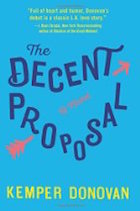
Kemper Donovan, The Decent Proposal — I was drawn to this book because of the title, and I knew very little about it going in. The premise is that a mysterious benefactor has promised two L.A. residents, happy-go-lucky Richard and highly regimented Elizabeth, that they will each receive half a million dollars if they agree to meet each other once a week for a year and talk — just talk. Of course they accede to the proposal, and of course they start out as very different people but eventually find some common ground. I liked the development of the relationship between Richard and Elizabeth, especially since I honestly didn’t know whether it was going to end in friendship or romance. I could have done without most of the other characters, actually; they seemed like they should get their own novels rather than being relegated to secondary characters in this one. I also think people who have lived in L.A. would get more out of the book, since it’s definitely written in that specific setting. Overall, I did like the book, but I’m glad I got it from the library instead of buying.

Mini-Reviews #3: June Books, Part 1

Still making my way through my review backlog, so here are some more short ones:

Lilac GirlsUnexpected Everything, The

Martha Hall Kelly, Lilac Girls — For the past few years, I’ve really gravitated toward books set during World War II, especially those dealing with the “home front” experience rather than the actual fighting. So I think I wanted to like this book more than I did. I found the story of Kasia, a Polish girl imprisoned in Ravensbrück, to be the most compelling. I especially liked how the book follows her (and the other characters) long after the war is over and shows the psychological scars that still remain. But I didn’t like Caroline’s story at all; I found her the least interesting character, and the romance between her and Paul didn’t do anything for me. The book is worth reading if you like the time period, but I’d recommend Elizabeth Wein’s Rose Under Fire for a better book on Ravensbrück.

Morgan Matson, The Unexpected Everything — I’ve said it before, but it’s true: Morgan Matson writes the perfect summer reads! I really enjoyed this one, which centers around politician’s daughter Andie and a summer that doesn’t go quite according to plan. One of my favorite aspects of the book is that Andie has a really close group of girlfriends, and those relationships are just as important as her newfound romance. I’d definitely recommend this book as an adorable summer read, especially for those who enjoy YA.

Summer Before the War, TheDarker Shade of Magic, ACocaine Blues

Helen Simonson, The Summer Before the War — I really enjoyed this quiet, character-driven novel, although I wouldn’t recommend it to those who love lots of action and unpredictable twists. The plot (such as it is) centers around a young woman who moves to a rural English village to become the new Latin teacher. As one might expect, she meets with some resistance from the locals because of her youth and gender, but she also wins over some key players, including the unconventional Agatha Kent and her two nephews. Most of the book involves the resulting social politics, although the titular war (World War I) does intrude near the end.

V.E. Schwab, A Darker Shade of Magic — This book hooked me from the first line: “Kell wore a very peculiar coat. It had neither one side, which would be conventional, nor two, which would be unexpected, but several, which was, of course, impossible.” The novel is an exciting blend of fantasy and sci fi, combining magical artifacts with parallel universes. The hero is a conflicted, magic-wielding prince, and the heroine is a scrappy thief and would-be pirate. In short, I loved it and have already purchased book 2, A Gathering of Shadows!

Kerry Greenwood, Cocaine Blues — After watching and LOVING “Miss Fisher’s Murder Mysteries,” I decided to pick up the first book in the series. Phryne is a wonderfully entertaining character: intelligent, rich, attractive, and determined to get the most out of life. I also really enjoyed the setting of 1920s Melbourne, where Phryne rubs elbows with all sorts of people, from wealthy blue bloods to socialist cab drivers to feisty maidservants. I did miss Inspector Jack Robinson, who apparently has a much smaller role in the books than he does in the TV series. I also didn’t care too much about the mystery, but I still liked the book for its setting and protagonist.

Mini-Reviews #2: May books

Still behind on reviews, so here’s a batch of minis for the books I read in May!

Spy Among Friends, AOne Perfect Day

Ben Macintyre, A Spy Among Friends: Kim Philby and the Great Betrayal — Guys, if you’re at all interested in espionage in the 20th century, you need to read Ben Macintyre! This is a fascinating stranger-than-fiction account of Kim Philby, an old-school English gentleman who rose to an extremely high position in the Secret Service while actually being a spy for the USSR.

Rebecca Mead, One Perfect Day: The Selling of the American Wedding — Mead, a British journalist, examines the contemporary American wedding from a sociological and monetary perspective. If you enjoy weddings but suspect they’ve gone off the rails in recent years decades–particularly in the ever-inflating costs for both the couple getting married and their guests–you’ll find a lot of interesting material here.

Vinegar GirlRaven King, TheLike Water for Chocolate

Anne Tyler, Vinegar Girl — First there was The Austen Project, for which six famous contemporary authors tried their hand at updating the novels of Jane Austen. Now Hogarth Shakespeare is doing a similar project with the Bard’s plays, with Vinegar Girl being a retelling of The Taming of the Shrew. Judging it as a novel, I found it a very pleasant read, albeit not particularly original or memorable. But I didn’t think it was a particularly good retelling of The Taming of the Shrew! So whether you enjoy the book will probably depend on what you’re looking for.

Maggie Stiefvater, The Raven King — If you love the series, you’ll love the ending! I thought certain plot elements were resolved a bit too abruptly, but the heart of the book–the relationships between Blue, Gansey, Ronan, Adam, and Noah–remains true. I was also torn on the addition of Henry Cheng as a character. First of all, I should say that I LOVED Henry Cheng! (Maybe he could have his own book? More Henry Cheng, please!) But part of me felt like the book was already crowded enough between the five main players and all the people at Fox Way. Be that as it may, I found this book to be a deeply satisfying ending to a wonderful series. If you love fantasy, you definitely need to read it!

Laura Esquivel, Like Water for Chocolate (trans. Carol Christensen and Thomas Christensen) — I’d heard a lot of good things about this book; people are always mentioning magical realism and comparing it to Sarah Addison Allen’s books (which I love). But ultimately, it didn’t do much for me. I felt sorry for Tita, doomed to take care of her bullying mother and remain unmarried while the love of her life marries her sister. But I also found the entire situation entirely too melodramatic, and the supernatural elements didn’t charm me. Overall, a disappointing read.

Mini-Reviews #1: Readathon leftovers

It’s pretty obvious that I haven’t spent much time on this blog lately. *blush* What can I say — life has been busy for the past couple of months, and when I’ve had free time, I’ve preferred to spend it doing other things (like reading!). As a result, I have a pretty huge backlog of books that I haven’t written about yet, and the thought of sitting down to compose a full review for each one is incredibly daunting. So, rather than continuing to avoid the task, I’ve decided to do three batches of mini-reviews — just titles and authors of the books I’ve been reading, along with a couple of sentences expressing my opinions. Once I catch up, I plan to go back to my regular style of reviewing. But for now, here are mini-reviews for the books I read during April’s 24-hour readathon:

Love, Lies and SpiesAs If!

Cindy Anstey, Love, Lies and Spies — A fun, lighthearted bit of Regency fluff for those who enjoy YA historical romance. I found the spy storyline weak, and the romance wasn’t quite compelling for me — Georgette Heyer, this is not! But it’s a pleasant enough read for fans of the genre.

Jen Chaney, As If! The Oral History of Clueless as Told by Amy Heckerling, the Cast, and the Crew — This book will only appeal to people who really love the movie “Clueless” and who are fascinated by behind-the-scenes movie knowledge. Fortunately, I fall within this demographic, so I really enjoyed the book!

Hermit of Eyton Forest, TheAlways the BridesmaidWhy Not Me?

Ellis Peters, The Hermit of Eyton Forest — Full disclosure: this installment of the Brother Cadfael series features a male character called Hyacinth. But I still love this series about a 12th-century Benedictine monk who solves crimes! (Who wouldn’t?)

Lindsey Kelk, Always the Bridesmaid — Entertaining British chick lit about a young woman named Maddie whose two best friends are at opposite ends of the romantic spectrum: one just got engaged, while the other is getting divorced. My friend pointed out that Maddie is a huge pushover, which she (my friend) found irritating. While I think that’s a fair criticism, I ultimately enjoyed the book for  its humor and romance, so I’d definitely read more by this author.

Mindy Kaling, Why Not Me? — I think Mindy Kaling is very talented and hilarious, and this book had me giggling pretty much nonstop. I like that she isn’t preachy, she’s very self-aware, and she doesn’t apologize for her confidence (some might say arrogance). As she says in the book, there’s nothing wrong with being confident — as long as you’ve put in the hard work to back it up. Bottom line: if you like Mindy Kaling, you’ll like this book.

Review: The River of No Return

River of No Return, TheBee Ridgway, The River of No Return

Nicholas Falcott, Marquess of Blackdown, is about to die on the battlefield at Salamanca. But instead of being trampled by a French cavalry horse, he suddenly disappears in a blaze of light and reappears in the 21st century. There, Nicholas finds himself under the protection of the Guild, a secret society of individuals with the ability to jump forward in time. The Guild provides Nick with a new identity, plenty of money, and enough information about the modern world for him to survive in the present. Nick believes it’s impossible to go back to his original time — until one day, out of the blue, the Guild leaders order him to do just that. They tell him about a rival group of time travelers whose attempts to change history will result in widespread disaster, unless Nick can go back to 1815 and stop them. But when he jumps back to his own time, he learns that the Guild is keeping secrets from him. He also reconnects with Julia Percy, his beautiful young neighbor who is somehow connected to this feud between time travelers.

This is a book I should have loved: it’s got Regency England, romance, intrigue, and time travel! But sadly, the novel’s underwhelming execution didn’t live up to its great premise. One of the biggest problems for me was the pacing. It took forever to set up the world and introduce Nick and Julia as characters. Once Nick jumps back to 1815 (about 1/4 of the way into the book), things pick up a little, but the pacing still drags. Nothing really important occurs until the last 50 pages or so, when the characters suddenly learn a whole lot of new information at breakneck speed. My other big problem with this novel is that NOTHING IS RESOLVED IN THE END. Nick eventually learns more about the future catastrophe that the time travelers are trying to prevent, but he doesn’t actually do anything about it. So basically, this book is one long setup for a payoff that isn’t going to happen until the sequel — and I don’t think it’s actually been published yet, so it could be a long wait! I’ll admit that I am a bit curious to know how things turn out, but it may not be worth the aggravation this book caused me.

Review: Act Like It

Act Like ItLucy Parker, Act Like It

Actress Lainie Graham is the sweetheart of the London stage, and her wholesome public persona is now especially sympathetic because she’s recently been dumped. In contrast, her co-star Richard Troy is the quintessential bad boy. His Byronic good looks and considerable talent have counterbalanced some of his negative behavior, but the public is no longer willing to overlook his violent temper. Desperate to get public opinion back on their side, the theater manager and Richard’s agent concoct a plan: Richard and Lainie will pretend to be in a relationship so that her positive image will rehabilitate Richard’s negative one. At first, Lainie objects to the plan — she can’t stand Richard’s obnoxious behavior and inflated ego — but she is eventually convinced to play along. As she spends more time with Richard, however, she learns that there’s much more to him than meets the eye. Meanwhile, Richard is surprised to discover that Lainie is intelligent, kind, and more than willing to match him quip for quip. But how can these two actors be confident that their so-called fake relationship has evolved into something real?

After a streak of books that weren’t grabbing my attention, I was delighted to discover this sweet romance! I always enjoy the “fake relationship becomes real” trope, so I was predisposed to like the book anyway. But the adorable banter between Lainie and Richard is what really sealed the deal for me. Their sarcastic jabs at one another soon become playful teasing, and these interactions really made their chemistry believable. I appreciated how their careers as actors added another layer of complexity to the relationship; I especially enjoyed watching Richard seethe as Lainie had to pretend to be in love with her ex, another actor in the same play. The book does contain some of the romance genre’s more annoying clichés, such as a physically perfect hero with piercing blue eyes and a Big Misunderstanding that needlessly threatens the relationship. But overall, this book was a lovely surprise that came along at just the right time for me. Definitely recommended for fans of romantic comedies!

Review: The Last Dragonslayer

Last Dragonslayer, TheJasper Fforde, The Last Dragonslayer

In the Ununited Kingdoms, magic is a part of everyday life, but it’s only used for the most mundane of tasks, like rewiring a house’s electricity or removing all the moles from the garden (or your face). But lately, the magic levels seem to be rising in the Kingdom of Hereford, and nobody quite knows why. Moreover, the local pre-cogs have begun to prophesy the death of the world’s last remaining dragon — an event of great importance, not only because dragons seem to be inextricably tied to magic, but also because once a dragon dies, its lands are up for grabs. Thus, the premonition inevitably results in a huge influx of people and corporations hoping to claim the Dragonlands for themselves. In the midst of all this, Jennifer Strange, a seemingly ordinary 15-year-old girl, learns that she has a surprising destiny: she is the Last Dragonslayer, the one fated to kill the dragon. The problem is, Jennifer isn’t quite sure she wants to do it….

As a big Fforde ffan, I’m glad I finally got around to reading this book, his first YA novel and the first book in a trilogy. Overall, I found it pretty enjoyable and quite reminiscent of the Thursday Next books in some ways. Like Thursday, Jennifer is a strong and intelligent heroine who’s willing to fight for her principles. She also has a quirky pet, although it’s not a dodo but a Quarkbeast, a visually terrifying creature with the personality of a dog. And just as Thursday often gets into trouble with the all-powerful Goliath corporation, Jennifer runs into similar problems with Consolidated Useful Stuff. In fact, maybe that’s the reason I didn’t like this book as much as Fforde’s other work — it’s a bit too similar to the Thursday Next series, except without all the fun literary references and time travel. I’d say it’s still worth reading if you enjoy Fforde’s particular brand of schtick, but it’s not the best entry point into his work.

Review: Quick Curtain

Quick CurtainAlan Melville, Quick Curtain

Crowds flock to the London premiere of Douglas B. Douglas’ sensational new musical comedy, hoping to catch a glimpse of stage idols Brandon Baker and Gwen Astle. But they get even more sensation than they bargained for when leading man Baker is shot dead in the middle of Act 2. Fortunately, Inspector Wilson of Scotland Yard is in the audience, along with his son Derek, an enterprising young journalist. When another cast member is found hanged in his dressing room, the obvious conclusion is that he murdered Baker, then committed suicide. But Inspector Wilson isn’t convinced, especially when he finds a bullet hole in a place that would be impossible under that theory of the crime. He and Derek jointly investigate the mystery, which leads them to a remote village, several salacious secrets, and an altogether unexpected solution to the mystery.

I absolutely love Golden Age mysteries, and this one was a very enjoyable read, unique in its lighthearted tone and somewhat breezy attitude to police procedure. (For instance, does Inspector Wilson even have jurisdiction over the case? In this book, it doesn’t matter: he’s first on the scene, so he simply commandeers the investigation.) I loved the humorous running commentary on show business of the era; apparently the author himself had a long career in the industry. And I laughed out loud at various silly jokes, particularly an exchange where the play’s director is impatiently waiting for the doctor to examine the corpse. Finally fed up, the director asks, “Well?” “Not at all; in fact, he’s dead,” the doctor replies. The mystery plot isn’t particularly original, and a twist in the last chapter may irritate readers who want their mystery authors to play fair. But I really enjoyed the book’s tongue-in-cheek style and would definitely recommend it to fans of the genre!