Mini-Reviews: Love, Stranger, Pen

Katherine Center, The Love Haters

Katie is a video producer at a struggling company that’s about to make some layoffs. So when her superior assigns her a job filming a Coast Guard rescue swimmer in Key West, she jumps at the chance—even though she knows nothing about the Coast Guard and can’t even swim. Things get even trickier when she meets her subject, Hutch, who is kind and patient and staggeringly handsome. But both Katie and Hutch will have to overcome some baggage if they want to embrace the possibility of love. I like Katherine Center’s books and devoured this one in a single sitting. It’s funny and charming and romantic, but it also delves into some deeper issues, most notably Katie’s struggles with body image. Frankly, I’m torn on how the book handles that particular element…I did sympathize with Katie at times, but (although the book never reveals her size or weight) it’s clear that she is not a fat person. And as a fat person myself, I sometimes felt annoyed by the book’s simplistic message of body positivity. But apart from that issue, I did like this novel a lot and would recommend it to rom-com fans.

Edith Layton, To Wed a Stranger

Lady Annabelle Wylde is the reigning beauty of London society, but after several years of pursuing and being rejected by various men, her reputation has taken some hits. Now she’s nearing 30 and decides it’s time to marry. Her new husband is Miles Croft, Viscount Pelham, who is reasonably wealthy and handsome and has the right social status. Neither of them loves the other, though they hope that love might grow. But when Annabelle falls ill and loses her looks, a romance seems less likely than ever. This is my first experience with Edith Layton, but it won’t be my last because I really enjoyed this book! I love a marriage of convenience, and I thought both Annabelle and Miles had realistic thoughts and feelings about their situation. I also liked Annabelle’s growth as she slowly realizes that her worth isn’t determined by her looks. This book is part of a series, and while it can be read as a stand-alone, it’s made me curious to try out a few of the earlier installments. I’d definitely recommend this one to fans of the genre; it’s one of the better Regencies I’ve read lately.

Megan Whalen Turner, Moira’s Pen

I’m a huge fan of the Queen’s Thief series by Megan Whalen Turner, so I was excited to pick up this collection of stories and other short works that are set in the same world. Some of the stories have been previously published in various editions of the series novels, while others are new. The book also contains some essays by the author sharing her inspiration for various places, items, and characters. I generally liked this collection, though it’s nowhere near as compelling or emotionally rich as the main series. It’s been a few years since I read the novels, so I didn’t remember who some of the supporting characters were; I think I’d have enjoyed the stories more if the main series were fresh in my mind. Still, it was nice to spend a little more time in this world, and the completist in me is glad to own this book. I’d only recommend it to those who love the series, though – if you haven’t read any of the main novels, you’ll have no idea what’s going on!

Mini-Reviews: Serfdom, Benevolent, Wicked

F.A. Hayek, The Road to Serfdom

F.A. Hayek was an Austrian economist who moved to England in the 1930s and subsequently taught in both the UK and US. He won the Nobel prize in economics in 1974. In this essay, written during World War II and first published in 1944, he argues that Nazi fascism was not a reaction against socialism but rather a natural progression of socialist ideas. In Hayek’s view, socialism (by which he seems to mean a centrally planned economy) is bad economics because competition, not central planning, is what allows new ideas and wealth-creating innovations to flourish. But it’s also bad politics because under a socialist system, individual freedom will disappear; all power will reside in the hands of the central planners/the state. I broadly agree with Hayek’s ideas here, so my opinion is biased. But I think this essay is worth reading for anyone who is interested in a “liberal” (as opposed to socialist) view of economics or in the history of socialist thought. Hayek doesn’t straw-man his opponents, and his arguments are thoughtful and measured. Maybe I’ll tackle one of his full-length books at some point!

Alison Goodman, The Benevolent Society of Ill-Mannered Ladies

Lady Augusta “Gus” Colbrook and her sister, Lady Julia, are unmarried women in their 40s and thus are basically invisible in society. Instead of dwindling into spinsterish obscurity, they decide to help vulnerable women who are being abused by the men in their lives. Aiding them in their quest is the handsome Lord Evan Belford, whose checkered past doesn’t deter Gus from a more-than-friendly interest. This novel is hard to categorize; it’s not exactly a romance or a mystery, though it has elements of both. But the book mainly depicts the negative aspects of Regency society, particularly the limits placed on women, and offers a sort of revenge fantasy in which the women take charge and triumph over all wrongdoers. For some readers, this will be exactly their cup of tea, but for me, it was too anachronistic and felt a bit preachy. I didn’t dislike the book, though! Goodman is a good writer, the plot adventures are fun, and Gus is (usually) a sympathetic character. I believe a sequel is planned, and I’ll likely read it when it comes out.

Stella Riley, The Wicked Cousin

After a too-strict upbringing, Sebastian Audley has spent the past several years behaving as outrageously as possible, first in England and then abroad. Now his scandalous ways are beginning to pall, and he hopes to return to England and lead a quieter life, but his reputation makes that difficult. Meanwhile, Cassandra Delahaye is determined not to be impressed by the rakish Sebastian, but she soon finds herself attracted to his good looks and roguish sense of humor. I’m officially a huge fan of this series and enjoyed this installment as well, but it felt a little too long. The main obstacle to the romance is Sebastian’s obsessed ex-lover, which means there’s a lot of plot to slog through even after Sebastian and Cassie fall in love. (I find that Stella Riley uses the “evil ex” trope pretty often, which I’m not fond of.) I still liked the book a lot, though, and it was nice to catch up with the various recurring characters. Looking forward to the next one!

Mini-Reviews: Golden, Holidays, Undertaking

Francis Spufford, Golden Hill

It’s November 1746, and Richard Smith has just arrived in the small town of New York. He visits a countinghouse and produces a note for 1,000 pounds — a huge sum. The denizens of New York don’t know what to make of him: Is he simply a rich man planning to explore the pleasures of a new place? Or is he some kind of fraud, spy, or scoundrel? As Smith explores the city, he gets into various kinds of financial, political, and romantic trouble, but it’s not till the end of the novel that his true purpose is revealed. I really enjoyed this book, which apes the picaresque adventures and digressive style of 18th-century novels. It does a good job of pointing out the social ills of the period (such a slavery) without being anachronistic or preachy. It’s also just plain fun to follow the possibly roguish Smith around and try to figure out what he’s up to, though the ending is a bit of a heartbreaker. But I’d still heartily recommend this book to historical fiction fans!

David Sedaris, Holidays on Ice

This book is a collection of holiday-themed stories and essays, some of them autobiographical and most previously published elsewhere. “SantaLand Diaries” chronicles the time Sedaris worked as a Macy’s elf, “Christmas Means Giving” follows two families as they compete to see who can best demonstrate the true meaning of the season, and “Jesus Shaves” sheds some light on different cultures’ Easter traditions. These short works contain some hilarious moments, but frankly, a lot of them are dark and depressing. One story ends with the murder of a baby, while in another, parents sell their children to a pedophile. So if you’re looking for light, fun stories to get you in the holiday spirit, I’d recommend skipping this one! But if you’re of a more cynical disposition during this time of year, then it could be just the thing for you. For me, it was a mixed bag and probably not a keeper.

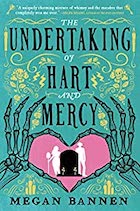
Megan Bannen, The Undertaking of Hart and Mercy

This book is a weird but winning genre mashup of romance, fantasy, and Western. Hart Ralston is a marshal in a fantasy world similar to our own, but with zombielike creatures called drudges; his job is to kill them and take their bodies to the nearby undertakers. One such undertaker is Mercy Birdsall, who loves her job but is desperately trying to keep the family business afloat, despite a sick father and uninterested brother. Hart and Mercy fight constantly, but their mutual antagonism is concealing very different feelings, which emerge when they become anonymous penpals. So basically, the book is The Shop around the Corner/You’ve Got Mail with a bit of zombie action and a Western flavor…which sounds like it shouldn’t work, but it totally does! I didn’t need quite as much world-building and would have preferred more of a buildup to the romance, but overall I loved this one and would recommend it if the premise sounds appealing.

Mini-Reviews: Sacred, Nursing, Swan

Sacred Wood and Major Early EssaysNursing Home MurderMurder on Black Swan Lane

T.S. Eliot, The Sacred Wood and Major Early Essays

Despite its shortness, this book was a real challenge for me. It’s a collection of essays by T.S. Eliot about literary criticism, mostly focusing on specific critics and their (rare) success and (common) failures. Since I hadn’t heard of, much less read, the vast majority of these critics, I found most of Eliot’s arguments extremely hard to follow. On the other hand, I do think reading this book was good for me — the mental equivalent of strenuous exercise. But this is probably the type of book best read in a college course, with a professor and other students on hand to help make sense of it.

Ngaio Marsh, The Nursing Home Murder

When the Home Secretary contracts acute appendicitis and dies on the operating table, his wife insists that he has been murdered. After all, there’s no shortage of suspects: the man had many political enemies, including one of the nurses who assisted with his operation. Another of the nurses was his mistress, who was devastated when he broke off their relationship. Even the operating surgeon is a suspect, since he’s in love with the mistress himself. Then there are the dead man’s wife and sister, who each inherit a substantial sum under his will. Fortunately, Inspector Alleyn and Sergeant Fox are on the case. I found this a thoroughly enjoyable Golden Age mystery, despite some pejorative discussion of mental illness (referring to it as a “taint” in someone’s heredity, for example). I’m slowly working my way through this series and am glad Ngaio Marsh was so prolific!

Andrea Penrose, Murder on Black Swan Lane

All London society knows about the animosity between the scientifically minded Lord Wrexham and the Reverend Josiah Holworthy. Cartoonist A.J. Quill has even been selling pointed satirical sketches about their feud. So when Holworthy is murdered, Wrexham is the number-one suspect. To clear his name, he hunts down A.J. Quill and discovers that “he” is actually Charlotte Sloane, a poor widow using her artistic talents to earn a meager living. They team up to solve the murder and are soon plunged into a sinister plot involving alchemy. I love a good Regency mystery, so I had high hopes for this book, but I ended up being a little disappointed. It’s not bad, per se, but nothing about it stood out to me, and I doubt I’ll continue with the series.

Mini-Reviews: Prim, Reading, Headliners

Awakening of Miss PrimI'd Rather Be ReadingHeadliners

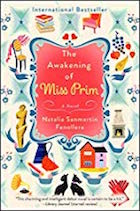
Natalia Sanmartin Fenollera, The Awakening of Miss Prim (trans. Sonia Soto)

This is a strange little novel about a young woman, Prudencia Prim, who applies for a position as a private librarian in a remote French village. A modern woman herself, she is initially shocked by the villagers’ old-fashioned beliefs and behavior. But she soon observes the happiness and prosperity of those around her, and with the help of her enigmatic employer, she comes to see the merits of their way of life. I think this book is aimed at a very particular audience, namely a certain subdivision of Catholics who are huge fans of G.K. Chesterton. If you don’t know what I’m talking about, I’d say this book is probably not for you! Even as part of the target audience, I still found it a little much.

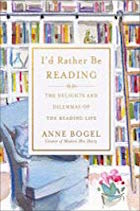
Anne Bogel, I’d Rather Be Reading: The Delights and Dilemmas of the Reading Life

I’m a big fan of Anne Bogel’s podcast, What Should I Read Next? So when I found her book at a library sale, I snatched it up! The essays are fun — nothing particularly new or memorable, but bibliophiles and fans of the author should enjoy them. A fun read, but not a keeper for me.

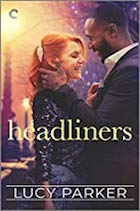
Lucy Parker, Headliners

Lucy Parker is an auto-buy author for me; I really love her contemporary romances set in the London entertainment world. In this one, protagonists Sabrina and Nick are rival TV presenters who are forced to work together to revive their network’s struggling morning show. If you enjoy enemies to lovers, this book is a great example! I especially liked how Sabrina and Nick resolve their conflicts like adults; there are no stupid misunderstandings or secrets kept for no reason. I note that, while this book can technically stand alone, it does refer back frequently to the events of the previous book, The Austen Playbook. Definitely recommended for romance fans, although my favorite Parker books remain her first two, Act Like It and Pretty Face.

Review: Ex Libris

Ex LibrisAnne Fadiman, Ex Libris: Confessions of a Common Reader

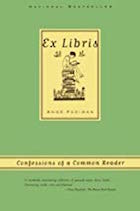
This collection of essays by Anne Fadiman deals with a topic that is dear to every reader’s heart: books and reading. In “Marrying Libraries,” she describes how she didn’t truly feel married to her husband until they merged their book collections. In “My Odd Shelf,” she shares her idiosyncratic passion for polar exploration narratives. In “The His’er Problem,” she discusses the English language’s deficiency in not having a gender-neutral third-person singular pronoun. In “The Catalogical Imperative,” she cheekily admits her love of mail-order catalogues. And in “Never Do That to a Book,” she divides readers into “courtly” book lovers and “carnal” book lovers, proudly declaring herself to be one of the latter. Throughout these essays, Fadiman keeps a fairly light, playful tone, but she also deals with weightier topics such as her father’s deteriorating health. Still, the focus remains on books and how the love of reading can shape a person’s life.

I don’t seem to be very good at reading essays; I tend to read them all in one gulp, like a novel, even though I think I ought to dip in and out, reading only a couple at a time. As with any short story or essay collection, some installments are better and more memorable than others. The one I enjoyed most is probably “Marrying Libraries,” which not only touched on serious issues like whose copy of a book should be kept and whose discarded, but also showed a sweet little glimpse into Fadiman’s relationship with her husband. I found “Never Do That to a Book” to be the most controversial, as Fadiman seems to poke fun at people who take care of their books as physical objects. She and her family, it seems, don’t mind dog-earing, tearing out pages, breaking spines, and so forth. I’m not saying those things are wrong, but I also don’t think it’s wrong to keep one’s books looking nice! Overall, I sometimes enjoyed Fadiman’s breezy tone and sometimes found her a bit pretentious. But the essays are certainly fun reads for book lovers!

Review: Are Women Human?

Are Women Human? by Dorothy L. SayersDorothy L. Sayers, Are Women Human?

Dorothy Sayers is best known for her mystery series featuring Lord Peter Wimsey, but she wrote on a lot of other topics too. This short volume contains two of her essays in which she explicitly talks about the role of women in society and the feminist movement as she perceived it in the early 20th century. Sayers’ central point in these essays is that people should spend less time thinking about “women” as a class and more about each particular woman as an individual. She notes that opinions, beliefs, intellect, and abilities vary among women just as they do among men. She also champions a woman’s right to work outside the home if she wants to; both women and men should be able to do work that they enjoy and at which they excel.

I really enjoyed both of these thoughtful, witty essays. Even though they were written many decades ago and the world has changed a lot since then, I think Sayers’ observations remain relevant and interesting. I especially liked what she says about the idea that a woman’s place is in the home. She points out that in the Middle Ages, a lot of the most interesting and important jobs were done in the home — weaving, dyeing, food production, brewing, estate management, etc. These all used to be women’s jobs, and they didn’t become men’s jobs until after the Industrial Revolution, when they moved into factories. I don’t tend to read a lot of feminist theory, but I’d recommend this book to anyone interested in the history of the feminist movement — or anyone looking for a quick, humorous, and thought-provoking read!