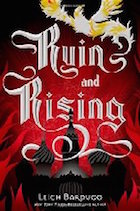
Review: Ruin and Rising

Ruin and RisingLeigh Bardugo, Ruin and Rising

***Warning: SPOILERS for previous books in the series!***

In the aftermath of the battle at Os Alta, the Darkling now sits on the Ravkan throne, and Alina and her followers have gone underground. Literally — they’re hiding out in a system of tunnels and caves beneath Ravka, where they are temporarily under the protection of the Apparat. But the Apparat has his own agenda: he wants Alina to serve as a figurehead for the loyal but uninformed peasants who believe she is a saint. Alina can’t submit to such a plan, especially when the Darkling is continually expanding his empire through the use of dark magic. But once she and her loyal allies escape, Alina knows she isn’t strong enough to defeat the Darkling, especially since she can no longer access her power. She decides to seek a third amplifier for her magic, the legendary firebird, and her sole clue leads her back to the village from which she and Mal originally came…but what she finds there will challenge everything she has ever believed.

Like the other two books in the trilogy, this is a well written novel with great world-building and an interesting plot. But I still find myself liking rather than loving these books. As I mentioned in my review of Shadow and Bone, I think my issue is that I don’t particularly like or relate to Alina as the main character. She seems to be entirely motivated by her momentous quest to defeat the Darkling, and outside of that, there’s not a lot of complexity to her character. I also don’t care about Mal, the main love interest, at all. He’s basically there to be dreamy and help Alina whenever the plot calls for it, and he doesn’t really have a personality outside of that. I found the secondary characters much more interesting, especially Nikolai — I’d love for him to get his own book at some point! I did enjoy the resolution of the plot and found the ending very satisfying. Overall, I wasn’t bowled over by this trilogy, but I’d still recommend it to YA fantasy fans.

Review: Siege and Storm

Siege and StormLeigh Bardugo, Siege and Storm

***Warning: SPOILERS for Shadow and Bone!***

After failing to kill the Darkling, Alina and her beloved Mal are on the run. They hope that by staying far away from Ravka, they can escape the Darkling’s wrath; unfortunately, however, he catches up with them almost immediately. Despite the Darkling’s growing power, he wants to bind Alina and her magic more closely to him by searching for a second amplifier, a legendary sea serpent. For this purpose, he hires the notorious pirate Sturmhond to sail them through the northern seas. Alina nearly despairs when the sea serpent is found and the second amplifier placed on her wrist, but she finds unexpected allies in Sturmhond and his crew. After escaping the Darkling’s clutches once again, Alina finds herself at the head of a fragmented Grisha army, whose job is to defend Ravka from a possible invasion. But will her tiny force be enough to withstand the Darkling’s might?

I think I enjoyed this book even more than Shadow and Bone, mostly because Alina is more sure of herself and more determined to take charge of her own destiny. I also absolutely loved Sturmhond! What can I say — I can’t resist a swashbuckling pirate with secrets! The plot twist involving his character was somewhat predictable for me, but I still enjoyed it, and I liked watching Alina react to a new set of problems and expectations. The addition of siblings Tolya and Tamar was also a lot of fun…I liked having more characters to care about than just Alina and Mal. Many second books in a trilogy suffer from “middle book syndrome,” but I think this one is a great read on its own, and it also sets up book three very nicely. Speaking of which, my review of Ruin and Rising is coming soon, after a brief detour or two!

Review: Shadow and Bone

Shadow and BoneLeigh Bardugo, Shadow and Bone

Orphan Alina Starkov has grown up believing she’s completely ordinary. Not particularly pretty or talented, she’s lived in the shadow of her best friend and fellow orphan Mal, who is handsome and popular and a talented tracker for the Ravkan army. But when Alina unexpectedly discovers that she has supernatural powers, her entire life changes in an instant. She is swept up into the world of the Grisha, an elite class of magicians who have the power to control everything from metals to tides to the human body. Alina herself has the ability to control sunlight, a rare and powerful magic that catches the attention of the Grisha’s commander, the mysterious Darkling. The Darkling encourages Alina to harness her power, telling her that she can change Ravka for the better. But in strengthening her magical abilities, will Alina end up losing the most essential part of herself?

After seeing a lot of hype for the Grisha trilogy around the Internet, I was excited to read these books but also nervous that they wouldn’t live up to their reputation. Overall, I enjoyed the trilogy, but I didn’t quite embrace it as wholeheartedly as many others have. This first book does a good job of setting the stage: the world of Ravka is robust and full of interesting details, and the central conflicts of the series are clearly established. I’m not sure how I feel about Alina as a character…she spends a lot of this book questioning herself and moping about her nonexistent love life. And yes, there’s something of a love triangle in the novel, but it’s eventually resolved in a very stark way. (In fact, I wish there had been a bit more ambiguity about it!) Fortunately, Alina does demonstrate some strength as the story progresses, and overall, I liked the book enough to pick up the second installment right away!

Review: The Queen of the Tearling

Queen of the Tearling, TheErika Johansen, The Queen of the Tearling

Princess Kelsea Raleigh Glynn has just turned 19, and it’s time for her to ascend the throne of the Tearling. But being the ruler of this kingdom is not exactly an enviable position. Competition for power is fierce — so much so, in fact, that Kelsea has been raised in exile and must be escorted to her palace by the Queen’s Guard, an elite group of warriors, in order to protect her from assassination. Her uncle, the regent, almost certainly wants her dead, and he is far from the only person in the Tearling who doubts Kelsea’s ability to rule. Most threatening of all, however, is the menace of the Red Queen, a powerful sorceress who rules the neighboring kingdom and has begun expanding her empire. Kelsea is shy, bookish, and plain — seemingly the last person in the world to make an effective ruler. But her strong sense of justice and the help of a few loyal allies eventually enable her to claim her throne and even — perhaps — to keep it, as she makes her first move to challenge the Red Queen’s supremacy.

I quite enjoyed this sword-and-sorcery novel, although the plot is certainly far from original. Kelsea is a relatable fantasy heroine, not particularly gifted at swordplay or magic, but grimly determined to hold onto her birthright and (essentially) not mess things up too badly. I also loved the basic premise that she has to win a place for herself in a situation where so many different factions are arrayed against her. I’m a sucker for a good political intrigue, and this book sets up a lot of different possible enemies who I’m sure will become more important in the sequels. The actual plot of this book is a little weak, in my opinion. The Red Queen is so over-the-top evil that I found her more annoying than threatening; I’d much rather see Kelsea deal with her internal foes than focus on defeating this “big bad.” But I want to spend more time in this world, especially to learn more about the Queen’s Guard and the Fetch. So I’ll definitely be picking up the sequel, The Invasion of the Tearling, one of these days!

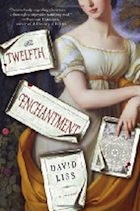
Review: The Twelfth Enchantment

Twelfth Enchantment, TheDavid Liss, The Twelfth Enchantment

As a young woman of no fortune in 19th-century England, Lucy Derrick’s choices are extremely limited. Her parents are dead, so she is forced to live with her odious uncle and his cruel housekeeper. Her only means of escape is to accept the advances of a prosperous local mill owner, but she doesn’t love the man and has delayed making a final decision. But everything changes when Lucy encounters the dashing Lord Byron, the principal landowner in the area. Byron shows up on Lucy’s doorstep with a mysterious illness that is soon revealed to be magical in origin. To Lucy’s surprise, she is actually able to help him through exercising her own magical abilities. This chance encounter leads Lucy into a shadowy world whose existence she had never before suspected — a world of changelings and faeries and soulless beings who cannot die. Assisted by her friend Mary Crawford (of Mansfield Park fame) and by Jonas Morrison, the man who once broke her heart, Lucy must navigate a supernatural power struggle and find an ancient spell book that will vanquish her immortal enemies once and for all.

This was my first encounter with David Liss, and I think it’s probably not the right entry point into his work. My understanding of his other books is that they are serious historical fiction, with plenty of exploration of the gritty realities of life in former eras. This book contains a lot of those same concerns, with Luddites and Rosicrucians both being fairly integral to the plot. But at the same time, this novel also has a lot of Regency romance tropes, like the lovely but impoverished young woman who seeks marriage both for love and for economic stability. As a result, the book felt slightly schizophrenic to me. Personally, I was more interested in Lucy’s individual character development and her romantic relationships than in the broader power struggle, so everything about the aforementioned Luddites and Rosicrucians was a real slog for me. In other words, it’s too heavy for a light, fluffy read; but the Regency-romance elements detract from the serious historical fiction aspects of the book. Some things did work for me, particularly the central romance, but overall I think the book suffers from trying to blend two very different genres.

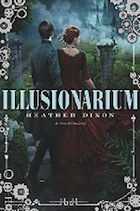
Review: Illusionarium

IllusionariumHeather Dixon, Illusionarium

Jonathan has always viewed himself as a completely ordinary young man. He works as an apprentice to his father, one of the foremost scientists in the city, but he is preparing to go to university in a few months. However, all his plans are derailed when the king tasks his father with an important assignment. All throughout the country, a terrible illness is gripping its women, and now the queen has succumbed. Jonathan and his father have only a few days to find the cure before she dies. Their only hope seems to lie with Lady Florel, the most famous scientist in the country. She suggests using a drug called fantillium, which causes shared hallucinations and can thus be used to speed up the apparent passage of time. This will effectively give Jonathan and his father more time to experiment with a cure. Jonathan soon discovers that he is skilled at using fantillium to create hallucinations, or illusions, to impress his audience. But his use of the drug has a dark side, as well as the potential for a shockingly drastic effect on his entire society.

This is a book with a lot of interesting ideas, but it all felt a little half-baked to me. I think the problem is that there are too many plotlines for this relatively short novel, and I wasn’t sure where I was supposed to focus my attention. There’s the “race against time to find a cure for the disease” story, which does get resolved in the end, but we still don’t know much about what caused the disease or why it only affects women (at least, not that I can remember). There’s the “look at this cool drug that causes illusions, but what about the possible negative consequences?” story, which is probably the most developed plot. But to me, it seemed a bit inconsequential in the end…while the illusions would probably be great to watch on the big screen, they’re not particularly exciting in book form. And then there’s some business with parallel universes, but those are never really explained or explored either. I did like Jonathan as a character, and I loved his enemy-turned-ally Lockwood. But unfortunately, character development definitely takes a backseat to plot in this book. Overall, it’s not a bad read, but I wasn’t particularly engaged by it.

Review: Uprooted

UprootedNaomi Novik, Uprooted

For as long as anyone can remember, Agnieszka’s tiny village has lived under the shadow of the Wood, a forest possessed by dark magic that corrupts everything and everyone that ventures too close to its borders. Fortunately, the village is also protected by the Dragon — not a literal dragon, but a powerful wizard whose magic helps to keep the Wood at bay. But the Dragon demands a price for his services: every ten years, he takes a girl from the village back to his tower with him. The girls always return at the end of ten years, apparently unharmed, but they never stay in the village for long. Agnieszka was born in a Dragon year, so she has the potential to be the one chosen as the next tribute. But everyone knows the Dragon will choose Kasia, the kindest and most beautiful girl in the village, who happens to be Agnieszka’s best friend. Agnieszka already hates the Dragon for taking Kasia away. But of course, when the Dragon actually comes, it’s Agnieszka whom he takes. At first, torn from everything she’s ever known, Agnieszka is shocked and afraid, and the Dragon treats her with coldness and contempt. But when she discovers that she herself has magical abilities, she is eventually able to stand with the Dragon in the fight against the Wood.

This is, hands down, my new favorite book of the year so far! Everything about the lush, magical writing completely sucked me in; I wanted to devour it and savor it at the same time. I’m actually somewhat at a loss to describe exactly why this book worked so well for me. For starters, Agnieszka is a heroine after my own heart. While she’s not immune from fear and self-doubt, she doesn’t allow those emotions to rule her life. She also remains staunchly loyal to her friends and family back home, and when Kasia needs help later in the novel, Agnieszka is the first person to rush to her aid. I also really grew to love the Dragon, although he’s an indisputable jerk at first — a bit Darcy-esque, in a way, which possibly explains things. 🙂 And the plot is just as compelling as the characters: I completely believed in the menace of the Wood and Agnieszka’s growing belief that it needs to be stopped once and for all. In short, have you ever started a book and felt like it was written specifically with you in mind, because it has everything you love and unfolds so perfectly? Uprooted is definitely one of those books for me! It’s everything I want my epic fantasy to be, and I wholeheartedly recommend it!

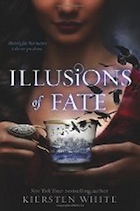
Review: Illusions of Fate

Illusions of FateKiersten White, Illusions of Fate

Jessamin has recently left her sunny island home of Melei to study at the prestigious university in Albion. But she hates the cold Alben weather and the narrow-minded Alben prejudices she is constantly exposed to because of her heritage and skin color. She is determined to endure the next few years and then leave Albion forever, but a chance meeting with a charming nobleman changes the entire course of her life. Finn Ackerley is attractive and wealthy, and he seems to be genuinely interested in Jessamin. He also happens to be an extremely powerful magician, and he possesses secrets that could have dire consequences for both Albion and the entire world. As Finn fights to save his country against the wicked, scheming Lord Downpike, Jessamin is caught in the middle. And when Lord Downpike discovers her relationship with Finn, he doesn’t hesitate to use her as a pawn in his power struggle. Can Jessamin outwit this deadly adversary and help Finn, all while remaining true to herself?

Historical fantasy is a genre I really enjoy, so I was predisposed to like this book, but I was a bit disappointed in the execution. There are a lot of really great ideas in the novel, but I wanted almost all of them to be explored in a lot more depth! For example, even though the book is set in a fictional world, it’s clearly meant to explore the issue of colonialism, but that side of things felt a bit superficial to me. I also loved the magical elements of this world, but in my opinion, the book doesn’t delve deeply enough into the history or the current power struggle with magic. The romance between Jessamin and Finn was adorable, but it also seemed fairly lightweight; I never truly connected with the characters or had particularly strong emotions about them getting together. Finally, the plot is resolved very abruptly in the end. I think all of these issues could have been resolved if the book had been longer, and I feel bad for nitpicking so much because that might have been the publisher’s fault rather than the author’s. And it is a light, enjoyable read; it’s just a bit insubstantial for my taste. But I would certainly try something else by Kiersten White in the future.

Review: Dreamer’s Pool

Dreamer's PoolJuliet Marillier, Dreamer’s Pool

This novel, set in early medieval Ireland, tells the story of Blackthorn, a young woman who has been imprisoned by a cruel chieftain and sentenced to death. But on the eve of her execution, she is saved by one of the Fair Folk, who grants her freedom under two conditions: she must assist anyone who asks for her help, and she cannot seek revenge against her jailer for seven years. Blackthorn reluctantly accepts these terms and escapes from the prison, along with fellow prisoner Grim. At first, the two travel aimlessly, with Blackthorn occasionally using her skills as a wise woman to help those who need medical attention. Eventually, they arrive in the kingdom of Dalriada, where Prince Oran asks Blackthorn for help. He is about to be married to Flidais, the daughter of a neighboring chieftain. He has fallen in love with her because of the letters she has sent him; but when Flidais arrives in person, she seems completely unlike the woman of the letters. Blackthorn and Grim help Oran to investigate his bride’s seemingly changed personality, and their search eventually leads to a shocking discovery about the nearby Dreamer’s Wood.

I’m a big fan of Juliet Marillier’s books, and I’m pleased to say that I liked this one also. The novel is narrated by Blackthorn, Grim, and Oran in turn, and each character’s voice is very specific and distinct from the others. Blackthorn is clearly the book’s true heroine, and I found her an interesting protagonist, especially because most of her motivation at this point stems from her (justifiable) rage at being imprisoned for so long. In other words, she’s not a very nice person, and her traumatic past often leads her to assume the worst of other people. But her flaws make her a compelling character, and I look forward to seeing how she continues to develop as the (planned) series progresses. Grim is also an intriguing character, although not as well fleshed out as Blackthorn; I’m eager to learn more of his backstory. Like most of Marillier’s novels, the pace of this one is quite slow, and I’m not sure the mystery with Flidais needed to be as drawn-out as it was. That said, I did like the book and will plan to continue with the series; I believe book 2 comes out later this year.

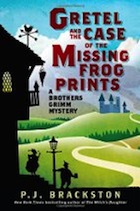
Review: Gretel and the Case of the Missing Frog Prints

Gretel and the Case of the Missing Frog PrintsP.J. Brackston, Gretel and the Case of the Missing Frog Prints

In the small town of Gesternstadt in 18th-century Germany, Gretel is something of a local celebrity. Her first claim to fame is being the Gretel, the one who escaped the clutches of an evil witch along with her gluttonous brother, Hans (a.k.a. Hansel). Now, the 35-year-old woman makes her living as a private investigator, and the biggest case of her life has just fallen into her lap. She has been summoned by Albrecht Durer the Much Much Younger, whose beautiful and beloved frog prints have been stolen. Gretel takes the case and travels to the busy metropolis of Nuremberg, accompanied by Hans, who wants to attend the city’s world-famous sausage festival. She soon stumbles across a variety of surprises, including a housecleaning hobgoblin, a secret brothel in the basement of a fancy hotel, and a veritable mafia of talking mice. And, naturally, her most promising suspect is later murdered at the scene of the crime. Can Gretel discover the thief, return the prints, and catch the murderer, all without being sidetracked by her dimwitted brother?

I got very excited by the premise of this book, which sounds like a delightfully subversive romp through both mystery and fairy-tale tropes. And indeed, there’s lots of fun stuff in this novel. Gretel has some wonderfully entertaining characteristics: she’s determined, confident, and extremely pragmatic. Hans is a good foil for her, reminding me of a Teutonic Bertie Wooster. But at the same time, I never found a reason to care about these characters; they don’t really develop over the course of the novel. Some of the humor also seemed forced, and the mystery itself was nothing special. I did enjoy the weird genre mashup of mystery plus fairy tale, and I would potentially read the sequel when it comes out. But a novel that’s pure spoof has got to be funny enough to justify itself, and I’m not sure that this one is. It certainly never reaches the zany heights of P.G. Wodehouse! Again, this book is an enjoyable read, but I was ultimately underwhelmed by it.