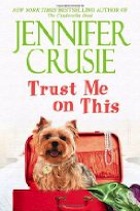
Review: Trust Me on This

Trust Me on ThisJennifer Crusie, Trust Me on This

Reporter Dennie Banks has just stumbled upon a story that could make her career: A renowned professor and marriage expert is about to get a divorce. Dennie learns that the professor will be attending a popular literature conference, so Dennie gets herself a ticket also, hoping to meet the professor there and pitch her story. Meanwhile, Alec Prentice is a government agent specializing in fraud prevention. Currently he’s on the trail of Brian Bond, a con man who’s been running a real estate scam for years. Alec learns that Bond will be at the same conference looking for his next victim, so Alec goes undercover to catch him in the act. Bond always works with a woman, so when Alec walks into the hotel bar and sees him talking to a beautiful brunette, he assumes that she’s Bond’s partner. Of course, the woman is actually Dennie, who was merely making polite chitchat with Bond. As both Alec and Dennie try to focus on their missions, they become increasingly distracted by their mutual attraction. But will their career ambitions get in the way of romance?

I’ve read and enjoyed some of Crusie’s books in the past, and this one was billed as a screwball comedy, so I was hoping to like it a lot more than I did. There’s nothing particularly wrong with the book, but there’s just nothing original or interesting about it either. I couldn’t really relate to Alec or Dennie, both perfect physical specimens whose intelligence is frequently mentioned but never actually shown. Their relationship seems to be based entirely on physical attraction, and neither character really changes in the course of the novel. The “comedy” aspect of the book also fell very flat to me; frankly, the witty banter just wasn’t that witty. The basic plot is fun and might make a decent movie, but it’s too flimsy to sustain an entire novel. I suppose the novel does touch on some deeper themes, such as the potential conflict between career ambitions and romantic relationships, but it doesn’t really say anything innovative about the issue. Overall, even as a fan of romantic comedies, I’d say skip this one.
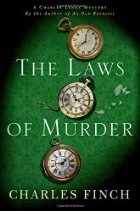
Review: The Laws of Murder

Laws of Murder, TheCharles Finch, The Laws of Murder

Victorian gentleman Charles Lenox has given up his seat in Parliament to return to his true vocation as a detective. He’s even started a detective agency with his friend John Dallington, former rival Polly Buchanan, and a talented Frenchman called LeMaire. Though the business is new, Lenox is confident that it will succeed; but a streak of bad publicity in the London newspapers causes trouble for the fledgling enterprise. Just when Lenox is considering throwing in the towel, however, an unexpected murder forces the police to seek out his services — for the victim is none other than Inspector Jenkins of Scotland Yard. Moreover, Jenkins’ body was found outside the town house of the Marquess of Wakefield, one of London’s most hardened (yet so far uncatchable) criminals. Was Jenkins investigating Wakefield when he met his death? Was Wakefield himself the killer? Lenox and his fellow detectives are on the case, but the conspiracy they uncover is more shocking than they ever could have imagined.

I like this series a lot, and this book is another good installment; but I have to confess, one month later, it’s hard for me to remember much about it! I do recall thinking that the mystery was a little predictable, but there were certainly enough twists and turns to keep me interested. The book also takes time to check in with the various secondary characters who comprise Lenox’s world, which I appreciated — although I would have liked to see even more of McConnell, Lady Jane, and the others! I also think it was a smart move to make Lenox part of a detective agency, as this introduces some new characters and relationships into the mix. The agency also illustrates some interesting areas of blindness in Lenox, especially regarding class. When the business begins to fail, Lenox is upset, but he is never in danger of experiencing real financial hardship. Some of his colleagues, however, depend on the agency for their livelihood, and this doesn’t occur to Lenox initially. So I appreciate that we got a little character growth in this installment, and I look forward to the next book!

Review: In for a Penny

In for a PennyRose Lerner, In for a Penny

The young Lord Nevinstoke, known to his friends as Nev, loves nothing more than a good time, whether it’s drinking with his friends or dallying with his mistress. But when his father dies unexpectedly, Nev suddenly inherits the responsibility of being head of the family, as well as a mountain of crushing debt. With a large estate to repair and no money for the task, his only choice is to marry a rich woman, and heiress Penelope Brown fits the bill nicely. Since Penelope’s father is a tradesman, she is not of Nev’s class, but her money seems a fair trade for his title. Nev and Penelope marry quickly, but despite their growing attraction to each other, they encounter many obstacles. Nev’s estate is in even worse shape than he thought, and he has no knowledge of business matters. His tenants have grown increasingly discontented as the estate has become less prosperous. And meanwhile, Penelope feels uprooted from everything familiar and thrust into a place where she doesn’t belong. Will Nev and Penelope be able to solve these problems and finally find happiness together?

I enjoy a good Regency romance every once in a while, and I’d read that this one is the next best thing to Georgette Heyer. I don’t know if I’d go that far, but I do think the book is very well written and often entertaining. I enjoy the “marriage of convenience turns into something more” trope, so I was predisposed to like the plot, and I also liked both Nev and Penelope as characters. Specifically, I was a big fan of how Nev grows and changes throughout the book. He starts out as a careless young man — albeit a likable one — who lives entirely for pleasure. But when he is confronted with his responsibilities for the first time, he takes them seriously and tries to learn all he can. I also sympathized with Penelope quite a bit, as she experiences a lot of insecurity when she marries “above” herself. I did get annoyed at all the misunderstandings between her and Nev, though; every time it seemed like they were finally on the same page, one of them would second-guess the relationship for no good reason. There was also a lot more, ahem, “romance” than I was expecting. But overall, as Regency romances go, this is a fairly enjoyable one.

Review: The Last Policeman

Last Policeman, TheBen H. Winters, The Last Policeman

Hank Palace, a police detective in Concord, New Hampshire, is investigating the death of a man who was found hanged in a McDonald’s bathroom. His fellow police officers are certain it’s a suicide, and with good reason: an asteroid is hurtling towards Earth, and collision is both certain and imminent. As a result, suicides are on the rise, along with a variety of other behaviors. Some people are “bucket listers,” quitting their jobs to chase their lifelong dreams while they still can. Some people turn to religion, others to drugs. In these circumstances, one more dead man — especially one who appears to have hanged himself — doesn’t matter very much to the police. But Hank suspects that there’s something wrong about this suicide, and he’s determined to discover what really happened. He uncovers several more mysteries in his investigation, including a hidden cache of drugs and a beautiful woman who knows more than she’s saying. But the biggest obstacle of all is the widespread indifference to his quest. If the end of the world is imminent, does one potential murder even matter?

This novel is an interesting combination of two popular genres, the police procedural and the apocalyptic novel, and I think it’s a fairly successful one. Hank Palace is a dry, unintentionally funny narrator who manages to retain some of his ideals despite the cynicism of his surroundings. Even though he knows that life is about to change forever (assuming life will continue at all after the asteroid hits), he remains devoted to his job. But the world of this novel is even more interesting than its narrator. I think the various reactions of people in the book to the impending catastrophe are very plausible. And the details Hank lets slip about the new role of government are as realistic as they are chilling. In this world, every crime is punishable by death or life imprisonment. There is no habeas corpus, so anyone suspected of lawbreaking is condemned without trial. The US Constitution is still the law of the land, but it’s impossible to enforce — and most government officials and police officers don’t really care. Overall, I was fascinated by the setting of this novel and will eventually continue with the series to see what happens.

Review: My True Love Gave to Me

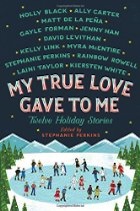
My True Love Gave to MeStephanie Perkins, ed., My True Love Gave to Me: Twelve Holiday Stories

This anthology of holiday romances contains stories from some of the biggest names in YA right now, including Rainbow Rowell, Kelly Link, Jenny Han, David Levithan, and editrix Stephanie Perkins. All twelve stories involve a romance and a winter holiday, but each one is different. There are Christmas stories and Chanukah stories, real-life settings and fantasy worlds, characters who find love and characters who find themselves. Rainbow Rowell’s “Midnights” tracks the friendship of Mags and Noel over the course of several New Year’s Eves, until the night their relationship changes forever. Jenny Han’s “Polaris Is Where You’ll Find Me” is narrated by the only human who lives at the North Pole. Myra McEntire’s “Beer Buckets and Baby Jesus” involves a bad boy, a preacher’s daughter, and a Christmas pageant gone horribly awry. The variety of stories in this collection guarantees that any lover of the winter holidays will find something in it to enjoy.

Short story collections are usually hit-or-miss for me, but because of the impressive list of contributors to this book, I was hoping for more “hits” than I got. I would say I quite liked about half the stories, with Rowell’s “Midnights” being my favorite by far. By spreading the story over several years, I really got a sense of the depth of Mags and Noel’s relationship, and the climactic scene was pitch-perfect. By contrast, I felt like a lot of the stories actually needed to be full novels in order to make a real impact. For example, “The Girl Who Woke the Dreamer” by Laini Taylor had lovely writing and an interesting world, but because the story is so short, there wasn’t really enough room to develop that world. I was also underwhelmed by Stephanie Perkins’ story, which surprised me because I love her novels! But again, I think the issue is that she didn’t really have enough space to develop her characters and make me care about them. As I said, I did like about half the stories, and I’ll be checking out more work by some of these authors (Kelly Link and Kiersten White in particular), but this is not a must-read collection.

Review: All the Light We Cannot See

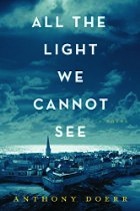
All the Light We Cannot SeeAnthony Doerr, All the Light We Cannot See

This sprawling novel tells the stories of two children growing up on opposite sides of World War II. Marie-Laure lives in Paris with her father, who is a locksmith working for the Museum of Natural History. She has been blind since the age of six, so her father has built a tiny replica of the city for her to memorize. But Marie-Laure is uprooted from these familiar surroundings when the Germans invade Paris and she has to flee to her great-uncle’s house on Saint-Malo. Meanwhile, Werner is a German orphan whose knack for fixing radios changes the course of his life. Instead of being doomed to a life of coal mining, he is chosen to attend a school where he will be trained as a Hitler Youth. Werner soon learns that the school is grueling and brutal, a place where weakness is mercilessly punished. But his desire to become a scientist, combined with fear for his own safety, keeps him silent. Werner’s story eventually converges with Marie-Laure’s in 1944, when the Germans are trying to hold Saint-Malo against an Allied invasion.

I was eager to read this novel after seeing several rave reviews, but unfortunately I have mixed feelings about it. I didn’t particularly like the novel’s structure, which constantly moves between Werner’s story and Marie-Laure’s, as well as jumping back and forth in time. Every time I got invested in one storyline, the book would jump to something else, which was frustrating. Also, there’s not a whole lot of plot in the book; it’s more a very detailed depiction of everyday life on both sides of WWII. That’s interesting in its own right, but I often became impatient with the meticulous descriptive language, especially when it came at the expense of the story. On the other hand, I’m very impressed with the character of Werner in this book. It’s easy (and justifiably so) to paint the Nazis as pure villains, but Werner manages to be a complex character whose motives are usually better than his actions. It helps that both he and Marie-Laure are children throughout most of the book, which makes them more sympathetic. Overall, I do think the novel is worth reading, but I’m glad I got it from the library rather than buying it.

Review: The Rosie Project

Rosie Project, TheGraeme Simsion, The Rosie Project

Professor Don Tillman is a brilliant geneticist, but his professional success is offset by his lack of luck in the romance department. Attacking this problem with all the force of his logical brain, Don comes up with the Wife Project: a questionnaire for prospective mates designed to weed out undesirable or incompatible qualities. Perhaps unsurprisingly, this does not go well…but then Don meets Rosie. Rosie is the exact opposite of the woman described by the questionnaire: she’s disorganized, spontaneous, and perpetually late. She also needs Don’s help to find her biological father, whom she has never met. Interested in her problem, Don agrees to participate in the Rosie Project. But the more time he spends with her, the more he begins to rethink his list of strict requirements for the ideal woman. He also re-examines his own life and discovers some surprising things about himself — including the fact that he just might have a chance at love after all.

This book was a huge hit when it came out last year, and I can absolutely see why! It’s a charming romantic comedy about two people who couldn’t be more wrong for each other — except, of course, they’re exactly right. Don is a great protagonist and narrator, and he’s unique for a romantic hero in that he has Asperger syndrome. I can’t speak to whether the author’s portrayal of a person with Asperger’s is authentic, but it rang true to me. I like that the book shows both the benefits and drawbacks to having a brain that works differently from most people’s. Don approaches the world in a very logical, structured fashion, which makes him a great scientist. But by the same token, he doesn’t always pick up on social cues or body language, which makes his courtship of Rosie difficult. Rosie herself didn’t make as much of an impression on me; she’s a quirky free spirit who doesn’t really rise above stereotype. But I loved the book for Don’s unique voice and for the sheer sweetness and humor of the love story. This is definitely one of my top reads of the year!

Review: The Brontës Went to Woolworths

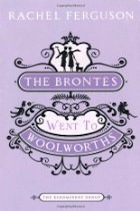
Brontes Went to Woolworths, TheRachel Ferguson, The Brontës Went to Woolworths

This book follows the fortunes of three sisters: Katrine is an actress, Deirdre is a journalist, and Sheil is still in the schoolroom. All three girls have very rich imaginations, and they have populated their world with a host of ficitonal friends, some of whom are based on real people. When the girls’ mother acts as a juror in the courtroom of Judge Toddington, the sisters immediately adopt him and his wife into their circle of imaginary friends. They affectionately nickname him “Toddy” and concoct a wealth of details about his life, from the state of his marriage to his favorite foods. But their world of make-believe collides with reality when Deirdre actually meets Judge Toddington’s wife at a charity event. As she and her sisters get to know Toddy in real life, will they be able to cope with the shattering of their illusions? Are they bound to be disappointed by the flesh-and-blood Toddingtons? And what would Toddy and his wife say if they knew the truth?

This is a strange little book, and I’m not quite sure how I feel about it. On the one hand, Deirdre and her sisters are a lot of fun, and their flights of fancy are as entertaining as they are ridiculous. I often got confused about what was actually fantasy versus reality — but then again, I think that’s the point. I also loved the actual characters of Judge Toddington and his wife, as distinct from the girls’ fictional narrative about them. They are both very kind people who actually want to become friends with the girls, and when they realize that they are stepping into a pre-existing narrative, they do their best not to disturb the girls’ fun. On the other hand, I couldn’t help being a little put off by the girls themselves. The reader is clearly supposed to sympathize with their flights of fancy, but I couldn’t help identifying a little bit with Sheil’s governess, who is shocked by the magnitude of their fantasy world. These girls are not practical, and they live a wildly sheltered life; I found them quite irritating at times. Still, the book is very charming overall, and I’d recommend it to anyone who likes the premise.

Review: Blue Lily, Lily Blue

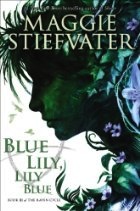
Blue Lily, Lily BlueMaggie Stiefvater, Blue Lily, Lily Blue

***Warning: SPOILERS for previous books in the series!***

Blue Sargent and the Raven Boys are approaching the end of their quest to find the long-lost Welsh king Owen Glendower. But as always, there are complications. First of all, Blue’s mother is missing, and the cryptic note she left behind says only that she is “underground.” Is she one step ahead of them in the search for Glendower, or has she gotten involved in something more sinister? Then there’s the fact that Colin Greenmantle, the person who hired the Gray Man to kidnap Ronan in The Dream Thieves, is in town — and he’s the boys’ new Latin teacher. Worst of all, when Blue and the boys finally locate the cave where Glendower rests, they realize that their troubles are only just beginning. For there is more than one entity dwelling in this cave, and some things are better left asleep…

As a fan of the previous books in the Raven Cycle, I pretty much devoured this installment. I think it might be my favorite book yet in the series, because it’s finally starting to pull together the various plot threads and character relationships that have been simmering since the first book. More secrets are revealed, the plot continues to twist and turn, and various characters’ motivations are slowly uncovered. I really like the fact that Blue, Gansey, Ronan, Adam, and Noah have become this inseparable unit now. In the first two books, there was a lot of tension between various members of the group, with everyone trying to figure out whom to trust. But in this book, they have finally accepted each other and decided to work together. I also love how certain characters (Blue and Adam in particular) are thinking about their futures: Even if they do manage to find Glendower, what happens then? So I’m very excited to see how things will turn out, and I can’t wait for the release of the fourth and final book next year!

Review: The Beauty Chorus

Beauty Chorus, TheKate Lord Brown, The Beauty Chorus

This novel centers around three female pilots who join the Air Transport Auxiliary, ferrying planes back and forth between Allied bases during World War II. Evie Chase is a headstrong young debutante who enjoys her life of privilege but wants to “do her bit” for the war effort — and escape from her odious stepmother. Stella Grainger is struggling with being separated from her baby boy, whom she’s sent to her husband’s parents in Ireland. And Megan Jones, a 17-year-old Welsh girl, wants nothing more than to keep her family’s farm running and to marry her sweetheart, Bill. These three young women couldn’t be more different, but when they join the ATA and become roommates, they form an extremely close bond. Together they deal with the challenges of flying different aircraft, the discrimination they face for being women in a man’s world, and the joys and sorrows of wartime love affairs. But despite their strength and determination, they can never quite escape the brutal realities of war.

This is a book I really wanted to love. The story has so much going for it — WWII, female pilots, romance, and even a little espionage! — but unfortunately, I was disappointed. The biggest problem for me was the clunky writing style; for example, on one occasion, the author drops a character name into the story before introducing that character. I had to flip backward to make sure I hadn’t somehow missed his entrance, but in fact, it was just a confusing way to introduce the new character. There’s also a lot of head-hopping in the book; not only does the point of view shift between the three girls (which would be understandable), but there are random paragraphs from the perspectives of their suitors and various other minor characters. Finally, while I liked the main characters in theory, they never really rose above clichés. For example, Evie is a typical HF heroine: incredibly beautiful, naturally talented as a flyer, and implausibly far ahead of her time. Overall, while the book certainly wasn’t a slog, I can’t say I’d recommend it either.