Mini-Reviews: Shippers, Corpse, Brides

Katherine Center, The Shippers

JoJo Burton’s love life is a train wreck—a fact that becomes abundantly clear when she leaves her rich, “perfect” fiancé at the altar. JoJo thinks her problem may be rooted in unresolved feelings for her childhood crush, Finn Turner. Fortunately, her sister’s about to get married on a cruise ship, and newly divorced Finn is one of the guests. With several days of forced proximity and her sister’s help, JoJo is determined to attract Finn and thus fulfill her romantic destiny. The only problem is JoJo’s best friend, Cooper, who thinks her plan is ridiculous. As her attempts to lure Finn meet with disaster, JoJo eventually begins to question where her romantic destiny truly lies. This is a fun, fast-paced read with some cute banter, but I have to say that the romance drove me crazy! JoJo is implausibly blind to what’s right in front of her, and I don’t buy that Cooper would have kept his feelings a secret for so long. I also found the ending a bit anticlimactic after all the buildup. The book is still a fun, breezy summer read if you like this premise, but for me it’s not one of Center’s best.

Delano Ames, Corpse Diplomatique

Jane and Dagobert Brown are traveling through France when they encounter a violent death, about which Dagobert immediately suggests Jane write another mystery novel. While staying in Nice, they meet a diplomat from “Santa Rica” who is terrified of being assassinated. His fears seem justified when a bullet whizzes by his head, narrowly missing him but killing Major Hugh Arkwright instead. Who was the true intended victim, and who among the Browns’ new acquaintances at their French hotel is the killer? This series is enjoyable mainly for Jane’s snarky running commentary on the various people and events she’s writing about. The characters are largely well drawn, and I enjoyed the touches of humor, but the mystery itself is a bit lackluster; it kind of plods along without any real forward motion until the very end. Overall I liked this book fine, and I’d read more in the series if I came across them, but I don’t feel compelled to seek them out.

Amy Barry, Seven Brides for Beau McBride

After Junebug McBride found wives for two of her four older brothers, she’s been strictly forbidden from advertising for any more mail-order brides. But the third McBride brother, Beau, thinks Junebug had the right idea and places his own ad for a bride. Naturally, Junebug has to be involved and bets Beau that she can find a better wife than he can. But when she writes to six women instead of one, and they all come out West hoping to marry Beau, she has a problem on her hands. Especially when one of her brides, Ellie Neale, turns out to be best friends with Beau’s own pick, Diana—and Ellie soon falls for Beau herself! I enjoyed this fun Western romance, with its nonsensical yet enjoyable plot and over-the-top characters. Junebug is a lot and would be insufferable in real life, but she’s a lot of fun to read about. I liked that the seven potential brides were all decent and kind women, rather than being catty rivals. Beau and Ellie’s romance was sweet and had some funny moments due to Ellie’s melodramatic nature. I’m looking forward to the next book in the series!

Mini-Reviews: Trellised, Morning, Silent

Fiona Hill, The Trellised Lane

Julia has been the lady of the house since her mother’s death, but now that her father has remarried, she no longer has that freedom and authority. Despite liking her new stepmother, Julia wants to regain her lost responsibilities and urges her brother, Fitz, to accompany her to London so that she can marry and leave home. She soon catches the eye of a French nobleman with a dubious past, but is herself attracted to a friend of her stepmother’s. Meanwhile, Fitz’s innocence is challenged by the new friends he meets in London. Last year I really enjoyed Fiona Hill’s The Country Gentleman and consequently bought an e-book collection of her novels. Unfortunately, this one didn’t really work for me; it just felt very unoriginal and paint-by-numbers. The stakes couldn’t be lower, and none of the characters are particularly well developed. Not a terrible book, just bland as an unsalted cracker.

Eva Ibbotson, The Morning Gift

Ruth Berger was born and raised in Vienna as the privileged daughter of a well-off professor. But in 1938, because of her Jewish heritage, Vienna is no longer safe. Her family emigrates to England, but due to a paperwork mix-up, she is left behind. Enter Quinton Somerville, a British professor who once studied with Ruth’s father and decides to help her get out of Austria. Unfortunately, the only way to do it is by marrying her. Quin and Ruth agree they’ll annul the marriage once they reach England, but of course fate has other ideas. Eva Ibbotson’s books are the ultimate comfort reads for me. They’re full of warmth and community, with luxurious descriptions of scenery and music and food. But they’re saved from being too sickly sweet by some moments of genuine gravity and heartbreak, such as the story of the Ziller quartet in this book. Work is stressful at the moment, so I needed a familiar comfort read, and this novel was the perfect choice!

C.S. Lewis, Out of the Silent Planet

Philologist Elwin Ransom is on a walking tour of England when he encounters an old schoolfellow, Devine, and a brilliant physicist, Dr. Weston. They’re working on a mysterious object that turns out to be a spaceship—and the hapless Ransom is taken on board by force. He learns that Devine and Weston are taking him to another planet, Malacandra, which is inhabited by sapient beings who requested Ransom for some ominous purpose. But when the three men land on Malacandra, Ransom soon learns that the planet and its inhabitants are nothing like he expected. This book was written in the ’30s, and it cleverly interrogates the tropes of science fiction that were popular at the time (what aliens would be like, what would be the experience of space travel). The plot is a bit slow-moving, with lots of descriptive language about the terrain and the various species Ransom meets. There are also some thinly veiled religious ideas, which is to be expected with Lewis. Overall, this is a pretty good space-travel tale, but it’s definitely more on the philosophical than the adventurous side.

Mini-Reviews: Waltz, First, Apprentice

Cornell Woolrich, Waltz into Darkness

Louis Durand, age 37, is a prosperous but lonely businessman in 1880s New Orleans. Unable to bear his solitude, he begins corresponding with Julia Russell and proposes to her sight unseen. To his delight, the woman who arrives is younger and more beautiful than he expected. They marry immediately, and Louis is happy at first, but eventually he begins to notice some worrisome behaviors in his new wife. This novel is the literary equivalent of a train wreck: You know it’s going to be a disaster, but you can’t look away. I felt awful for Louis from the very first chapter, which reveals his aching loneliness and his hope that it’s finally about to end. I wanted things to work out for him, even though it was always obvious that they wouldn’t. The book is well written but painful! Ultimately, I’m just not a noir person; but if you are, I highly recommend Cornell Woolrich.

Lynn Painter, First and Forever

Duffy Distefano and her family are huge fans of the Minnesota Coyotes football team. But when the team’s mascot gropes Duffy at a game—and her retaliation is caught on camera—she becomes a target for Coyotes fans. She’s invited to tell her side of the story on a local morning TV show, only to be confronted by a Coyotes player, Connor Cunningham, who’s there to do damage control for the team. Their on-air conversation, which reads as flirtatious banter, creates good PR for the Coyotes, who suggest that Connor ask Duffy out to further improve the team’s image. But as they get to know each other better, they both develop real feelings. I really like Lynn Painter’s romances, which are fun and light with great banter, and this one is no exception. I’m not a sports person at all, so I felt like I was getting a little peek at a new-to-me subculture. I did find the plot a little bland, and the third-act breakup was both predictable and unnecessary, though at least it didn’t last too long. But overall, I liked this one and will be interested to see if there’s a sequel, as there did seem to be some chemistry between Duffy’s brother and her best friend!

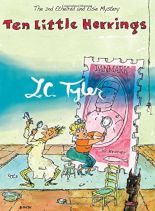
L.C. Tyler, The Herring-Seller’s Apprentice

Ethelred Tressider is a mediocre mystery writer and a bit of a sad sack. His wife, Geraldine, left him for his best friend years ago, and now he has neither a romantic partner nor any close friends. The only person he seems to interact with regularly is his literary agent, the abrasive Elsie Thirkettle. But when Geraldine goes missing—along with a fortune she obtained by scamming investors—it’s up to Ethelred, with unwanted assistance from Elsie, to solve the case. This book is a light, humorous mystery that has some fun playing with the conventions of the genre. I loved Elsie’s no-nonsense voice and the way she bullies Ethelred—for his own good, of course! That said, while I’ll definitely read book two because I own it, I’m not sure I’m invested enough to commit to the whole series.

Mini-Reviews: Spindle’s, Portent, Nowlan

Robin McKinley, Spindle’s End

In this retelling of Sleeping Beauty, Katriona attends the baby princess’s name-day, where she witnesses the evil fairy lay her curse on the infant. In the ensuing fear and chaos, Katriona is charged with taking the princess away and keeping her safe. Not knowing what else to do, she takes the baby back to her small backwater village, where she and her aunt raise “Rosie” as their own. But as Rosie grows up, she gradually becomes aware of her true identity and the terrible fate that awaits her. Robin McKinley’s novels are books of my heart, and this one is no exception. The pacing is very slow, but that just gives readers time to immerse themselves in Rosie’s world, in the homely little village community among the people and animals who love her. The book follows the fairy tale pretty closely while creating very specific characters and putting a unique spin on the ending. In short, I can’t be objective about this book; I love it and enjoyed this reread immensely.

Elizabeth Bailey, The Deathly Portent

Ottilia Fanshawe and her husband, Lord Francis, are on a journey when their carriage breaks down near the village of Witherley. They attempt to summon the blacksmith to repair the carriage, only to discover that the man has just died in violent circumstances. The locals are blaming Cassie Dale, who allegedly had a vision of the blacksmith’s death and who they believe is a witch. Tillie is convinced there’s a more rational explanation for the crime, and as she and Francis linger in town to investigate, they discover many people in the village with possible motives for murder. I liked this historical mystery, but I think I enjoyed the historical bits more than the mystery bits. I was able to guess the killer, even though the person’s motive was extremely farfetched, and there were maybe a few too many suspects. I did like Tillie and Francis’s dynamic, though, as well as the secondary romance between Cassie Dale and the vicar. I’d be interested to read more in this series, but I’ll get them from the library rather than buying.

Alden Nowlan: Selected Poems

Several years ago, someone on LibraryThing (I wish I could remember who!) posted a poem by Alden Nowlan that intrigued me enough to pick up a book of his poetry. Nowlan was a 20th-century Canadian poet from rural Nova Scotia, and his poems often deal with themes of poverty and the natural world. I doubt most of the poems will stay with me, but almost all had at least one image or phrase that struck me as interesting. Here’s one of my favorites from the collection:

“Canadian Love Song”

Your body’s a small word with many meanings.
Love. If. Yes. But. Death.
Surely I will love you a little while,
perhaps as long as I have breath.

December is thirteen months long,
July’s one afternoon; therefore,
lovers must outwit wool,
learn how to puncture fur.

To my love’s bed, to keep her warm,
I’ll carry wrapped and heated stones.
That which is comfort to the flesh
is sometimes torture to the bones.

Mini-Reviews: Educating, Joyful, Lucky

Patricia Cabot, Educating Caroline

Lady Caroline Linford is shocked and dismayed to discover her fiancé in the arms of another woman. Feeling unable to break off the engagement, she decides she needs some lessons in seduction so that she can keep her betrothed from straying. And who better to teach her than the “Lothario of London,” Braden Granville? Braden is surprised by Caroline’s proposal, since she’s such an innocent and proper young lady, while he’s a self-made man from the slums of London. But he’s also intrigued—and finds himself giving her a much more hands-on tutorial than either of them expected. This is one of the first historical romance novels I ever read, and I was curious to see if it would hold up to my fond, nostalgic memories. By and large, I still found it an enjoyable read! It’s almost a parody of the genre, which made me willing to overlook the book’s sillier elements, and there’s a decent suspense plot alongside the main romance. It’s not great literature by any means, but if you’re in the mood for a light and fluffy historical romance, this one is a fun time.

Ellis Peters, Death and the Joyful Woman

Sixteen-year-old Dominic Felse meets the beautiful 22-year-old Kitty Norris and falls immediately, painfully in love with her. So when she is arrested for the murder of Alfred Armiger, an enormously wealthy but not very popular local entrepreneur, Dominic knows she must be innocent and attempts to find the real killer. Is it Armiger’s estranged son and his wife, who lost out on the dead man’s fortune? Or could the murder have something to do with a tavern sign of dubious artistic merit? I’m really enjoying these Felse novels, not just for the vintage-mystery charm but for the lovely characterizations, especially of George and Dominic. Their relationship is loving but complicated now that Dominic is on the verge of adulthood. The solution to the mystery is almost irrelevant to the central conflicts of the novel, but that’s a minor quibble when the book is this enjoyable. I’ll definitely be continuing with this series at some point!

Diane Farr, Under a Lucky Star

When Derek Whittaker rescues Lady Cynthia Fitzwilliam from the unwelcome attentions of another man, it’s love at first sight for them both. Derek immediately plans to court Cynthia, but at their next meeting she rebuffs him. Hurt and angry, Derek tries to forget about her; but when they meet again three years later at a house party, he’s annoyed to find that he is still drawn to her. Meanwhile, Cynthia struggles with her attraction to Derek, since she feels duty-bound to marry a very rich man to support her family. Diane Farr is a good writer, and I’ve enjoyed some of her books, but this one frustrated me. I’m not a fan of insta-love generally, and in this case it felt like Derek and Cynthia kept having the same argument over and over again. But I did like that Cynthia’s scheming mother gets her comeuppance in the end! Overall, this book is a quick and pleasant read, but it just wasn’t the right story for me.

Mini-Reviews: Regency, Eyes, Spellman

Georgette Heyer, Regency Buck

Judith Taverner and her brother Peregrine travel to London to meet their guardian, Lord Worth, who they assume is a curmudgeonly old man. In fact, Worth is relatively young, a leader of fashionable society, and friends with Beau Brummell. His autocratic manner immediately offends strong-willed Judith, and their frequent arguments comprise the most dramatic parts of the book. Meanwhile, someone is trying to kill Peregrine, but is the villain Worth or someone else? I love Heyer, but this is not one of my favorites by her, and now I remember why. It’s one of her earliest Regency romances, and it seems like she dumped all her research here. We get so much detail about Beau Brummell, the Royal Pavilion at Brighton, prizefighting, and so on that there’s no space for the romance. The hero treats Judith badly, and we don’t get enough insight into his feelings or motives. If you want a detailed window into the Regency era, this novel is great, but it’s not very satisfying as a romance.

Zora Neale Hurston, Their Eyes Were Watching God

Janie Crawford is a young black woman living in Florida in the early 20th century. Her grandmother, who was born in slavery, has a specific vision for Janie’s life: She should marry a well-to-do man and let him take care of her, so that she never has to work or struggle. But Janie has an adventurous spirit and wants to see more of the world. Some of her choices don’t work out—she meets men who want to stifle and control her, and she endures poverty and great suffering. But she also finds true love and spiritual freedom despite her circumstances. This is a beautifully written novel with a compelling protagonist; Janie felt like a real person to me, and in the end I was convinced that she’d be okay no matter what happened next. I also liked the portrayal of Janie’s community, which felt vivid and true to life. The characters all use a specific dialect, which means you have to pay close attention while reading, but I think that’s a feature rather than a bug. Overall, I can see why this book is regarded as a classic and would definitely recommend it.

Lisa Lutz, The Spellman Files

The Spellmans are a loving but dysfunctional family of private investigators. They tail each other around town, record each other’s private conversations, and break into each other’s locked rooms. Twenty-eight-year-old Izzy, who narrates this novel, is the screwup of the Spellman children and wants to leave the family business. But her parents make her take on one last case before they’ll allow her to quit, and Izzy’s questionable investigative tactics cause even more family drama. This is a really clever book with a fun premise—I enjoyed Izzy’s deadpan narrative voice and the various hijinks she and her family get into. At the same time, it all requires a huge suspension of disbelief, and you can’t think too hard about the reality of this family or you’ll realize how truly tragic and dysfunctional it is. This is the first book in a series, but I’m not sure I’ll be continuing…I did enjoy it, but I don’t think I need more.

Mini-Reviews: Hitchhiker’s, Rake, Emma

Douglas Adams, The Hitchhiker’s Guide to the Galaxy

It’s an ordinary Thursday, and British everyman Arthur Dent is lying in front of a bulldozer, trying to stop his house from being demolished. Little does he know that the entire planet is about to be demolished to make way for an interstellar bypass. Fortunately, his alien friend, Ford Prefect, saves him from vaporization by hitching a ride on a spaceship. From there, Arthur and Ford brave many dangers, including Vogon poetry, infinite improbability, automated attacks from dead planets, and the evil machinations of white mice. I remember reading this book (and the sequels) in my tween or teen years, and at the time I thought it was hilarious. This time around, I could still appreciate some of the humor, but I had less patience for it. The book isn’t attempting to be anything more than a rapid-fire series of jokes, and after a while I found it a bit tedious. So even though there’s no real resolution at the end of this novel, I’m not tempted to continue with the series.

Mary Jo Putney, The Rake

Notorious rake Reggie Davenport is growing tired of his aimless life; so when his cousin, the Earl of Wargrave, unexpectedly gives him an estate, he views it as a fresh start. Upon arriving at the estate, Reggie is shocked to discover that his very capable steward is a woman, Alys Weston. Alys fled her aristocratic family at a young age and has fought hard to make her own way in the world, so at first she fears and resents Reggie’s presence. Eventually they discover each other’s good qualities, but Reggie’s drinking problem threatens their relationship. I was pleasantly surprised by this book! I loved its refusal to romanticize rakishness: Reggie’s drinking and womanizing have serious consequences, particularly his struggle with what we now call alcoholism. His feelings for Alys are one motivating factor in his desire to change, but not the only one, and her love doesn’t magically solve his problems. I liked Alys too and related to her insecurities, but this is really Reggie’s book. I would highly recommend it to historical romance fans, and I’m interested in trying more by Putney—anyone have any recommendations?

Audrey Bellezza and Emily Harding, Emma of 83rd Street

In this contemporary retelling of Jane Austen’s Emma, Emma Woodhouse is a privileged 23-year-old living on the Upper East Side and getting a master’s in art history. Socially, she’s at a loose end now that her beloved older sister has married and moved out. So when she meets country-mouse classmate Nadine, Emma decides to give her a makeover—as well as some dubious romantic advice. Emma’s friend Knightley doesn’t hesitate to point out the flaws in her approach, but lately their good-natured sparring seems to be taking a romantic turn. I adore Austen but tend to steer clear of retellings; I broke my rule for this one, and sadly I don’t think it was worth it. The novel has its good points—it successfully translates the original book’s major plot points, and it gives us some peeks at Knightley’s point of view—but to me it felt like a standard contemporary romance with nothing particularly interesting or compelling about it. Unless you’re a diehard Austen fanfic lover, I’d skip this one.

Mini-Reviews: Gilded, Enchanting, Scoop

Elizabeth Bailey, The Gilded Shroud

In this Georgian-era historical mystery, Emily Fanshawe, the marchioness of Polbrook, is strangled in her bedchamber, and the most likely suspect is her husband. Their marriage has always been contentious, they argued the night before the murder, and now Lord Polbrook is nowhere to be found. His family is horrified yet determined to prove him innocent—a task that falls on his younger brother, Lord Francis Fanshawe, and on his mother’s new companion, Ottilia Draycott, whose clever mind soon uncovers some pertinent secrets. I read this book a long time ago and remember liking it, so I’m pleased to say I really enjoyed it this time as well! The historical setting feels grounded, and both Francis and Ottilia are interesting, sympathetic characters. The mystery is well plotted but a bit slow, and I found it less compelling than the romantic subplot. But I’m excited to read the next book, which I also own, and it looks like Bailey has also written some romances that I’d like to check out!

Stephanie Burgis, Enchanting the Fae Queen

Imperial general Gerard Moireul is a brilliant military strategist with an unassailable reputation for honor and integrity. Queen Lorelei of Balravia is notorious for her flighty, scandalous behavior. They’ve been nemeses for years, both politically and personally. But when a magical bargain forces them to compete in a fae tournament, they must work together, and slowly they come to realize they’re much more alike than they thought. I’m generally a Burgis fan, and I enjoy the enemies-to-lovers trope, so overall I found this quite fun. Both Gerard and Lorelei are likable characters underneath their exaggerated public personas, and I’m especially fond of an uptight, duty-bound hero. I do think the broader political situation in this fantasy world is boring and basic; the book is more enjoyable when it focuses on the romance. Overall, it’s a fun read, and you don’t necessarily have to read the previous book, Wooing the Witch Queen, to follow this one.

Evelyn Waugh, Scoop

British novelist John Courteney Boot has gotten himself entangled with the wrong woman and needs to skip town. He asks a friend to get him a job as a foreign correspondent covering the imminent war in the East African republic of Ishmaelia. But through a series of misunderstandings, the newspaper sends the wrong man, William Boot, who writes a nature column and has absolutely no desire to travel beyond his country village. As William embarks on his bewildering adventure, he learns more than he bargained for about journalism and international relations. This novel is both a biting satire on journalism and an extremely well-plotted farce. I loved how William’s oblivious blundering essentially caused the revolution (and counterrevolution) in Ishmaelia. On the minus side, there aren’t really any characters to root for, and the worldview expressed by the novel is cynical and bleak. Overall, I enjoyed the book’s humor but don’t think I’d ever want to reread it.

Mini-Reviews: Unlikely, Penance, Outcrossing

Betty Neels, An Unlikely Romance

Orphan Trixie Doveton doesn’t expect too much from life; she’s content with her work as a nurse-in-training and doesn’t believe she’ll ever marry. So she’s shocked when Professor Krijn van der Brink-Schaaksma, a renowned endocrinologist and very eligible bachelor, proposes a marriage of convenience. He needs someone to manage his social life and keep his acquaintances at bay so he can concentrate on the book he’s writing. Trixie, having fallen in love with him almost immediately, accepts—but can she be happy when the man she desperately loves hardly seems to notice her? I enjoyed this a bit more than my previous Neels title, No Need to Say Goodbye. I liked that Trixie wasn’t a complete doormat; though she outwardly conforms to all Krijn’s expectations, she isn’t happy about it and occasionally lets her anger show. I also liked getting a few glimpses into Krijn’s head as his feelings for his wife begin to change. It’s not a deep or significant book, but not bad for a quick, nostalgic read.

Ellis Peters, Brother Cadfael’s Penance

***Warning: SPOILERS for previous books in the series!***

In the late fall of A.D. 1145, the civil war between King Stephen and Empress Maud rages on, but most people just want the fighting to be over, regardless of the victor. To that end, one of the empress’s major supporters changes sides and surrenders a key castle to Stephen. When some of the castle’s knights refuse to betray the empress, they are taken prisoner. Among them is Olivier de Bretagne, Brother Cadfael’s son from his crusading days. Cadfael sets out for Coventry, where a peace conference is being held, to see if he can locate and ransom Olivier. But doing so will risk his place among his Benedictine brethren—and possibly even his life. I adore this series and am sad to have finished it, but I think this is an extremely fitting conclusion. Cadfael faces his biggest challenge yet, as he’s torn between love of his vocation and love of his son. The book also explores the complexities of friendship, loyalty, and father-son relationships, all while painting a vivid picture of medieval life. I can’t recommend this series highly enough, although I definitely think this book should be read last.

Celia Lake, Outcrossing

In this fantastical version of 1920s England, Rufus Pride is magically gifted but untrained, since the man who was supposed to teach him died in the Great War. Now Rufus is struggling to make ends meet with no steady trade, magical or otherwise. Meanwhile, Ferry Wright is from an aristocratic family, but she’s become a governess rather than marry the much older man her parents have chosen for her. When Rufus and Ferry meet, they’re immediately drawn to each other but don’t see a way to be together. Then Rufus falls in with a gang of smugglers who put both his and Ferry’s lives in danger. This book is marketed as a “cozy historical fantasy romance,” which is a fair description and right up my alley. I found it slight but charming, although the dialogue was occasionally a bit stilted to my ear. I also could have done without the two or three steamy scenes. But overall, I enjoyed this one and would consider reading more by the author – she seems to be quite prolific!

Mini-Reviews: Ring, Moon, Earl

Lois McMaster Bujold, The Spirit Ring

In a magical version of Renaissance Italy, Fiametta is the privileged daughter of a goldsmith and master mage. Her biggest problem is an unrequited crush on one of the duke’s soldiers—that is, until the duke is assassinated by a rival who seems to command dark magic. When this man’s soldiers kill Fiametta’s father and seize his corpse for use in an evil ritual, she teams up with the local abbot, who also has some knowledge of magic, and with Thur, a would-be metalworker who was supposed to be her father’s new apprentice. This stand-alone fantasy novel is one of Bujold’s earlier works, but it has a lot of her characteristic elements: strong world-building, an intelligent heroine with agency, and ordinary people doing heroic things because there’s no one else around to do them. The book has a YA feel to it, possibly because Fiametta and Thur are both teenagers, and their romance is a bit underdeveloped. Overall, though, I really enjoyed this one and would recommend it to fantasy fans!

Robert A. Heinlein, The Moon Is a Harsh Mistress

It’s 2075, and the Federated Nations of Earth have established a thriving colony on the moon. But times are tough on Luna, whose resources are being unfairly exploited by the Terran government. A small group of Lunar citizens decides to start a revolution, including narrator Manny, an engineer who has befriended self-aware supercomputer “Mike.” Along with a crafty professor, a beautiful revolutionary, and a Terran self-proclaimed soldier of fortune, Manny and Mike engineer a rebellion—but at what cost? This novel combines clever world-building with speculative science and libertarian political philosophy. There are some interesting ideas in it, and I liked Manny’s narrative voice once I got used to the Lunar dialect, but I also found it a slog; it really drags after the initial setup. It was fascinating that some aspects of the plot were very dated while others still felt timely. Overall, this was a mixed bag for me, and I’ll probably wait a while before trying anything else by Heinlein.

Kate Pembrooke, Not the Kind of Earl You Marry

William Atherton, the earl of Norwood, is a man of unassailable respectability and political aspirations. So when a newspaper announces his engagement to Charlotte Hurst, a social nobody whom he’s never even met before, he’s furious. But when it becomes obvious that Charlotte knows nothing about the announcement either, William proposes that they pretend it’s true: A temporary engagement will prevent any scandal and give him the chance to figure out who’s really behind the announcement. But as William and Charlotte spend more time together, their fake betrothal starts to feel all too real. I enjoy the fake relationship trope, and this is an inoffensive example of it, but honestly the book fell a bit flat for me. Contrary to the title, William is exactly the kind of earl anyone would marry—handsome, rich, intelligent, kind, and essentially flawless. Lovely in real life but dull in fiction, and Charlotte is no better. Overall, the book just feels like the blandest possible version of this story, and I’m not particularly tempted to pick up the sequel.