Review: Gretel and the Case of the Missing Frog Prints

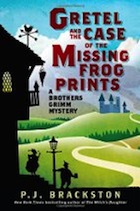
Gretel and the Case of the Missing Frog PrintsP.J. Brackston, Gretel and the Case of the Missing Frog Prints

In the small town of Gesternstadt in 18th-century Germany, Gretel is something of a local celebrity. Her first claim to fame is being the Gretel, the one who escaped the clutches of an evil witch along with her gluttonous brother, Hans (a.k.a. Hansel). Now, the 35-year-old woman makes her living as a private investigator, and the biggest case of her life has just fallen into her lap. She has been summoned by Albrecht Durer the Much Much Younger, whose beautiful and beloved frog prints have been stolen. Gretel takes the case and travels to the busy metropolis of Nuremberg, accompanied by Hans, who wants to attend the city’s world-famous sausage festival. She soon stumbles across a variety of surprises, including a housecleaning hobgoblin, a secret brothel in the basement of a fancy hotel, and a veritable mafia of talking mice. And, naturally, her most promising suspect is later murdered at the scene of the crime. Can Gretel discover the thief, return the prints, and catch the murderer, all without being sidetracked by her dimwitted brother?

I got very excited by the premise of this book, which sounds like a delightfully subversive romp through both mystery and fairy-tale tropes. And indeed, there’s lots of fun stuff in this novel. Gretel has some wonderfully entertaining characteristics: she’s determined, confident, and extremely pragmatic. Hans is a good foil for her, reminding me of a Teutonic Bertie Wooster. But at the same time, I never found a reason to care about these characters; they don’t really develop over the course of the novel. Some of the humor also seemed forced, and the mystery itself was nothing special. I did enjoy the weird genre mashup of mystery plus fairy tale, and I would potentially read the sequel when it comes out. But a novel that’s pure spoof has got to be funny enough to justify itself, and I’m not sure that this one is. It certainly never reaches the zany heights of P.G. Wodehouse! Again, this book is an enjoyable read, but I was ultimately underwhelmed by it.
Review: Don’t Point That Thing at Me

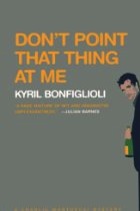
Don't Point That Thing at MeKyril Bonfiglioli, Don’t Point That Thing at Me

This picaresque novel is narrated by the Hon. Charlie Mortdecai, an art dealer who usually operates on the shady side of the law. In the opening scene he is visited by Inspector Martland (of a secret branch of the British police) in connection with a stolen Goya. Mortdecai claims to know nothing of the matter, but he cheekily admits to the reader that it is hidden under the floorboards. After Martland’s visit, Mortdecai knows he must unload the painting, but his mission is complicated by the murder of one of his associates. Even worse, someone seems to want Mortdecai dead as well — so he strikes a bargain with Martland to get diplomatic passage to America, where he hopes to make good his escape. There he encounters a variety of adventures, from constant surveillance by men in blue Buicks to the sexual aggressiveness of a rich American widow. Through it all, Mortdecai maintains a cheerful unconcern as he matches wits with several dangerous opponents.

I have very conflicting feelings about this book. On the one hand, I don’t think I understood the plot at all; there’s definitely a painting involved, and a valuable antique Rolls Royce, and various people who want Mortdecai dead, but I was always a bit confused about what was actually going on. On the other hand, Mortdecai has a delightful narrative voice — very reminiscent of Bertie Wooster, if Bertie were an art thief with a crasser mode of expression. (For example, Mortdecai’s valet/bodyguard is called Jock Strapp, which is either funny to you or it isn’t.) So the book does provide a lot of laughs, but in the end I’m not really sure what to think of it. The novel is first in a series, and I may check out the others at some point. The movie “Mortdecai,” which comes out today in the U.S., is also based on this series, and I’m interested to see how it deviates from the book. Johnny Depp seems like a very odd casting choice, for starters, but I’m nevertheless intrigued!

Review: Good Omens

Good OmensNeil Gaiman & Terry Pratchett, Good Omens

Since the beginning of the world, the forces of good and evil have been preparing for battle, and now Armageddon is imminent. The Four Horsepersons of the Apocalypse roam the earth, the Antichrist is about to be born, and the end times are at hand. But angel Aziraphale and demon Crowley aren’t terribly enthusiastic about the upcoming war and ensuing destruction of Earth. In fact, they’ve both become rather fond of the planet and the foolish humans who populate it. So unbeknownst to their superiors, they strike a truce: neither one of them will attempt to influence the newborn Antichrist in their favor. Little do they know that, thanks to a mix-up at the hospital, they’ve focused their efforts on the wrong baby! Meanwhile, the Antichrist grows up as a perfectly normal human boy called Adam Young, who knows nothing about his special destiny. But as the signs of the end times become harder to ignore, Aziraphale and Crowley must race against time to prevent Adam from unwittingly using his powers to destroy the world.

This book is a delightful romp through the Book of Revelation and common cultural perceptions regarding the end of the world. It truly has something for everyone, from demons to witchfinders to psychics to aliens, and I lost count of the jokes that made me laugh out loud! I loved the fact that Famine (one of the Horsepersons) was a diet guru, and that one of Crowley’s most notable Hellish accomplishments was the M25 motorway surrounding London. The book’s plot is rather sprawling, and I wasn’t a big fan of every storyline (didn’t care too much about Anathema Device, for example, although I loved Newton Pulsifer — the name alone!). But then again, who cares about plot when there’s such brilliant silliness to enjoy? I do think this book would be best enjoyed by people who are at least somewhat familiar with the Book of Revelation, because otherwise you won’t get all the jokes! But I honestly think that anyone who enjoys British humor will find this book hugely entertaining.

Review: Texts from Jane Eyre

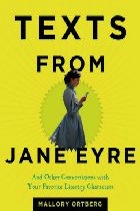
Texts from Jane EyreMallory Ortberg, Texts from Jane Eyre: And Other Conversations with Your Favorite Literary Characters

Mallory Ortberg, popular writer for websites such as The Hairpin and The Toast, has expanded her ingenious “Texts From” series into a book. What if the various authors, poets, and characters you studied in school had the ability to text? Hamlet would probably be a whiny teenager who refuses to come out of his room for dinner. William Carlos Williams would be constantly bugging his wife to bring home more plums from the grocery store. And Mrs. Bennet certainly wouldn’t miss an opportunity to urge her daughters to snag rich husbands! From Achilles to Virginia Woolf, Wuthering Heights to Sweet Valley High, nothing is safe from Ortberg’s satirical (and often punctuation-less) eye.

It’s hard to review humor because it’s so subjective: You either think it’s funny or you don’t. I’m definitely a fan of Ortberg’s style — the texts from Jane Eyre had me ROLLING the first time I read them! — so I enjoyed this book. I definitely think it helps to be familiar with the source material; most of the literary references are to pretty famous works, but there are also sections on The Hunger Games and The Baby-Sitters Club, so it’s a rather random, eclectic mix. The biggest criticism I have about the book is that it’s kind of one-note. The premise is funny, but there’s really nothing more to it. Basically, I don’t think it’s a book that I’d need to read over and over again, but it would be a great gift for someone who loves literature!

N.B. I received an ARC of this book through the LibraryThing Early Reviewers program. The publication date, per Amazon, is November 4.

Review: No Bed for Bacon

No Bed for BaconCaryl Brahms & S.J. Simon, No Bed for Bacon

In this hilarious send-up of the Elizabethan era — or rather, the Elizabethan era as perceived by popular culture — Sir Francis Bacon is desperate to obtain a bed that Queen Elizabeth has slept in during one of her royal progresses. He wants it to be an heirloom for his family, as he knows the bed’s value will only increase through the years. Sir Walter Raleigh’s attention is divided between his new cloak, which he hopes will be the envy of everyone at Elizabeth’s court (especially that dandy, the Earl of Essex), and his upcoming introduction of the potato to England. Meanwhile, Sir Francis Drake is grumbling about the fact that he hasn’t been able to do any really good pirating in years; theater owner Philip Henslowe will do anything in his power to shut down his rival, Burbage; and Shakespeare is trying to work on a new play, Love’s Labour’s Wunne, but he keeps getting distracted by the problem of how to spell his own name. Add a little romance, an overly ambitious watchman, and some reminiscing about the glory days of the Armada, and the stage is set for high comedy with a few history lessons thrown in.

I didn’t know it until I read the introduction, but this book is actually part of the basis for the Academy Award-winning movie “Shakespeare in Love.” But while the movie focuses almost entirely on the romance between Shakespeare and the noble Lady Viola, in the book it’s just one of many plots involving the most famous figures of the Elizabethan age. If you know anything about the era or are interested in learning more, I highly recommend this book! It’s pure farce, so there isn’t much “plot” to speak of, but the jokes are more than funny enough to make up for that! One of my favorites was an exchange between Shakespeare and Bacon about some plot element of Shakespeare’s play that Bacon didn’t like. Shakespeare responds with great indignation, “Master Bacon, do I write my plays or do you?” Then there’s this internal monologue from a Puritan who seeks to shut down the theater: “People had no right to enjoy themselves. He was going to stop them. His cause was a just one and he knew it. He was enjoying himself.” So if you like Shakespeare and don’t mind a little (or a lot of) silliness, you should definitely check out this book!

Review: One More Thing

One More Thing-Stories and Other StoriesB.J. Novak, One More Thing: Stories and Other Stories

In this collection of (very) short stories, B.J. Novak — formerly a writer, producer, and actor on the US version of “The Office” — uses his comedic imagination to ask a variety of hypothetical questions. What if the hare who lost the fabled race to the tortoise became obsessed with thoughts of a rematch? What if the handsome man you met in a bar turned out to be a brutally violent African warlord? What if you could literally hold a mirror up to Earth? And what if Chris Hansen, of “To Catch a Predator” fame, were forced to go to a Justin Bieber concert at the insistence of his tween daughter? Novak answers these questions and many more in his debut collection of funny, dark, ridiculous, and often poignant stories.

The first thing to say about these stories is that most of them are very short, some no more than a page or two. So most of the stories don’t have time to delve deeply into plot or character; rather, they focus sharply on a single joke or idea (see, for example, “The Comedy Central Roast of Nelson Mandela” or “The Market Was Down”). In that sense, it’s easy to see the influence of Novak’s TV background. However, even if you aren’t a fan of “The Office” or its style of comedy, you should still find plenty to enjoy in this book! I was very impressed by how smart Novak obviously is; clever wordplay and literary allusions abound. Several of the stories are laugh-out-loud funny, but the comedy is often followed by a swift stab to the gut. One story in particular, “The Ghost of Mark Twain,” gave me chills. Overall, I wasn’t sure what to expect when I picked up this book, but I was very pleasantly surprised!

I was fortunate to be able to attend a book signing with Novak at which he read a few of the stories out loud. Having heard the stories in his own voice, I would strongly recommend the audiobook to those of you who enjoy that format. Apparently Novak reads many of the stories himself, although there are some “special guest appearances” by other actors such as Mindy Kaling and Lena Dunham.

Review: The World of Jeeves

World of Jeeves, TheP.G. Wodehouse, The World of Jeeves

This book is an omnibus of short stories describing the adventures of Bertie Wooster, an amiable but dim aristocrat in early 20th-century England, and Jeeves, the consummate gentleman’s gentleman. Bertie is a friendly soul who just wants to be left alone to enjoy himself. Unfortunately, he has plenty of friends and relatives who are continually making demands on him, both financially and emotionally. His terrifying Aunt Agatha holds him in contempt, yet she is constantly trying to “improve” him and set him up with equally terrifying young females. His friend Bingo Little is always falling desperately in love with some girl or other, and for some reason he always approaches Bertie for help. Though Bertie is not overburdened with brains, he has a generous heart and usually wants to help. Good thing he has Jeeves, whose gravity and intelligence always manage to get Bertie and his friends out of whatever scrapes they’re in.

What can I say about Jeeves and Wooster that the entire world hasn’t said already? Wodehouse has a very specific style and brand of humor, and literally nobody does it better than he does. Bertie’s narrative voice is an utter joy to read, showcasing his own lack of intelligence but also satirizing the pretentious language of some popular fiction at the time. Strangely enough, his friends and family all think of him as the village idiot, but he’s probably smarter than most of his friends — definitely wiser than poor Bingo, for example! And the interplay between Bertie and Jeeves is wonderful; Jeeves always appears completely respectful and subservient, yet he dominates Bertie mercilessly (for his own good, of course!). I definitely recommend the story “Bertie Changes His Mind,” which is narrated by Jeeves and demonstrates how skillfully he is able to manipulate his employer. My one caveat is that you should pace yourself while reading this book, because the stories are all very similar and could become tedious after a while. But I loved it and would recommend it to anyone who enjoys British humor and wants a good belly laugh!

Review: Never Have I Ever

Never Have I EverKatie Heaney, Never Have I Ever: My Life (So Far) Without a Date

Katie Heaney is a 25-year-old writer for popular websites such as BuzzFeed and The Hairpin. Also, she has never been in a relationship — or, as she colorfully puts it, “Not one boyfriend. Not one short-term dating situation. Not one person with whom I regularly hung out and kissed on the face.” In this memoir (of sorts), Katie reminisces about her non-romantic history, from her first optimistic but doomed crush in elementary school to the humiliation of having no one to “couples skate” with during her 7th-grade field trip to the roller rink. She remembers her hopeless crush on the popular boy in high school, her romantic misadventures in college, and her almost-relationship in grad school that never quite worked out. Through it all, Katie maintains a tongue-in-cheek tone as she describes her own social awkwardness, how being dateless for so long has (and has not) defined her, and the relationships that truly matter most in her life, which are her friendships.

I picked up this book both for the topic and because I think Katie Heaney is hilarious. Overall, I really enjoyed the book, even though I think some of her other writings — particularly her Reading Between the Texts series — are much funnier. Basically this is a book that won’t surprise you: If you’re interested in the premise and enjoy the author’s sense of humor, you’ll like it. I found a lot of the anecdotes very relatable, especially those hopeless middle- and high-school crushes and the endless over-analysis that accompanies them (he said hi to me at lunch — what does that mean?!?!). But one of the most enjoyable aspects of the book, to me, was that her pursuit of romance turned out to be more of a quest for friendship; my favorite scenes were between her and her best friend Rylee, whom she obviously loves dearly. All in all, this is a fun, light read that doesn’t take itself too seriously. Recommended for plane or beach reading.

Review: The Letters of Nancy Mitford and Evelyn Waugh

Letters of Nancy Mitford and Evelyn Waugh, TheCharlotte Mosley, ed., The Letters of Nancy Mitford and Evelyn Waugh

“I want to write a sad story of a man who gave up drink and hated all his chums. It is me.” — Evelyn Waugh, 12 November 1944.

Nancy Mitford and Evelyn Waugh were two of the most popular and respected authors of the early and mid-20th century; they were also lifelong friends who kept up a correspondence lasting more than two decades. This book is a collection of their letters to each other, which are full of jokes, literary allusions, and most of all gossip. They each had a very pointed, satirical sense of humor that was frequently directed at members of their own social set — and quite often at each other. In many ways they couldn’t be more different: Waugh was very conservative, old-fashioned, and staunchly Roman Catholic, while Mitford was a spiritually indifferent socialist living as an expatriate in Paris. But their correspondence reveals that they understood one another and shared a deep, affectionate friendship. Through their discussions of current events, important people, and of course books (both their own and other people’s), Mitford and Waugh’s letters provide a unique window into their age.

It’s taken me a long time to write this review, because how can one “review” a collection of letters that weren’t (necessarily) meant to be public? All I can say is that I enjoyed reading them. I’ve read a few books by each of these authors — Mitford’s The Pursuit of Love and Love in a Cold Climate, Waugh’s Brideshead Revisited and A Handful of Dust — but otherwise I didn’t know much about either of them. I do think some level of familiarity with their work is helpful, but you definitely don’t have to be an expert in order to enjoy these letters. They’re often hilarious (how I shrieked, as Nancy would say) and also have some interesting discussions about literature. I want to read more of their books now! Of course, their chatter about mutual friends and acquaintances was hard to follow, although the editor did a fairly good job of identifying people in footnotes; but I still enjoyed this collection overall. If you’re interested in early- and mid-20th-century literature, this might be a good book to seek out.

Review: Un Lun Dun

Un Lun DunChina Miéville, Un Lun Dun

Zanna and Deeba, two seemingly ordinarly pre-teen girls, are suddenly thrust into an unfamiliar world when they follow an umbrella into a dark London basement and emerge in Un Lun Dun. Un Lun Dun is an “abcity,” part of a universe that parallels our own but has many significant differences. (For example, giraffes aren’t exactly harmless herbivores in Un Lun Dun….) At first, Zanna and Deeba only want to go home; but they soon learn that Un Lun Dun is under attack by the evil Smog, and Zanna is supposed to be the “Schwazzy,” or chosen one, who will fulfill an ancient prophecy and defeat it. The girls are willing enough to help, but when their first encounter with the Smog goes terribly wrong, it’s up to Deeba, rather than the chosen Zanna, to save the day.

This was my first encounter with Miéville, and I’m thinking it won’t be my last. If you enjoy detailed world-building and clever puns, this is definitely a book for you! The world of Un Lun Dun is wildly inventive, from the trash-can warriors known as “binjas” to the flying buses to the “extreme librarians” who populate the abcity. You may think the book sounds a lot like Gaiman’s Neverwhere, what with the alternate London setting, but I was actually reminded a lot more of Jasper Fforde. The plot itself is rather predictable, but it’s still a fun ride to follow Deeba as she figures out who her real allies and her real enemies are. Some may find the book a bit preachy on the issue of environmentalism — the villain is literally called Smog, after all — but since this book is aimed toward younger readers, I suppose the message shouldn’t be too subtle! All in all, I found this book very entertaining, and I’m interested to try some of Miéville’s adult novels now.