Review: Niccolò Rising

Niccolo RisingDorothy Dunnett, Niccolò Rising

In 15th-century Bruges, commerce is intimately linked to power: the more astute and skillful the merchant, the greater his position in society. So while nobility and ancient bloodlines are still important, ordinary men and women have unprecedented opportunities to raise their social standing. This novel follows the fortunes of Claes, a dyer’s apprentice whose easygoing demeanor disguises an extremely shrewd mind. Among his friends and employers, Claes is regarded as little more than the village idiot, which makes it all the easier for him to obtain useful knowledge simply by keeping his ears open and his mouth shut. When he learns about a risky business opportunity that could result in a huge payoff, Claes doesn’t hesitate to act on the information. But his quest for riches causes him to offend some powerful people, including a Scottish nobleman who has both financial and personal reasons to hate Claes.

Dorothy Dunnett is one of those authors I really want to like. I’ve heard great things about her books, and I love well-written historical fiction, so I thought she would be right up my alley. But when I tried the first book in her Lymond Chronicles a few years ago, I couldn’t get past the first chapter. I was hoping that this book from a different series would work better for me, but unfortunately it didn’t. My first problem was the number of characters; there are too many people to keep track of, and there’s a lot of hopping between different points of view. Secondly, I couldn’t figure out what was happening for a large portion of the novel. Dunnett likes to allude mysteriously to things instead of describing them directly, which I found incredibly frustrating. I didn’t understand even the main plot until the book was almost over! I think Dunnett’s intention was to build suspense and then have a big reveal at the end, but in my opinion, the resolution didn’t make up for the hundreds of pages of confusion I had to endure first. I did enjoy the setting of late medieval/early Renaissance Bruges, but I wouldn’t recommend this slog of a book to anyone!
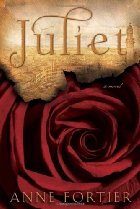

Review: Juliet

JulietAnne Fortier, Juliet

Julie Jacobs and her twin sister, Janice, have lived with their Aunt Rose ever since their parents died tragically when they were babies. When Aunt Rose dies, her will stipulates that Janice will inherit her entire fortune, including the house. Julie is shocked and angered by this slight, until she discovers that Aunt Rose has left her some old documents that belonged to her mother — documents that hint at a treasure hidden somewhere in Siena, Italy. Julie immediately goes to Siena in hopes of discovering this hypothetical treasure, but she soon finds that her inheritance — and indeed her whole identity — is bound up in the story of Romeo and Juliet. Far from being the fictional creation of William Shakespeare, their story is based on true events that occurred in Siena in the 1300s. As Julie digs deeper into the medieval legend of Romeo and Juliet, she eventually discovers some priceless artifacts connected to the lovers and finds her own destiny in the process.

Though Romeo and Juliet is by no means my favorite Shakespeare play (that would be Much Ado About Nothing, in case you were wondering!), I was excited to read this book for its combination of literary detection and romance. Unfortunately, I ended up not liking it very much! My main problem is that the heroine, Julie, is too whiny. She constantly complains about Janice’s poor treatment of her growing up, and she’s always bemoaning her “unattractive” appearance, even though she immediately catches the eye of a handsome Italian. I also hated her narrative style, which is completely stilted and unrealistic. The dialogue is almost uniformly terrible. As for the actual story, parts of it were interesting, especially in the historical chapters. But as events unfolded, I grew more and more irritated at the supernatural elements of the plot, which I was not expecting at all. Basically there’s this Ancient Curse ™ that hangs over Julie and her paramour, who are sort of reincarnations of the original Romeo and Juliet, and they need to break it in order to live happily ever after. The farther I got through the book, the more I went from “not great, but still readable” to “I can’t wait for this mess to end!” Overall, not recommended.

Review: Dead Men Don’t Ski

Dead Men Don't SkiPatricia Moyes, Dead Men Don’t Ski

Inspector Henry Tibbett and his wife Emmy are looking forward to a relaxing ski holiday in the Alpine town of Santa Chiara, Italy. However, Henry has also been asked to keep his eyes peeled for information relating to an international smuggling ring that might be headquartered in the area. Though reluctant to spoil his holiday with work, Henry can’t help but notice that several of his fellow vacationers have secrets to hide. Then one of the other guests at his hotel, Fritz Hauser, is found murdered on the ski lift. As Henry helps the local police to investigate, he soon learns that Hauser was involved in the smuggling ring — and that several of the hotel guests had good reasons for wanting him dead.

I think this book could best be described as a “traveling” English country house mystery. All the key elements are there — unlikable murder victim, plenty of suspects, an unusual crime scene which demands very precise alibis from everyone — but it happens to take place in a ski villa rather than an English country house. Since I love the genre, I found a lot to enjoy in this book. I especially enjoyed the subtle deviations from the standard mystery formula: for example, two of the characters are a hearty English colonel and his domineering wife, yet there’s more to both of them that meets the eye. Also, the “foreigners” in classic mystery novels always seem to be there as mere background, but here they were truly fleshed-out characters with actual relevance to the plot. I believe this is the first book in a series featuring Tibbett, and I’d gladly read more. Definitely recommended for classic mystery fans!