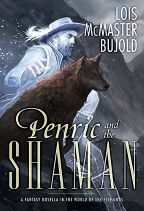


Lois McMaster Bujold, Penric and the Shaman
Four years after making the acquaintance of the demon Desdemona, sorcerer Penric has become a divine in the Bastard’s order. In that capacity, he is asked to participate in the hunt for a runaway shaman who’s responsible for the death of a young nobleman. His partner, the in-world equivalent of a police officer, distrusts all sorcerers and isn’t impressed by Pen’s youth and affability. But as they work together, they come to understand one another better—and realize that the shaman also isn’t quite what he seems. This novella has a lot of world-building that I found a bit hard to follow, even though I’ve read The Hallowed Hunt, which introduced the concept of shamans in this world. There’s also not much conflict; all the major players are well-intentioned and willing to collaborate to solve their problems. But I did enjoy the story and liked seeing Pen impress those who initially underestimated him. I’m excited to continue this series!
Ernest Hemingway, A Moveable Feast
I just got back from my first trip to Paris and thought this would be the perfect book to read while I was there! It’s Hemingway’s fictionalized account of his life in Paris in the 1920s with his first wife, Hadley. He talks about his favorite cafés, his writing process, his affinity for gambling and skiing, and his many friends and acquaintances in the Parisian literary world, such as Gertrude Stein and F. Scott Fitzgerald. I wouldn’t say I’m a huge Hemingway fan, but I do admire his writing style, and there are plenty of wonderfully evocative turns of phrase in this book. I think it’s a bit uneven—which is fair, as it was incomplete when he died and published posthumously—and I’m not sure I’ll ever want to reread it. I think it’s a bit too inside-baseball unless you’re intimately familiar with Hemingway and all the people he describes. Still, it’s reminded me that I would like to read more of Hemingway’s fiction.
Caroline Linden, An Earl Like You
Hugh Deveraux has just inherited an earldom, and with it a mountain of debt that his father had kept secret. With a widowed mother and two sisters to support, he needs money fast. He tries to recover his fortunes at the gaming tables, where he receives an unusual proposal: Rich merchant Edward Cross wants his daughter, Eliza, to marry an aristocrat. If Hugh is willing to be the bridegroom, Cross will pay all his debts and give Eliza a hefty dowry. Hugh is reluctant at first, but when he meets the warm and down-to-earth Eliza, he decides to go through with the marriage. But what will happen when Eliza discovers that her handsome suitor is only after her money? I quite enjoyed this variation on the marriage-of-convenience plot, where only one partner knows it’s a marriage of convenience. Hugh’s deception is appalling, especially because the kind and trusting Eliza thinks it’s a love match, and the book treats this conflict with the gravity it deserves while still making Hugh a likable and redeemable character. I liked this one and may try more from the author.








 You Book Me All Night Long