Review: The Unpleasantness at the Bellona Club

Unpleasantness at the Bellona Club, TheDorothy L. Sayers, The Unpleasantness at the Bellona Club

On November 11, ninety-year-old General Fentiman is found dead in an armchair at the Bellona Club. No one knows exactly when his death occurred—information essential in determining the recipient of a substantial inheritance. But that is only one of the mysteries vexing Lord Peter Wimsey. The aristocratic sleuth needs every bit of his amazing skills to discover why the proud officer’s lapel was missing the requisite red poppy on Armistice Day, how the Bellona Club’s telephone was fixed without a repairman, and, most puzzling of all, why the great man’s knee swung freely when the rest of him was stiff with rigor mortis. (Summary from Amazon.com.)

I think this is my favorite Lord Peter Wimsey book so far. The mystery plot is ingenious and provides an intellectually satisfying solution. I also appreciate how character-driven Sayers’ mysteries are in comparison to, say, Agatha Christie’s. (Not to bash Dame Agatha, but I think her books are far more plot-driven, with the characters rarely being very three-dimensional.) I was especially fascinated by Ann Dorland, one of the potential heirs to the general’s fortune. Her behavior is suspicious throughout the novel, but is she guilty? And if not, why does she act the way she does? The one jarring note to this mystery is the ending, where Lord Peter unmasks the killer and essentially suggests that, instead of going through the humiliation of an arrest and trial, the person should just commit suicide. I guess this attitude makes sense for the time, when people set more store by their honor than they do today…and of course, a convicted murderer would face the death penalty anyway…but I was still taken aback by Lord Peter’s suggestion! Still, I enjoyed the book and look forward to continuing with the series.
Review: First Impressions

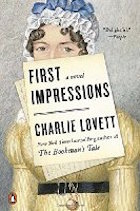
First ImpressionsCharlie Lovett, First Impressions

Book lover and Austen enthusiast Sophie Collingwood has recently taken a job at an antiquarian bookshop in London when two different customers request a copy of the same obscure book: the second edition of A Little Book of Allegories by Richard Mansfield. Their queries draw Sophie into a mystery that will cast doubt on the true authorship of Pride and Prejudice—and ultimately threaten Sophie’s life.

In a dual narrative that alternates between Sophie’s quest to uncover the truth—while choosing between two suitors—and a young Jane Austen’s touching friendship with the aging cleric Richard Mansfield, Lovett weaves a romantic, suspenseful, and utterly compelling novel about love in all its forms and the joys of a life lived in books. (Summary from Amazon.com.)

I should have known better than to pick this one up. My love of Jane Austen means that I’ve read a lot of the retellings, re-imaginings, and spinoffs of her novels, and most of them have ranged from “meh” to truly awful. So I should have known that I’d dislike this book, and indeed, the writing style had turned me off by the end of the first chapter. The author unwisely makes Jane Austen a character and tries to imitate her voice, with disastrous results.

Further, the entire “past” storyline had essentially no stakes, being nothing more than an account of the friendship between Austen and an elderly clergyman. In the “present” storyline, book lover Sophie Collingwood comes across said clergyman’s name in connection with Austen and investigates a possible plagiarism scandal. Because of course Austen lovers want to read books suggesting that she didn’t actually create her own work!

Anyway, Sophie is an utter ninny caught between a Darcy and a Wickham, although they’re pretty equally insufferable! The Wickham (whose name I can’t actually remember) is supposed to be skeevy, of course, but the Darcy also exhibits some major stalker vibes. Therefore, I didn’t buy the love triangle or enjoy the romance. So for me, the book failed on basically every front. Maybe I’m being too harsh; I’d read some positive reviews of the novel, and possibly my expectations were too high. But unfortunately, this book is in my “bottom 10” for the year.

Review: A Curious Beginning

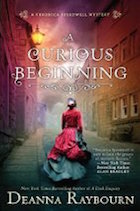
Curious Beginning, ADeanna Raybourn, A Curious Beginning

London, 1887. As the city prepares to celebrate Queen Victoria’s golden jubilee, Veronica Speedwell is marking a milestone of her own. After burying her spinster aunt, the orphaned Veronica is free to resume her world travels in pursuit of scientific inquiry—and the occasional romantic dalliance. As familiar with hunting butterflies as she is fending off admirers, Veronica wields her butterfly net and a sharpened hatpin with equal aplomb, and with her last connection to England now gone, she intends to embark upon the journey of a lifetime.

But fate has other plans, as Veronica discovers when she thwarts her own abduction with the help of an enigmatic German baron with ties to her mysterious past. Promising to reveal in time what he knows of the plot against her, the baron offers her temporary sanctuary in the care of his friend Stoker—a reclusive natural historian as intriguing as he is bad-tempered. But before the baron can deliver on his tantalizing vow to reveal the secrets he has concealed for decades, he is found murdered. Suddenly Veronica and Stoker are forced to go on the run from an elusive assailant, wary partners in search of the villainous truth. (Summary from Amazon.com.)

I’ve read and enjoyed the first few Lady Julia Grey books, so I was excited to learn that Raybourn has begun a new mystery series featuring intrepid lepidopterist Veronica Speedwell. Unfortunately, this book really didn’t work for me. It’s a good read in the sense that it’s well written and moves quickly, but I couldn’t get over my dislike of both Veronica and her partner/love interest, Stoker. Historical fiction can be difficult because the protagonists should be realistic for their time period but also sympathetic to modern readers. Veronica errs on the side of being far too modern for her era. She pursues a scientific career by traveling all over the world without a chaperone, and she engages in a variety of sexual affairs, apparently without any consequences to her reputation as a gentlewoman. I simply didn’t find her believable. As for Stoker, he’s a generic brooding alpha male type, and that’s basically all you need to know. It’s not a bad book, by any means, but it didn’t deliver what I look for in historical fiction.

Review: Unnatural Death

Unnatural DeathDorothy L. Sayers, Unnatural Death

While dining out one day, Lord Peter Wimsey and his friend Inspector Parker are discussing so-called accidental deaths that might actually be murders. A young doctor overhears them and joins their conversation. He shares the story of a former patient, an elderly woman with cancer who died rather suddenly. She was terminally ill, and no signs of foul play were found on the body, so everyone believed her death was natural; but the doctor was nevertheless suspicious because she had seemed to be improving lately. The woman’s great-niece and presumed heiress was living with her at the time, so she had opportunity, but her motive was questionable because the old lady would die soon enough from natural causes. Lord Peter is intrigued by the case and decides to investigate. He employs Miss Climpson, a chatty but intelligent spinster, to temporarily relocate to the dead woman’s village and do some discreet investigating. Meanwhile, he and Parker search for other suspects, motives, and possible methods of the murder.

After rediscovering Dorothy Sayers earlier this year, I’ve embarked on a project to read all her Lord Peter Wimsey books in publication order. This is book #3 in the series, but if I recall correctly, it can be read as a standalone. I enjoyed this book a lot, but I feel like it’s a very unusual detective story. Despite a high body count, it doesn’t feel very action-packed or plot-driven. The main mystery is not whodunnit, but why and how. One of the biggest clues to the motive is a tiny change in an obscure property statute. Nevertheless, I found the mystery compelling and was eager to solve the complete puzzle of how and why the murder took place. Also, Miss Climpson is delightful; this is her first appearance in the series, but I believe she’ll be a recurring character in future books. She reminds me somewhat of a Jane Austen character — one of the good-hearted chatterboxes, like a more intelligent Miss Bates. I wasn’t completely on board with the characterization of the villain, whose psychology didn’t ring true for me. I doubt this will be my favorite Sayers mystery, but I did enjoy it and look forward to reading the rest of the series.

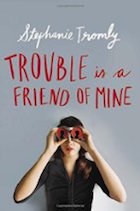
Review: Trouble Is a Friend of Mine

Trouble Is a Friend of MineStephanie Tromly, Trouble Is a Friend of Mine

Zoe Webster is an utterly normal teenage girl who’s just trying to survive her parents’ divorce and her subsequent move to a small town in upstate New York. But her life is turned upside down when she meets her neighbor and classmate Digby, who’s basically the opposite of normal. He’s rude and annoying, he wears suits all the time, and he’s obsessed with the recent disappearance of a local teenage girl. Somehow he ropes Zoe, along with his former best friend Henry, into his plan to investigate the disappearance. Their research leads them to a perverted gynecologist, a drug ring, and a possible cult, as they eventually learn that the girl’s disappearance isn’t quite what it seems. Meanwhile, Zoe tries to sort through her feelings for Digby, who has involuntarily become one of her closest friends, and maybe even something more.

A lot of the hype for this book compared it to “Veronica Mars,” a TV show I really enjoyed, but unfortunately I don’t think such comparisons are particularly accurate. Yes, like VM, this book features a teen detective who solves a mystery with his friends, and there’s even a reference to the VM theme song in the book. But in my opinion, the similarities really end there; VM is much funnier and its mysteries more compelling than the events of the book. I just wasn’t engaged by the novel at all, despite the fact that there’s nothing particularly wrong with it. Maybe my issue is that the characters didn’t seem real to me. Zoe, the narrator, is essentially a blank canvas — she’s so forgettable that I had to look up her name. Digby has more personality, but since we see him through Zoe’s eyes, he remains pretty mysterious throughout the book. I didn’t get much insight into what makes him tick or why he wants to hang out with Zoe. Overall, this is not a bad book, and fans of YA mysteries might like it, but I was hoping for more.

Review: The Thirty-Nine Steps

39 Steps, TheJohn Buchan, The Thirty-Nine Steps

Richard Hannay is fed up. He has just returned to London after several years in South Africa, where he’s led an adventurous life and made a modest fortune. His current life of leisure in England seems incredibly dull by comparison — that is, until his neighbor knocks on his door one day with an amazing story about international conspiracies, assassination plots, and his own very important mission. Hannay isn’t sure what to make of the story at first but agrees to keep his neighbor’s secret. When the man is murdered shortly thereafter, Hannay concludes that his farfetched story must actually be true, and he decides to take over the dead man’s mission to deliver some secret documents to a highly important member of the British government. He immediately finds himself on the run, as the people who murdered his neighbor are now on his trail. Hannay encounters a variety of people on his journey, both friend and foe, and he relies on his instincts to tell him whom he can trust with his story. In some cases these instincts are right, while in others, they are very, very wrong. But somehow, he always manages to stay one step ahead of his pursuers as he searches for the mysterious location with the 39 steps, where the evildoers can all be captured in one fell swoop.

This is one of those books that’s fun to read as a historical artifact, but I feel like it would never be published today. Spy thrillers are so popular in book, TV, and movie formats that audiences have become very sophisticated. The plot of this book may have been cutting-edge when it was published in 1915, but for a modern reader, it’s pretty predictable and really strains credulity at times. Hannay’s actual mission isn’t important; the dramatic tension in the book comes from the fact that he’s being followed, as well as the fact that some pursuers are actually lying in wait for him. There is one pretty suspenseful scene near the end where Hannay is in a room with the suspected evildoers, and he’s suddenly struck with self-doubt: are these people actually the bad guys, or has he been imagining the whole thing? But I did mentally roll my eyes at Hannay several times, as he basically blurts out the entire story to everyone he meets without once stopping to wonder, “Should I actually trust this person?” Still, despite its flaws, I did find the book entertaining and would consider reading more of Hannay’s adventures. I also need to check out the Hitchcock movie now!

Review: The Thousand-Dollar Tan Line

Thousand Dollar Tan Line, TheRob Thomas and Jennifer Graham, The Thousand-Dollar Tan Line

***Warning: Spoilers for the “Veronica Mars” TV show and movie!***

This first Veronica Mars book picks up right after the movie left off: Veronica has just turned down a lucrative job as a lawyer in NYC to return to her hometown of Neptune, California, as a private investigator. Unfortunately, business isn’t so great, due to her father’s extended recovery (after being hit by a car in the movie) and Neptune’s continued hostility toward her. But when spring break arrives in Neptune with its drinking, drugs, and all-night partying, Veronica soon has more work than she bargained for. A freshman girl goes missing, and the oafish local sheriff does nothing to look for her, claiming that she probably just wandered off on her own. But after speaking to the girl’s friends, Veronica is sure that something awful happened to her. Did her on-again, off-again boyfriend lose his temper one night? Or did someone abduct her from the party she attended on the last night her friends saw her? As Veronica investigates the case, she runs into several people from her past, including Eli “Weevil” Navarro, Dick Casablancas, and her estranged mother — not to mention her best friends Wallace and Mac. But when a second girl goes missing, Veronica must focus all of her attention on the case, or risk becoming a victim herself.

I’ve long been a fan of the “Veronica Mars” TV show, and I was very excited about the movie that continued her story 10 years later. Now showrunner Rob Thomas has responded to the show’s following by writing books that continue the story even further. I definitely think that fans of “Veronica Mars” will like this book, which honestly feels just like a vintage episode of the show. Veronica may be older, but she still has the same tough-as-nails persona, always ready with a sarcastic quip to mask any hint of vulnerability. But this book does open some old wounds for her, as she once again meets the mother who abandoned her. On the one hand, she wants to protect herself and is rightly suspicious of her mother’s motives; on the other hand, part of her wants to reach out and forgive. I hope subsequent books continue to explore this relationship, which could lead to some interesting character growth on Veronica’s part. I was a little disappointed that some of my beloved characters from the show got short shrift, particularly Logan (deployed overseas) and Keith (still recuperating), who each only got a couple of scenes. As for the mystery, I thought it was very clever, and I was definitely surprised by the reveal at the end. So I would definitely recommend this to “Veronica Mars” fans, but it probably doesn’t work very well as a standalone novel.

Review: Every Breath

Every BreathEllie Marney, Every Breath

Rachel Watts has recently moved with her family from their farm in rural Australia to the big city of Melbourne. Watts hates almost everything about her new home — everything, that is, except her neighbor and best friend, James Mycroft. Mycroft is brilliant but unstable, often conducting dangerous scientific experiments in his bedroom. He’s also alone nearly all the time, since his parents both died years ago, and the aunt with whom he lives is never around. Nevertheless, despite the concerns of Watts’ parents, she and Mycroft are inseparable. So when someone they know — a homeless man named Dave who hangs out near the local zoo — is brutally murdered, they decide to investigate the case together. The police assume it was a random act of violence, but Watts and Mycroft suspect that there may have been a specific motive behind Dave’s death. As they investigate, Watts and Mycroft also grow closer, but they both fear the consequences of changing their relationship.

As you might have guessed from the characters’ names, this book owes more than a little to Sherlock Holmes, and I have to say, I really enjoyed it! Though the hero’s name is Mycroft, he possesses all of the frenetic energy, vividness, and charisma of Sherlock. Obviously he would be a pain to live with in real life, but on the page, he’s an utterly compelling character — I can totally see why Watts is harboring more-than-friendly feelings towards him! I liked Watts a lot, too; she provides a much-needed voice of reason to reel Mycroft in when he goes off the rails. The mystery aspect of the novel is well done, although I suspected the culprit fairly early in the book. And in another nod to Arthur Conan Doyle, there’s a dog who plays an important role in the solution of the crime. While the book’s major plotlines are all resolved in the end, the door is definitely open for a sequel — which I have already pre-ordered! I’m not sure why this book struck me so positively, except to say that I enjoyed spending time with these characters and look forward to reading about their further adventures.

Review: The Rose Rent

Rose Rent, TheEllis Peters, The Rose Rent

In this 13th installment of the Brother Cadfael series, the Benedictine Abbey of Saints Peter and Paul is disturbed by yet another murder — and this time the victim is one of their own. Judith Perle, a young widow, rents a valuable cottage to the abbey in exchange for a single white rose to be paid from its garden once a year. Brother Eluric is charged with delivering the rose, but a few days before payment is due, he is found dead in the cottage garden. Moreover, the rosebush has been disfigured, its branches hacked off. As the monks mourn Brother Eluric’s death, Cadfael wonders who could have done such a terrible deed. His investigation ultimately centers around Judith Perle, whose wealth and beauty have attracted several new suitors. Because of the cottage’s value, any man who married Judith would want it to be included in her dowry; and if the abbey failed to pay the rose rent, the cottage would return to Judith’s estate without restrictions. As Cadfael searches for Brother Eluric’s killer among the men in Judith’s life, a kidnapping and a second murder ultimately reveal the culprit.

It’s hard to believe that a series could still be good after 13 books, but this latest installment of the Cadfael series was just as enjoyable to me as the first book. There’s a definite formula to this series: there’s almost always a romantic subplot, and the real-life historical events of the era occasionally impinge on Cadfael and the other inhabitants of Shrewsbury. But if you enjoy this formula, which I do, you’ll love the series! I always recommend starting with book one, [A Morbid Taste for Bones], but I think you could read this book without missing any key information and without spoilers for the earlier books. As for this novel in particular, I really don’t have much else to say about it! Simply put, I liked it and will continue with the series. Only seven more books to go!

Review: Murder Underground

Murder UndergroundMavis Doriel Hay, Murder Underground

Miss Euphemia Pongleton is an unpleasant old woman living in a dreary but respectable London boardinghouse. When she is strangled on the steps of the Belsize Park underground station, her fellow boardinghouse residents are surprised rather than saddened; but they soon move past their shock to speculate on who might have done the deed. The police have arrested one suspect, the boyfriend of a maid in the boardinghouse who had been involved with some petty thievery. But the maid is convinced her man is innocent, and the boarders entertain themselves by coming up with alternate theories of the murder. Naturally, Miss Pongleton’s nephew Basil, who always seems to need money and who depends on inheriting his aunt’s fortune, is a prime suspect. But Basil, despite some highly suspicious behavior on the day of the murder, insists that he is innocent. Are his protests a clever ruse, or could someone else in the boardinghouse have wanted Miss Pongleton dead?

This was a very enjoyable Golden Age mystery, although there’s really nothing that makes it stand out from the genre as a whole. But sometimes formulaic plots are comforting, and that’s why I usually enjoy mysteries from this era. There’s the unpleasant murder victim whom we don’t need to mourn; a variety of suspects with a variety of motives, secrets, and questionable alibis; the secondary love story; and the amateur detectives who solve the crime without the involvement or assistance of the police. The mystery is well plotted, and I didn’t guess who the murderer was (although I suspected almost every character at one point or other). There are also some lovely bits of humor, such as when the boardinghouse residents fight tenaciously — but silently — over who gets to sit in Miss Pongleton’s chair. All in all, I’d recommend this to fans of Golden Age mysteries, but it’s definitely not a stellar example of the genre.