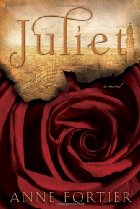
Review: Juliet

JulietAnne Fortier, Juliet

Julie Jacobs and her twin sister, Janice, have lived with their Aunt Rose ever since their parents died tragically when they were babies. When Aunt Rose dies, her will stipulates that Janice will inherit her entire fortune, including the house. Julie is shocked and angered by this slight, until she discovers that Aunt Rose has left her some old documents that belonged to her mother — documents that hint at a treasure hidden somewhere in Siena, Italy. Julie immediately goes to Siena in hopes of discovering this hypothetical treasure, but she soon finds that her inheritance — and indeed her whole identity — is bound up in the story of Romeo and Juliet. Far from being the fictional creation of William Shakespeare, their story is based on true events that occurred in Siena in the 1300s. As Julie digs deeper into the medieval legend of Romeo and Juliet, she eventually discovers some priceless artifacts connected to the lovers and finds her own destiny in the process.

Though Romeo and Juliet is by no means my favorite Shakespeare play (that would be Much Ado About Nothing, in case you were wondering!), I was excited to read this book for its combination of literary detection and romance. Unfortunately, I ended up not liking it very much! My main problem is that the heroine, Julie, is too whiny. She constantly complains about Janice’s poor treatment of her growing up, and she’s always bemoaning her “unattractive” appearance, even though she immediately catches the eye of a handsome Italian. I also hated her narrative style, which is completely stilted and unrealistic. The dialogue is almost uniformly terrible. As for the actual story, parts of it were interesting, especially in the historical chapters. But as events unfolded, I grew more and more irritated at the supernatural elements of the plot, which I was not expecting at all. Basically there’s this Ancient Curse ™ that hangs over Julie and her paramour, who are sort of reincarnations of the original Romeo and Juliet, and they need to break it in order to live happily ever after. The farther I got through the book, the more I went from “not great, but still readable” to “I can’t wait for this mess to end!” Overall, not recommended.

Review: Dead Men Don’t Ski

Dead Men Don't SkiPatricia Moyes, Dead Men Don’t Ski

Inspector Henry Tibbett and his wife Emmy are looking forward to a relaxing ski holiday in the Alpine town of Santa Chiara, Italy. However, Henry has also been asked to keep his eyes peeled for information relating to an international smuggling ring that might be headquartered in the area. Though reluctant to spoil his holiday with work, Henry can’t help but notice that several of his fellow vacationers have secrets to hide. Then one of the other guests at his hotel, Fritz Hauser, is found murdered on the ski lift. As Henry helps the local police to investigate, he soon learns that Hauser was involved in the smuggling ring — and that several of the hotel guests had good reasons for wanting him dead.

I think this book could best be described as a “traveling” English country house mystery. All the key elements are there — unlikable murder victim, plenty of suspects, an unusual crime scene which demands very precise alibis from everyone — but it happens to take place in a ski villa rather than an English country house. Since I love the genre, I found a lot to enjoy in this book. I especially enjoyed the subtle deviations from the standard mystery formula: for example, two of the characters are a hearty English colonel and his domineering wife, yet there’s more to both of them that meets the eye. Also, the “foreigners” in classic mystery novels always seem to be there as mere background, but here they were truly fleshed-out characters with actual relevance to the plot. I believe this is the first book in a series featuring Tibbett, and I’d gladly read more. Definitely recommended for classic mystery fans!

Review: Speaking from Among the Bones

Speaking From Among the Bones by Alan…Alan Bradley, Speaking from Among the Bones

I received this book through the LibraryThing Early Reviewer program. Its U.S. release date is January 29.

In this fifth Flavia de Luce adventure, the entire town of Bishop’s Lacey is agog at the forthcoming exhumation of St. Tancred from the village church. Of course, Flavia is determined to be present when the saint’s body is uncovered. But in her eagerness to be on the scene when the exhumation takes place, Flavia discovers another body in the church: that of the organist, whose corpse has been hidden in St. Tancred’s crypt. As Flavia investigates the organist’s death, she also stumbles upon several other mysteries. For example, what is wrong with the local magistrate’s son, and why is he kept in a locked room? Where do the tunnels underneath St. Tancred’s churchyard lead? Is Feely actually getting married, and if so, to whom? And of course, will the de Luces have to leave their beloved yet crumbling home at Buckshaw?

Five books in, this series is still going strong. I always enjoy Flavia’s adventures, and I think she’s becoming a bit more human (and less serial-killer-esque) with each new book. I wonder if Alan Bradley will ever let her grow up, or if she’ll always stay a precocious pre-teen. I’m kind of torn about which scenario I’d rather see…but regardless, Flavia is a whole lot of fun to watch as she copes with the pressures of adult life that intrude on her childhood. While corpses and detection are still a game to her, she is remarkably sensitive about her family’s complex emotions as their life at Buckshaw is threatened. I like that her familial relationships seem to be moving forward (albeit at a glacial pace) and that she may now have some competition as a detective in Adam Sowerby, a newcomer who specializes in botany and “inquiries.” There are enough interesting teasers here that I’m really looking forward to the next book!

Review: The Leavenworth Case

The Leavenworth Case: A Lawyer's Story by…Anna Katharine Green, The Leavenworth Case

In this early American detective novel, young lawyer Everett Raymond is shocked to discover that a longtime client of his firm, Horatio Leavenworth, has been shot dead in his New York home. Since the firm’s senior partner is ill, Mr. Raymond takes on the responsibility of visiting the bereaved family, which consists of two beautiful nieces, a private secretary, and the servants. He also attends the inquest, where the evidence points to one of the nieces, Eleanore Leavenworth, as the guilty party. But Mr. Raymond, struck by Eleanore’s beauty and grace, is convinced of her innocence. He decides to clear her name by collaborating with the police detective in charge of the case, Ebenezer Gryce. But his investigation unearths a shocking secret about the Leavenworth family that may have dire consequences for the family as well as for the murder investigation.

This book is a mystery novel written in the 19th century; that’s pretty much all you need to know to decide whether or not you’ll enjoy it. I thought it was an entertaining and quick read. Despite the flowery language, the book moves quite quickly, with the shocking news of Mr. Leavenworth’s murder being revealed on the first page. The plot is engaging and inventive, especially for its time (the book predates Sherlock Holmes by several years). The characters, on the other hand, are a bit dull and ill-formed. Mr. Raymond, the narrator, could basically be anybody; and the Leavenworth women have few characteristics, at least for the first half of the book, other than being extremely beautiful. So if you’re looking for a deep psychological study, this book probably isn’t for you. But I still found it fun and entertaining, and I’d consider reading more of Green’s work.

Review: I Am Half-Sick of Shadows

I Am Half-Sick of Shadows by Alan BradleyAlan Bradley, I Am Half-Sick of Shadows

It’s Christmas at Buckshaw, and Flavia de Luce is determined to use her chemical knowledge to capture Father Christmas, proving that he really exists once and for all. But her holiday plans must take a backseat when a film crew arrives at Buckshaw with movie star Phyllis Wyvern in tow. Flavia is fascinated by the spectacle and quickly insinuates herself into the proceedings. She is especially interested in Phyllis Wyvern, who turns out to be hiding several secrets under her glamorous façade. When Phyllis is found strangled by a length of film, Flavia once again investigates in hopes of discovering the killer. But with the entire film crew and half of Bishop’s Lacey snowed in at Buckshaw, everyone is a suspect — which makes this case Flavia’s most difficult and dangerous one yet.

This is yet another enjoyable outing for Flavia de Luce, and the festive Christmas atmosphere is an added bonus. The mystery plot is a bit underdeveloped, in my opinion, with a solution that basically comes out of nowhere. But for me, it was more interesting to read about the film crew and all its internal drama, as well as the townspeople’s response to having celebrities in their midst. I also enjoyed reading more about Flavia’s strained familial relationships, which finally seem to be loosening up a bit. Fans of the series should enjoy this installment despite the weak mystery plot.

Review: A Red Herring Without Mustard

A Red Herring Without Mustard by Alan…Alan Bradley, A Red Herring Without Mustard

At the church fête in Bishop’s Lacey, Flavia de Luce is drawn to the fortune-teller’s tent, where a local Gypsy gazes into a crystal ball to see the past or the future — for a price. Flavia impulsively invites the Gypsy woman to camp on the grounds of Buckshaw but is shocked when she finds the woman badly beaten the next morning. Who would want to harm the Gypsy, and could the incident possibly be related to an alleged kidnapping that took place several years ago? As usual, Flavia is excited to be in the thick of a mystery, especially when the body of a poacher is soon afterwards found at Buckshaw. Once again, Flavia is on the case, accompanied by her trusty bicycle Gladys. But will she be able to beat local policeman Inspector Hewitt to the solution?

I don’t have too much to say about this book other than what I already said about The Weed That Strings the Hangman’s Bag. I enjoyed this installment of the series a bit more because the pacing is better. The Gypsy woman is attacked very early in the book, so the mystery kicks off right away. As always, it’s fun to follow Flavia along in her investigations; I especially like when she pretends to be a sweet, innocent little girl. I’m also continuing to enjoy the fraught familial relationships of the de Luce family. Honestly, I get a bit angry with the father sometimes. Why isn’t he paying more attention to his girls? And Ophelia and Daphne are so consistently mean to Flavia that it’s almost unbelievable. There are a few flickers of kindness from them, but mostly they terrorize her — which is fun to read but also a bit one-note. Still, I enjoyed this book a lot and look forward to I Am Half-Sick of Shadows.

Review: The Man in the Queue

The Man in the Queue by Josephine TeyJosephine Tey, The Man in the Queue

When an unidentified man is stabbed to death while waiting in line outside a theater, the crime becomes an immediate sensation in London. Inspector Alan Grant of Scotland Yard is assigned to the case, which at first seems impossible. The people standing closest to the dead man noticed nothing, and the murderer seems to have left no trace behind. However, eventually one witness mentions that he saw the dead man arguing with someone in the queue — someone who afterwards left in a hurry. With the help of this statement, Grant is soon on the trail of the man who argued with the victim. However, the more evidence Grant obtains, the more complicated the case seems to grow.

My experience so far with Josephine Tey has been very hit-or-miss: I was disappointed by The Daughter of Time, I really liked Brat Farrar, and now I find myself underwhelmed by this book. I read in the introduction that Tey didn’t like to use the standard conventions of the mystery genre, and that’s certainly evident in this novel. A lot of the book takes place inside Grant’s head, as he immediately begins to theorize about what sort of man might have committed this crime. Thus, much of the novel is Grant jumping to conclusions and then being proved wrong as more evidence is uncovered — which may be true to life but isn’t a lot of fun to read about. The mystery is also technically not “fair,” as the solution comes out of nowhere with no clues given in advance. So I wasn’t a huge fan of this book, but I think I will try some more Josephine Tey in hopes of finding something better.

Review: The Weed That Strings the Hangman’s Bag

The Weed That Strings the Hangman's Bag by…Alan Bradley, The Weed That Strings the Hangman’s Bag

In  this second Flavia de Luce novel, the town of Bishop’s Lacey plays host to some prestigious guests from the BBC. Rupert Porson, puppeteer and creator of the popular TV show “The Magic Kingdom,” has arrived in town with his entourage and plans to put on a show. Naturally, Flavia is in the thick of things, helping to set up the show and making friends with Rupert’s beautiful companion, Nialla. Being an exceptionally observant child, Flavia notices that there is some tension between Rupert and Nialla, and also that Rupert seems to have a surprising number of acquaintances in Bishop’s Lacey. When Rupert is murdered during the climactic moment of his show, Flavia is on the case, using her intelligence and passion for chemistry to discover the killer and uncover new information about a years-old tragedy.

How you feel about this series will largely depend on how you feel about its narrator and protagonist, Flavia de Luce. She’s an incredibly precocious 11-year-old girl who has an encyclopedic knowledge of poisons and can’t keep her nose out of a mystery. Personally, I don’t find her remotely believable, or even very likable, but she is extremely entertaining. This book moves fairly slowly, with lots of top-heavy exposition as the main players are introduced. For this reason, I was less interested in the mystery than in the de Luce family dynamics, which are both fascinating and a little disturbing. But fans of The Sweetness at the Bottom of the Pie will undoubtedly enjoy this second installment of the series, and I’ve already borrowed the next two books from the library.

Review: Death at Wentwater Court

Carola Dunn, Death at Wentwater Court

The Honorable Daisy Dalrymple doesn’t need to work for a living, but she’d rather be independent than live with her disagreeable relatives. She works as a journalist, writing about English country houses for the society columns. Her latest assignment is at Wentwater Court; since Daisy knows the family slightly, it shouldn’t be difficult for her to get some good interviews. Daisy arrives in the midst of a small house party and soon notices tension within the group. When one of the guests is found dead, everyone assumes it’s an accident, but Daisy finds evidence that points to murder. Inspector Alec Fletcher of Scotland Yard arrives to take charge of the case, and Daisy is eager to assist the investigation. But what if the murderer is someone she knows and cares about?

This is a fun little cozy mystery set in the 1920s. Daisy Dalrymple is a likable heroine — cheerful, intelligent, modern but not unbelievably so. I often get annoyed with amateur detectives in mystery novels, because they always seem to do stupid things (not tell the police everything, go off to hunt the killer on their own, etc.). But here, Daisy works with the police, and her motives are pretty plausible: she wants to help prove her friends’ innocence if possible, and she’s attracted to Inspector Fletcher. And from Alec’s point of view, it makes sense to ask for Daisy’s help because she knows the people involved but is still a somewhat impartial observer. The actual plot is somewhat unoriginal and forgettable, but the book is still a pleasant read. I wouldn’t mind reading more in the Daisy Dalrymple series.

Review: Death in Zanzibar

Death in Zanzibar by M. M. KayeM.M. Kaye, Death in Zanzibar

Dany Ashton has lived a fairly sheltered life with her Aunt Henrietta in rural England, but she dreams of travel and adventure. So when she has the opportunity to visit her mother and stepfather in Zanzibar, she jumps at the chance. However, before she even gets on the plane to leave England, mysterious events conspire to throw obstacles in her path. Her room is searched, her passport is stolen — and the family solicitor, whom Dany had visited earlier in the day to pick up a document for her stepfather, is murdered. Dany nevertheless manages to get to Zanzibar, but more sinister occurrences follow her. When a member of her stepfather’s house party dies, seemingly by accident, Dany can’t help suspecting that it might be murder — and that her own life may also be in danger.

I have really enjoyed all the “Death in…” books, but I think this one is my new favorite. I liked that there isn’t a lot of tedious exposition at the beginning of the story; rather, Dany is immediately plunged into a mystery and a possible romance, so I was paying attention right away. It was also interesting to read about 1950s Zanzibar from a British perspective. Kaye describes it as an idyllic region fairly removed from politics, yet communism and Cold War ideology are beginning to creep into the area. Kaye is also fairly evenhanded in her portrayal of the native Africans, though certain turns of phrase are harsh on 21st-century ears. If you like the basic premise of “girl travels to exotic location and becomes embroiled in danger and romance,” you’ll probably enjoy this book. Recommended, especially for armchair travelers!