Review: Belief or Nonbelief?

Belief or Nonbelief?Umberto Eco and Cardinal Martini, Belief or Nonbelief?: A Confrontation (trans. Minna Proctor)

This slim volume is a collection of letters written in the 1990s between Umberto Eco, renowned author, scholar, and atheist, and Carlo Maria Martini, a cardinal of the Catholic Church. The letters, which were originally published in an Italian newspaper, present these men’s opposing points of view on a number of philosophical and theological topics, including: secular and religious perspectives on the end of the world, the politically fraught issue of when human life begins, the Catholic Church’s refusal to admit women to the priesthood, and the ultimate source of human ethics. Though Eco and Martini often disagree, their letters maintain a consistent tone of civility and open-mindedness that is all too rare in public discourse nowadays.

I enjoyed this book, and I think it’s somewhat unique in that both believers and nonbelievers could get something out of it. As I mentioned, both Eco and Martini approach the conversation with sincerity and goodwill, never mocking or belittling each other’s positions, but actually having a genuine dialogue and hoping to learn from one another. I wish our public figures in general would take the hint! I will say, though, that I don’t think these letters would actually change anyone’s mind; an atheist wouldn’t suddenly convert to Christianity, nor would a religious person lose his/her faith because of this book. Because the letters were originally written for newspaper publication, they couldn’t be long or in-depth enough to explore the topics thoroughly. Basically, I came away from this book wanting more, but I’d still recommend it if the subject matter appeals to you.
Review: Bridge of Spies

Bridge of SpiesGiles Whittell, Bridge of Spies: A True Story of the Cold War

This book tells the story of a Cold War prisoner exchange that, in the author’s view, helped to stave off World War Three. William Fisher, a.k.a. Rudolf Abel, was a Soviet agent (actually British by nationality) who was captured in New York city because of his work spying on the U.S. nuclear program. Francis Gary Powers was an American pilot flying reconnaissance over the Soviet Union to get a look at its nuclear arsenal; he was shot down on one of his missions and imprisoned in Russia. And Frederic Pryor actually had nothing to do with the spy game at all — he was simply an American student in Berlin studying Eastern economics, arrested by the Stasi because he fit their profile of what a spy should look like. Cold War tensions were running high at this time, so the agreement to trade Abel for Powers and Pryor was a vital gesture of good faith between the U.S. and the Soviet Union.

In my American history classes in school, my teachers would always run out of time at the end of the year, so we’d usually only get as far as World War II in the lesson plan. As a result, I know basically nothing about the Cold War and was excited to read this book to learn more. I have to say, I found it slow going at first, as Whittell takes a long time to set up the three prisoners’ backgrounds. He also goes into stupefying detail about the type of plane Powers flew and the various engineering difficulties that its inventors encountered. But once the prisoners’ arrests are described, the book picks up considerably as it focuses on the political machinations needed to accomplish the prisoner exchange. The book also seems to be very well-researched, as Whittell was able to interview many of the people involved firsthand. I’m not sure it’s a particularly groundbreaking work, but I did find it interesting, and I’m now looking forward to seeing the film version with Tom Hanks.

Review: Spinster

SpinsterKate Bolick, Spinster: Making a Life of One’s Own

In this book that’s part literary biography, part memoir, journalist Kate Bolick engages with the notion of “spinsterhood” and claims that, rather than being used pejoratively, it should be seen as a term of female autonomy and empowerment. She notes that contemporary society is full of single women (whether never-married, widowed, or divorced), but “spinsterhood” is still largely viewed as an aberration. In other words, as she states in the first sentence of Chapter 1, “Whom to marry, and when it will happen — these two questions define every woman’s existence…” Bolick talks about her own life as a 40-something, never-married woman and how she was inspired to find her own path by the lives of five literary women: Maeve Brennan, Neith Boyce, Edna St. Vincent Millay, Charlotte Perkins Gilman, and Edith Wharton. She weaves the biographies of these women into her own autobiography as she explores what it means to be a spinster and concludes that it can actually be a good thing.

This book was an odd read for me; some parts of it were very interesting and thought-provoking, while others made me roll my eyes in annoyance. I think its main problem is that it’s trying to be too many different genres; I was hoping for more of a cultural study and often found Bolick’s personal reminiscences tiresome. I also struggled with her definition of spinsterhood. To me, a spinster would be a woman who remains unmarried and uncoupled throughout her life. But Bolick’s literary inspirations, all of whom she styles as “spinsters,” mostly did get married eventually. Some of the marriages were tempestuous, and some of them ended in divorce, but these women did not live their entire lives uncoupled. Bolick herself, though technically never married, talks at length about her previous and current relationships, and she has even cohabited with some of her romantic partners. So I feel like she’s not really writing from the perspective of a spinster, but rather as a woman who is in a long-term, committed relationship — married in all but name. That said, the little biographies of the five “spinsters” who inspired Bolick were interesting, and I’d like to learn more about these writers and/or read some of their works. But overall, this book disappointed me; it just wasn’t what I expected.

Review: Is Everyone Hanging Out Without Me? (And Other Concerns)

Is Everyone Hanging Out Without Me?Mindy Kaling, Is Everyone Hanging Out Without Me? (And Other Concerns)

This book is Mindy Kaling’s memoir of her journey from a chubby, awkward kid who adored SNL and Monty Python to a famous TV writer and actress (and, later, showrunner, although this book came out before “The Mindy Project” got going). She writes about being a relatively unpopular child whose friends’ interests didn’t quite align with her own, about moving to New York City and finding unexpected success with her Off-Broadway play “Matt & Ben,” about meeting Greg Daniels and landing her role as Kelly Kapoor on “The Office,” about her hatred of comedy roasts and her self-described uselessness as a writer (for a brief period) on SNL, and about her funny and frustrating experiences in Hollywood. There’s a little bit about romance, but mostly in the abstract; this book is not a tell-all, by any means. And while Kaling does address her identity as an Indian American, as well as her totally-normal-but-big-for-Hollywood size, these aren’t the focus of her book, and nor should they be. Instead, this memoir offers a fun, lighthearted look at Kaling’s life and career in television.

This book is exactly what you’d expect it to be if you’re familiar with Mindy Kaling’s persona and style of comedy. It’s as if your good friend, the one whose crazy escapades you like to live vicariously though, is chatting to you after a late night of drinking wine and watching romantic comedies. It’s very light and very funny, and I enjoyed it immensely; it would make excellent plane reading. One of my favorite sections was the chapter on “Types of Women in Romantic Comedies Who Are Not Real,” which debunks the myth of the beautiful klutz. (Because seriously, “klutzy” seems to be the go-to flaw for writers who still want their heroines to be cool and witty and gorgeous and without actual flaws. Do any of us really know smart, hot women who fall down the stairs on a regular basis?) I also loved the list of possible Hollywood movies coming to theaters soon, including “Crest Whitestrips,” “Untitled Jennifer Lopez Sonia Sotomayor Project,” “Street Smart,” and “Street Stupid” (“Street Smart” sequel). Some of them do sound frighteningly plausible! So, bottom line: this is a funny, enjoyable book by a woman who is both successful and relatable. If you like Mindy Kaling, you should definitely check it out!

Review: As You Wish

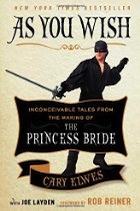
As You WishCary Elwes with Joe Layden, As You Wish: Inconceivable Tales from the Making of “The Princess Bride”

In this book, Cary Elwes shares his memories of making the beloved movie “The Princess Bride.” He talks about reading the book (by William Goldman) as a child, meeting director Rob Reiner for the first time, and being extremely nervous about his audition. He also reminisces fondly about his fellow cast members, particularly the late André the Giant, whom he describes as a true “gentle giant.” The book also spends a lot of time on the sword fight between Westley and Inigo, for which Elwes and Mandy Patinkin spent almost every free moment training. The filmmakers were determined to produce a duel that could hold its own with some of the greatest sword fights in movie history, and Elwes recalls the intensity of his training in detail. Along with Elwes’ own narrative, this book contains anecdotes from many other people involved with the film, including Rob Reiner (director), Robin Wright (Buttercup), Wallace Shawn (Vizzini), Chris Sarandon (Prince Humperdinck), and Billy Crystal (Miracle Max). Overall, the book presents a fond, nostalgic look at the making of this classic film.

“The Princess Bride” is one of my all-time favorite movies, so I was definitely the intended audience for this book! I must say, it’s clear that Cary Elwes is not a writer by nature…the prose is often a bit stilted, especially when he describes his inner thoughts and reactions to what’s going on. However, the book is very readable, and it provides a great window into Elwes’ experiences in making this movie. I like the fact that other actors’ stories are included, so that it’s not just one person’s point of view. I also learned a lot of interesting tidbits about the process: for example, Elwes badly injured his foot during shooting, so there are a few scenes in which (if you’re looking for it) you can see him limping or favoring his bad foot. Wallace Shawn, who played Vizzini, was terrified of being fired because he’d heard that Danny DeVito had originally been considered for the part. And Billy Crystal apparently improvised some of the funniest lines in the Miracle Max scene, including the bit about the mutton, lettuce, and tomato sandwich! Overall, I’d definitely recommend this book to fans of the movie — and then I HIGHLY suggest re-watching the film! 🙂

Review: Jane Austen Cover to Cover

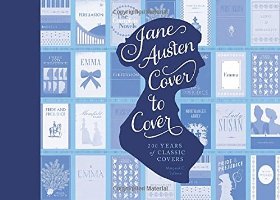
Jane Austen Cover to CoverMargaret C. Sullivan, Jane Austen Cover to Cover: 200 Years of Classic Covers

This is a book that delivers exactly what it promises: AustenBlog editrix Margaret C. Sullivan has compiled a large (though not exhausitve) collection of covers of Jane Austen’s novels, from the earliest published editions of the Regency period to the movie tie-in editions of today. The covers are arranged chronologically, giving Sullivan the opportunity to discuss related topics such as the publishing industry in Austen’s day, the waxing and waning of Austen’s popularity in both the U.K. and the U.S., and the Janeite resurgence that began in the 1990s with the iconic image of a wet-shirted Colin Firth as Mr. Darcy. The covers themselves are a delightful hodgepodge of different styles, from the somber scholarly editions to the far-out art of the 1970s. Overall, I enjoyed the book but found it rather insubstantial; it doesn’t really have anything to say about the broader cultural relevance (if any) of Austen cover art. Still, it would make a great gift for Janeites or for anyone who judges a book by its cover!

Review: Texts from Jane Eyre

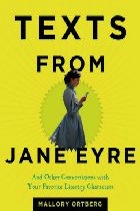
Texts from Jane EyreMallory Ortberg, Texts from Jane Eyre: And Other Conversations with Your Favorite Literary Characters

Mallory Ortberg, popular writer for websites such as The Hairpin and The Toast, has expanded her ingenious “Texts From” series into a book. What if the various authors, poets, and characters you studied in school had the ability to text? Hamlet would probably be a whiny teenager who refuses to come out of his room for dinner. William Carlos Williams would be constantly bugging his wife to bring home more plums from the grocery store. And Mrs. Bennet certainly wouldn’t miss an opportunity to urge her daughters to snag rich husbands! From Achilles to Virginia Woolf, Wuthering Heights to Sweet Valley High, nothing is safe from Ortberg’s satirical (and often punctuation-less) eye.

It’s hard to review humor because it’s so subjective: You either think it’s funny or you don’t. I’m definitely a fan of Ortberg’s style — the texts from Jane Eyre had me ROLLING the first time I read them! — so I enjoyed this book. I definitely think it helps to be familiar with the source material; most of the literary references are to pretty famous works, but there are also sections on The Hunger Games and The Baby-Sitters Club, so it’s a rather random, eclectic mix. The biggest criticism I have about the book is that it’s kind of one-note. The premise is funny, but there’s really nothing more to it. Basically, I don’t think it’s a book that I’d need to read over and over again, but it would be a great gift for someone who loves literature!

N.B. I received an ARC of this book through the LibraryThing Early Reviewers program. The publication date, per Amazon, is November 4.

Review: Something New

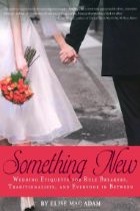
Something NewElise Mac Adam, Something New: Wedding Etiquette for Rule Breakers, Traditionalists, and Everyone in Between

As the title indicates, this book is a wedding etiquette guide for brides (and others) who don’t quite fit into the traditional wedding mold. They don’t necessarily want to feel like a princess on their “special day,” they don’t want to spend six figures on their wedding reception, and they don’t want to buy a whole bunch of crap and annoy their families in the name of tradition or etiquette. To address this audience, Elise Mac Adam (erstwhile etiquette columnist at the now-defunct Indie Bride website) has written a straightforward, bare-bones approach to wedding etiquette. She describes the most common traditions surrounding various aspects of wedding planning, from the wording of invitations to the etiquette of gift registries. Then she explains why these traditions exist and how they can be modified to work for modern brides. Finally, she shares questions and answers from her days as an advice columnist to give examples of proper etiquette in action.

As I read this book, I couldn’t help comparing it with Meg Keene’s A Practical Wedding, which I think is a fantastic resource for engaged couples. This book is good, too, but it fulfills a somewhat different need. Keene’s book is more philosophical and doesn’t get into very much detail about invitation wording and the like. In contrast, this book gets a little bit more specific about the nitty-gritty aspects of wedding planning. Still, it’s not as detailed as it could be, so brides who are extremely type-A or who dream of the perfect Martha Stewart wedding likely won’t get much out of it. But for brides who want a more laid-back affair and just don’t want to upset their grannies, this book could be a good resource. I’ll likely keep my copy around for future reference!

Review: In Tearing Haste

In Tearing HasteCharlotte Mosley, ed., In Tearing Haste: Letters Between Deborah Devonshire and Patrick Leigh Fermor

Deborah Devonshire began life as the youngest of the (in)famous Mitford sisters, but she unexpectedly became the duchess of Devonshire when her husband, Andrew Cavendish, inherited the duchy from his brother. Patrick Leigh Fermor was a travel writer who became a war hero by kidnapping the commanding German officer on the Nazi-occupied island of Crete. (The movie “Ill Met by Moonlight” is a fictionalized account of his experience.) The two first met when Deborah was still a young debutante, but they eventually formed a deep friendship, as well as a correspondence that would last for more than half a century. Although “darling Paddy” and “darling Debo” lived through many political upheavals and personal tragedies, their letters to each other always remained upbeat, humorous, and cheerful.

I usually find nonfiction very slow going, but this book was a pleasure to read. Both “Debo” and “Paddy” wrote in a lively conversational style that’s very easy to read, and I felt truly immersed in their day-to-day lives. Patrick often wrote about the various exotic places he visited, including the little town in Greece where he and his wife eventually settled. Deborah largely stayed on the Devonshire estates in England and Ireland, where she waxed poetic about sheep breeding and various fox-hunting excursions. The book also provides some fascinating insights into the psychology of the British upper classes: for example, Deborah mentions, with the utmost casualness, dining with President Kennedy several times. Though there’s not much in-depth discussion of the historical events through which they lived, anyone who is interested in reading a firsthand account of the 20th century should pick up this book! I’d also recommend it for fans of the Mitfords or early 20th-century British literature in general.

Review: Double Cross

Double CrossBen Macintyre, Double Cross: The True Story of the D-Day Spies

Seventy years ago, the Allies stormed the beaches of Normandy and began the campaign to liberate Nazi-occupied Europe. Many circumstances contributed to the success of the D-Day invasion, but one of the most important factors was the campaign of disinformation being fed to the Germans by a network of double agents whose sole purpose was to convince the Abwehr that the Allies would be landing at Calais rather than Normandy. Had these agents failed, the Germans would have concentrated their forces at Normandy, most likely stopping the Allied invasion in its tracks. This book tells the stories of the individual double agents involved in this task, including Serbian playboy Dusko Popov (“Tricycle”), Peruvian socialite Elvira Chaudoir (“Bronx”), and Polish nationalist Roman Czerniawski (“Valentine”). Ultimately, Macintyre makes a convincing case for the proposition that the Allies would never have won the war on the battlefields had they not already won the intelligence war.

This book gives a wealth of fascinating detail about the six men and women who acted as double agents in Britain, allegedly spying for Germany but really working for the Allies. I was shocked to learn that British intelligence had actually discovered and turned every German agent in Britain at the time! Because of this, the Allies were able to present a unified message to the Germans, subtlely directing their attention away from Normandy and toward other possible invasion sites. Some of the specific stories in the book prove once again that truth is stranger than fiction: for example, Dusko Popov thrived on creating networks of sub-agents that were entirely fictional, yet he retained the Abwehr’s complete trust. I also loved the fact that these double agents were handled in Britain by the Twenty Committee, so named because the Roman numeral for 20 is XX, or “double cross.” In short, if you’re interested in true stories of WWII-era espionage, Ben Macintyre is your man!