Review: Never Have I Ever

Never Have I EverKatie Heaney, Never Have I Ever: My Life (So Far) Without a Date

Katie Heaney is a 25-year-old writer for popular websites such as BuzzFeed and The Hairpin. Also, she has never been in a relationship — or, as she colorfully puts it, “Not one boyfriend. Not one short-term dating situation. Not one person with whom I regularly hung out and kissed on the face.” In this memoir (of sorts), Katie reminisces about her non-romantic history, from her first optimistic but doomed crush in elementary school to the humiliation of having no one to “couples skate” with during her 7th-grade field trip to the roller rink. She remembers her hopeless crush on the popular boy in high school, her romantic misadventures in college, and her almost-relationship in grad school that never quite worked out. Through it all, Katie maintains a tongue-in-cheek tone as she describes her own social awkwardness, how being dateless for so long has (and has not) defined her, and the relationships that truly matter most in her life, which are her friendships.

I picked up this book both for the topic and because I think Katie Heaney is hilarious. Overall, I really enjoyed the book, even though I think some of her other writings — particularly her Reading Between the Texts series — are much funnier. Basically this is a book that won’t surprise you: If you’re interested in the premise and enjoy the author’s sense of humor, you’ll like it. I found a lot of the anecdotes very relatable, especially those hopeless middle- and high-school crushes and the endless over-analysis that accompanies them (he said hi to me at lunch — what does that mean?!?!). But one of the most enjoyable aspects of the book, to me, was that her pursuit of romance turned out to be more of a quest for friendship; my favorite scenes were between her and her best friend Rylee, whom she obviously loves dearly. All in all, this is a fun, light read that doesn’t take itself too seriously. Recommended for plane or beach reading.

Review: The Letters of Nancy Mitford and Evelyn Waugh

Letters of Nancy Mitford and Evelyn Waugh, TheCharlotte Mosley, ed., The Letters of Nancy Mitford and Evelyn Waugh

“I want to write a sad story of a man who gave up drink and hated all his chums. It is me.” — Evelyn Waugh, 12 November 1944.

Nancy Mitford and Evelyn Waugh were two of the most popular and respected authors of the early and mid-20th century; they were also lifelong friends who kept up a correspondence lasting more than two decades. This book is a collection of their letters to each other, which are full of jokes, literary allusions, and most of all gossip. They each had a very pointed, satirical sense of humor that was frequently directed at members of their own social set — and quite often at each other. In many ways they couldn’t be more different: Waugh was very conservative, old-fashioned, and staunchly Roman Catholic, while Mitford was a spiritually indifferent socialist living as an expatriate in Paris. But their correspondence reveals that they understood one another and shared a deep, affectionate friendship. Through their discussions of current events, important people, and of course books (both their own and other people’s), Mitford and Waugh’s letters provide a unique window into their age.

It’s taken me a long time to write this review, because how can one “review” a collection of letters that weren’t (necessarily) meant to be public? All I can say is that I enjoyed reading them. I’ve read a few books by each of these authors — Mitford’s The Pursuit of Love and Love in a Cold Climate, Waugh’s Brideshead Revisited and A Handful of Dust — but otherwise I didn’t know much about either of them. I do think some level of familiarity with their work is helpful, but you definitely don’t have to be an expert in order to enjoy these letters. They’re often hilarious (how I shrieked, as Nancy would say) and also have some interesting discussions about literature. I want to read more of their books now! Of course, their chatter about mutual friends and acquaintances was hard to follow, although the editor did a fairly good job of identifying people in footnotes; but I still enjoyed this collection overall. If you’re interested in early- and mid-20th-century literature, this might be a good book to seek out.

Review: Life of Johnson

Life of JohnsonJames Boswell, Life of Johnson

James Boswell and Samuel Johnson were unlikely friends: Boswell was a young Scottish nobleman with a penchant for drinking and whoring, while Johnson was poorer, much more devout (in theory, at least), and a good 30 years older. Yet throughout the course of this monumental work, Boswell describes his reverence for Johnson’s intelligence, morality, and literary talents — a reverence so extreme that Boswell took notes on almost every conversation he ever had with the older man. As a result, this biography is stuffed full of Boswell’s personal anecdotes, letters both to and from Johnson, and first-person accounts of other contemporaries who knew him. Near the end of the book, Boswell states: “The character of Samuel Johnson has, I trust, been so developed in the course of this work, that they who have honoured it with a perusal, may be considered as well acquainted with him.” And indeed, anyone who reads this book will come away with an extremely vivid picture of a remarkable man.

This book is so huge and deals with so many things that I don’t quite know what to say about it. At first I was very intimidated, both by its length and by Boswell’s flowery 18th-century prose. But even though it’s not a quick read, this book contains a wealth of fascinating details about Johnson and the age in which he lived. I was struck by how literary the 18th century was, in the sense that seemingly anyone with a claim to intelligence was churning out books and pamphlets. In that way, Johnson’s time is very similar to our own, where everybody can (and does) publish blogs, tweets, and other forms of instantaneous literature. I was also fascinated by Johnson’s unique character; though intelligent, he was often pompous, narrow-minded, and abrasive. I frequently found myself underlining various Johnsonian sayings that were wise, or funny, or both — but I would have hated to be forced to converse with him! Overall, I would recommend this book to anyone interested in the time period or who enjoys very thorough biographies!

Review: No Plot? No Problem!

No Plot? No Problem!Chris Baty, No Plot? No Problem!: A Low-Stress, High-Velocity Guide to Writing a Novel in 30 Days

This book, written by the creator of NaNoWriMo, explains the origin of his crazy idea to write a 50,000-word novel in 30 days. Its target audience is those creative, literature-loving types who often say to themselves, “Someday I’d like to write a novel,” but who haven’t actually done anything to make their dream happen. Baty’s central point is that the best way to write a novel is just to sit down and write it — and to give yourself an impossibly short deadline so that you can’t let procrastination or perfectionism get in the way. This book introduces the concept of NaNoWriMo and offers a guided tour of each week, complete with tips from people who have successfully hit the 50,000-word target in the past. It also offers suggestsions for how to keep motivated, what to do when you get stuck, and how to conquer your pesky Inner Editor.

Not sure if I’ve mentioned this yet, but I am participating in NaNoWriMo this month (and am already falling behind in my word count, due to an incredibly busy first weekend!), so I seized the opportunity to read this book before all the madness began. I really enjoyed Baty’s breezy, tongue-in-cheek tone, which underscores the fact that this is a ridiculous undertaking that is highly unlikely to produce quality work. I also found several of his suggestions helpful, particularly the idea of finding time to write every day by making a schedule and eliminating nonproductive activities. I know I can waste several hours a day doing nothing but watching TV or puttering around the apartment…but now I’m going to spend those hours writing intead! I should say, though, that this is not a good resource for learning about the craft of writing. Other than very basic definitions of plot, setting, and characters, this book doesn’t offer advice about style or improving the quality of your writing. I’d recommend it to people who are interested in doing NaNoWriMo, but those who want a more general writing guide should look elsewhere.

Review: Miss Manners’ Guide to a Surprisingly Dignified Wedding

Miss Manners' Guide to a Surprisingly Dignified WeddingJudith Martin & Jacobina Martin, Miss Manners’ Guide to a Surprisingly Dignified Wedding

In this book, which is apparently a revised and updated version of her earlier books on the subject, Miss Manners tackles the fraught subject of wedding etiquette. The modern wedding industry tends to use the term “etiquette” to justify a countless number of expensive, stressful, time-consuming tasks. But Miss Manners maintains that etiquette is just a fancy word for treating people with respect — and it has nothing to do with save-the-dates, unity candles, or wedding favors. Using her trademark saucy style, she answers questions on a variety of wedding-related topics and explains that a truly proper wedding is one that leaves both the betrothed couple and the guests as relaxed and joyful as possible.

I had never encountered Miss Manners before, and she definitely has a very distinctive style — sort of a tongue-in-cheek Austenesque tone. I can see how it would get on some people’s nerves, but I absolutely loved it! I also learned a lot of really interesting things about so-called wedding “traditions” that were unheard-of a generation ago. For example, here’s Miss Manners’ remark to a bride who was concerned about wedding favors: “Who told you that you had to give out wedding favors? Etiquette has never thought of weddings as comparable to children’s birthday parties where the guests might need consolation for not being the center of attention.” The problem is, even if favors are unnecessary, most people expect them and will think you’re rude if you don’t provide them. So I’m not sure how useful this book ultimately is…but it’s still a very entertaining read!

Review: A Practical Wedding

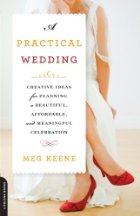
A Practical WeddingMeg Keene, A Practical Wedding: Creative Ideas for Planning a Beautiful, Affordable, and Meaningful Celebration

Meg Keene, creator of the blog A Practical Wedding, here sets forth her philosophy of weddings, which basically boils down to a few simple principles: (1) It’s not the greatest day of your life — or at least it shouldn’t be! (2) The only requirement for a perfect wedding is that you end up married at the end of it. And (3) it doesn’t have to cost your entire life’s savings! This book discusses wedding planning in light of these principles, from the engagement to the big day to the marriage that follows. It doesn’t delve too deeply into the details; for example, you’re not going to find a list of inexpensive-yet-chic venues or bakeries or stationery vendors here. Rather, this book takes a big-picture look at some of the most common wedding-related stressors and offers common-sense advice on how to rise above them.

Lately I’ve been very into wedding-related things. I watch all those bridal shows on TLC — “Say Yes to the Dress,” “Four Weddings,” “I Found the Gown,” etc. I’d like to blame some sort of external pressure, but I’m afraid I just like romantic stories and pretty dresses! While I enjoy these shows, though, I often find myself thinking that the women on them must be insane. Spending thousands of dollars on a wedding dress? Throwing a fit because the bridesmaids’ dresses don’t perfectly match the table linens? It’s a strange world we live in, folks. Well, this book is a wonderful antidote for all the wedding craziness out there! It really puts the wedding celebration in perspective without underrating the importance of marriage. It also offers advice on how to deal with the inevitable problems, like financial constraints and meddlesome relatives. I’m not married or engaged right now, but if and when I do take the plunge, I’ll definitely be referring to this book again!

Review: Operation Mincemeat

Operation MincemeatBen Macintyre, Operation Mincemeat: How a Dead Man and a Bizarre Plan Fooled the Nazis and Assured an Allied Victory

This book about a World War II intelligence operation proves once again that truth is stranger than fiction. In the spring of 1943, the Allies hoped to invade a Europe that was firmly in control of the Nazis. The obvious target for an invasion was Sicily, but unfortunately, the Germans knew this all too well. So a few creative members of British intelligence came up with a daring plan, codenamed “Operation Mincemeat”: They would float a dead body wearing a British uniform onto a Spanish beach. This corpse would be carrying top-secret — and totally false — documents stating that the Allies were planning to launch a two-pronged attack against Greece and Sardinia; Sicily would only be a “decoy” target. Since neutral Spain had pro-German sympathies, it was hoped that the Spaniards would turn over these documents to the Germans and thus convince the Axis to rearrange their defensive forces. This book tells the story of this extraordinary plan and its even more extraordinary success.

I’m not normally a big reader of nonfiction, but the premise of this book caught my attention right away, and I’m really glad it did! This is an extremely readable and entertaining account of a plan so farfetched, it couldn’t possibly be true — except it is. The book covers every aspect of Operation Mincemeat with meticulous attention to detail, describing everything from the difficulties of acquiring an appropriate body to the creation of a fictitious identity for the corpse to the various personalities who contributed to the formation of the plan. To me, one of the most astonishing things about the operation was how easily everything could have gone wrong. What if the Spanish authorities had returned the documents to the British immediately (as, indeed, some of them tried to do)? What if the Germans had been skeptical of this intelligence instead of eagerly grasping at a welcome piece of news? In short, this is a well-written account of an absolutely fascinating subject. I definitely plan to read more by Ben Macintrye — Double Cross: The True Story of the D-Day Spies is already on my wishlist!

Review: Luckiest Man

Luckiest ManJonathan Eig, Luckiest Man: The Life and Death of Lou Gehrig

This well-researched biography of Lou Gehrig follows his life and baseball career in vivid detail, from his humble beginnings playing high school ball to his stellar performance as first baseman and power hitter for the New York Yankees. Along the way, Eig discusses some of the broader social developments in America in the 1920s and ’30s, but the focus remains on baseball and how it evolved throughout the early 20th century. The book uses a wealth of primary sources, particularly the many newspaper stories that covered Gehrig’s remarkable career. Most importantly, though, this biography illuminates Gehrig’s personality — humble, modest, conscientious, hardworking, and determined to do his best in life both on and off the field.

I don’t particularly follow baseball (or any other sport, frankly), but for some reason I’ve always been interested in Lou Gehrig — probably because he was left-handed, like me, and because he died tragically young. So I decided to check out this biography, and I’m glad I did because it is fantastic. I felt like I really got a sense of Lou Gehrig as a person, and it was a pleasure to read about someone so admirable. I also loved learning more about the other legendary players of that era: Babe Ruth figures prominently in the book, and there are plentiful references to other greats like Ty Cobb and Joe DiMaggio. Eig discusses Gehrig’s baseball career in great detail, sometimes describing almost every play of a game. I suppose this might be boring for some, but I really appreciated all the information since I knew basically nothing coming in. Overall, I would highly recommend this book to anyone, although it will probably be most appealing to baseball fans.

Review: Are Women Human?

Are Women Human? by Dorothy L. SayersDorothy L. Sayers, Are Women Human?

Dorothy Sayers is best known for her mystery series featuring Lord Peter Wimsey, but she wrote on a lot of other topics too. This short volume contains two of her essays in which she explicitly talks about the role of women in society and the feminist movement as she perceived it in the early 20th century. Sayers’ central point in these essays is that people should spend less time thinking about “women” as a class and more about each particular woman as an individual. She notes that opinions, beliefs, intellect, and abilities vary among women just as they do among men. She also champions a woman’s right to work outside the home if she wants to; both women and men should be able to do work that they enjoy and at which they excel.

I really enjoyed both of these thoughtful, witty essays. Even though they were written many decades ago and the world has changed a lot since then, I think Sayers’ observations remain relevant and interesting. I especially liked what she says about the idea that a woman’s place is in the home. She points out that in the Middle Ages, a lot of the most interesting and important jobs were done in the home — weaving, dyeing, food production, brewing, estate management, etc. These all used to be women’s jobs, and they didn’t become men’s jobs until after the Industrial Revolution, when they moved into factories. I don’t tend to read a lot of feminist theory, but I’d recommend this book to anyone interested in the history of the feminist movement — or anyone looking for a quick, humorous, and thought-provoking read!

Review: Holy Days

Holy Days: Meditations on the Feasts, Fasts,…Pope Benedict XVI, Holy Days: Meditations on the Feasts, Fasts, and Other Solemnities of the Church

This little book comprises excerpts of sermons that Pope Benedict XVI has given on various Catholic holy days throughout the past few years. Most passages are short, a few paragraphs at most, but they all have something thoughtful and interesting to say about some aspect of Catholic theology. My only complaint is how short the book is (less than 100 pages); I would have liked to read the excerpted sermons in full and delve into each holy day a little more deeply. Nevertheless, I enjoyed the book and plan to use it as a devotional text, reading the relevant sermons throughout the year. I’d recommend this one to Catholics, as long as they don’t mind a fairly cursory look at the holy days mentioned.

I received this book through the LibraryThing Early Reviewers program.