Mini-Reviews: Serfdom, Benevolent, Wicked

F.A. Hayek, The Road to Serfdom

F.A. Hayek was an Austrian economist who moved to England in the 1930s and subsequently taught in both the UK and US. He won the Nobel prize in economics in 1974. In this essay, written during World War II and first published in 1944, he argues that Nazi fascism was not a reaction against socialism but rather a natural progression of socialist ideas. In Hayek’s view, socialism (by which he seems to mean a centrally planned economy) is bad economics because competition, not central planning, is what allows new ideas and wealth-creating innovations to flourish. But it’s also bad politics because under a socialist system, individual freedom will disappear; all power will reside in the hands of the central planners/the state. I broadly agree with Hayek’s ideas here, so my opinion is biased. But I think this essay is worth reading for anyone who is interested in a “liberal” (as opposed to socialist) view of economics or in the history of socialist thought. Hayek doesn’t straw-man his opponents, and his arguments are thoughtful and measured. Maybe I’ll tackle one of his full-length books at some point!

Alison Goodman, The Benevolent Society of Ill-Mannered Ladies

Lady Augusta “Gus” Colbrook and her sister, Lady Julia, are unmarried women in their 40s and thus are basically invisible in society. Instead of dwindling into spinsterish obscurity, they decide to help vulnerable women who are being abused by the men in their lives. Aiding them in their quest is the handsome Lord Evan Belford, whose checkered past doesn’t deter Gus from a more-than-friendly interest. This novel is hard to categorize; it’s not exactly a romance or a mystery, though it has elements of both. But the book mainly depicts the negative aspects of Regency society, particularly the limits placed on women, and offers a sort of revenge fantasy in which the women take charge and triumph over all wrongdoers. For some readers, this will be exactly their cup of tea, but for me, it was too anachronistic and felt a bit preachy. I didn’t dislike the book, though! Goodman is a good writer, the plot adventures are fun, and Gus is (usually) a sympathetic character. I believe a sequel is planned, and I’ll likely read it when it comes out.

Stella Riley, The Wicked Cousin

After a too-strict upbringing, Sebastian Audley has spent the past several years behaving as outrageously as possible, first in England and then abroad. Now his scandalous ways are beginning to pall, and he hopes to return to England and lead a quieter life, but his reputation makes that difficult. Meanwhile, Cassandra Delahaye is determined not to be impressed by the rakish Sebastian, but she soon finds herself attracted to his good looks and roguish sense of humor. I’m officially a huge fan of this series and enjoyed this installment as well, but it felt a little too long. The main obstacle to the romance is Sebastian’s obsessed ex-lover, which means there’s a lot of plot to slog through even after Sebastian and Cassie fall in love. (I find that Stella Riley uses the “evil ex” trope pretty often, which I’m not fond of.) I still liked the book a lot, though, and it was nice to catch up with the various recurring characters. Looking forward to the next one!
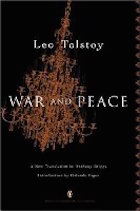
Review: War and Peace

War and PeaceLeo Tolstoy, War and Peace (trans. Anthony Briggs)

“Set against the sweeping panoply of Napoleon’s invasion of Russia, War and Peace — presented here in the first new English translation in forty years — is often considered the greatest novel ever written. At its center are Pierre Bezukhov, searching for meaning in his life; cynical Prince Andrei, ennobled by wartime suffering; and Natasha Rostov, whose impulsiveness threatens to destroy her happiness. As Tolstoy follows the changing fortunes of his characters, he crafts a view of humanity that is both epic and intimate and that continues to define fiction at its most resplendent.” (Summary from Amazon.)

It took me more than three months to read this book, and I’m still not quite sure what to make of it. I feel a bit presumptuous in criticizing such a well-known classic, but certain parts of the novel worked for me much more than others. There’s a lot of social comedy in this book, which I loved! And I find the Napoleonic era fascinating, although I’ve only been exposed to it from a British point of view, so it was interesting to see that conflict from a Russian perspective. However, there are reasons most people never finish this book, and those reasons are: the overly long, mind-numbingly tedious descriptions of battles; philosophical digressions; and tirades about the right and wrong way to study history. I do think this book is worth reading once, but I’m glad I don’t ever have to read it again!

I also want to note that I liked the Briggs translation; it’s not as word-for-word accurate as the Pevear-Volokhonsky translation is rumored to be, but I suspect it’s more readable. Instead of footnoting the long French passages, Briggs just translates them directly into English, although he does note when certain characters are speaking French. I actually preferred this, but some readers may not. Also, the Briggs translation is pretty aggressively British; for example, some of the lower-class soldiers have Cockney accents! Again, I didn’t mind this, but I can see how others might. All in all, I’d recommend this translation for casual readers but maybe not for serious scholars.

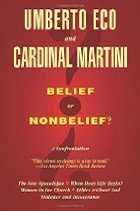
Review: Belief or Nonbelief?

Belief or Nonbelief?Umberto Eco and Cardinal Martini, Belief or Nonbelief?: A Confrontation (trans. Minna Proctor)

This slim volume is a collection of letters written in the 1990s between Umberto Eco, renowned author, scholar, and atheist, and Carlo Maria Martini, a cardinal of the Catholic Church. The letters, which were originally published in an Italian newspaper, present these men’s opposing points of view on a number of philosophical and theological topics, including: secular and religious perspectives on the end of the world, the politically fraught issue of when human life begins, the Catholic Church’s refusal to admit women to the priesthood, and the ultimate source of human ethics. Though Eco and Martini often disagree, their letters maintain a consistent tone of civility and open-mindedness that is all too rare in public discourse nowadays.

I enjoyed this book, and I think it’s somewhat unique in that both believers and nonbelievers could get something out of it. As I mentioned, both Eco and Martini approach the conversation with sincerity and goodwill, never mocking or belittling each other’s positions, but actually having a genuine dialogue and hoping to learn from one another. I wish our public figures in general would take the hint! I will say, though, that I don’t think these letters would actually change anyone’s mind; an atheist wouldn’t suddenly convert to Christianity, nor would a religious person lose his/her faith because of this book. Because the letters were originally written for newspaper publication, they couldn’t be long or in-depth enough to explore the topics thoroughly. Basically, I came away from this book wanting more, but I’d still recommend it if the subject matter appeals to you.

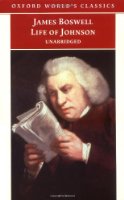
Review: Life of Johnson

Life of JohnsonJames Boswell, Life of Johnson

James Boswell and Samuel Johnson were unlikely friends: Boswell was a young Scottish nobleman with a penchant for drinking and whoring, while Johnson was poorer, much more devout (in theory, at least), and a good 30 years older. Yet throughout the course of this monumental work, Boswell describes his reverence for Johnson’s intelligence, morality, and literary talents — a reverence so extreme that Boswell took notes on almost every conversation he ever had with the older man. As a result, this biography is stuffed full of Boswell’s personal anecdotes, letters both to and from Johnson, and first-person accounts of other contemporaries who knew him. Near the end of the book, Boswell states: “The character of Samuel Johnson has, I trust, been so developed in the course of this work, that they who have honoured it with a perusal, may be considered as well acquainted with him.” And indeed, anyone who reads this book will come away with an extremely vivid picture of a remarkable man.

This book is so huge and deals with so many things that I don’t quite know what to say about it. At first I was very intimidated, both by its length and by Boswell’s flowery 18th-century prose. But even though it’s not a quick read, this book contains a wealth of fascinating details about Johnson and the age in which he lived. I was struck by how literary the 18th century was, in the sense that seemingly anyone with a claim to intelligence was churning out books and pamphlets. In that way, Johnson’s time is very similar to our own, where everybody can (and does) publish blogs, tweets, and other forms of instantaneous literature. I was also fascinated by Johnson’s unique character; though intelligent, he was often pompous, narrow-minded, and abrasive. I frequently found myself underlining various Johnsonian sayings that were wise, or funny, or both — but I would have hated to be forced to converse with him! Overall, I would recommend this book to anyone interested in the time period or who enjoys very thorough biographies!

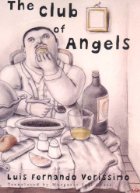
Review: The Club of Angels

The Club of AngelsLuis Fernando Verissimo, The Club of Angels (trans. Margaret Jull Costa)

The narrator of this short book, Daniel, is a member of a very exclusive society of gourmands: He and nine other men regularly meet at each other’s houses to feast on the most delicious, exotic, flavorful meals they can create. The club hasn’t met recently due to some bad blood between the members, but then Daniel meets the mysterious chef Lucídio, who agrees to cook for them. The club members all converge on Daniel’s apartment and are delighted to find that Lucídio’s cooking is the best they’ve ever tasted. But then one of the guests mysteriously dies the next day — and the meal Lucídio had prepared was that guest’s favorite dish. The club continues to hold more dinners, and another member dies after each one. Yet for some reason, Daniel and his friends can’t resist experiencing these exquisitely perfect meals, even with the knowledge that each bite could be their last.

From the moment I read the epigraph of this creepy little novel, I was hooked: “All desire is a desire for death. — A possible Japanese maxim.” Verissimo wasn’t being lazy in his attribution; the saying is actually referenced in the novel, and it highlights Daniel’s unreliability as a narrator. From the start, he warns us that he might be making up the whole story, and then he goes on to give a brief philosophy of the detective novel. So you’ll know within the first two pages whether you’ll like this book or not; I thought it was weird and thought-provoking and very good! My library shelves it in the mystery section, which doesn’t make sense to me, since “whodunit” is clear from the outset (well, kind of). But watching the motives slowly unfold was interesting and surprisingly suspenseful. I should also point out that this book is set in Brazil, and the main characters are essentially a microcosm of Brazilian society, from the political protester to the ex-priest to the criminal. Overall, I enjoyed this book a lot and would definitely recommend it, as well as Verissimo’s other novel, Borges and the Eternal Orangutans.

Review: Manalive

Manalive by G. K. ChestertonG.K. Chesterton, Manalive

This novel takes place in a dull, dreary London boardinghouse whose inhabitants are terribly bored and listless — that is, until Innocent Smith bursts into their lives. Smith has extremely odd manners that startle the boardinghouse dwellers at first, but soon his gaiety and zest for life become contagious, even inspiring courage and romance in the hearts of the other characters. However, just as they’re all starting to enjoy themselves, Smith is cornered by two mental health doctors who claim that he is criminally insane. They accuse him of committing murder, burglary, polygamy, and a host of other crimes. The boardinghouse residents are shocked, but one of them suggests an informal “trial” to determine whether Smith is a force of good or evil.

I think the trick to liking this book is to approach it as a fable rather than as a novel in the traditional sense. There’s not much character development, nor is there a real plot to speak of; instead, the book satirizes modern psychology (“modern” being 1912, when the book was published) and explores a host of philosophical issues ranging from the profound to the (apparently) trivial. Being a diehard Chesterton fan, I enjoyed this book, but I wouldn’t recommend it to someone reading Chesterton for the first time. Start with Orthodoxy instead, which is a wonderful introduction to his style and his philosophy.