Mini-Reviews: Hitchhiker’s, Rake, Emma

Douglas Adams, The Hitchhiker’s Guide to the Galaxy

It’s an ordinary Thursday, and British everyman Arthur Dent is lying in front of a bulldozer, trying to stop his house from being demolished. Little does he know that the entire planet is about to be demolished to make way for an interstellar bypass. Fortunately, his alien friend, Ford Prefect, saves him from vaporization by hitching a ride on a spaceship. From there, Arthur and Ford brave many dangers, including Vogon poetry, infinite improbability, automated attacks from dead planets, and the evil machinations of white mice. I remember reading this book (and the sequels) in my tween or teen years, and at the time I thought it was hilarious. This time around, I could still appreciate some of the humor, but I had less patience for it. The book isn’t attempting to be anything more than a rapid-fire series of jokes, and after a while I found it a bit tedious. So even though there’s no real resolution at the end of this novel, I’m not tempted to continue with the series.

Mary Jo Putney, The Rake

Notorious rake Reggie Davenport is growing tired of his aimless life; so when his cousin, the Earl of Wargrave, unexpectedly gives him an estate, he views it as a fresh start. Upon arriving at the estate, Reggie is shocked to discover that his very capable steward is a woman, Alys Weston. Alys fled her aristocratic family at a young age and has fought hard to make her own way in the world, so at first she fears and resents Reggie’s presence. Eventually they discover each other’s good qualities, but Reggie’s drinking problem threatens their relationship. I was pleasantly surprised by this book! I loved its refusal to romanticize rakishness: Reggie’s drinking and womanizing have serious consequences, particularly his struggle with what we now call alcoholism. His feelings for Alys are one motivating factor in his desire to change, but not the only one, and her love doesn’t magically solve his problems. I liked Alys too and related to her insecurities, but this is really Reggie’s book. I would highly recommend it to historical romance fans, and I’m interested in trying more by Putney—anyone have any recommendations?

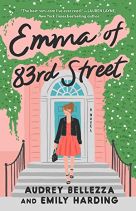
Audrey Bellezza and Emily Harding, Emma of 83rd Street

In this contemporary retelling of Jane Austen’s Emma, Emma Woodhouse is a privileged 23-year-old living on the Upper East Side and getting a master’s in art history. Socially, she’s at a loose end now that her beloved older sister has married and moved out. So when she meets country-mouse classmate Nadine, Emma decides to give her a makeover—as well as some dubious romantic advice. Emma’s friend Knightley doesn’t hesitate to point out the flaws in her approach, but lately their good-natured sparring seems to be taking a romantic turn. I adore Austen but tend to steer clear of retellings; I broke my rule for this one, and sadly I don’t think it was worth it. The novel has its good points—it successfully translates the original book’s major plot points, and it gives us some peeks at Knightley’s point of view—but to me it felt like a standard contemporary romance with nothing particularly interesting or compelling about it. Unless you’re a diehard Austen fanfic lover, I’d skip this one.
Mini-Reviews: Ring, Moon, Earl

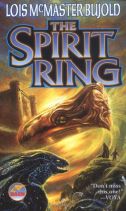
Lois McMaster Bujold, The Spirit Ring

In a magical version of Renaissance Italy, Fiametta is the privileged daughter of a goldsmith and master mage. Her biggest problem is an unrequited crush on one of the duke’s soldiers—that is, until the duke is assassinated by a rival who seems to command dark magic. When this man’s soldiers kill Fiametta’s father and seize his corpse for use in an evil ritual, she teams up with the local abbot, who also has some knowledge of magic, and with Thur, a would-be metalworker who was supposed to be her father’s new apprentice. This stand-alone fantasy novel is one of Bujold’s earlier works, but it has a lot of her characteristic elements: strong world-building, an intelligent heroine with agency, and ordinary people doing heroic things because there’s no one else around to do them. The book has a YA feel to it, possibly because Fiametta and Thur are both teenagers, and their romance is a bit underdeveloped. Overall, though, I really enjoyed this one and would recommend it to fantasy fans!

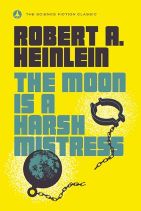
Robert A. Heinlein, The Moon Is a Harsh Mistress

It’s 2075, and the Federated Nations of Earth have established a thriving colony on the moon. But times are tough on Luna, whose resources are being unfairly exploited by the Terran government. A small group of Lunar citizens decides to start a revolution, including narrator Manny, an engineer who has befriended self-aware supercomputer “Mike.” Along with a crafty professor, a beautiful revolutionary, and a Terran self-proclaimed soldier of fortune, Manny and Mike engineer a rebellion—but at what cost? This novel combines clever world-building with speculative science and libertarian political philosophy. There are some interesting ideas in it, and I liked Manny’s narrative voice once I got used to the Lunar dialect, but I also found it a slog; it really drags after the initial setup. It was fascinating that some aspects of the plot were very dated while others still felt timely. Overall, this was a mixed bag for me, and I’ll probably wait a while before trying anything else by Heinlein.

Kate Pembrooke, Not the Kind of Earl You Marry

William Atherton, the earl of Norwood, is a man of unassailable respectability and political aspirations. So when a newspaper announces his engagement to Charlotte Hurst, a social nobody whom he’s never even met before, he’s furious. But when it becomes obvious that Charlotte knows nothing about the announcement either, William proposes that they pretend it’s true: A temporary engagement will prevent any scandal and give him the chance to figure out who’s really behind the announcement. But as William and Charlotte spend more time together, their fake betrothal starts to feel all too real. I enjoy the fake relationship trope, and this is an inoffensive example of it, but honestly the book fell a bit flat for me. Contrary to the title, William is exactly the kind of earl anyone would marry—handsome, rich, intelligent, kind, and essentially flawless. Lovely in real life but dull in fiction, and Charlotte is no better. Overall, the book just feels like the blandest possible version of this story, and I’m not particularly tempted to pick up the sequel.

Mini-Reviews: Children, Christmas, Mistletoe

P.D. James, The Children of Men

This dystopian novel imagines a near-future world in which no human children have been born since 1995. England is ruled by a seemingly benevolent dictator called the Warden, and most people’s material needs are satisfied. But the human race is dying out, and hope is a thing of the past. Theo Faron, a 50-year-old Oxford professor, views the future with detachment and despair. But when a young woman, one of his former students, approaches him with a surprising request, he finds himself unwillingly getting involved with a resistance movement. I’m of two minds about this book. On the plus side, it’s steeped in deep questions about morality and whether good and evil even matter if the world is ending. Certain scenes are quite memorable and chilling, and the dramatic tension builds effectively even when there’s not much going on. On the minus side, the pacing is slow, the world-building doesn’t feel completely thought out, and the ending leaves a lot of unanswered questions. I’m excited to talk about this book with my office reading group, as I’m sure it will generate an interesting discussion. But for me personally, it was an unsettling read.

Martha Waters, Christmas Is All Around

Artist Charlotte has never enjoyed Christmas, and she especially hates holiday rom-coms because when she was nine years old, she had a role in the modern holiday classic Christmas, Truly, which she’d love to forget about. But when she visits her sister in England for the holidays, she finds she can’t escape her past as they tour an estate that was used as a set on the film. There Charlotte meets Graham, the estate’s handsome owner, who hires her for an art project to bring much-needed publicity to the estate. Will grumpy Grinch Charlotte find herself in a holiday rom-com of her own? I enjoyed Martha Waters’s recent historical mystery and wanted to try more of her work, so I was excited for this contemporary romance. Unfortunately, it wasn’t quite as funny as I wanted it to be, and I didn’t really connect with the characters. It’s still a pleasant read – there are some fun one-liners, plentiful Love, Actually references, and cozy Christmas vibes – but this book won’t be a keeper for me.

Chloe Liese, The Mistletoe Motive

Gabriella Di Natale and Jonathan Frost are work nemeses. They’re co-managers of Bailey’s Bookstore and couldn’t be more different: Gabby is a festive ball of sunshine who loves the bookstore’s soul, while Jonathan is cold and grumpy and all about the bottom line. But as Christmas approaches, Gabby starts experiencing a strange attraction to Jonathan—an attraction that just might be reciprocated. I enjoy the enemies-to-lovers trope, so I was hoping to like this holiday novella a lot more than I did. But it suffers from perfect hero syndrome: Jonathan is outrageously handsome, incredibly attuned to Gabby’s every need, and the ideal ally when she discloses her autism. And while I think it’s great to see neurodivergent folks represented in romance, autism (plus loving Christmas) basically felt like Gabby’s entire personality. She’s so mean to Jonathan, yet he’s completely devoted to her. And don’t get me started on the overly Christmassy names—there is literally a character named George Bailey. In short, I found this book frustrating, and I won’t be reading more by Chloe Liese.

Mini-Reviews: Orphans, Systems, Bookshop

Lois McMaster Bujold, The Orphans of Raspay

Penric is sailing home from what should have been a routine journey, but naturally his ship is captured by pirates, and things only get worse from there. Among his fellow captives are two young orphan girls who will almost certainly be sold into slavery, so Pen takes responsibility for them as he engineers a prison break. But between pirates, corrupt merchants, and a local distrust of sorcerers, it’s all Pen and Des can do to keep themselves and their charges alive. This is another enjoyable installment in the Penric and Desdemona saga, heavy on adventure and light on character development. I wonder if we’ll see the two orphans, Lencia and Seuka, in subsequent books. Otherwise, I don’t have much to say about this one – it’s entertaining but doesn’t really feel like a crucial (or even particularly necessary) installment of the series.

Martha Wells, All Systems Red

This novella is narrated by a SecUnit, a robotic “construct” made of both organic and inorganic materials, whose job is basically to provide security for whoever hires it. It’s currently accompanying a crew on a mission of planetary exploration, but all it really wants to do is watch soap operas on its entertainment feed. The longer the self-designated Murderbot spends with this particular crew of humans, however, the more it begins to care about them. And when it senses something off about the mission, it must figure out whether and how to help the humans. The Murderbot series has gotten a lot of hype, and I can definitely see why; the concept is fascinating, particularly now that AI is so prominent in our society, and Murderbot is a snarky yet sympathetic character. I’m just not sure if it’s my thing, you know? I did enjoy the story, but I haven’t decided whether I care enough to continue with the series—with apologies to all the Murderbot lovers out there!

Jenny Colgan, The Christmas Bookshop

Carmen has just been laid off and is struggling to find work in her dying Scottish town. She ends up moving to Edinburgh to stay with her sister, Sofia, who seems to have the perfect life — which Carmen both mocks and envies. Sofia gets Carmen a job with Mr. McCredie, who owns an unprofitable bookstore and expects Carmen to turn things around somehow. At first, Carmen hates everything about her new situation, but she eventually finds things to love about her job, the city, and even her sister. This book is like a warm hug; it’s cozy and Christmassy and makes me want to visit Edinburgh in December, despite what sounds like horrific weather. I loved Carmen and Sofia’s relationship, which felt very realistic and nuanced, and there’s a sweet romance as well, though it doesn’t get much page time. I would definitely recommend this as a great read to get into the holiday spirit!

Mini-Reviews: Substitute, Local, Cover

Alice Coldbreath, A Substitute Wife for the Prizefighter

Lizzie Anderson is a “poor relation” in a respectable Victorian family. Benedict Toomes is a prizefighter with a prison record. But he’s also rich, which makes him just barely acceptable as a fiancé for Lizzie’s cousin, Betsy. Lizzie and Benedict heartily dislike each other; but when Lizzie inadvertently causes a scandal and the family casts her out, Benedict surprises himself by coming to her rescue. Already tired of Betsy, he proposes to Lizzie instead, and since she has no other options, she accepts. As she adapts to Benedict’s life as a boxer on the fair circuit, the two slowly grow closer. Alice Coldbreath is quickly becoming one of my go-to authors for historical romance. I loved the detail about life as a traveling fair performer, as well as the romance between Lizzie and Benedict. It’s steamier than I normally prefer, but I loved how honest and direct they are with each other. My only complaint is that not a lot happens; Lizzie meets a lot of people who add some fun color but don’t end up being particularly important to the story. Still, I’d highly recommend this one to fans of the genre who are looking for something different in terms of setting and social class.

Sharon Lee and Steve Miller, Local Custom

Er Thom yos’Galan is a Liaden from a prominent clan; as such, his duty is to make an advantageous marriage. But he’s still consumed with feelings for an old love, the Terran Anne Davis. Three years later, he resolves to see Anne once more before fulfilling his duty to his clan. But when he learns that their affair resulted in a child, his life becomes much more complicated. I’ve heard good things about the Liaden books, and this one was suggested as a good entry point. I found some of the setting and terminology a bit difficult to understand at first, but the main plot is easy enough to follow. The novel is billed as a “space Regency,” which pretty much sums up the genre and vibe. I wish more time were spent on the development of Er Thom and Anne’s romance, but they’re pretty much obsessed with each other from the start, so I’d call it more a novel of manners than a true romance. Overall, I liked the book fine, but I’m not sure I care enough to continue with the series.

Mhairi McFarlane, Cover Story

Investigative journalist Bel has just gotten a tip on a huge story: The beloved mayor of her city is preying on his young female staffers and receiving favors from a known criminal. To get the evidence she needs, Bel goes undercover, but her plan is almost ruined when her new colleague, Connor, sees her using her fake persona while talking to a potential source. To salvage the situation, Bel claims Connor is her boyfriend, even though they actually dislike each other. But as they work together to chase the story, they slowly change their opinions. I love McFarlane’s contemporary romances, and I enjoyed the ride here as well; she’s very good at writing clever banter and conveying the slow build of attraction. But in this case, I don’t believe that Bel and Connor are actually a good match. They are terrible communicators throughout the book, including at the very end when they both dither about confessing their feelings. I also felt there was a bit too much going on in general, with two of Bel’s exes creating problems that didn’t matter and Connor dealing with trauma from a previous job and relationship. I do still think this book is a good read, but it’s not one of my favorites by the author.

Mini-Reviews: Luck, Marriage, Only

Kate Clayborn, Beginner’s Luck

Six months ago, Kit Averin and her two best friends, Zoe and Greer, won the lottery. But Kit has no interest in changing her lifestyle, and despite being a brilliant materials scientist, she’s content with her job as a lab technician at the local university. When headhunter Ben Tucker comes to town to recruit her for a big manufacturing corporation, she turns him down flat. But as he persists and she gets to know him better, their growing attraction poses a threat to both Ben’s career and Kit’s hard-won sense of community. I’m a big fan of Kate Clayborn’s, and this book is no exception. It’s a contemporary romance in which the protagonists generally communicate well and act like adults, which I found extremely refreshing! I also liked that both Kit’s and Ben’s characters are revealed through their relationships, especially Ben and his dad. The resolution to the book’s central conflict is a bit glossed over, and I feel like Kit perhaps needs a bit more therapy to deal with her extreme aversion to change. But overall, I really enjoyed this book and am eager to continue with the series!

Mary Balogh, First Comes Marriage

This novel is the first in the Huxtables series, introducing a group of genteel but impoverished siblings whose destiny is changed forever when the brother, Stephen, unexpectedly inherits an earldom. Elliott Wallace, Viscount Lyngate, brings the news that Stephen is the new Earl of Merton and proposes to take him to London and instruct him in the duties of his new station. But since Stephen is only 17, his three older sisters demand to accompany him. For various plot reasons, Elliott agrees to a marriage of convenience with the second sister, the widowed Vanessa. But what starts as mutual antagonism eventually transforms into attraction and love. I generally enjoy Balogh’s historical romances, but while this book was fine, it didn’t make much of an impression on me. Beyond the initial setup, I barely recall any plot details, and I only read the book a week ago! I am mildly curious about the other Huxtables’ romances, so I’ll probably continue the series at some point, but this one was just okay.

Jennifer Estep, Only Bad Options

In a futuristic, spacefaring society, Vesper Quill is a “lab rat” working for Kent Corporation. When she spots a design flaw in Kent’s new line of spaceships—a flaw that’s already resulted in a fatal crash—she notifies her superiors, only to be summarily fired and conscripted into the Imperial army, where she’ll most likely die in battle. But Vesper unexpectedly survives by teaming up with Kyrion Caldaren, one of the Empire’s most elite warriors. They come from two different worlds, but when an inconvenient psychic bond forms between them, they’ll have to work together to take down their enemies. This book is the equivalent of a summer blockbuster movie—not too deep, but plenty of action-packed fun. I liked the political intrigue and the reluctant attraction between Vesper and Kyrion, and I’ll probably continue with the series to find out how their story is resolved.

Mini-Reviews: Archive, Swept, Otherwhere

Genevieve Cogman, The Dark Archive

In the penultimate installment of the Invisible Library series, Irene Winters and her friends face a whole new set of problems. They’re the targets of various assassination attempts (even more so than usual), a new master criminal is on the loose in London, and an old enemy unexpectedly resurfaces. To figure out exactly who’s after them and why, Irene and company travel to a scientific exposition that leads to a dramatic showdown in Barcelona’s Sagrada Familia. As with the series in general, I liked this book, though I didn’t find it particularly hard to put down. With only one book left in the series, I’m wondering if everything will be wrapped up in a satisfying way. All along I’ve suspected that the Library may not be completely benign, but I fear the last book won’t explore that idea and will force me to take it at face value. I also question the durability of Irene and Kai’s relationship (and whatever happened to her unresolved sexual tension with Vale?). Looking forward to reading the last book to see how it all turns out.

Beth O’Leary, Swept Away

The back cover of this novel asks, “What if you were lost at sea … with your one-night stand?” And that’s the entire plot of this contemporary romance. Lexi and Zeke meet in a bar on the north coast of England. They have great sex in Zeke’s houseboat, but due to a miscommunication, neither of them secures the boat to the dock. So the next morning, they’ve been washed out to sea and must work together to survive and find their way home. I really like Beth O’Leary’s writing in general, and this book mostly worked for me. I loved the slow-burn romance; both Lexi and Zeke are very guarded people, and it’s lovely to watch them gradually let each other in. The survival stuff wasn’t as compelling for me, and I never really felt they were in serious danger (though of course in real life, they totally would be!). So The Flatshare is still my favorite O’Leary novel, but I did enjoy this one very much as well.

Emily J. Taylor, The Otherwhere Post

Maeve’s father is a notorious murderer, so for the past several years she’s lived under assumed names, never staying in one place long or getting too close to anyone. When she receives an anonymous letter saying her father was innocent, she’s determined to find out more. The answers may be at the Otherwhere Post, a place that teaches the art of scriptomancy—magic-infused writing that allows people to travel between worlds. But the search is dangerous, and Maeve may not be ready for the answers she finds. I really liked the concept of this novel (a school for magic writing! Alternate universes!), but for me, the plot and characters didn’t live up to it. Everything just felt a bit predictable—the characterization, the romance, the “twists” all felt like exactly what you’d find in a typical YA fantasy novel. Plus, Maeve does some unethical (and stupid) things in the course of her quest, which made her a less sympathetic character to me. Overall, a fine but not an exceptional read.

Mini-Reviews: Promised, Stab, Bonnet

Connie Willis and Cynthia Felice, Promised Land

Delanna’s mother has just died, so she’s returned from her fancy education in the big city to her home planet to claim her inheritance. To her dismay, she learns that under the planet’s laws, she has to live on her property for one year before she’s allowed to sell. Moreover, she’s legally married to Sonny Tanner, the man who owns the neighboring property. Delanna is furious to be stuck in what she considers a backwater full of ignorant yokels, but the longer she remains on this planet, the more she grows to like her surroundings—and Sonny. Though there are some sci-fi trappings, this novel reads more like a Western, as the main characters rough it on a frontier planet with few luxuries. Delanna is quite a spoiled brat initially but changes for the better as she gets to know Sonny and the other locals better. This book isn’t as unique or interesting as Willis’s solo work, but I did enjoy it and would recommend it to fans of the premise.

Jill Bearup, Just Stab Me Now

Caroline is writing a novel, which she imagines as a tropey, enemies-to-lovers romantasy complete with smoldering glances and flirty banter. Unfortunately, her characters have other ideas. The heroine, Rosamund, is a widow still grieving for her dead husband, and she’s laser-focused on the diplomatic mission she’s supposed to carry out. The hero, Leo, is quiet and kind, not the cocky charmer Caroline had envisioned. As Rosamund and Leo navigate the complicated politics of their world together, Caroline occasionally pops in with questions and advice—all while navigating her own real-life romance with her persnickety editor.

This book apparently started as a YouTube series called The Fantasy Heroine, and I’m glad I didn’t know that beforehand, because I might never have read this book, which would have been a real shame. The fantasy book-within-a-book is genuinely entertaining, and I liked how the narrative gleefully skewers a lot of romance tropes (“Only one bed? No problem, I’ll sleep on the floor!”). The contemporary story is pretty thin—I didn’t care about Caroline’s work woes at all—but otherwise, I really liked this one! I may even go back and watch the web series now…

Mary Balogh, The Plumed Bonnet

Alistair Munro, the duke of Bridgwater, is handsome, rich, and bored out of his mind. So when he spots a bedraggled young woman while traveling, he impulsively offers her a ride. She’s dressed in gaudy attire that leads him to believe she’s a prostitute. But Stephanie Gray is actually a respectable young woman who worked as a governess until inheriting an unexpected fortune, which she’s on her way to claim. Alistair doesn’t believe her farfetched story, but when he learns the truth, he realizes he’s compromised a lady and promptly offers to marry her. Stephanie accepts, but she’s horrified to discover that he’s a duke and she’ll need to learn how to act like a duchess. Can they build a workable marriage, and perhaps even find love, after such a bad beginning? I was in the mood for a Balogh novel and decided to revisit this one, which I first read about five years ago. It’s not a top-tier Balogh for me, but I liked that both of the characters truly grow and change throughout the story. Overall, a pleasant read that I finished in a single day.

Mini-Reviews: Frederica, Crusade, Perils

Georgette Heyer, Frederica

The Marquis of Alverstoke is rich, influential, and sought-after in London society, but he’s also jaded and quickly grows bored with most people. That changes, however, when he meets the Merrivilles, distant family connections who have just moved to London. Frederica, the eldest, wants her beautiful younger sister to have a Season so that she can make an advantageous marriage, and she asks Alverstoke for help. Somewhat to his own surprise, he agrees – and soon finds himself invested in the welfare of all the Merrivilles, but perhaps Frederica most of all. This is such an enjoyable Heyer novel, with schoolboys Jessamy and (especially) Felix Merriville stealing every scene they’re in! I also love how the romance between Frederica and Alverstoke develops; they become good friends first, and they often find common ground as the only two rational adults in the room. I’m glad I revisited this one – it’s always a treat to immerse myself in Heyer’s Regency world!

Poul Anderson, The High Crusade

This is a “first contact” story with an unexpected twist: The aliens come to Earth, expecting to conquer it with minimal trouble, as they’ve done with many other planets. But it’s the Year of Our Lord 1345, and when the spaceship opens, it’s immediately stormed and overrun by Sir Roger de Tourneville and his band of merry Englishmen. They plan to use the ship to invade France, and then perhaps take it on crusade to the Holy Land. But a treacherous alien survivor takes them into outer space instead, where they encounter strange planets, hostile aliens, and baffling new technologies. I really enjoyed this book, which is written in the style of a medieval chronicle. The narrator, Brother Parvus, is earnest, religious, and sincere in his belief that despite the aliens’ superior knowledge and technology, they’re no match for true God-fearing Englishmen. The book is full of adventure and humor, with creative battle sequences and even a love story. I’d definitely recommend this one if the premise appeals to you!

Claudia Gray, The Perils of Lady Catherine de Bourgh

Jonathan Darcy and Juliet Tilney—now known in their social circles as talented amateur investigators—receive a summons to Rosings, where Lady Catherine de Bourgh has recently endured several attempts on her life. She orders them to find the person responsible, but the only possible suspects seem to be family and close friends—Lady Catherine’s daughter, Anne; her son-in-law, Colonel Fitzwilliam; her neighbors, the Collinses; or the servants, who have been with the family for many years. Meanwhile, Jonathan and Juliet have developed strong feelings for one another, but each is convinced the other doesn’t reciprocate. I’m continuing to enjoy this series, which does a good job of imagining the continuing lives of Austen’s characters. I liked the decision to pair Anne with Colonel Fitzwilliam and was interested in their relationship. I also really enjoyed the side plot of the antagonism between Fitzwilliam Darcy and Henry Tilney—both great guys, but I can see how they’d rub each other the wrong way at first! Recommended for fans of Austen-inspired mysteries, but start with book 1, The Murder of Mr. Wickham.

Mini-Reviews: Impossible, Tea, Rectory

Connie Willis, Impossible Things

I’m not a huge fan of short stories, but I do love Connie Willis, so I decided to revisit this collection of her early stories and novellas, which were all originally published in the ’80s and early ’90s. I was pleasantly surprised to find that there are really no duds in the collection, though of course some stories resonated with me more than others. I particularly enjoyed “Spice Pogrom,” an homage to the screwball comedy; “Chance,” a heartbreaker about a woman who’s consumed with regret over a bad choice she made years ago; and “Winter’s Tale,” a compelling, contemplative take on a Shakespeare conspiracy theory. The collection contains both tragic and comic stories, but even the tragic ones generally have a hint of hope or humor, and even the comic ones have surprisingly sharp edges. I still prefer Willis’s full-length novels, but if you like the author (or sci-fi stories in general), these stories are well worth reading also.

India Holton, The Secret Service of Tea and Treason

This final book in the Dangerous Damsels trilogy focuses on Alice Dearlove and Daniel Bixby, both of whom appeared in the previous book as a lady’s maid and butler, respectively. In fact, they’re two of the best spies in England’s shadow government, and now they’re tasked with working on a mission together. The Wisteria Society is allegedly plotting to assassinate Queen Victoria using a mysterious new weapon. Alice and Daniel must pose as a married couple, infiltrate the Society, and steal the weapon; naturally, complications ensue when the ruse starts feeling all too real. This book shares with its predecessors a light tone, copious literary references, silly piratical hijinks, and a central romance. But I think this is my favorite of the trilogy because I loved Alice and (especially) Daniel. Both are dealing with childhood trauma and neurodivergent brains that make them feel like outsiders, and it’s lovely to watch them slowly realize that they understand each other. That said, this series is a fun read, but I’m not sure I’ll ever feel the need to reread it.

Catherine Lloyd, Death Comes to the Rectory

Lucy and Robert Kurland are excited for the christening of their baby daughter, Elizabeth. But as they welcome their family and friends for the event, they’re also surprised by some unwanted guests: Harriet and Basil Northam, the daughter and son-in-law of Robert’s Aunt Rose, who recently married Lucy’s father. The obnoxious Northams have long sponged off of Aunt Rose and aren’t pleased that her remarriage may now disinherit them. When Basil Northam is found stabbed to death in the rectory study, Lucy’s father becomes the chief suspect, which causes tension between Robert and Lucy as they investigate the crime. This book is the last of the Kurland St. Mary mysteries, and while it doesn’t really feel like a series finale, it fits right in with the rest of the series: pleasant but bland, and not particularly remarkable as a mystery. I did like the brief observations on inequities in the justice system, but they’re not treated with much depth. Overall, these books are quick, undemanding reads, but I wouldn’t enthusiastically recommend the series. It’s fine, but I feel pretty tepid about it.