Mini-Reviews: Brittany, Thing, Diamonds

Assignment in BrittanyJust One Damned Thing after AnotherDiamonds Are a Girl's Best Friend

Helen MacInnes, Assignment in Brittany

Martin Hearne, a British intelligence agent, has just been given a new assignment. He happens to bear an uncanny resemblance to Bertrand Corlay, a Frenchman recuperating in an English hospital after the evacuation of Dunkirk. His job will be to impersonate Corlay and go “home” to the village of Saint-Déodat in Brittany, where he will research the movements of the occupying German troops. Of course, complications ensue as Hearne meets Corlay’s family, shelters an American journalist, and has several unpleasant run-ins with the Nazis. His situation becomes even more precarious when he realizes that the real Corlay hasn’t been entirely truthful with him. I really enjoyed this suspenseful and entertaining book. It’s all the more remarkable because the novel was published in 1942, when the outcome of the war was far from certain. Definitely recommended for fans of spy and/or World War II novels.

Jodi Taylor, Just One Damned Thing after Another

When Madeleine “Max” Maxwell is recruited to join the St. Mary’s Institute of Historical Research, she gets a lot more than she bargained for: the historians of St. Mary’s “investigate major historical events in contemporary time” — in other words, time travel! Max embraces the concept wholeheartedly and soon proves herself adept at her new job. But when a trip to the late Cretaceous goes horribly wrong, Max learns that another group of time travelers is wreaking havoc with history, and the St. Mary’s gang will have to stop them in order to protect both the past and the future. This book is a fun romp, although Max is one of those heroines who’s annoyingly good at everything. I found the present timeline hard to follow; the book starts with Max arriving at St. Mary’s, but it seems like several months (or years?) pass without really being acknowledged. There’s also a graphic sex scene that I could have done without. Despite these quibbles, though, I did enjoy the book and will most likely continue with the series.

Jenny Colgan, Diamonds Are a Girl’s Best Friend

This chick lit novel is about Sophie Chesterton, a shallow socialite whose life is upended when her father dies, and the terms of his will state that she must earn her own living for six months before receiving her inheritance. Sophie moves into a dirty flat in South London with four guys, attempts to pursue her interest in photography, and falls for not one but two of her roommates. Normally I really enjoy Jenny Colgan’s novels, but this one was disappointing. Sophie does grow throughout the book, but she’s so awful in the beginning that it’s hard to completely buy her redemption. I also didn’t find the romance angle satisfying; the outcome seemed to come out of the blue, so that I had no chance to become invested. I still recommend Colgan’s books in general, but this one just wasn’t for me.

Mini-Reviews: Witch, Scarlet, Homicide

Water Witch*Study in Scarlet WomenHome Sweet Homicide

Cynthia Felice and Connie Willis, Water Witch

I’m a huge Connie Willis fan, so I had high hopes for this book, especially because it also contains some of my favorite elements: con artists, a missing princess, and a sci-fi/romance combo. But overall I found it pretty underwhelming. I really liked the kernel of the story, but I wanted it to be fleshed out a lot more, especially the characterization. The romance essentially comes out of nowhere, and I never really felt like I got to know the hero at all. That said, I really liked a twist involving one of the secondary characters, who came to be a lot more important than I initially expected. Overall, I didn’t like this as much as Willis’s solo work, but I already own two more Willis/Felice collaborations, so I’ll definitely read them at some point.

Sherry Thomas, A Study in Scarlet Women

I’d heard great things about the Lady Sherlock series but was hesitant to dive in, fearing that the books wouldn’t live up to the hype. But I was pleasantly surprised — I really enjoyed this book, which recasts literature’s most famous detective as Charlotte Holmes, a Victorian woman whose brilliant mind is constrained by the social rules of her time. So she decides to leave home and forge her own path. Meanwhile, of course, she solves several murders by realizing that they are all connected. I loved this take on a Holmesian character; Charlotte has a brilliant deductive mind but also really enjoys fashion, and her style is surprisingly ornate and gaudy. I also loved that the book, while sympathetic to Charlotte, also shows her flaws and the negative consequences of some of her decisions. I will definitely continue with the series sooner rather than later!

Craig Rice, Home Sweet Homicide

I found this mystery novel delightful. It’s about three children (ages 8 to 14, I believe) whose mother is a popular mystery novelist. When their neighbor is murdered in real life, the kids are ecstatic — now Mother might get some new material for her books, and the publicity is bound to be good for business. Plus, the handsome detective working the case looks like excellent stepfather material, though Mother doesn’t seem to agree. The children team up to solve the mystery with the help of their friends and neighbors; the result is a farcical romp that I thoroughly enjoyed.

Review: Aurora Blazing

Aurora BlazingJessie Mihalik, Aurora Blazing

Bianca von Hasenberg, a daughter of one of the three High Houses in the Consortium (an interplanetary governing body), adopts the public persona of an empty-headed space princess. But she’s actually an extremely gifted intelligence-gatherer with a wide network of informants, usually women she has quietly rescued from bad domestic situations. Thanks to the illicit experiments of her late husband, Gregory, Bianca also has the ability to detect and decode nearly any message sent via technology, no matter how complex its encryption. So when Bianca’s brother Ferdinand — the heir to House von Hasenberg — is kidnapped, she feels compelled to use her expertise to save him. But Ian Bishop, House von Hasenberg’s head of security, is determined to protect Bianca by refusing to let her participate in the investigation. Bianca doesn’t take his orders lying down, however, and soon she’s on the run with an angry, and infuriatingly attractive, Ian in hot pursuit. Eventually, they realize that they will accomplish more by working together, but their fragile trust may not survive all the dangerous ordeals that await them.

I enjoyed the first book in this series, Polaris Rising, and was excited for this sequel, which seemed like it would contain more of my favorite romance tropes—forced proximity, enemies to lovers, grumpy hero, and so on. But while those tropes do exist in the book, they fell flat for me, mostly because the romance definitely takes a backseat to the external plot in this book. It’s almost the halfway point before Bianca and Ian end up on the same spaceship, and even then, there isn’t very much development of their relationship. The turn from enemies to lovers seems very abrupt, and Ian’s shift in demeanor was particularly jarring to me. The character development is clumsy; Bianca and Ian each get a scene where one explains a tragic incident in his/her past to the other, but that’s it. It all feels very rote. I wanted more about Ian’s past, especially how he was able to become the head of House von Hasenberg security before age 30, and I think Bianca’s disastrous marriage should have been explored in more depth too. Plot-wise, there’s plenty of action, as well as fun tech discussions if you’re into that sort of thing. But overall, I’m pretty “meh” on this book. I will probably still read the third one when it comes out next year, though!

Review: The Woman Who Died a Lot

Woman Who Died a LotJasper Fforde, The Woman Who Died a Lot

This seventh book in the Thursday Next series continues the madcap adventures of Thursday Next, her family, and the alternate-reality Swindon that is obsessed with all things literary. Thursday is now middle-aged and struggling with the fact that she’s not as physically resilient as she used to be. She hopes to become the head of a newly reinstated SpecOps 27 (the division of the government dealing with literary crimes), but instead, she’s offered the job of Chief Librarian of Swindon All-You-Can-Eat-at-Fatso’s Drink Not Included Library, a plum assignment that gives her absolute power within the library’s domain. But there’s still plenty of trouble to go around. Her son Friday’s career at the ChronoGuard is halted when time travel is ruled impossible, and he’s now coming to terms with a very different destiny. Meanwhile, the Global Standard Deity is preparing to smite Swindon within a week, unless Thursday’s genius daughter Tuesday can find a way to stop it. Not to mention, the sinister Goliath Corp is up to its usual skulduggery, and more than one person seems to want Thursday dead.

I’m a longtime Fforde ffan, but I haven’t been as impressed by his last few books. Maybe the novelty of his humor has worn off for me, but I was only intermittently amused by this installment. There are still a lot of fun jokes and gags and wordplay, but the whole seems like less than the sum of its parts. The Thursday vs. Goliath stuff was fine, but it felt like a retread of previous books with nothing particularly new to add. The Chronoguard stuff was more interesting — I especially enjoyed the idea that time travel works (or used to work) because someone would invent the technology in the future, and therefore it could be used in the present. I wanted a little more about Thursday’s Librarian gig, but her library-related adventures are fairly peripheral to the main plot. In fact, I’m realizing that there aren’t a lot of literature-related hijinks in this novel. Unlike the first few books, which were constantly jumping into and out of specific literary worlds, this one doesn’t contain many literary allusions at all. Maybe that’s why earlier books in the series worked for me better than the last few. Regardless, I’m glad to be caught up with the Thursday Next series, but I’m also glad that it’s now (as far as I can tell) complete.

Review: Last of Her Name

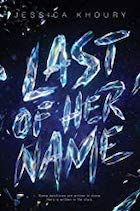
Last of Her NameJessica Khoury, Last of Her Name

Stacia Androvna has grown up happy on a fringe planet near the edge of the galaxy. She’s never paid much attention to politics, although she knows that things have been fairly bleak since the revolution that overthrew the Leonovan empire. Still, she never expected that the unrest in the galaxy would affect her — until the direktor Eminent himself, the leader of the revolutionary government, shows up on her planet claiming that she is a Leonovan princess. Stacia doesn’t believe it, but she knows she must escape or die. Now on the run with her childhood friend Pol, she is determined to save the rest of her loved ones, especially her best friend Clio. But the direktor Eminent will do whatever it takes to capture Stacia, and there are also Loyalist forces hoping to find and use her for their own ends. Is Stacia really the princess, and if so, will she be able to use what little power she has to save her friends?

I adore the Anastasia animated movie and was excited to read a book that sounded like a sci-fi take on that story. Unfortunately, the plot of the novel is quite different; while the setup is clearly based on the execution of the Romanovs during the Russian Revolution, the rest of the plot is essentially an action movie set in space. Which I have no problem with, but it’s not what I was expecting or hoping for. The book is a fast read that’s jam-packed with plot, which definitely kept me turning the pages. Some of the twists were very clever, although some went a bit too far for my taste — it kept feeling like the book should end, and then there would be yet another attack/betrayal/reversal of fortune. I didn’t really connect to the characters, but maybe that’s my issue and not the book’s; all these spunky YA SFF heroines are starting to feel the same to me, so I found Stacia rather two-dimensional. Overall, I liked this book fine, but I was a bit underwhelmed.

Review: Polaris Rising

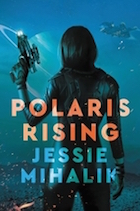
Polaris RisingJessie Mihalik, Polaris Rising

Ada von Hasenberg is a princess on the run. The universe is ruled by a Consortium of noble Houses, of which the von Hasenberg family is one of the most powerful. As a result, Ada’s duty is to marry for her House’s political advantage, but rather than accept her fate, she’s determined to carve her own path. Unfortunately, she’s captured by a mercenary ship and forced to share a cell with Marcus Loch, the so-called Devil of Fornax Zero. Loch is said to have butchered his regiment in a past military action, so he has a price on his head almost as big as Ada’s. Now, Ada and Loch must work together to escape captivity — but when her fiancé, the son of a rival House, comes looking for her, Ada begins to suspect that more than a marriage is at stake. To figure out what’s going on, she’ll need Loch’s help, even though she’s finding it harder and harder to fight her attraction to him.

I found it hard to summarize this book because it’s chock full of plot. All you really need to know is that this is a very entertaining, page-turning sci-fi/romance adventure, and I really enjoyed it. Ada is a strong heroine, but not one of the obnoxious variety; she’s not incredibly amazing at everything, nor does she rush into decisions without thinking carefully about them first. One of my favorite details was how she always (smartly) checks for bugs and tracking devices when she enters an unfamiliar environment. I also found the overall plot compelling, albeit a little predictable. I wasn’t as enthralled with the romance — Loch is a pretty stereotypical alpha male (although not a jerk, which is nice!), and since the book is only told from Ada’s point of view, I felt I didn’t get a good insight into what makes him tick. Their relationship doesn’t seem to be based on anything more than physical attraction, so it fell a little flat for me. Nevertheless, this was a really fun read for me, and I look forward to reading the next book in the series when it comes out this fall!

Mini-reviews: Duke, Christmas, Memorial

Duke in Shining ArmorLoretta Chase, A Duke in Shining Armor

This book is the first in a series starring a trio of dukes known as Their Dis-Graces. Ripley, Ashmont, and Blackwood have been friends since childhood, and together they’ve drunk, gambled, and whored their way through London society. Now Ashmont is getting married, but the bride — bookish, practical Olympia Hightower — is having second thoughts. When she runs away on the wedding day, it’s up to best man Ripley to track her down and return her to Ashmont. The trouble is, the more time Ripley spends with Olympia, the more he wants her for himself. I really enjoy Loretta Chase’s writing, especially her humor, but this book was not the right book for me. I really don’t like the “reformed rake” trope, and Ripley is such a stereotypical alpha-male hero. (That said, the humor makes him somewhat more bearable.) But I’ll still be reading more Loretta Chase, and perhaps even more in this series…Blackwood’s marital difficulties, a tiny side plot in this book, sound intriguing!

A Lot Like ChristmasConnie Willis, A Lot Like Christmas

This collection of Christmas-themed short stories with a speculative-fiction twist is a revised and expanded edition of Miracle and Other Christmas Stories. I still stand by my review of that book, but here are my comments on the new stories:

  • “All about Emily” — A sly take on the movie All about Eve featuring an aging Broadway actress and a robot who wants to be a Rockette. A fun one for fans of musicals and old movies.
  • “All Seated on the Ground” — The aliens have arrived, but no one can figure out what they want. The clue may reside in a Christmas carol, so protagonist Meg teams up with choir director Calvin to solve the mystery. A lovely and romantic meditation on “peace on earth.”
  • “deck.halls@boughs/holly” — I liked this funny rom-com about the effects of technology, especially the internet, on Christmas. It’s futuristic and over the top, of course, but the story does a great job of presenting different views on the issue — with a charming romance thrown in!
  • “Now Showing” — Lindsay really wants to see a particular movie, but she keeps being thwarted by circumstance. It seems like the universe is conspiring against her . . . and according to her ex-boyfriend Jack, that’s exactly what is happening. I really liked this playful homage to romantic-suspense-adventure movies such as How to Steal a Million, French Kiss, and Romancing the Stone.
  • “Just Like the Ones We Used to Know” — Thanks to climate change (or a “discontinuity,” or Armageddon, or . . . ?), places all over the world are having a white Christmas. Places like Los Angeles, and Honolulu, and Jerusalem. The story follows various characters as they deal with the unexpected snowstorm and try to figure out what’s causing it. I thought there were maybe a few too many characters in this one, and at least one storyline was never satisfactorily resolved.

All in all, I’m glad I purchased this one, even though I already own Miracle and Other Christmas Stories. But if you don’t have either book, definitely go with A Lot Like Christmas instead!

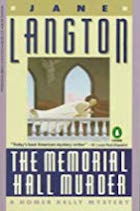
Memorial Hall MurderJane Langton, The Memorial Hall Murder

This is the third book in the Homer Kelly mystery series, but it can definitely be read as a stand-alone. The book begins with an explosion that destroys part of Memorial Hall on the campus of Harvard University. A headless body is found in the rubble, and it is soon identified as the corpse of Hamilton Dow, an extremely popular music professor. Homer Kelly, who used to work at the district attorney’s office, happens to be on the scene and decides to investigate. As a mystery, the book is nothing to write home about; the reader is given a lot of information early on, and the perpetrator’s identity isn’t hard to discover. I kept thinking there would be a plot twist to point the finger in a new direction, but it never came. However, the book is fun to read for its playful satire of university life and its prominent featuring of Handel’s Messiah. All in all, I’d consider reading more books in this series.

Review: The Humans

humans.jpgMatt Haig, The Humans

Professor Andrew Martin, a mathematician at Cambridge University, has just proved the Riemann hypothesis, an action that represents a huge breakthrough with dramatic consequences for the improvement of human science and technology. Unfortunately, his discovery has come to the attention of an alien race that, believing all humans are motivated by violence and greed, will do anything to prevent it from going public. Therefore, one of the aliens is sent to Earth to invade the professor’s body, destroy the proof of the Riemann hypothesis, and kill anyone who might know about the discovery — including the professor’s wife and troubled teenage son. At first, the alien is eager to complete his mission; but the more time he spends on Earth, the more he comes to understand and even love the humans around him.

I went into this book knowing very little about it, and I was pleasantly surprised by how much I enjoyed it! Matt Haig has a light, playful style but doesn’t shy away from more serious moments, as when the alien narrator begins to feel the tension between his growing empathy with the humans and his own cultural values. I liked that the book is a sort of philosophical thought experiment, exploring how the human race might look to an intelligent but emotionally detached outsider, and ultimately considering the question of what it means to be human. Oddly, I found the human culture on display in this book to be a bit off-putting . . . for example, the fact that Andrew Martin’s son is named Gulliver rubbed me the wrong way. But overall, this is a fun read with a good mixture of levity and thoughtfulness.

Review: Heart of Iron

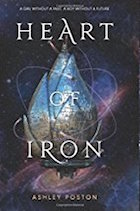
Heart of IronAshley Poston, Heart of Iron

Ana was raised an outlaw on the spaceship Dossier, under the rough but loving care of the infamous Captain Siege and her crew. She remembers nothing of her life before the Dossier found her; the only connection to her past is her Metal (robot), D09, who also happens to be her best friend. When D09 starts to malfunction, Ana is so desperate to save him that she’ll even steal the coordinates for the long-lost spaceship Tsarina, which is rumored to have the information she’ll need to repair D09. But her plan goes wrong when Robb, an Ironblood (upper class) boy who has his own reasons for seeking the Tsarina, gets the coordinates first. Now Ana and Robb find themselves on the same side as they search for answers. Meanwhile, the Iron Kingdom needs a new leader, since a rebellion several years ago killed the entire royal family. Robb’s corrupt brother Erik is next in line, but legend has it that one of the murdered emperor’s children may have survived after all. . . .

This book was originally pitched as “Anastasia meets Firefly,” and since I love both of those things, I figured I’d be the ideal reader for this novel! Unfortunately, that didn’t turn out to be the case, but I want to emphasize that my problems with the book are very specific and may not be problems for another reader! It’s certainly a fun read overall, with a nice blend of outer space action and political intrigue. But for me, the book is missing the elements I was hoping for based on the premise. My favorite aspects of Anastasia are the con angle and the enemies-to-lovers romance, neither of which are present in this book. Instead, one of the main plot lines is a romance between a human and a robot, and I just couldn’t get past it. I think the discussion about artificial intelligence and consciousness is absolutely fascinating, but there’s not much debate about it in the novel; rather, all the “good” characters simply accept D09’s humanity, which just left me with a lot of questions and frustration. Also, I found the Firefly elements to be a little superficial: yes, there’s a ragtag crew of space pirates/adventurers, but only a few of them get any significant characterization. In short, all I can say is that this book didn’t deliver what I was hoping for based on the premise. But again, that has a lot to do with my own subjective expectations, and I expect that many other readers will love it!

Mini-reviews: Inevitable, Ready, Loving, Duke

That Inevitable Victorian ThingReady Player One

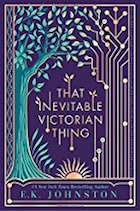
E.K. Johnston, That Inevitable Victorian Thing — This alt-historical novel is set in a version of the Victorian era in which technology has greatly advanced, leading to innovations such as a computer that predicts a person’s optimal spouse based on his or her genetic code. In this world, heir to the throne Margaret travels to Canada, posing as a commoner to have one last hurrah before she must submit to a computer-arranged marriage. There she meets Helena and August, who have been unofficially promised to each other for years but who both harbor shocking secrets.

I have mixed feelings about this book. I think it succeeds best when it focuses on the changing relationships among the three main characters (if you’re wondering whether there’s a queer love triangle, the answer is yes). On the other hand, I found myself in a situation where I actually wanted more world-building! The book contains some fascinating ideas about how the world might have been different if things had gone differently in the actual Victorian era, but I wish those ideas had been developed more. Also, I think there’s one significant plot weakness: about halfway through the novel, a big secret is revealed about Helena, but the implications of that secret are never really addressed. Not a bad book, by any means, but I didn’t like it nearly as much as I wanted to.

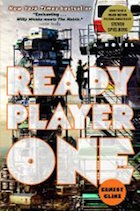
Ernest Cline, Ready Player One — I have to say, I did not enjoy this book at all! I know it’s very popular, and I can see how it would appeal to lovers of ’80s geek culture, but it is emphatically not the book for me. The protagonist, Wade, is a smug know-it-all who thinks he’s better than everyone else because of his dedication to memorizing the minutia of ’80s movies, music, and video games. He’s the kind of guy who will judge you for not knowing some obscure piece of trivia and claim that you’re not a “true fan” of whatever thing. I honestly can’t remember the last book I read whose protagonist annoyed me so much! That said, the overall concept — sort of The Matrix meets The Westing Game — is fun; it just doesn’t make up for the insufferable “hero,” in my opinion.

Loving Cup, TheDuke and I, The

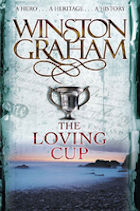
Winston Graham, The Loving Cup — In the 10th Poldark book, Clowance makes a decision about her future; Jeremy struggles with his obsessive, unrequited love for Cuby; and tensions between Valentine and George finally come to a head. I’m so behind on reviews that I’ve actually finished the series now, so I can’t quite remember which events happened in this book versus others. I do remember Jeremy’s ultimate decision regarding Cuby, which was based on TERRIBLE advice from Ross! I also didn’t love the continued presence of Stephen Carrington, who starts to rehabilitate himself only to fall even more spectacularly. Still, I really enjoyed the series overall, and this installment did some important place-setting for the final two books.

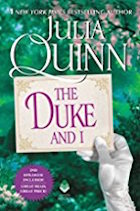
Julia Quinn, The Duke and I — I’d read one Julia Quinn book previously (Just Like Heaven) and enjoyed it, so I decided to try this first book in her famous Bridgerton series. It’s a fun, quick read, but for me it never rose above somewhat mindless entertainment. For one thing, I’m not a huge fan of the “notorious rake is reformed by the love of a good woman” plotline. For another, I didn’t quite know what to make of the hero’s personal history, which basically amounts to serious verbal and emotional abuse from his father. Clearly this backstory is meant to make the hero more interesting and to create an obstacle in the plot; but the book generally has such a lighthearted tone that the backstory seems incongruous and almost inappropriate. All that said, I do enjoy some nice Regency fluff every now and then, so I’ll probably read more by this author…but maybe I’ll try one of her other series!