Review: Asleep in the Sun

Asleep in the SunAdolfo Bioy Casares, Asleep in the Sun (trans. Suzanne Jill Levine)

Lucio Bordenave is a fairly ordinary, contented man who lives with his wife, Diana, and an old servant called Ceferina. His life is not without problems, however, and most of them center around Diana, who is very high-strung and always seems to be unhappy about something. Lucio protests that he loves his wife and is generally happy in his marriage…but when a doctor from the nearby sanatorium suggests that Diana might benefit from a short treatment there, Lucio finds himself agreeing. Diana accordingly goes to the mental hospital, and when she returns, she is joyful, loving, and contented. At first, Lucio is pleased with Diana’s “cure,” but eventually he begins to feel that something is not quite right. But when he attempts to get more information from the mental hospital, he is propelled into a nightmarish state of confusion that culminates in his learning the shocking truth.

This is my first book by Bioy Casares, and I’ve read almost no South American literature, so I honestly had no idea what to expect. Overall, I was pleasantly surprised by this weird little novel. I really liked the narrative structure: Lucio is the narrator for most of the book, and the first page reveals that he is writing to an old acquaintance for help — so you know right away that something has gone terribly wrong. The framework also inevitably raises questions about Lucio’s reliability; is he lying, or has he possibly gone mad from worrying about a perceived difference in his wife that doesn’t really exist? An interesting ambiguity is maintained for most of the novel, but in the end — fortunately, from my point of view — the truth is revealed. I’m not opposed to ambiguous endings in certain circumstances, but I’ll admit that in general, I prefer to have some level of closure. I also want to note that most editions of this book have HUGE spoilers in the cover blurb; the NYRB edition is an especially egregious offender. For this reason, I’d encourage people to avoid plot synopses as much as possible and go into the book “blind”; I promise you’ll enjoy it more that way!

Review: Curtsies & Conspiracies

Curtsies and ConspiraciesGail Carriger, Curtsies & Conspiracies

After the events of Etiquette & Espionage, Miss Sophronia Temminick is back at Mademoiselle Geraldine’s finishing school, where young ladies learn to finish…anyone or anything. Sophronia learns that she has received top marks in her espionage classes, which causes resentment among the other students, even her close friends. Meanwhile, she discovers more information about the crystalline valve prototype that caused so much trouble in the previous book. While she tries to learn more about the valve’s purpose, it quickly becomes evident that she’s not the only interested party — and that her best friend Dimity might be in danger because of it. While Sophronia attempts to put her clandestine skills to good use, she must also cope with the arrival of boys from a rival academy — including one who flirts with her most scandalously! Will Sophronia be able to protect her friend and solve the mystery, all while trying to listen to her confused heart?

This second book in Carriger’s Finishing School series is another fun Victorian romp with steampunk trappings. The world of these books is fascinating and very entertaining, with its steam-powered “mechanimals” and rules of supernatural etiquette. This book even furnishes a few specific alternate-universe facts, such as that the telegraph was introduced a few years ago but failed dismally. These tidbits help to anchor the novel’s plot a bit more in reality, which is important because most of it is so entirely silly! If you’re not familiar with Carriger’s schtick, be prepared for a lot of riduculous names and pseudo-British witticisms. I personally enjoy the silliness, but your mileage may vary. I also quite like Sophronia, a delightfully practical, self-assured heroine who doesn’t let little things like rules or restrictions prevent her from satisfying her curiosity. My only complaint is that I’m still very confused about the valve and the various parties involved. No one’s motives are clear yet, which makes it hard to know whether Sophronia is doing a good job or not. But I’m still definitely planning to continue with the series to find out!

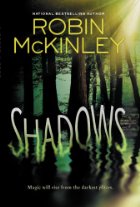
Review: Shadows

ShadowsRobin McKinley, Shadows

At first glance, Maggie seems to be an ordinary teenage girl: she loves animals, hates algebra, and thinks there’s something wrong with her new stepfather, Val. But it’s not just Val’s funny Oldworld accent or terrible taste in shirts that worries Maggie. It’s the fact that he’s always surrounded by shadows that don’t make sense; they’re the wrong shapes, and there are far too many of them to be natural. To make matters worse, Maggie has started to notice some troubling things about her hometown in Newworld — unexplained phenomena that almost look like breaks in reality. Eventually Maggie confronts Val and learns some unpleasant truths about Newworld and its way of dealing with unnatural occurrences.

I’ve been a huge fan of Robin McKinley’s since the first time I read The Hero and the Crown in elementary school, so I was ecstatic to learn that she’d written a new book, even if it wasn’t the long-awaited continuation of Pegasus. However, I’m sorry to say that I was very disappointed in this book. It does contain many of the classic McKinley touches, such as a wonderful canine companion, a no-nonsense heroine with plenty of gumption, and (less happily) a magical system that is never fully explained. But overall, I felt let down by this story; there were a lot of very interesting threads running throughout the novel, but they were never gathered together in the end. I’m not sure whether a sequel is planned or not, but some further resolution of the story definitely seems necessary. I can’t help but wonder if McKinley was attempting to write her version of the dyptopian YA novel that is so popular nowadays. All I can say is, I vastly prefer her older books!

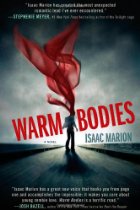
Review: Warm Bodies

Warm BodiesIsaac Marion, Warm Bodies

In this unusual take on the zombie novel, the protagonist is one of the walking dead. Sometime in the near future, civilization has collapsed, and the world is a perpetual battleground between the living and the undead. “R” and his fellow zombies live in an abandoned airport, where they shuffle around mindlessly and occasionally hunt the living to satisfy their desire for human brains. But “R” is different; though he can’t speak or move like a living person, he is a thoughtful and sensitive soul who can’t help wondering why the world is in such terrible shape. Then he meets Julie, a living girl who sparks an unusual desire in him: instead of eating her brain, he wants to protect her. As “R” and Julie slowly get to know one another, they decide that it’s time to heal their damaged world — and maybe heal each other in the process.

I am emphatically not a reader of zombie novels, but so many people have raved about this one that curiosity got the better of me. Overall I thought the portrayal of zombies was very clever. In the world of this novel, they’re not necessarily mindless monsters; they just can’t communicate with the living (and, of course, they eat brains). But some things did confuse me: for example, “R” says he can’t remember anything about his former life, yet he’s able to make complex literary references (he mentions Moby Dick at one point). Why can he remember these details but not the bigger picture of his life? But speaking of literary references, I don’t think it’s a coincidence that the characters’ names are “R” and Julie — there’s even a balcony scene! The book also mentions John Lennon’s “Imagine,” which got me to thinking…in a sense, this book hypothesizes what kind of world might exist if the lyrics of “Imagine” came true. Imagine there’s no countries, no religion, no possessions…and you might get a world close to this one. (Of course, Lennon also imagines world peace, so it’s not exactly identical.) Anyway, I have mixed feelings about this book, but I did find it quite thought-provoking.

Review: Blackout / All Clear

Blackout by Connie WillisConnie Willis, Blackout and All Clear

In the year 2060, time travel is not only possible, but it’s the preferred method of historical research. Instead of digging through old records to get a sense of a particular time period, why not just go there in person and see for yourself? Mike, Polly, and Eileen are three such historians who have all been assigned to World War II. Mike is going to Dover, where he’ll pose as a journalist and interview the heroes of the evacuation of Dunkirk. Polly will be a London shopgirl in the midst of the Blitz, and Eileen will be observing evacuees in the English countryside. Soon after they arrive at their assignments, however, things begin to go wrong. Minor discrepancies in the historical record start showing up — which ought to be impossible, because everyone knows that historians can’t affect the outcome of events. Then all three of their “drops” (the portals through which they can return to their own time) mysteriously close, leaving them stranded in World War II. As Mike, Polly, and Eileen try every possible method of reopening the drops, they’re forced to conclude that they might be trapped in the wrong time forever.

All Clear by Connie WillisAlthough Blackout and All Clear were published in two volumes, they’re really just one novel, so I’m reviewing them together. My overall feeling about this book is one of awe. This was obviously a labor of love for Connie Willis, and it is truly epic in scope. The time period is meticulously researched, and I really felt like I was there in World War II, seeing how ordinary people reacted to the war and especially to the Blitz. That said, the book is extremely long (over 1,000 pages if you count both volumes), and it probably could have been trimmed substantially. Additionally, there were several confusing plot threads that jumped between different characters and different time periods. These were all resolved by the end of the book, but it made the reading experience a bit difficult at times. On the other hand, there were so many little diversions that I loved — the allusions to Shakespeare and Agatha Christie, for example, as well as the segment where every character was named after someone in The Importance of Being Earnest. So I have mixed feelings about this novel, but overall I have a lot of respect for what Willis accomplished here. Definitely recommended for people interested in  WWII!

Review: Year Zero

Year Zero: A Novel by Rob ReidRob Reid, Year Zero

Nick Carter is a midlevel associate at an intellectual property law firm. His biggest problems are lack of job security — if he doesn’t get on the partner track soon, he’ll most likely be fired — and his crush on the hot girl in his apartment building. But things get a whole lot worse for Nick when two aliens suddenly appear in his office and announce that Earth is in serious trouble. The aliens explain that Earth’s music is the most popular in the universe and that various alien species have been pirating the music at an alarming rate. Due to Earth’s copyright laws, the aliens owe us a whole lot of money — and they’re not happy about it. Can Nick use his legal knowledge and bluffing ability to save the world?

This is an extremely clever sci-fi novel whose success really depends on its premise. If the idea of aliens getting all worked up over copyright infringement appeals to you, you’ll most likely enjoy this book. Personally, I thought it was a funny and entertaining read. The satire of U.S. copyright laws and their total inability to deal with the Internet is pretty spot-on, but the book mostly focuses on silliness rather than social commentary. I loved the musical in-jokes, which mostly focus on classic rock (“year zero” to the aliens is 1977, the year in which they were first exposed to Earth music). Gotta love a universe where aliens will be reduced to a state of quivering ecstasy by hearing a Simply Red song! Anyway, as I said, if you like the premise, this one is worth a read.

Review: Dirk Gently’s Holistic Detective Agency

Dirk Gently's Holistic Detective Agency by…Douglas Adams, Dirk Gently’s Holistic Detective Agency

It’s nearly impossible to describe the plot of this book, since there’s so much going on. Suffice it to say that it involves a murder, a mechanical monk (who believes things so you don’t have to), an extremely dull dinner at St. Cedd’s College, Cambridge, a ghost, a cutting-edge (in 1986) computer program, a conjuring trick, a time machine, and the poetry of Samuel Taylor Coleridge. There’s also some musings on Schrödinger’s cat, a sliver of romance, and a fairly staggering number of coincidences that ultimately demonstrate “the fundamental interconnectedness of all things.” In short, it’s a wacky sci-fi rollercoaster of a read, and fans of the “Hitchhiker” books should really enjoy it.

Normally this is the point at which I’d talk about what I liked, what I didn’t like, and my overall opinion of the book. But for some reason, I don’t have much else to say about it. I found it a very enjoyable read and laughed aloud several times (often in public). There were a few parts where the scientific explanations came dangerously close to going over my head, but I was always able to follow what was going on. I would have liked a little more character development for Richard, who is pretty much the only everyman in a world populated by nutcases. But Dirk Gently is absolutely delightful, especially when he’s bamboozling old ladies into paying for his trips to the Bahamas — because although he’s been hired to find their lost cats, the vacations are all part of his process. (OK, so I have things to say about it after all!) In short, I’d definitely recommend this book if you’re in the mood for some humorous science fiction. I plan to read the sequel, The Long Dark Tea-Time of the Soul, one of these days.

Review: Agent of Change

Steve Miller & Sharon Lee, Agent of Change

Val Con yos’Phelium has just completed his latest covert mission  when he runs into a young woman being attacked by five or six mercenaries. Against his better judgment, he enters the fray and helps her to fend off her attackers. As a result, he learns that Miri Robertson is a mercenary and ex-bodyguard who has run afoul of the Juntavas, a kind of interplanetary mafia. Both on the run, Val Con and Miri decide to team up: together they will acquire adequate money and transportation to make good their escape. Of course, their plan is complicated by several more attacks from both the Juntavas and the local police. As they fight their way to freedom and encounter various friends and foes, Val Con and Miri also begin to develop feelings for each other beyond simple partnership.

You know that saying about judging a book by its cover? Well, this is one situation where you can absolutely do it. This book is a fairly conventional (to the best of my knowledge — I haven’t read that much sci fi) space opera with a hint of romance. And yes, there are giant turtles! I enjoyed it while I was reading it, but afterward I started noticing a lot of unanswered questions. For example, we know that Val Con is a spy and that his handlers have somehow rewired his brain; he’s able to make precise calculations about his chances of survival over a given period of time. But we don’t really know anything about his employers or the nature of his work as a spy. There are several other novels in this series, and I’m guessing this is not the first one, although it’s proven hard for me to verify the order of the books. So maybe that’s why I found the story a bit confusing. I’m not curious enough to track down the rest of the books, so I suppose I’ll just have to live with those loose ends. Still, this novel is a fun read for what it is.