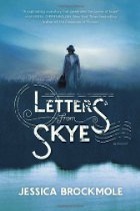
Review: Letters from Skye

Letters from SkyeJessica Brockmole, Letters from Skye

This epistolary novel tells two parallel love stories, each set against the backdrop of a world war. In 1912, Scottish poet Elspeth Dunn receives a fan letter from David Graham, an exuberant young American. Elspeth replies to the letter, and she and Davey soon strike up a regular correspondence. At first they discuss literature and their favorite books, but soon they’re exchanging ideas about everything under the sun, including their most secret dreams. Unsurprisingly, Elspeth and Davey fall in love, but their romance is fraught with complications. When America enters World War I, Davey enlists immediately as an ambulance driver on the battlefields of France. Additionally, Elspeth is already married, so her stolen moments with Davey are as fleeting as they are precious. Meanwhile, in 1940, Elspeth’s daughter Margaret — also involved in a wartime romance — stumbles upon one of Davey’s letters and decides to search for the secrets in her mother’s past.

In theory, I should love this book, since it combines a lot of my favorite things: epistolary novel, WWI and WWII setting, love stories, family secrets. But while I found it an entertaining read, my overall experience was somewhat disappointing. First of all, the story is really about Elspeth and Davey, so the parts about Margaret felt very cursory and not fleshed out at all. I would have liked to know a lot more about her reactions to her mother’s secret, as well as the details of her own romance. Also, the story itself seems very superficial, given the gravity of the WWI backdrop. Even though I enjoy light romances with happy endings, I felt like this book lacked emotional stakes. Elspeth and Davey are likeable characters, and their letters are often very charming, but I was never in any real doubt about the end result of their story. Maybe part of my problem is that this book seems like a copycat of The Guernsey Literary and Potato Peel Pie Society, only not nearly as good! Overall, this book is a nice, quick read, but it won’t stay with me the way Guernsey has.
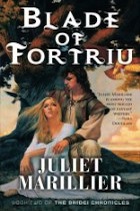
Review: Blade of Fortriu

Blade of FortriuJuliet Marillier, Blade of Fortriu

In this sequel to The Dark Mirror, King Bridei of the Priteni believes his mission is to eradicate the Gaels and their Christian religion from his lands. He is a strong king, brave in battle and devout in his allegiance to the old gods, so he’s the ideal person to unite the Priteni against this outside threat. Bridei is planning a big move against the Gaels, but in order to succeed, he needs the help of a foreign chieftain named Alpin. Bridei therefore proposes to offer his royal hostage, Ana, to Alpin as a bride, hoping this will ensure his loyalty. Ana longs to marry for love, but she knows she has no choice in the matter. She sets out for Alpin’s lands in the company of Faolan, Bridei’s most trusted bodyguard, spy, and assassin. As Ana and Faolan travel together, their relationship deepens, but she is already promised to Alpin. And when she finally arrives at Alpin’s court, Ana discovers a shocking secret that will have drastic implications for both Bridei’s campaign and her own heart.

Much like its predecessor, The Dark Mirror, this book is very slow-paced, and I had trouble getting into it as a result. I find the world of this series fascinating; it’s based on historical facts (the Priteni were real, and Bridei really was their king for a time), but Marillier weaves many fantastical elements into the setting. Half the novel focuses on Ana’s story, while the other half follows Bridei’s campaign against the Gaels. Personally, I was much more interested in Ana’s story, especially since I always enjoy a little romance with my fantasy! Interestingly, the story seems very predictable at first, but it eventually veers into an unexpected direction. I wasn’t entirely pleased with the resolution of Ana’s story, but it does provide some interesting avenues to explore in the final book of the trilogy. I’ll definitely be reading The Well of Shades to see how everything turns out, but I don’t think this series is Marillier’s best work. Try her Sevenwaters books instead!

Review: The Shadowy Horses

The Shadowy HorsesSusanna Kearsley, The Shadowy Horses

Verity Grey is a young archaeologist who has recently quit her job at the British Museum and is looking for freelance work. Her former colleague (and ex-boyfriend) Adrian tells her about a potential job in the coastal town of Eyemouth, Scotland, but he is vague about the details. Nevertheless, Verity is intrigued enough to travel to Eyemouth for an interview. There she learns that the head of the expedition, wealthy archaeologist Peter Quinnell, is hoping to find traces of the Ninth Roman Legion, which appeared in Britain in the second century A.D. and then vanished from history. Verity is excited to be part of such a potentially major find — until she learns that Quinnell has no tangible evidence that the Ninth ever passed through Eyemouth. Rather, he is basing his expedition on the word of an eight-year-old boy who is said to have the second sight. Verity is extremely skeptical at first; but the longer she spends in Eyemouth, the more she becomes convinced that something supernatural is at work.

I was surprised to discover that, unlike many of Susanna Kearsley’s other novels, this book is not a work of historical fiction; all the action takes place in the present day. Aside from that, however, The Shadowy Horses definitely has a similar feel to Kearsley’s other books. There is a young, intellectual heroine who is fascinated by history; a story in the present that closely parallels a story in the past; various supernatural elements (in this case, a ghost!); and a romance. These are all things that generally appeal to me in books, but once again, I found myself unable to get emotionally involved with this novel. There is just something about Kearsley’s writing that keeps me at a distance; though her books (including this one) are very readable, I’m never on the edge of my seat, dying to know what will happen next. A lack of dramatic tension, perhaps? Anyway, I did enjoy this book — the bits about archaeology were especially fascinating, though probably a bit outdated now — but it wasn’t anything more than a pleasant read for me.

Review: Life of Johnson

Life of JohnsonJames Boswell, Life of Johnson

James Boswell and Samuel Johnson were unlikely friends: Boswell was a young Scottish nobleman with a penchant for drinking and whoring, while Johnson was poorer, much more devout (in theory, at least), and a good 30 years older. Yet throughout the course of this monumental work, Boswell describes his reverence for Johnson’s intelligence, morality, and literary talents — a reverence so extreme that Boswell took notes on almost every conversation he ever had with the older man. As a result, this biography is stuffed full of Boswell’s personal anecdotes, letters both to and from Johnson, and first-person accounts of other contemporaries who knew him. Near the end of the book, Boswell states: “The character of Samuel Johnson has, I trust, been so developed in the course of this work, that they who have honoured it with a perusal, may be considered as well acquainted with him.” And indeed, anyone who reads this book will come away with an extremely vivid picture of a remarkable man.

This book is so huge and deals with so many things that I don’t quite know what to say about it. At first I was very intimidated, both by its length and by Boswell’s flowery 18th-century prose. But even though it’s not a quick read, this book contains a wealth of fascinating details about Johnson and the age in which he lived. I was struck by how literary the 18th century was, in the sense that seemingly anyone with a claim to intelligence was churning out books and pamphlets. In that way, Johnson’s time is very similar to our own, where everybody can (and does) publish blogs, tweets, and other forms of instantaneous literature. I was also fascinated by Johnson’s unique character; though intelligent, he was often pompous, narrow-minded, and abrasive. I frequently found myself underlining various Johnsonian sayings that were wise, or funny, or both — but I would have hated to be forced to converse with him! Overall, I would recommend this book to anyone interested in the time period or who enjoys very thorough biographies!