Review: The Woman Who Died a Lot

Woman Who Died a LotJasper Fforde, The Woman Who Died a Lot

This seventh book in the Thursday Next series continues the madcap adventures of Thursday Next, her family, and the alternate-reality Swindon that is obsessed with all things literary. Thursday is now middle-aged and struggling with the fact that she’s not as physically resilient as she used to be. She hopes to become the head of a newly reinstated SpecOps 27 (the division of the government dealing with literary crimes), but instead, she’s offered the job of Chief Librarian of Swindon All-You-Can-Eat-at-Fatso’s Drink Not Included Library, a plum assignment that gives her absolute power within the library’s domain. But there’s still plenty of trouble to go around. Her son Friday’s career at the ChronoGuard is halted when time travel is ruled impossible, and he’s now coming to terms with a very different destiny. Meanwhile, the Global Standard Deity is preparing to smite Swindon within a week, unless Thursday’s genius daughter Tuesday can find a way to stop it. Not to mention, the sinister Goliath Corp is up to its usual skulduggery, and more than one person seems to want Thursday dead.

I’m a longtime Fforde ffan, but I haven’t been as impressed by his last few books. Maybe the novelty of his humor has worn off for me, but I was only intermittently amused by this installment. There are still a lot of fun jokes and gags and wordplay, but the whole seems like less than the sum of its parts. The Thursday vs. Goliath stuff was fine, but it felt like a retread of previous books with nothing particularly new to add. The Chronoguard stuff was more interesting — I especially enjoyed the idea that time travel works (or used to work) because someone would invent the technology in the future, and therefore it could be used in the present. I wanted a little more about Thursday’s Librarian gig, but her library-related adventures are fairly peripheral to the main plot. In fact, I’m realizing that there aren’t a lot of literature-related hijinks in this novel. Unlike the first few books, which were constantly jumping into and out of specific literary worlds, this one doesn’t contain many literary allusions at all. Maybe that’s why earlier books in the series worked for me better than the last few. Regardless, I’m glad to be caught up with the Thursday Next series, but I’m also glad that it’s now (as far as I can tell) complete.
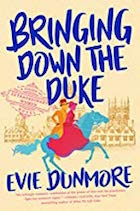
Review: Bringing Down the Duke

Bringing Down the Duke.jpgEvie Dunmore, Bringing Down the Duke

It’s 1879, and Oxford University has just opened its door to female students. Annabelle Archer is eager to take her place among them, especially when the alternative is acting as an unpaid servant for her male cousin and his family. She has received a scholarship from the National Society for Women’s Suffrage, so in return for her tuition, she must become involved with the women’s suffrage movement, targeting men of influence in Parliament who might be convinced to vote in their favor. But when Annabelle takes the fight to Sebastian Devereux, the duke of Montgomery, she takes on more than she bargained for. Sebastian is certainly a man of influence, but he is also cold, calculating, and intimidating. Annabelle manages to insinuate herself into Sebastian’s household, but her mission is complicated by the powerful attraction she feels for the duke. The attraction is mutual, but Annabelle’s station in life is so far below Sebastian’s that a happy outcome seems impossible.

The cover of this book is somewhat misleading (although I personally like it!); the story is much less of a romp than the cover indicates, and despite the cartoon-y art, it is a romance novel with some fairly explicit sex scenes. I also think the book’s description is a little misleading, in that it makes it sound like the women’s suffrage movement is going to be a big focus of the plot. But aside from Annabelle’s attendance at a few meetings, and one rally that serves as a plot point, that aspect of the book is not very prominent. So if you’re imagining a book filled with kickass suffragettes earnestly debating political issues, you’ll be disappointed. Nevertheless, I think the book works very well as a romance. Annabelle and Sebastian have an intense and believable chemistry, and their class differences pose a very real obstacle to their relationship. I liked that they both, especially Sebastian, kept trying to find a way to make things work, instead of passively bemoaning their fate. The secondary characters aren’t as well rendered, but they’ll probably be more fleshed out in the inevitable sequels. Overall, I really enjoyed this book and would definitely read more by Dunmore.

Review: Dead Man’s Shoes

Dead Man's Shoes.jpgLeo Bruce, Dead Man’s Shoes

This mystery novel begins on a sea journey from Tangier to London. Everyone on the boat is annoyed by one of the passengers, Wilbury Larkin, who speaks too loudly and seems to enjoy being as obnoxious as possible. Moreover, they’re all convinced that he murdered Gregory Willick, a rich Englishman who was recently shot dead on his daily afternoon walk. Larkin claims that he didn’t murder Willick and that he’s going back to England to prove his innocence. But the night before the boat docks, Larkin falls, or jumps, or is pushed overboard. The crew members find a typed suicide note in Larkin’s cabin, but they realize that it could have easily been faked. Still, the police are happy to think that Larkin committed suicide; now they can close two cases, Larkin’s and Willick’s. But history teacher/amateur detective Carolus Deene isn’t satisfied, so with the help of his precocious student Rupert Priggley, he sets out to investigate both deaths.

A couple years ago I read Leo Bruce’s Case for Three Detectives and found it absolutely delightful! So when I saw a couple of his Carolus Deene books at a local library sale, I snatched them up immediately. Unfortunately, I didn’t enjoy this book as much as Case for Three Detectives: it’s not nearly as funny, the mystery is predictable, and there’s not much character development. To be fair, Carolus Deene is a series character — this book is fourth in the series — so maybe he’s more fleshed out in other installments. But it seems that, as with many vintage detective novels, the focus is all on the mystery itself, not on who’s solving it. This particular mystery has a very interesting central concept, but the execution falls flat because it’s increasingly obvious as the book goes on that only one person could have done it. Figuring out the “how” is somewhat interesting, but the inevitability of the solution killed a lot of the suspense for me. Overall, this book was OK, and I’ll read the other Carolus Deene book I own at some point, but I’m not in a hurry to do so.

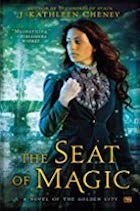
Review: The Seat of Magic

Seat of MagicJ. Kathleen Cheney, The Seat of Magic

Two weeks after the events of The Golden City, Duilio is missing Oriana and getting slightly worried: he’s had no word from her since she left his house for her sereia homeland. But he has plenty of distractions to occupy his mind: it seems that someone is killing prostitutes in the Golden City without leaving a visible mark on their corpses. And someone — the same person, or someone else? — is murdering nonhuman individuals and removing their magical body parts. As Duilio and his cousin Joaquim investigate these crimes, they once again uncover dark magic and a plot that threatens the very existence of Northern Portugal. Meanwhile, Oriana learns some shocking information about her family and realizes that her own past may be directly connected to the conspiracy Duilio is uncovering. Together, Oriana and Duilio must act to prevent a political catastrophe — and also finally to address their feelings for one another.

I liked but didn’t love the first book in this series, and I find myself feeling the same way about this installment. I probably prefer it slightly to The Golden City because there’s less exposition about the world and the major characters. I also think the mystery plots are a little tighter and better integrated with each other. My favorite part of this book was Duilio’s relationship with the infante, who — as brother of the reigning prince and next in line for the throne — is kept under house arrest to prevent a coup. The infante is a fun character, and I enjoy a good political intrigue plot, so I was definitely on board for that storyline. I also liked learning more about Joaquim and getting inside his head a little bit. As in the first book, I think the murder-and-magic stuff is actually the weakest part; but at least it ties in well with the other plot lines in this installment of the series. Finally, I was glad to see how Duilio and Oriana resolved their relationship conflicts. Overall, I’m not racing to pick up the next book, but I do plan to continue with the series at some point.

Review: The Famous Heroine / The Plumed Bonnet

Famous Heroine:Plumed BonnetMary Balogh, The Famous Heroine / The Plumed Bonnet

This volume collects two of Balogh’s earlier novels, which each focus on couples who marry first and fall in love later. In The Famous Heroine, Cora Downes, the daughter of a rich merchant, is launched into high society in hopes that she’ll find an aristocratic husband. But Cora is clumsy, outspoken, and ignorant of the rules of this new world. Lord Francis Kneller takes her under his wing, and they become good friends — until he inadvertently “compromises” her and feels honor-bound to marry her. In The Plumed Bonnet, Alistair Munro, the duke of Bridgwater, gives a ride to a hitchhiking young woman out of boredom. Because of her gaudy clothes, he assumes she’s a prostitute and listens with amusement to her unlikely story of misfortune. But when he learns that Stephanie Gray’s story is true, he realizes that he’s ruined her reputation and must marry her to make amends.

I’ve been slowly discovering Mary Balogh’s books and haven’t hit a bad one yet! I didn’t find either of the romances entirely compelling — something prevented me from becoming fully emotionally invested — but these two novels are on the short side, so perhaps there was just less space for character development. And there’s still plenty to enjoy with both of these books. I liked Cora’s frank nature and was amused by Francis’s attitude toward her: bewilderment slowly transforming into delight. They’re a more fun, lighthearted couple than Alistair and Stephanie, but I found Stephanie’s conflict (she’s trying so hard to become duchess material that she begins to lose herself) more interesting. I should note that these two books are actually the third and fourth installments of a series that starts with Dark Angel and Lord Carew’s Bride; the heroes and heroines of those books appear in both of these as well. You don’t HAVE to read the first two books to understand what’s going on, but it would give you some extra context. Overall, I liked these books a lot and will continue my wanderings through Balogh’s backlist.

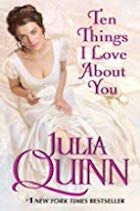
Review: Ten Things I Love about You

Ten Things I Love about YouJulia Quinn, Ten Things I Love about You

Sebastian Grey occupies an unusual social position: he is the heir apparent to his uncle, the Earl of Newbury, but if the earl marries and has a son, Sebastian gets nothing. The earl hates Sebastian and is therefore desperate to marry a young, fertile bride. His eye falls on Annabel Winslow, who is young enough to be his granddaughter, but whose numerous siblings and wide hips seem to guarantee her ability to produce heirs. Though Annabel is repulsed by the earl, she feels obligated to marry him to gain financial security for her impoverished family. But of course, complications ensue when Sebastian and Annabel meet and are immediately attracted to one another — each without knowing the other’s identity. When they discover their situation, Sebastian initially sees an opportunity to thwart his uncle’s plans; but he soon realizes that his feelings for Annabel are all too genuine.

It’s telling that I read this book a week ago and could barely remember the plot; I had to read some Amazon reviews to refresh my memory. It’s not a bad book, and I can’t point to anything specific that annoyed me about it, but it just didn’t leave much of an impression on me. Earlier this year I read and enjoyed the prequel to this book, What Happens in London, and found Sebastian to be a delightfully fun character. The scene in which he performs a dramatic reading from a lurid gothic novel (of which he is secretly the author) was a highlight of that book. So I was excited to read his story, but I found it underwhelming. We don’t really get to know more about Sebastian as a character. We learn that he’s had insomnia ever since returning from the Napoleonic Wars, and we know that he enjoys writing novels, but neither one of these character traits is really explored. And while Annabel seems perfectly nice, it’s never entirely clear why he falls in love with her. Overall, a very “meh” read.

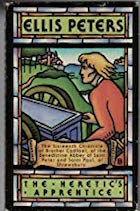
Review: The Heretic’s Apprentice

Heretic's ApprenticeEllis Peters, The Heretic’s Apprentice

In the summer of 1143, the Benedictine abbey of Saints Peter and Paul in Shrewsbury is preparing for its annual festival in honor of St. Winifred. But the celebrations are somewhat dampened when a young man called Elave arrives with the body of his master, Sir William Lythwood, who died returning from a seven-year pilgrimage to the Holy Land. Elave requests that Sir William be buried at the abbey, but questions from a visiting cleric reveal that the dead man had discussed and possibly even espoused heretical views. Elave hotly defends his master and is accused of being a heretic himself. When his accuser is later found stabbed to death, Elave falls under suspicion for murder as well. Luckily, Brother Cadfael is once again on the case, both to solve the mystery and to help clear Elave’s name of the heresy charge.

It’s always a pleasure to spend some time with Brother Cadfael, and this installment of the series is no different. All the quintessential elements of the formula are there: Cadfael gets involved through his knowledge of herbs and healing, he solves the mystery with the help of Hugh Beringar, and he helps two young lovers get together. I particularly enjoyed the heresy plot of this book; not only was it interesting (at least for me) to think about the theological topics at issue, but I liked the fact that no one was a complete villain. The book clearly intends us to side with Elave, and the cleric who interrogates him is portrayed as being too rigid, yet we later catch a glimpse of his humanity as well. The mystery is well plotted, although I was able to guess the culprit in advance. Overall, this is a series I continue to love, and I’m sorry I only have four books left!

Review: The Enchanted Forest Chronicles

Enchanted Forest ChroniclesPatricia C. Wrede, The Enchanted Forest Chronicles

These four stories take place in a fractured-fairytale setting and center around Cimorene, a princess who refuses to be proper. In Dealing with Dragons, Cimorene wants to escape marriage to a handsome but dull prince, so she runs away and offers to become the princess of the dragon Kazul. She has many adventures in her new life, most importantly thwarting some meddlesome wizards who hope to steal the dragons’ magic. In Searching for Dragons, Mendanbar, the king of the Enchanted Forest, needs to find out who is stealing magic from the forest, so he teams up with Cimorene to discover that those pesky wizards are at it again. Calling on Dragons follows the witch Morwen, who discovers yet another wizard plot and must alert Cimorene and Mendanbar, with the help of her nine cats and a magician named Telemain. Finally, in Talking to Dragons, Cimorene’s son Daystar has his own adventure and learns about his past as a result.

What a delight these books are! They’re marketed for children, but they contain so much sly humor that they can definitely be enjoyed by adults as well. It’s fun to catch all the references to, and subversions of, fairytale tropes: for example, in the first book, Cimorene is perpetually annoyed by knights and princes who keep trying to “rescue” her.   I also really loved all the main characters in these books, especially the women. Cimorene is a delightful heroine, strong-minded and pragmatic, who can solve any problem that comes her way, including melting a troublesome wizard. And the witch Morwen reminds me a great deal of Professor McGonagall — stern, but with a heart of gold underneath. I unapologetically shipped her and Telemain! Some things didn’t quite work for me, such as the rabbit-turned-donkey in the third book; he’s meant to be comic relief, but I found him a little much. And Shiara, a main character in the fourth book, seems a little bit too much like Cimorene. But all in all, I really enjoyed these books and am frankly annoyed that I don’t know any eight- or nine-year-old children to share them with!

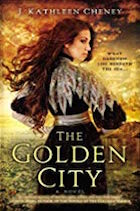
Review: The Golden City

Golden CityJ. Kathleen Cheney, The Golden City

In an alternate-history version of 1902 Portugal, the country has been divided in half because of differing attitudes to the nonhuman creatures living within its borders. In Northern Portugal, the nonhumans are banned from the Golden City and must remain in their own island territories. Oriana Paredes is a sereia (siren), and she is in the Golden City illegally to spy for her people. As a cover, she works as a companion to Lady Isabel Amaral. When she and Isabel are both kidnapped and trapped underwater to die, Oriana’s heritage allows her to survive. She vows to avenge Isabel’s death and teams up with Duilio Ferreira, an aristocrat with selkie blood and ties to the police. As they investigate the kidnapping, they uncover a much larger conspiracy involving government corruption and dark magic. They also begin to fall in love, but many obstacles stand in the way of their relationship.

I enjoy the historical fantasy genre, and the somewhat unusual setting of early-20th-century Portugal inspired me to pick up this book. I liked the book overall, but the world-building is not particularly strong. There are a few passages of exposition near the beginning, in which the author tries to explain the alternate history, the nonhuman races, and the social structure of the Golden City, but it’s all a little confusing and muddled. People who pick up this book because they want to read about selkies and sirens will likely be disappointed, because the novel doesn’t explore the nonhuman cultures in any real depth. On the other hand, people who like “fantasies of manners” will probably enjoy the book overall, as I did. I found the plot a bit overwhelming, but I liked the interactions between Oriana and Duilio, and I look forward to reading more about them in the sequels.

Review: Duplicate Death

Duplicate DeathGeorgette Heyer, Duplicate Death

Young barrister and future baronet Timothy Harte is in love with Beulah Birtley, but his family fears she’s an unsuitable match. She works as a secretary for Mrs. Haddington, a widow with shady origins who has somehow found a way into London society. When a man is murdered at Mrs. Haddington’s bridge party, suspicion falls on Beulah, and Timothy is determined to prove her innocence. But Beulah is clearly hiding something, and she had both motive and opportunity to commit the murder. Luckily, the policeman in charge of the case is Chief Inspector Hemingway, who remembers Timothy from an earlier encounter (detailed in They Found Him Dead). As Hemingway and his assistant investigate the case, they discover not only Beulah’s secret but a host of others. They develop what seems to be a convincing theory of the crime — until a second murder throws all their conclusions into doubt.

Once again, Heyer delivers a mystery in which the plot is a lot less interesting than the characters. But her sparkling dialogue and incisive social commentary make up for any weaknesses in the mystery itself. I enjoyed Timothy’s interactions with Beulah, which strongly reminded me of Heyer’s romances. I also liked the fact that, for the first time in a Heyer mystery, the policemen are actual characters! Hemingway gets a lot more time on page than he has done in previous mysteries, and his exchanges with the Scottish Inspector Grant are some of the funniest in the book. But as I mentioned earlier, the mystery plot isn’t particularly strong, particularly when it comes to the second murder. The book also describes a homosexual character in very derogatory terms by today’s standards. Overall, I did enjoy this book and would recommend it to people who like Heyer and/or vintage mysteries, but it’s not a keeper for me.