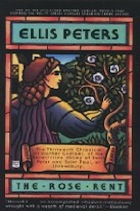
Review: The Rose Rent

Rose Rent, TheEllis Peters, The Rose Rent

In this 13th installment of the Brother Cadfael series, the Benedictine Abbey of Saints Peter and Paul is disturbed by yet another murder — and this time the victim is one of their own. Judith Perle, a young widow, rents a valuable cottage to the abbey in exchange for a single white rose to be paid from its garden once a year. Brother Eluric is charged with delivering the rose, but a few days before payment is due, he is found dead in the cottage garden. Moreover, the rosebush has been disfigured, its branches hacked off. As the monks mourn Brother Eluric’s death, Cadfael wonders who could have done such a terrible deed. His investigation ultimately centers around Judith Perle, whose wealth and beauty have attracted several new suitors. Because of the cottage’s value, any man who married Judith would want it to be included in her dowry; and if the abbey failed to pay the rose rent, the cottage would return to Judith’s estate without restrictions. As Cadfael searches for Brother Eluric’s killer among the men in Judith’s life, a kidnapping and a second murder ultimately reveal the culprit.

It’s hard to believe that a series could still be good after 13 books, but this latest installment of the Cadfael series was just as enjoyable to me as the first book. There’s a definite formula to this series: there’s almost always a romantic subplot, and the real-life historical events of the era occasionally impinge on Cadfael and the other inhabitants of Shrewsbury. But if you enjoy this formula, which I do, you’ll love the series! I always recommend starting with book one, [A Morbid Taste for Bones], but I think you could read this book without missing any key information and without spoilers for the earlier books. As for this novel in particular, I really don’t have much else to say about it! Simply put, I liked it and will continue with the series. Only seven more books to go!

Review: Dreamer’s Pool

Dreamer's PoolJuliet Marillier, Dreamer’s Pool

This novel, set in early medieval Ireland, tells the story of Blackthorn, a young woman who has been imprisoned by a cruel chieftain and sentenced to death. But on the eve of her execution, she is saved by one of the Fair Folk, who grants her freedom under two conditions: she must assist anyone who asks for her help, and she cannot seek revenge against her jailer for seven years. Blackthorn reluctantly accepts these terms and escapes from the prison, along with fellow prisoner Grim. At first, the two travel aimlessly, with Blackthorn occasionally using her skills as a wise woman to help those who need medical attention. Eventually, they arrive in the kingdom of Dalriada, where Prince Oran asks Blackthorn for help. He is about to be married to Flidais, the daughter of a neighboring chieftain. He has fallen in love with her because of the letters she has sent him; but when Flidais arrives in person, she seems completely unlike the woman of the letters. Blackthorn and Grim help Oran to investigate his bride’s seemingly changed personality, and their search eventually leads to a shocking discovery about the nearby Dreamer’s Wood.

I’m a big fan of Juliet Marillier’s books, and I’m pleased to say that I liked this one also. The novel is narrated by Blackthorn, Grim, and Oran in turn, and each character’s voice is very specific and distinct from the others. Blackthorn is clearly the book’s true heroine, and I found her an interesting protagonist, especially because most of her motivation at this point stems from her (justifiable) rage at being imprisoned for so long. In other words, she’s not a very nice person, and her traumatic past often leads her to assume the worst of other people. But her flaws make her a compelling character, and I look forward to seeing how she continues to develop as the (planned) series progresses. Grim is also an intriguing character, although not as well fleshed out as Blackthorn; I’m eager to learn more of his backstory. Like most of Marillier’s novels, the pace of this one is quite slow, and I’m not sure the mystery with Flidais needed to be as drawn-out as it was. That said, I did like the book and will plan to continue with the series; I believe book 2 comes out later this year.

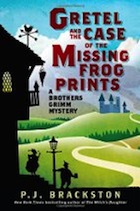
Review: Gretel and the Case of the Missing Frog Prints

Gretel and the Case of the Missing Frog PrintsP.J. Brackston, Gretel and the Case of the Missing Frog Prints

In the small town of Gesternstadt in 18th-century Germany, Gretel is something of a local celebrity. Her first claim to fame is being the Gretel, the one who escaped the clutches of an evil witch along with her gluttonous brother, Hans (a.k.a. Hansel). Now, the 35-year-old woman makes her living as a private investigator, and the biggest case of her life has just fallen into her lap. She has been summoned by Albrecht Durer the Much Much Younger, whose beautiful and beloved frog prints have been stolen. Gretel takes the case and travels to the busy metropolis of Nuremberg, accompanied by Hans, who wants to attend the city’s world-famous sausage festival. She soon stumbles across a variety of surprises, including a housecleaning hobgoblin, a secret brothel in the basement of a fancy hotel, and a veritable mafia of talking mice. And, naturally, her most promising suspect is later murdered at the scene of the crime. Can Gretel discover the thief, return the prints, and catch the murderer, all without being sidetracked by her dimwitted brother?

I got very excited by the premise of this book, which sounds like a delightfully subversive romp through both mystery and fairy-tale tropes. And indeed, there’s lots of fun stuff in this novel. Gretel has some wonderfully entertaining characteristics: she’s determined, confident, and extremely pragmatic. Hans is a good foil for her, reminding me of a Teutonic Bertie Wooster. But at the same time, I never found a reason to care about these characters; they don’t really develop over the course of the novel. Some of the humor also seemed forced, and the mystery itself was nothing special. I did enjoy the weird genre mashup of mystery plus fairy tale, and I would potentially read the sequel when it comes out. But a novel that’s pure spoof has got to be funny enough to justify itself, and I’m not sure that this one is. It certainly never reaches the zany heights of P.G. Wodehouse! Again, this book is an enjoyable read, but I was ultimately underwhelmed by it.

Review: Saga, Volumes 3-4

Saga Volume 3Saga Volume 4

Brian K. Vaughan & Fiona Staples, Saga: Volume Three and Saga: Volume Four

Volumes 3 and 4 of this saga (see what I did there?) continue the story of star-crossed lovers Marko and Alana and their daughter, Hazel, who is now a toddler. Fleeing their many pursuers, the family first takes shelter with Alana’s favorite author, D. Oswald Heist, whose romance novels have a surprisingly political subtext. But they’re unable to stay there for long, since a variety of people (and other entities) are hot on their trail. These pursuers include: The Will, a bounty hunter who’s still grieving for his dead paramour; Marko’s ex-fiancée Gwendolyn, who has a score to settle; a robot prince who’s following orders, even though he’d rather be at home with his wife and son; and two tabloid reporters named Upsher and Doff. Now, in addition to the many dangers that Marko and Alana will face if they’re caught, they also begin to face troubles within their marriage. Alana gets a job that introduces her to a dangerous drug, while Marko is tempted by a young mother he meets while at the playground with Hazel.

I enjoyed the first two volumes of this series, and I’m pleased that these two volumes continue to be entertaining, with a nice blend of dark humor and pathos. I remember being a little bit confused in the earlier installments because of the plethora of characters, but I think I’m clearer now about what’s going on. I was particularly happy to get a little more background on the robot kingdom, so I can see now how they fit into the bigger picture. I’m genuinely concerned about Hazel and her little family, and I hope they will be able to stick together going forward! I also have a soft spot for The Will and am interested to see what happens to him next. I definitely think that fans of graphic novels and/or science fiction should check out this series. Unfortunately, I believe only four volumes have been published as of now, but I’ll definitely look for Volume 5 when it comes out!

Review: As Chimney Sweepers Come to Dust

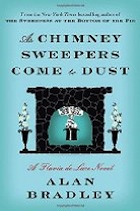
As Chimney Sweepers Come to DustAlan Bradley, As Chimney Sweepers Come to Dust

***Warning: SPOILERS for previous books in the series!***

Flavia de Luce’s life has been turned upside-down by the shocking revelation that her mother, Harriet, worked as a spy for England before her death. What’s more, Harriet was groomed for this work at an elite Canadian boarding school, where she belonged to a secret society called the Nide. Now the twelve-year-old Flavia must follow in her mother’s footsteps all the way to Miss Bodycote’s Female Academy, so that she can carry on the family’s legacy of covert service to England. But Flavia is less than thrilled about leaving Buckshaw and all her family and friends behind. Still, Miss Bodycote’s proves more interesting than Flavia expected when a dead body falls down the chimney into her bedroom on her very first night at the school. But whose body is it, and who would have placed the remains there? Was it a fellow student? The science teacher who was once tried for murder? Perhaps even the stern headmistress herself? Once again, Flavia uses her insatiable curiosity and her passion for chemistry to discover how, why, and by whom the victim was murdered. She also struggles to fit in at Miss Bodycote’s and eventually makes an important decision about her future.

This book marks a significant change in the direction of the series, as Flavia is uprooted from Bishop’s Lacey and placed in different surroundings with an entirely new cast of characters. Some people were skeptical about this change, but I was optimistic going in; if series aren’t willing to shake things up sometimes, they risk becoming stale. Unfortunately, I don’t think this particular change was terribly successful. The idea of Flavia trying to fit in at a strict boarding school filled me with glee, but this book doesn’t spend much time on her interactions with the other students, except as necessary for her investigation. And the book really suffers for not having Father, Feely, Daffy, and Dogger to be Flavia’s confidantes, friends, and sometimes enemies. I don’t read this series predominantly for the mysteries; while these are usually fine, the books’ charm lies in Flavia and her unique reactions to the people around her. And sadly, in this book, her social interactions just weren’t as funny, interesting, or poignant as they usually are. The end of this novel promises another change for Flavia, and I hope that the next book will take things in a more satisfying direction.

Review: Seraphina

SeraphinaRachel Hartman, Seraphina

The kingdom of Goredd is populated with both humans and dragons, who manage to live peacefully together — for the moment. Not so long ago, the two sides were at war, and even now, the peace between them is very fragile. Dragons are intelligent creatures who can take on human bodies, so they must wear special bells to differentiate themselves from their human neighbors. In this world, Seraphina has a secret that places her in a uniquely dangerous position: she is half-human, half-dragon. No one knew that her mother was a dragon — not even her father, when they first married — and Seraphina is dedicated to preserving the secret at all costs. She seeks to be invisible and hides the telltale scales covering her arms and waist. But when a member of the royal family is murdered in a suspiciously draconian way, she finds herself caught between the two sides of her heritage. As she begins to investigate the murder, with the help of dashing Prince Lucian Kiggs, she uncovers some unexpected secrets about her family’s past and her own identity. But can she solve the mystery before war erupts between humans and dragons once again?

This is a book that a lot of people love, but I must admit, it took me a while to get into it. I was intrigued by the world immediately, being a sucker for political intrigue, and I liked the unusual portrayal of dragons. In this book, they are hyper-rational creatures who thrive as scholars and musicians, but they lack human emotions and empathy. Nevertheless, some of the dragons in this book become more human-like the longer they associate with humans, and these transformations are a great source of conflict. I also really liked that the conflict between humans and dragons isn’t one-sided at all. Both sides contain extremists who would like to return to all-out war, but there are also moderates who want to preserve the peace. As I said, I did have some trouble connecting with the book at first, and I think it’s because an awful lot of information has to be conveyed up front in order to understand what’s going on. Once the story gets moving, though, things pick up considerably, and I really enjoyed the story overall. The sequel, Shadow Scale, just came out, and I look forward to reading it!

Review: Snobbery with Violence

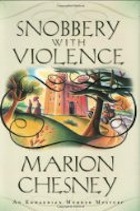
Snobbery with ViolenceMarion Chesney, Snobbery with Violence

Captain Harry Cathcart has recently been invalided out of the army and is looking for something to do with himself. Since he is a gentleman, he is not expected to work for a living; yet, although he is the younger son of a baron, the upper classes don’t entirely accept him as one of their own. Putting his ambiguous social standing to use, Harry becomes a discreet fixer for members of the upper class with problems that they’d like to keep quiet. In this capacity, he is hired to investigate Sir Geoffrey Blandon, a suitor of Lady Rose Summer, because Lady Rose’s father is unsure of the man’s intentions. Harry quickly discovers that Sir Geoffrey intends nothing honorable, but when Rose learns of Harry’s activities, she is furious with him. Unfortunately, Rose and Harry soon meet again at the Marquess of Hedley’s house party; but their constant bickering must take a backseat when one of the guests is found dead. Harry suspects murder and begins to investigate quietly. But when Rose insists on getting involved, her interference could prove deadly.

I’ve had a streak of disappointing books lately, and unfortunately, this one is no exception. I loved the idea of this book — mystery and romance in Edwardian England — but the execution fell sadly flat. Every character was a cardboard cutout, including the two protagonists. Harry is a dour alpha male type, while Rose is a feisty 21st-century heroine in period costume. She befriends her maid (a former actress), is active in the suffragette movement, and doesn’t enjoy the Season’s balls and parties like other girls do. Such characters could be interesting, if they ever rose above caricatures, but they never spoke or behaved like real human beings. The book occasionally attempts to comment on the social inequities of the era, but even its depiction of class struggles is superficial, not thought-provoking. As for the mystery, I can’t remember a thing about it, so I guess it was fine, but certainly nothing extraordinary. Marion Chesney is an extremely prolific author — she also writes as M.C. Beaton — so maybe her other books and series are better. But I have no hesitation in recommending others to skip this one!

Review: High Rising

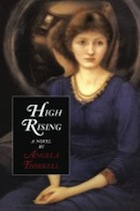
High RisingAngela Thirkell, High Rising

This gentle novel chronicles daily life in an English village between the wars. The protagonist is Laura Morland, a widowed mother of four sons, who earns a living by writing popular but insubstantial novels. Though three of her boys are grown up, she has her hands full with the youngest, Tony, who is currently obsessed with toy trains. She also observes the follies and foibles of her neighbors and friends, and she is not above interfering when the situation warrants it. For example, wealthy widower George Knox has just hired a conniving secretary who bullies his daughter and appears determined to become his wife; since George is oblivious, Laura takes it upon herself to get rid of the odious woman. Then there’s Sibyl Knox, a sweet young girl with no matrimonial prospects as yet, but Laura has a particular match in mind. And finally, there’s loyal Anne Todd, who has sacrificed everything to care for her sick mother but who still longs for a little romance. Can Laura surmount these various obstacles and ensure happy endings for all involved?

This is my first encounter with Angela Thirkell, but it definitely won’t be my last! In the past few years, I’ve discovered that I really love the types of books published by Persephone, Virago, and Bloomsbury. They’re usually written by women, usually in the 20th century prior to World War II, and they usually deal with the quiet, domestic problems of village life. For me, these books are a form of escapism to a (supposedly) simpler time, but they are also wonderful character studies that explore various forms of human weakness with humor and compassion. In this book, for example, there are no real heroes or villains; even Miss Grey, the objectionable secretary, is ultimately more pathetic than evil. The book is sweet and often quite funny, especially in its descriptions of Tony. I was a little disappointed that Laura herself didn’t end up finding a suitable match, but I suppose that only adds to the realism of the book. Overall, I’m not sure I’ll be re-reading this particular book, but I’ll definitely be continuing with the Barsetshire series!

N.B. I should add that the edition I read (pictured) is full of typos, misspellings and other errors. I’d suggest finding a different version if you can!

Review: Saga, Volumes 1-2

Saga Volume 1Saga Volume 2

Brian K. Vaughan & Fiona Staples, Saga: Volume One and Saga: Volume Two

This graphic novel tells the story of one family’s struggle to survive in the midst of a brutal interplanetary war. Alana is from Landfall, the largest planet in the galaxy. Marko is from Wreath, its satellite. When they meet, they fall in love almost immediately; but unfortunately for them, Landfall and Wreath have been at war for as long as anyone can remember. Since both Alana’s and Marko’s people disapprove of their marriage, the star-crossed lovers have no choice but to flee. They end up on the remote backwater planet of Cleave, where their daughter Hazel is born. The story is narrated by Hazel as she describes her parents’ escape from the forces seeking to tear them apart. But various parties from both Landfall and Cleave are pursuing this family, and it will take all their courage and ingenuity to survive.

After seeing some positive reviews of Saga, I decided to give the series a try, even though I generally don’t read graphic novels. (I have nothing against them, but I’m not a very visual person, so I generally find the artwork more distracting than helpful for the story.) I’m very glad I gave this series a chance, since I ended up enjoying it quite a bit. The story is very compelling and spans several genres, from romance to survival adventure to space opera. I loved the banter between Alana and Marko, who clearly care a lot about each other and express their love through teasing. I also found Hazel’s voice to be very compelling, and I look forward to seeing how she grows as the series progresses. There’s some colorful language and a few graphic (ha ha) images, so be warned if that bothers you. Overall, I definitely plan to continue with the series, and I already have Volumes 3 and 4 from the library!

Review: The Ruby Red Trilogy

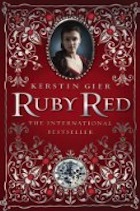
Ruby RedSapphire BlueEmerald Green

Kerstin Gier, Ruby Red, Sapphire Blue, and Emerald Green (trans. Anthea Bell)

Gwyneth Shepherd belongs to an unusual family: every generation, one of its members has the ability to travel through time. Gwyneth has always assumed that her cousin Charlotte has this gift, and Charlotte has spent her entire life preparing for it. But to everyone’s shock, it is Gwyneth who unexpectedly travels through time, revealing herself as the true possessor of the gift. Unfortunately, Gwyneth doesn’t have Charlotte’s extensive training in history and etiquette to help her navigate the past. Moreover, it seems that her family, as well as a secret cabal of fellow time-travelers, is keeping a lot of crucial information from her. For example, what is the meaning of the mysterious prophecy involving “the ruby”? Who is the Count Saint-Germain, and what is his plan for Gwyneth? And most importantly, can Gwyneth trust her partner in time travel, Gideon de Villiers, whose unpredictable behavior both frustrates and attracts her?

First off, I’m very glad that I read all these books at once, because there’s definitely no resolution to the story at the end of Ruby Red or Sapphire Blue. I did enjoy the series overall, but in looking back, I find myself focusing more on its flaws. The plot feels very cluttered to me: Gwyneth and Gideon are constantly jumping back and forth through time to uncover various secrets, yet at the same time, nothing much really happens until about halfway through the second book. The series sets up lots of mysteries, but most of them are fairly easy to solve. It all just felt a little overwrought to me. Also, I was not a fan of the romance; I don’t think Gwyneth should have put up with Gideon’s mixed signals and condescending behavior! I do have to say, I was impressed with how the time travel itself was handled; the timeline of the series makes sense, and I didn’t catch any glaring logical inconsistencies. If you like the genre and don’t mind YA, this series is worth a read, but I’m glad I got the books from the library instead of buying them.