Review: Trent’s Last Case

Trent's Last CaseE.C. Bentley, Trent’s Last Case

When internationally renowned financier Sigsbee Manderson is found dead on the grounds outside his home, the news sends shock waves throughout English society. Hoping to learn more about the circumstances of Manderson’s death, a notable newspaper magnate calls upon Philip Trent, journalist and amateur detective, to go into Manderson’s neighborhood and investigate the case. Trent soon discovers that Manderson was almost universally disliked, so there is no shortage of suspects, from either of Manderson’s two secretaries to his estranged wife. The more Trent learns about the case, the more he suspects Mrs. Manderson of being involved in her husband’s death. All too soon, Trent arrives at a theory of the case that heavily implicates Mrs. Manderson — which is unfortunate, because he has fallen head over heels in love with her. Will he do the law-abiding thing and disclose his solution to the police, or will he protect the woman he loves?

Contrary to what the title suggests, this is actually the first book featuring Philip Trent; after a 20-year gap, Bentley eventually wrote two more Trent books. Anyway, I knew I would enjoy this book from the moment I saw the dedication to G.K. Chesterton, whom I love. And indeed, there is a sort of Chestertonian twist to the mystery about halfway through, which I don’t want to spoil but which I really, really enjoyed! The writing style is a bit ponderous and old-fashioned, as you’d expect from a book originally published in 1913, but I soon got used to it. I liked Philip Trent as a character; unlike some of literature’s more famous detectives (ahem, Holmes and Poirot), he’s a fairly normal human being without dramatic idiosyncrasies. The romance is very sweet, and the solution to the mystery is both ingenious and unexpected — or at least it was to me! I would definitely recommend this book to fans of vintage mysteries, especially those who are interested in the history of the detective novel.
Review: The Gilded Shroud

Gilded Shroud, TheElizabeth Bailey, The Gilded Shroud

Ottilia Draycott has just accepted a position as companion to the Dowager Lady Polbrook, expecting nothing more adventurous than a change of scenery after her former position as governess to her two young nephews. But on her very first day at her new post, the current Lady Polbrook (the dowager’s daughter-in-law) is found dead in her room, having been strangled sometime during the night. The household immediately falls into a panic, especially when it becomes evident that the master of the house has disappeared. Ottilia knows that suspicion is bound to fall on Randal Polbrook; no one knows where he has gone or why, and it’s common knowledge that he and his wife were estranged. But Ottilia, after examining the scene of the crime, believes the late Lady Polbrook was entertaining a lover on the night she died. She shares her suspicions with the dowager and with Lord Francis Fanshawe, the younger brother of the absent marquis. Together, they try to discover the lover’s identity and clear Randal’s name, while minimizing the scandal as much as possible. Meanwhile, the pragmatic, clear-headed Ottilia finds her objectivity compromised as she grows closer to Lord Francis.

I love a good historical mystery, and this book is a very solid member of the genre. Ottilia (despite her ridiculous name) is a very likable heroine, with a keen intelligence and a mischievous sense of humor. The other major players are also interesting, from the sharp-tongued but kindly dowager to the handsome Lord Francis. At times I felt that the characters were essentially copied from Georgette Heyer, but since I’m a big Heyer fan, I didn’t mind too much! And one big difference between this book and Heyer’s novels is that here, the servants aren’t just window dressing; they actually have some relevance to the plot. The mystery is well done, although I was able to guess the culprit before the solution was revealed in the book. I also liked the writing style, which seemed appropriate to the time period but was still fairly easy to understand. Oddly enough, my least favorite part of this book was the romance, which just seemed a bit stilted. Overall, I liked this book and will certainly read the sequel at some point, but I didn’t love it in the same way I love Kate Ross’s books, for example.

Review: Don’t Point That Thing at Me

Don't Point That Thing at MeKyril Bonfiglioli, Don’t Point That Thing at Me

This picaresque novel is narrated by the Hon. Charlie Mortdecai, an art dealer who usually operates on the shady side of the law. In the opening scene he is visited by Inspector Martland (of a secret branch of the British police) in connection with a stolen Goya. Mortdecai claims to know nothing of the matter, but he cheekily admits to the reader that it is hidden under the floorboards. After Martland’s visit, Mortdecai knows he must unload the painting, but his mission is complicated by the murder of one of his associates. Even worse, someone seems to want Mortdecai dead as well — so he strikes a bargain with Martland to get diplomatic passage to America, where he hopes to make good his escape. There he encounters a variety of adventures, from constant surveillance by men in blue Buicks to the sexual aggressiveness of a rich American widow. Through it all, Mortdecai maintains a cheerful unconcern as he matches wits with several dangerous opponents.

I have very conflicting feelings about this book. On the one hand, I don’t think I understood the plot at all; there’s definitely a painting involved, and a valuable antique Rolls Royce, and various people who want Mortdecai dead, but I was always a bit confused about what was actually going on. On the other hand, Mortdecai has a delightful narrative voice — very reminiscent of Bertie Wooster, if Bertie were an art thief with a crasser mode of expression. (For example, Mortdecai’s valet/bodyguard is called Jock Strapp, which is either funny to you or it isn’t.) So the book does provide a lot of laughs, but in the end I’m not really sure what to think of it. The novel is first in a series, and I may check out the others at some point. The movie “Mortdecai,” which comes out today in the U.S., is also based on this series, and I’m interested to see how it deviates from the book. Johnny Depp seems like a very odd casting choice, for starters, but I’m nevertheless intrigued!

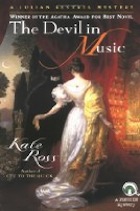
Review: The Devil in Music

Devil in Music, TheKate Ross, The Devil in Music

This final installment of the Julian Kestrel series moves from England to Italy, as Julian encounters a five-year-old mystery while traveling on the Continent. Lodovico Malvezzi, a powerful Milanese nobleman, was murdered in 1821, but because of the unstable political situation at the time, the local officials covered up the true cause of his death. Now, in 1825, the truth has finally come out, and the police are once more searching for Lodovico’s killer. The most likely suspect is a young tenor called Orfeo, whom Lodovico had been training for a career in opera and who disappeared shortly after the murder. But Lodovico had kept the singer’s real name a secret, and no one can give a clear description of him to the police. Meanwhile, Julian suspects that Orfeo may not be the guilty party, and he begins to investigate Lodovico’s family, including his fascinating young widow, Beatrice, and his politically involved brother, Carlo. He soon discovers several motives for Lodovico’s murder — but secrets from Julian’s own past will emerge before he can unmask the killer.

As previously mentioned, this is the last book in the Julian Kestrel series, and I’m heartbroken to have come to the end of it! I absolutely love historical fiction, mysteries, and anything set in the Regency period, so this series is really the perfect fit for me. Plus, I’m a sucker for a dandy who is more than he appears to be, which is definitely the case with Julian! That said, I’m not quite sure how I feel about this book specifically. The different setting was interesting, and I enjoyed the little bits of background about Italian politics and opera that permeate the book. I also liked the resolution of the mystery, although certain aspects of it were very predictable. The book’s pacing is also a little slow, and the focus of the book is much more on Julian’s character development than on the plot. While I was glad to see some more exploration of his character, it didn’t altogether satisfy me. I think my issue is the romance between Julian and Beatrice, which just didn’t ring true for me. Still, this is a good book in a great series, and I really wish there were more Julian Kestrel mysteries!

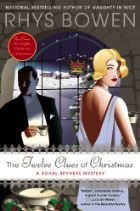
Review: The Twelve Clues of Christmas

Twelve Clues of Christmas, TheRhys Bowen, The Twelve Clues of Christmas

‘Tis the season to be jolly, but Lady Georgiana Rannoch is anticipating a bleak, joyless Christmas at her brother’s estate in Scotland. Her sister-in-law Fig has made it abundantly clear that Georgie is an unwelcome burden, so Georgie begins to search for a way to escape for the holidays. Finally, the perfect solution lands in her lap: she is offered a job as social hostess for a large house party at an English country estate. Georgie jumps at the chance to get away from Fig (and make a little money in the process), especially when she learns that her mother will also be staying in the neighborhood. When Georgie arrives at the estate, she discovers that her employer is trying to stage the perfect English Christmas for a diverse group of paying guests. But the seemingly idyllic country village is soon plagued by a string of suspicious deaths. All of them appear to be accidents, but Georgie suspects that they could be murders. But what do the dead people have in common, and who in the village would be clever and ruthless enough to kill them?

I enjoyed this latest installment of the Royal Spyness series. It has all the fluffy fun of previous books, but the mystery is a bit more substantial compared to some of Georgie’s earlier adventures. I’ve always liked the series for its frothy tone and historical trappings, especially Georgie’s run-ins with real historial figures (for example, Noel Coward makes an appearance in this book!). But historically, the mystery plots themselves have been relatively weak. This one was more complex, with several different plot threads that all tied together in the end. Georgie’s personal life also progresses a bit in this installment, as she and Darcy finally profess their love for each other and begin to talk about marriage. I always want more Darcy in these books…he seems to come in for the sole purpose of ruthlessly kissing Georgie in corridors, but there are hints that he’s also involved in some sort of espionage. I’d love him to marry Georgie and take her along on his adventures! The series seems due for some sort of shake-up, and I’m interested to see whether the status quo will change in future installments.

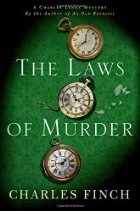
Review: The Laws of Murder

Laws of Murder, TheCharles Finch, The Laws of Murder

Victorian gentleman Charles Lenox has given up his seat in Parliament to return to his true vocation as a detective. He’s even started a detective agency with his friend John Dallington, former rival Polly Buchanan, and a talented Frenchman called LeMaire. Though the business is new, Lenox is confident that it will succeed; but a streak of bad publicity in the London newspapers causes trouble for the fledgling enterprise. Just when Lenox is considering throwing in the towel, however, an unexpected murder forces the police to seek out his services — for the victim is none other than Inspector Jenkins of Scotland Yard. Moreover, Jenkins’ body was found outside the town house of the Marquess of Wakefield, one of London’s most hardened (yet so far uncatchable) criminals. Was Jenkins investigating Wakefield when he met his death? Was Wakefield himself the killer? Lenox and his fellow detectives are on the case, but the conspiracy they uncover is more shocking than they ever could have imagined.

I like this series a lot, and this book is another good installment; but I have to confess, one month later, it’s hard for me to remember much about it! I do recall thinking that the mystery was a little predictable, but there were certainly enough twists and turns to keep me interested. The book also takes time to check in with the various secondary characters who comprise Lenox’s world, which I appreciated — although I would have liked to see even more of McConnell, Lady Jane, and the others! I also think it was a smart move to make Lenox part of a detective agency, as this introduces some new characters and relationships into the mix. The agency also illustrates some interesting areas of blindness in Lenox, especially regarding class. When the business begins to fail, Lenox is upset, but he is never in danger of experiencing real financial hardship. Some of his colleagues, however, depend on the agency for their livelihood, and this doesn’t occur to Lenox initially. So I appreciate that we got a little character growth in this installment, and I look forward to the next book!

Review: The Last Policeman

Last Policeman, TheBen H. Winters, The Last Policeman

Hank Palace, a police detective in Concord, New Hampshire, is investigating the death of a man who was found hanged in a McDonald’s bathroom. His fellow police officers are certain it’s a suicide, and with good reason: an asteroid is hurtling towards Earth, and collision is both certain and imminent. As a result, suicides are on the rise, along with a variety of other behaviors. Some people are “bucket listers,” quitting their jobs to chase their lifelong dreams while they still can. Some people turn to religion, others to drugs. In these circumstances, one more dead man — especially one who appears to have hanged himself — doesn’t matter very much to the police. But Hank suspects that there’s something wrong about this suicide, and he’s determined to discover what really happened. He uncovers several more mysteries in his investigation, including a hidden cache of drugs and a beautiful woman who knows more than she’s saying. But the biggest obstacle of all is the widespread indifference to his quest. If the end of the world is imminent, does one potential murder even matter?

This novel is an interesting combination of two popular genres, the police procedural and the apocalyptic novel, and I think it’s a fairly successful one. Hank Palace is a dry, unintentionally funny narrator who manages to retain some of his ideals despite the cynicism of his surroundings. Even though he knows that life is about to change forever (assuming life will continue at all after the asteroid hits), he remains devoted to his job. But the world of this novel is even more interesting than its narrator. I think the various reactions of people in the book to the impending catastrophe are very plausible. And the details Hank lets slip about the new role of government are as realistic as they are chilling. In this world, every crime is punishable by death or life imprisonment. There is no habeas corpus, so anyone suspected of lawbreaking is condemned without trial. The US Constitution is still the law of the land, but it’s impossible to enforce — and most government officials and police officers don’t really care. Overall, I was fascinated by the setting of this novel and will eventually continue with the series to see what happens.

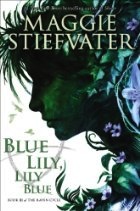
Review: Blue Lily, Lily Blue

Blue Lily, Lily BlueMaggie Stiefvater, Blue Lily, Lily Blue

***Warning: SPOILERS for previous books in the series!***

Blue Sargent and the Raven Boys are approaching the end of their quest to find the long-lost Welsh king Owen Glendower. But as always, there are complications. First of all, Blue’s mother is missing, and the cryptic note she left behind says only that she is “underground.” Is she one step ahead of them in the search for Glendower, or has she gotten involved in something more sinister? Then there’s the fact that Colin Greenmantle, the person who hired the Gray Man to kidnap Ronan in The Dream Thieves, is in town — and he’s the boys’ new Latin teacher. Worst of all, when Blue and the boys finally locate the cave where Glendower rests, they realize that their troubles are only just beginning. For there is more than one entity dwelling in this cave, and some things are better left asleep…

As a fan of the previous books in the Raven Cycle, I pretty much devoured this installment. I think it might be my favorite book yet in the series, because it’s finally starting to pull together the various plot threads and character relationships that have been simmering since the first book. More secrets are revealed, the plot continues to twist and turn, and various characters’ motivations are slowly uncovered. I really like the fact that Blue, Gansey, Ronan, Adam, and Noah have become this inseparable unit now. In the first two books, there was a lot of tension between various members of the group, with everyone trying to figure out whom to trust. But in this book, they have finally accepted each other and decided to work together. I also love how certain characters (Blue and Adam in particular) are thinking about their futures: Even if they do manage to find Glendower, what happens then? So I’m very excited to see how things will turn out, and I can’t wait for the release of the fourth and final book next year!

Review: In Your Dreams

In Your DreamsKristan Higgins, In Your Dreams

Emmaline Neal is one of three police officers in the tiny town of Manningsport, New York. She’s a tough, no-nonsense woman who knows her way around a Taser, but she’s also dealing with the fallout of a broken heart. Her first love is about to marry the shrew he dumped Emmaline for — and even worse, he’s invited her to the wedding! Emmaline knows she can’t go alone, so she reluctantly asks Jack Holland to be her date. Jack is friendly, popular, and drop-dead gorgeous, and he can’t say no to a damsel in distress. Em is aware that she’s definitely not Jack’s type, so she’s determined to keep her distance. But after a little wedding-related humiliation and a few glasses of wine, her practical resolutions fly out the window. After one amazing night together, Em tries to fight her growing feelings for Jack — even though he actually seems to be interested in her, too. But Jack is dealing with his own problems, including the sudden reappearance of his dainty ex-wife, who is not-so-subtly trying to get him back. Will Jack and Em be able to overcome their respective pasts and finally find happiness together?

As a Kristan Higgins fan, I’ve been reading and enjoying each new book that comes out, but I have to say that this is definitely my favorite of her recent books! Jack and Em both feel like real people to me, and they each have very specific baggage that prevents them from immediately falling into each other’s arms. I also — contrary to my expectation! — really liked the presence of the Evil Ex in this book. Having an ex-lover resurface is often a tedious, contrived obstacle to keep the hero and heroine apart; but in this book, the presence of Jack’s ex illuminates certain aspects of his character that show why he works with Emmaline. Here, the Evil Ex isn’t actually evil, but she is very needy and can be selfish. By contrast, Jack and Em are both giving people who are willing to sacrifice a lot for the people they love. I do have a few issues with the ending of the book, though; everything seems to work out a little too perfectly. For example, even Emmaline’s ex is redeemed in the end, which I don’t think was necessary. But even despite the magically perfect ending, I’d definitely recommend this book to fans of contemporary romance!

Review: The Neruda Case

Neruda Case, TheRoberto Ampuero, The Neruda Case (trans. Carolina De Robertis)

Cayetano Brulé, one of the most respected private investigators in Valparaíso, is on his way to meet a prospective client when he stops at a restaurant for lunch. When he opens the menu, he sees a photograph of Pablo Neruda and immediately recalls his first case as a detective, in which his client was the Nobel laureate himself. Suddenly it’s 1973, and Cayetano (a Cuban by birth) is somewhat adrift in his adopted homeland of Chile. At a political party with his wife, Cayetano meets Neruda for the first time, and they soon strike up a conversation. Later, Neruda invites Cayetano to his home and makes a surprising request: he wants Cayetano to find a missing person, a doctor whom Neruda knew many years ago. Cayetano’s search takes him to Mexico City, Havana, and even East Berlin, and he eventually learns that Neruda’s desire to find the doctor is not as straightforward as it seems. Meanwhile, Chile is also experiencing a period of upheaval, as Salvador Allende’s Marxist government is succeeded by the dictatorship of Pinochet.

This novel attempts to do many different things, with mixed results. As a mystery, I think it falls flat; there is no real urgency to Cayetano’s search, and the results of his investigation ultimately don’t matter very much to the story. The book is more successful at painting a portrait of Pablo Neruda at the end of his life. I feel like I got a sense of his personality and his importance to Chile as a political figure. Best of all, this book does a wonderful job of depicting the political situation in Chile at the time and relating it to the wider issue of global politics. It’s no coincidence that Cayetano mostly visits Communist countries, in an era dominated by the Cold War and the ideological conflicts between socialism and capitalism. The novel is definitely not neutral on this subject; both Cayetano and Neruda favor Allende’s government, while Cayetano condemns his wife’s more radical Communism. Overall, I was fascinated by the setting much more than I was by the story. So I’m glad I read this book, but I won’t be seeking out any more installments of the series.