Review: Roseanna

RoseannaMaj Sjöwall and Per Wahlöö, Roseanna (trans. Lois Roth)

This book begins in the summer of 1965, when a dead body is dredged up from the bottom of a Swedish lake. The corpse is female and naked, with no clothing, jewelry, or personal effects of any kind. The police determine that she was raped and strangled to death, but they have absolutely no clue as to her identity, much less the murderer’s. Police inspector Martin Beck launches an investigation with the help of his colleagues; after weeks of diligent searching, they are able to identify the woman as Roseanna McGraw, an American woman who was touring Sweden by cruise. Slowly, Beck and the other policemen begin to piece together Roseanna’s final days, and with help from the American police, they are able to learn something about her character as well. Beck gradually begins to form an opinion about the personality of the murderer, and sifting through the scanty data gives him a specific suspect. But due to the lack of hard evidence in the case, Beck and his colleagues must set a daring, and dangerous, trap.

I’m a big fan of the mystery genre in general, but I tend to gravitate toward mysteries in which the reader is able to solve the crime right alongside the detective. This book is definitely not like that, but it offers a fascinating alternative perspective on what a mystery novel can be. The focus isn’t on the victim’s character or on a list of potential suspects who can be eliminated one by one; rather, it’s a very realistic portrayal of how police investigations actually work, with all the tedium and frustration and dead ends they entail. One detail I loved is how the case actually took the policemen months to solve, and how they were also working on other cases in the meantime. Interestingly, Beck’s personality is basically irrelevant, and we don’t learn much about him even though this is the first book in “his” series. Crime-solving is much more of a communal endeavor in this novel than it is in the (predominantly) British and American mysteries I’ve read — indicating a broader cultural difference, I suspect! Be that as it may, I enjoyed this book and would recommend it to mystery lovers, even though it was a departure from my normal reading experience.
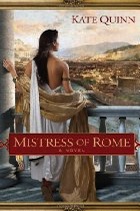
Review: Mistress of Rome

Mistress of RomeKate Quinn, Mistress of Rome

In the late first century A.D., Thea is a Jewish slave girl living in Rome after the rest of her family committed suicide during the siege of Masada. Thea’s owner, the spiteful Lepida Pollia, misses no opportunity to berate and abuse her; so when Rome’s most popular gladiator, Arius the Barbarian, falls in love with Thea and spurns Lepida’s advances, Lepida immediately takes a brutal revenge. This novel follows the stories of Thea, Arius, Lepida, and several other characters as they all try to better their fortunes, with varying degrees of success. Eventually, Thea uses her talents as a singer and musician to perform before the most fashionable crowds in Rome, where she catches the eye of Emperor Domitian. As the emperor’s mistress, she becomes the most powerful woman in Rome; but the more she learns about the enigmatic emperor’s true nature, the more desperate she becomes to escape her fate.

This is one of those books that hooked me almost immediately, and I found it compulsively readable. Ever since I took Latin in high school, I’ve been interested in the setting of ancient Rome, and this book explores so many aspects of life at that time, from social mores to military strategy to fashion. It’s a truly fascinating time period, and Quinn takes full advantage of the drama it provides. Indeed, the book is almost too melodramatic at times; it’s very much a soap opera, complete with fake deaths, illegitimate children, and even an orgy. The love story between Thea and Arius is often sweet but occasionally becomes a bit too over-the-top. I feel like I should also mention a particular review on Amazon, which pointed out several flaws in plot logic and historical accuracy. But personally, I really enjoyed the novel overall, and I’ll definitely seek out the sequels at some point. If you like your historical fiction gory, sexy, and extremely dramatic, I highly recommend this book!

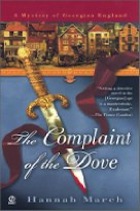
Review: The Complaint of the Dove

Complaint of the Dove, TheHannah March, The Complaint of the Dove

In 1760s England, private tutor Robert Fairfax is charged with escorting his pupil, Matthew Hemsley, to London for a bit of town polish. But Fairfax is apprehensive: how can he introduce Matthew to the worldly, sophisticated atmosphere of London while at the same time protecting him from bad influences? Unfortunately, during their very first trip to the theater, Matthew instantly falls in love with the beautiful and popular actress Lucy Dove. Though she is a sweet and talented girl, her profession is most unsuitable, so Fairfax hopes that Matthew’s infatuation is only temporary. But Matthew gets into even bigger trouble when Lucy is murdered shortly afterwards, and he is found at the crime scene under very suspicious circumstances. When Matthew is actually arrested for the murder, Fairfax knows it is his duty to clear his pupil’s name — which means launching an investigation to discover the real killer.

I discovered this series by accident at a library book sale where the second and third books were available for 25 cents each, so of course I had to track down the first book as well! I was intrigued by the concept of a Georgian mystery, since I haven’t seen many novels set in that era (especially compared to the much more popular 19th century!). Fortunately (or perhaps unfortunately, given the magnitude of my TBR list already), I’ve discovered a new mystery series to enjoy! I loved the period detail: the crush of theatergoers more interested in each other than in what’s happening onstage; the elaborate wigs, patches, and high heels worn by aristocratic men and women alike; the rudimentary knowledge of medicine, including the ingestion of mercury as a cure for venereal disease. It’s a fascinating time period, and March really brings the era to life. I also liked Robert Fairfax as a sleuth, and I look forward to seeing how his complex character will develop in subsequent books. Overall, I’d definitely recommend this book to fans of historical mysteries!

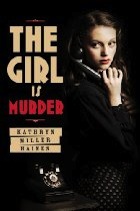
Review: The Girl Is Murder

Girl Is Murder, TheKathryn Miller Haines, The Girl Is Murder

Fifteen-year-old Iris Anderson is having a hard time. About a year ago, her Pop returned from Pearl Harbor with a missing leg, which meant he was no longer able to do the active work required by his business as a private investigator. As a result, Pop and Iris have moved from their old affluent neighborhood to a poor area on the Lower East Side, and Iris has to go to public school instead of the elite private school she formerly attended. Hoping to get closer to her only surviving parent (her mother committed suicide shortly after Pop returned from the war), Iris tries to help Pop with his cases, but he forbids her from having anything to do with the PI business. When one of the boys at Iris’ new school goes missing, however, she can’t help but do a little sleuthing. Along the way, she makes a few friends at her new school, including the unpopular Pearl and the glamorous, fast-talking Suze; but as Iris navigates her way through various cliques and social minefields, how will she know whom she can really trust?

If you enjoy Haines’ Rosie Winter mysteries, you’ll feel right at home in the world of this novel, set in the fall of 1942. The book isn’t about World War II, yet the war permeates almost every aspect of Iris’ life, from the slang used by Suze and the other cool girls at school to the disturbing racisim and anti-Semitism espoused by some of the characters. (These attitudes are definitely not condoned by the book, however; they simply mirror the atttitudes of many Americans at that time.) I liked Iris as a protagonist; her problems are specific to her era yet also universal, as she struggles with her own identity, fitting in, and building a relationship with a distant parent. Her voice is occasionally too precocious for a 15-year-old, but I found that flaw forgivable since she’s so entertaining. As a mystery, the book is very weak; Iris doesn’t spend much time investigating anything, and she’s not even the one who solves the case! So I’d recommend this to someone looking for an interesting YA book about World War II, but it’s not a great read for a mystery fan.

Review: The Raven in the Foregate

Raven in the Foregate, TheEllis Peters, The Raven in the Foregate

In December of A.D. 1141, the Benedictine Abbey of Sts. Peter and Paul in Shrewsbury welcomes a new parish priest to Holy Cross Church in the Abbey Foregate. The former priest was a kindly old man much beloved by his parishioners, so everyone is nervous about what to expect from the newcomer. Father Ainoth soon confirms the monks’ worst fears: although he is a scholar and a scrupulously holy man, he is extremely harsh with his congregation and soon stirs up bad feeling in Shrewsbury. When his drowned corpse is found in the river near the mill, it’s up to Brother Cadfael, herbalist and amateur detective, to solve the mystery. Cadfael also acquires a new assistant, supposedly the nephew of Father Ainoth’s houskeeper, but it soon becomes obvious that the boy is more than he seems. Meanwhile, both the abbey and the town continue to be affected by the ongoing civil war between King Stephen and Empress Maud.

This book is the 12th installment of the Cadfael series, and anyone who likes the series will enjoy this book as well. Once again Cadfael finds himself in the position of having to solve a murder, aid a pair of young lovers, uncover a political secret, and hide that secret from the local authorities in the interest of a higher justice. As a longtime fan of the series, I can’t help but love every Cadfael book, but I must admit that the prose does occasionally veer toward the purple end of the spectrum. Also, because Peters sticks to almost the same formula in every book, I found the plot pretty predictable. I was a bit disappointed that the murder and the political intrigue weren’t more closely connected; I thought more could have been done with certain aspects of the story to make the plot more exciting. Still, I love the series and definitely plan to read the remaining eight books. They’re wonderfully relaxing reads if you enjoy a medieval setting!

Review: Young Miles

Young MilesLois McMaster Bujold, Young Miles

This omnibus of two novels and a novella tells the story of Miles Vorkosigan’s first adventures. In The Warrior’s Apprentice, Miles has just flunked out of the Imperial Academy, where he’d hoped to distinguish himself like his father, the Prime Minister of Barrayar. Instead, he consoles himself by going on a mission to help his bodyguard’s daughter (and secret love), Elena. Of course, things quickly go wrong, and he finds himself at the head of a troop of space mercenaries. In The Mountains of Mourning, Miles is sent to a remote Barrayaran village to investigate the murder of a deformed child, a case that has special meaning for him. And in The Vor Game, Miles rejoins his army of mercenaries after a simple intelligence-gathering mission goes awry — with Gregor, the Emperor of Barrayar, in tow. Miles just can’t seem to stay out of trouble; but his brilliant strategic mind always keeps him one step ahead of his enemies.

I read the two books about Miles’ parents, Shards of Honor and Barrayar, several years ago and really liked them. So I’m glad I finally picked up these next books about the beginning of Miles’ career. I liked all three stories a lot, mostly because Miles is such a wonderfully entertaining character. In these books he’s often immature, and he still has a lot of growing up to do; but he does start to change for the better when he encounters some of the harsh realities of being a commander. Miles has a tendency to bluff his way from one situaton to the next, and he eventually learns that this approach often has dangerous consequences for his subordinates. I think the weak link in this omnibus is the first half of The Vor Game; not much happens that’s relevant to the later plot, and there is also a loose end with a corpse in a drainpipe that I wish had been more developed. But overall, I really enjoyed these books and would recommend them to anyone who likes space opera. I look forward to reading more about Miles and his adventures!

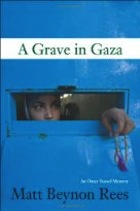
Review: A Grave in Gaza

Grave in Gaza, AMatt Beynon Rees, A Grave in Gaza

Omar Yussef, a middle-aged teacher at a school in Bethlehem, is accompanying his boss Magnus Wallender on an inspection of the UN schools in Gaza, along with James Cree, another UN official. Almost as soon as they cross the border, however, they are confronted with injustice and violence: a professor who exposed corruption at his university has just been arrested and will likely be killed, unless Omar can prevent it from happening. Meanwhile, a lieutenant in a Palestinian military group has just been killed, and the presumed culprit is part of an arms-smuggling organization called the Saladin Brigade. But when Omar speaks to the alleged murderer, he begins to wonder whether the man is actually guilty. As Omar and his colleagues investigate these issues, they realize that the two crimes might be connected. At the same time, they are drawn deeper and deeper into a rivalry between military leaders who are fighting for control of Gaza; as a result, their own lives may be in danger.

As with The Collaborator of Bethlehem, the strength of this book is its depiction of life in contemporary Palestine. Rees uses his journalistic background to portray the conflicts, corruption, and political turmoil of this region in an extremely vivid way. At the same time, he illustrates the lives of ordinary Palestinians with great sympathy, showing how they try to do their best in very difficult circumstances. Read as a mystery novel, the story isn’t particularly compelling; although Omar Yussef does solve the lieutenant’s murder, that investigation is secondary to his discovery of how the various crimes and acts of violence are linked together. I liked learning a little more about Omar Yussef’s past in this installment of the series, as well as seeing more of his friendship with the Bethlehem police chief. There are also a few new characters that I’ll be interested to follow in future books. Overall, this is a book and series I’d highly recommend for its setting, and I will probably seek out the third Omar Yussef mystery at some point.

Review: The Giver

Giver, TheLois Lowry, The Giver

Eleven-year-old Jonas lives with his parents and sister in an idyllic place called simply the Community. The Community is governed by a set of Rules covering all aspects of life, which results in a peaceful, orderly society. Everyone has a specific role to play in the Community, with the Elders evaluating the children on their twelfth birthday in order to determine how they will serve the Community as adults. Jonas is looking forward to his Ceremony of Twelve with great excitement, wondering which job he’ll be assigned to perform. But when the fateful day finally arrives, Jonas is stunned to learn that he’s been chosen for the most prestigious and mysterious job of all: he will be the Community’s new Receiver. At first Jonas doesn’t even know what being the Receiver entails, but he soon learns that it will isolate him from everyone he knows, even his family. And as his training with the former Receiver (now called the Giver) continues, Jonas realizes that the supposedly benevolent Community is hiding some very dark secrets.

Despite the fact that this book came out during my childhood, I somehow never read it before. So I was a bit nervous that I wouldn’t enjoy it, reading it for the first time as an adult. Fortunately, my fear was groundless — I thought this was an absolutely fantastic book! Of course, some of the more sinister aspects of the Community will be unsurprising to adult readers, who have presumably encountered other dystopian novels and can guess what’s coming. But Lowry does such an amazing job of peeling back the seemingly perfect facade of the Community bit by bit, slowly revealing surprising tidbits of this allegedly ideal world. I also really loved the character of Jonas, who reacts to his new discoveries in such an understandable way. I practically got chills at the scene where he gets his list of Rules for how to be the Receiver — it perfectly encapsulates the confusing new world he’s been thrust into. Finally, I liked the ambiguity of the ending; Jonas decides to take a stand, but the outcome of this decision remains uncertain. I highly recommend this book to anyone who likes dystopian novels!

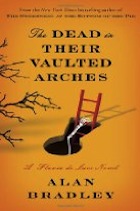
Review: The Dead in Their Vaulted Arches

Dead in Their Vaulted Arches, TheAlan Bradley, The Dead in Their Vaulted Arches

***Warning: MAJOR SPOILERS for previous books in this series!***

At the end of Speaking from Among the Bones, Flavia and her family received the shocking news that her mother, who disappeared many years ago somewhere in Tibet, had been found. This book begins with the de Luce family waiting at the train station for Harriet’s body to come home. Though Flavia is shocked and grieving, she can’t help wondering why Winston Churchill himself has come to pay his respects. Then there’s the man on the platform who whispers a mysterious message into Flavia’s ear and falls to his death on the tracks minutes later. Or was he pushed? As Flavia tries to sort out her feelings about her mother’s death, she can’t help but dig into the secrets of her family’s past — which, of course, turn out to be much bigger and more important than she ever imagined. Not only does she eventually solve the case of the man who died at the train station, but she discovers shocking information about Harriet’s death — and about her own future destiny.

I’ve enjoyed the Flavia de Luce series from the start, but this book is definitely my new favorite. The mystery plot is only so-so; the backstory of Flavia’s mother is rather predictable, and the villain of the book doesn’t have a terribly coherent motivation for some of the events that take place. Still, there is definitely more to be learned about the de Luce family’s past, and I’m sure additional solutions will be revealed in future books! I also think some of the secondary characters got short shrift in this installment; I wanted more of the vicar, the inspector, Adam Sowerby, and the other denizens of Bishop’s Lacey. But despite these nitpicks, I think this book got the most important thing exactly right: the reactions of Flavia and her father and sisters to Harriet’s death. This novel is a story of bereavement and grief much more than a mystery story, and in that light I think it’s fantastic. If you’re a fan of this series, you definitely won’t want to miss this installment! I can’t wait to see what’s next for Flavia and the rest of the de Luces.

Review: Between Two Thorns

Between Two ThornsEmma Newman, Between Two Thorns

This novel follows three different characters as their stories intertwine in a fantastical world. First there’s Sam, a middle-aged drunkard with marital problems who find himself running afoul of powerful creatures that he never knew existed. Then there’s Cathy, the daughter of a noble family in the Nether, a world that mirrors our own world (known to those in the Nether as Mundanus). Folk in the Nether are patronized by various Fae overlords, so they have access to magic — but they are also beholden to the dangerous, capricious Fae. Cathy desperately wants to escape her life in the Nether and has been studying at Cambridge in Mundanus, but eventually her family and her Fae patron catch up with her. And finally, there is Max, an Arbiter whose job is to protect mundanes from Fae interference. But something is wrong with the Arbiters in Bath and London, and it just might be connected to a Fae-based power struggle in the Nether.

I think my summary of the plot is pretty confusing; but to be fair, the book itself is pretty confusing too! If you like a lot of world-building, though, you’ll probably find a lot to enjoy. The Nether is essentially a world that is connected to the Fae (although its inhabitants are all humans), and it has the general atmosphere of 18th- or 19th-century England. Cathy is desperate to escape to Mundanus because she doesn’t want to be forced into an arranged marriage and become some man’s property. I found her story easiest to follow, and therefore I enjoyed it the most, although I think Cathy is a bit of a Mary Sue. Max is a more interesting character — I liked the idea that Arbiters’ souls are disconnected from their bodies so that they can remain emotionless and therefore uncorruptible. Nonetheless, I’m still not entirely clear on what Arbiters do, and obviously there is much more to be revealed in the sequels. In fact, my biggest complaint with the book is that it’s really just a setup for the subsequent books; none of the storylines are really resolved. Still, I liked the world-building enough that I will probably give the next book a chance.