Review: Spirit’s End

Spirit's EndRachel Aaron, Spirit’s End

***Warning: SPOILERS for previous books in this series!***

At the end of The Spirit War, the only thing that stood between the tiny island kingdom of Osera and total annihilation was Eli Monpress. To save his friends, Eli did the one thing he swore he’d never do: ask the Shepherdess for help. Now Eli is forced to live in the Shepherdess’ isolated realm and submit to her marks of favor while the world around him falls apart. Someone is stealing stars, the world’s strongest spirits, which is throwing the lesser spirits into a panic. Miranda is trapped in a power struggle with the Spirit Court, Josef is taking up the reins of kingship, and Nico is still fighting against the demon inside her. But this scattered group of allies must band together to face their biggest challenge yet, which just might be the end of the world.

As the convoluted summary should make clear, this is definitely not a stand-alone novel! Rather, this book is the conclusion to the Eli Monpress quintet, and it finally resolves the overarching plot elements of the series. It was nice to get some answers to the big questions raised in previous books about who is really running the universe and what the powers of Eli’s world are up against. That said, I was a little disappointed in this book; it felt bloated and unfocused, and it spent too much time on action sequences rather than character development. I absolutely loved the first three books in this series, and I think it’s because they were very tightly focused and had a clearly defined world. In the last two books, the story became a bit too epic, if that makes sense. The uniqueness of Eli and his world were sacrificed to the tired fantasy trope of a huge good-vs.-evil battle. Overall, I’m glad I read this book because it concluded the series, but I wish Aaron had taken things in a different direction.

Review: Dark Triumph

Dark TriumphRobin LaFevers, Dark Triumph

This installment of the His Fair Assassin trilogy features Sybella, a novice of the convent of St. Mortain whose troubled past has driven her to the edge of madness. Chafing under the convent’s restrictions, Sybella is eager to receive her first assignment…until she learns that she’ll be staying in the household of the traitor D’Albret, who is waging war against the rightful duchess of Brittany. Not only is D’Albret faithless and cruel, but he also happens to be Sybella’s own father, the man who has made her entire life miserable. Sybella’s only hope is that the convent will allow her to kill him, but her actual orders are very different: She must rescue the Beast of Waroch, a skilled knight who is vital to the duchess’ cause, from D’Albret’s dungeons. As Sybella and the Beast engineer their escape, they begin to develop a strong bond. But will they reach the duchess in time to inform her of D’Albret’s latest treachery?

This book is very hard to summarize, mostly because it’s the second book in a series, and it definitely does not stand alone. The action essentially begins where the first book left off, and most of the major players have already been introduced. So if the premise of this book sounds interesting to you, I would definitely go back and read Grave Mercy first! If you’ve already read and enjoyed it, you’ll like this one too. As with the first book, there’s a nice mix of action, political maneuvering, and romance. I liked Sybella’s character but wished that the Beast had been fleshed out more; for this reason, I wasn’t totally captivated by the love story. The overarching plot of the duchess vs. D’Albret continues to be interesting, and I look forward to seeing what happens in the third book. I also want to learn more about the convent and its role in the political turmoil; there is definitely more going on there than meets the eye! As you can tell, I’m invested in the world of this series, and I highly recommend it to fans of YA and historical fantasy.

Review: Niccolò Rising

Niccolo RisingDorothy Dunnett, Niccolò Rising

In 15th-century Bruges, commerce is intimately linked to power: the more astute and skillful the merchant, the greater his position in society. So while nobility and ancient bloodlines are still important, ordinary men and women have unprecedented opportunities to raise their social standing. This novel follows the fortunes of Claes, a dyer’s apprentice whose easygoing demeanor disguises an extremely shrewd mind. Among his friends and employers, Claes is regarded as little more than the village idiot, which makes it all the easier for him to obtain useful knowledge simply by keeping his ears open and his mouth shut. When he learns about a risky business opportunity that could result in a huge payoff, Claes doesn’t hesitate to act on the information. But his quest for riches causes him to offend some powerful people, including a Scottish nobleman who has both financial and personal reasons to hate Claes.

Dorothy Dunnett is one of those authors I really want to like. I’ve heard great things about her books, and I love well-written historical fiction, so I thought she would be right up my alley. But when I tried the first book in her Lymond Chronicles a few years ago, I couldn’t get past the first chapter. I was hoping that this book from a different series would work better for me, but unfortunately it didn’t. My first problem was the number of characters; there are too many people to keep track of, and there’s a lot of hopping between different points of view. Secondly, I couldn’t figure out what was happening for a large portion of the novel. Dunnett likes to allude mysteriously to things instead of describing them directly, which I found incredibly frustrating. I didn’t understand even the main plot until the book was almost over! I think Dunnett’s intention was to build suspense and then have a big reveal at the end, but in my opinion, the resolution didn’t make up for the hundreds of pages of confusion I had to endure first. I did enjoy the setting of late medieval/early Renaissance Bruges, but I wouldn’t recommend this slog of a book to anyone!

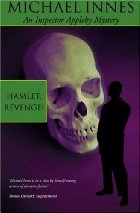
Review: Hamlet, Revenge!

Hamlet, Revenge!Michael Innes, Hamlet, Revenge!

Something is rotten at Scamnum Court. The noble English estate is hosting a large house party in order to produce an amateur performance of Hamlet, but things go wrong almost immediately when cryptic threats — some of them taken from the text of Hamlet itself — are delivered to various houseguests. Then Lord Auldearn, a guest who also happens to be the Lord Chancellor of England, is murdered onstage during opening night. The sheer audacity of the murder makes it particularly hard to solve; although the scene of the crime was packed with actors and spectators, it appears that no one saw a thing. Also, there is no shortage of suspects or possible reasons for the crime. Was Lord Auldearn murdered for the confidential state papers in his possession, or was the motive more personal? Inspector Appleby of Scotland Yard must unravel this complex case and discover a diabolically clever murderer.

I have to confess that I spent most of this book being completely bewildered. There were so many characters to keep track of, and I wasn’t sure who would turn out to be important to the plot, so I exhausted myself trying to keep tabs on everyone! This is also a very cerebral mystery; most of the “action” is conversations between Inspector Appleby and his friend Giles Gott. However, I definitely enjoyed the book more as I got further into it, and the ultimate solution was both ingenious and unexpected. I would definitely recommend having read Hamlet, or at least being familiar with the plot, before reading this book; otherwise many of the allusions and plot twists will be very obscure. Overall, I’m not sure this is quite “my kind” of book, but I did enjoy it and would consider reading more by Innes. There’s a whole series featuring Inspector Appleby, and this book is #2, but I was able to follow everything without having read the first book.

Review: The Birth of Blue Satan

The Birth of Blue SatanPatricia Wynn, The Birth of Blue Satan

Set in England during the reign of George I, this book follows the turbulent fortunes of Gideon St. Mars. Gideon is a handsome and rich aristocrat who hopes to marry Isabella Mayfield, the most sought-after beauty in London. His father, however, disapproves of the match, so Gideon visits him in hopes of persuading him to change his mind. Unfortunately, they have a violent quarrel, which becomes a damning piece of evidence against Gideon when his father is murdered later that day. Although Gideon is innocent, his so-called friends in London society immediately begin to suspect and shun him, including Isabella. Only Isabella’s companion, Hester Kean, believes in Gideon’s innocence; with her help, Gideon must hide from the law until he can bring his father’s real murderer to justice.

This is one of those books whose plot seems custom-made for me: a murder mystery, a wrongly accused hero, an interesting period setting, and a slowly developing romance. So perhaps it’s needless to say that I really enjoyed it! The early 18th century is a period I don’t know much about, but it seems fascinating and ripe for dramatic conflict. George I, the first Hanoverian monarch, is on the throne of England, but there are plenty of dissenters who would like to restore the Stuart line to power. This larger conflict is woven into Gideon’s story, and I’m interested to see how events will unfold in future installments of the series. The only jarring aspect of this book, for me, was that all the women were addressed as “Mrs.” regardless of their marital status. An author’s note explains that this was apparently the custom at that time, but it definitely confused me at first! Otherwise, though, I liked this book a lot and will definitely seek out the sequels.

Review: The Crystal Cave

The Crystal CaveMary Stewart, The Crystal Cave

This novel, the first installment of Stewart’s Arthurian saga, reimagines the story of Merlin, legendary wizard and mentor to King Arthur. Merlin is the illegitimate son of the king of South Wales, a status that brings both privileges and dangers. He never goes hungry and is able to study with tutors, but he is also a target for anyone who might wish to succeed the king or seize power. When the king dies, the ensuing struggle for the throne puts Merlin in grave danger, and he decides to flee the kingdom. At age 12, with no name, no friends, and no particular skill with a sword, Merlin must learn to survive in a hostile world. He also begins to learn that he possesses unusual abilities — powers that enable him to see into the future and foretell the coming of Arthur, who will eventually become king of a united Britain.

I really enjoy Mary Stewart’s novels of romantic suspense, so I was excited to acquire her first three Arthurian books at a library sale a few years ago. But I have to admit, I was a little disappointed by this book. It’s well-written, and the historical insights into Roman Britain are fascinating…it just moves so slowly! It seems like the first hundred pages of a not-very-long novel are just about Merlin as a child in the king’s home, where nothing much happens to him, and he spends all day hiding in the ruins of the underground plumbing system. Once he leaves South Wales, the story picks up, and I quite enjoyed the descriptions of battles and political maneuverings among the various claimants to the British throne. I’ll read the remaining books because I already bought them, but I wasn’t as excited by this book as I’d hoped.

Review: The Winter of Her Discontent

The Winter of Her DiscontentRosie Winter and her best pal Jayne are struggling actresses trying to make it in New York City in the middle of World War II. But between the recent murder of Paulette, a fellow actress who lived in their boardinghouse, and their mobster friend Al’s confession that he did the deed, Rosie and Jayne aren’t exactly focused on chasing their dreams of fame. Rosie is convinced that Al’s innocent, so she gets herself cast in the show that Paulette was starring in before she died. She soon learns that the show seems plagued by bad luck: dancers slip and injure themselves, actresses are hit by cars, and even Rosie’s nemesis Ruby suddenly falls ill. As Rosie investigates Paulette’s murder and tries to find out what’s behind all the “accidents,” she eventually discovers a lot more than she bargained for — all while trying to survive rationing, blackouts, and not knowing whether her ex-boyfriend Jack is dead or alive.

I really liked the first book in this series, The War Against Miss Winter, so I immediately set out to acquire the rest of them! This is book 2, and it largely met my expectations, though I don’t think it’s quite as good as book 1. I enjoy Rosie’s blunt voice, which is littered with 1940s slang, and I think that both she and her best friend Jayne are very interesting characters. The mystery aspect of this book is definitely secondary to the character development and the WWII setting, but I thought it was rather clever. I also liked the showbiz setting of much of the novel, but obviously that won’t be appealing to everyone. At this point, I’m curious to see what’s next for Rosie, especially in her romantic relationships. She’s still carrying a torch for Jack and trying to find out where he is, but it’s a little hard for me to be invested since Jack hasn’t been “on page” yet. I’m also intrigued to follow her career, since it seems she’s bound for the South Pacific with the USO in book 3. I’m looking forward to continuing with Rosie’s adventures!

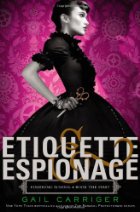
Review: Etiquette & Espionage

Etiquette & EspionageGail Carriger, Etiquette & Espionage

Fourteen-year-old Sophronia Temminnick is the despair of her mother due to her disheveled appearance and unladylike fascination with mechanical objects. In desperation, her mother decides to send her to finishing school — a prospect that fills Sophronia with dismay. But she soon discovers that Mademoiselle Geraldine’s Finishing School is much more than meets the eye. For one thing, it’s located on a giant dirigible; for another, lessons include weaponry and poisoning as well as dancing and the proper way to drink tea. Sophronia is delighted with her unexpected education, which proves to be useful when the school is attacked by foes who are looking for a valuable prototype. Along with her newfound friends both above- and belowdecks, Sophronia decides to learn more about the prototype and its significance, but her investigation may endanger her family as well as herself.

I very much enjoyed Gail Carriger’s Parasol Protectorate series, so I was eager to read this new book that is set in the same universe, but a few decades earlier. I’m happy to say that I liked it even more than the Parasol Protectorate books! The concept of a finishing school that teaches young ladies how to be dangerous secret agents is absolutely fascinating, and I was absorbed by the world of the novel. I really enjoyed the combination of Victoriana, steampunk, and humor that Carriger does so well; I especially loved the occasional bits of pure silliness, such as the existence of “flywaymen” (highwaymen that travel by hot air balloon) and a villainous society of Picklemen whose leader is known as the Great Chutney. There are also some wonderful secondary characters and a few potential love interests for Sophronia, so I definitely look forward to reading more books in this series!

Review: Dead Men Don’t Ski

Dead Men Don't SkiPatricia Moyes, Dead Men Don’t Ski

Inspector Henry Tibbett and his wife Emmy are looking forward to a relaxing ski holiday in the Alpine town of Santa Chiara, Italy. However, Henry has also been asked to keep his eyes peeled for information relating to an international smuggling ring that might be headquartered in the area. Though reluctant to spoil his holiday with work, Henry can’t help but notice that several of his fellow vacationers have secrets to hide. Then one of the other guests at his hotel, Fritz Hauser, is found murdered on the ski lift. As Henry helps the local police to investigate, he soon learns that Hauser was involved in the smuggling ring — and that several of the hotel guests had good reasons for wanting him dead.

I think this book could best be described as a “traveling” English country house mystery. All the key elements are there — unlikable murder victim, plenty of suspects, an unusual crime scene which demands very precise alibis from everyone — but it happens to take place in a ski villa rather than an English country house. Since I love the genre, I found a lot to enjoy in this book. I especially enjoyed the subtle deviations from the standard mystery formula: for example, two of the characters are a hearty English colonel and his domineering wife, yet there’s more to both of them that meets the eye. Also, the “foreigners” in classic mystery novels always seem to be there as mere background, but here they were truly fleshed-out characters with actual relevance to the plot. I believe this is the first book in a series featuring Tibbett, and I’d gladly read more. Definitely recommended for classic mystery fans!

Review: Speaking from Among the Bones

Speaking From Among the Bones by Alan…Alan Bradley, Speaking from Among the Bones

I received this book through the LibraryThing Early Reviewer program. Its U.S. release date is January 29.

In this fifth Flavia de Luce adventure, the entire town of Bishop’s Lacey is agog at the forthcoming exhumation of St. Tancred from the village church. Of course, Flavia is determined to be present when the saint’s body is uncovered. But in her eagerness to be on the scene when the exhumation takes place, Flavia discovers another body in the church: that of the organist, whose corpse has been hidden in St. Tancred’s crypt. As Flavia investigates the organist’s death, she also stumbles upon several other mysteries. For example, what is wrong with the local magistrate’s son, and why is he kept in a locked room? Where do the tunnels underneath St. Tancred’s churchyard lead? Is Feely actually getting married, and if so, to whom? And of course, will the de Luces have to leave their beloved yet crumbling home at Buckshaw?

Five books in, this series is still going strong. I always enjoy Flavia’s adventures, and I think she’s becoming a bit more human (and less serial-killer-esque) with each new book. I wonder if Alan Bradley will ever let her grow up, or if she’ll always stay a precocious pre-teen. I’m kind of torn about which scenario I’d rather see…but regardless, Flavia is a whole lot of fun to watch as she copes with the pressures of adult life that intrude on her childhood. While corpses and detection are still a game to her, she is remarkably sensitive about her family’s complex emotions as their life at Buckshaw is threatened. I like that her familial relationships seem to be moving forward (albeit at a glacial pace) and that she may now have some competition as a detective in Adam Sowerby, a newcomer who specializes in botany and “inquiries.” There are enough interesting teasers here that I’m really looking forward to the next book!