Review: The Shadowy Horses

The Shadowy HorsesSusanna Kearsley, The Shadowy Horses

Verity Grey is a young archaeologist who has recently quit her job at the British Museum and is looking for freelance work. Her former colleague (and ex-boyfriend) Adrian tells her about a potential job in the coastal town of Eyemouth, Scotland, but he is vague about the details. Nevertheless, Verity is intrigued enough to travel to Eyemouth for an interview. There she learns that the head of the expedition, wealthy archaeologist Peter Quinnell, is hoping to find traces of the Ninth Roman Legion, which appeared in Britain in the second century A.D. and then vanished from history. Verity is excited to be part of such a potentially major find — until she learns that Quinnell has no tangible evidence that the Ninth ever passed through Eyemouth. Rather, he is basing his expedition on the word of an eight-year-old boy who is said to have the second sight. Verity is extremely skeptical at first; but the longer she spends in Eyemouth, the more she becomes convinced that something supernatural is at work.

I was surprised to discover that, unlike many of Susanna Kearsley’s other novels, this book is not a work of historical fiction; all the action takes place in the present day. Aside from that, however, The Shadowy Horses definitely has a similar feel to Kearsley’s other books. There is a young, intellectual heroine who is fascinated by history; a story in the present that closely parallels a story in the past; various supernatural elements (in this case, a ghost!); and a romance. These are all things that generally appeal to me in books, but once again, I found myself unable to get emotionally involved with this novel. There is just something about Kearsley’s writing that keeps me at a distance; though her books (including this one) are very readable, I’m never on the edge of my seat, dying to know what will happen next. A lack of dramatic tension, perhaps? Anyway, I did enjoy this book — the bits about archaeology were especially fascinating, though probably a bit outdated now — but it wasn’t anything more than a pleasant read for me.

Tune in Tuesday with Katelyn: I miss your face like hell

Tune in Tuesday-pink I feel like I’m always sharing songs from TV and movies — is that weird and/or obnoxious? I just tend to discover more songs I like that way, rather than by listening to the same 5 songs the radio plays over and over again. So anyway, this week I am sharing a song that will forever make me think of the bittersweet series finale of “Chuck.” It seems to encompass both emotional turmoil and hope, which makes it perfect for the show’s final scene. Here is “Rivers and Roads” by The Head and the Heart.

Review: Between Two Thorns

Between Two ThornsEmma Newman, Between Two Thorns

This novel follows three different characters as their stories intertwine in a fantastical world. First there’s Sam, a middle-aged drunkard with marital problems who find himself running afoul of powerful creatures that he never knew existed. Then there’s Cathy, the daughter of a noble family in the Nether, a world that mirrors our own world (known to those in the Nether as Mundanus). Folk in the Nether are patronized by various Fae overlords, so they have access to magic — but they are also beholden to the dangerous, capricious Fae. Cathy desperately wants to escape her life in the Nether and has been studying at Cambridge in Mundanus, but eventually her family and her Fae patron catch up with her. And finally, there is Max, an Arbiter whose job is to protect mundanes from Fae interference. But something is wrong with the Arbiters in Bath and London, and it just might be connected to a Fae-based power struggle in the Nether.

I think my summary of the plot is pretty confusing; but to be fair, the book itself is pretty confusing too! If you like a lot of world-building, though, you’ll probably find a lot to enjoy. The Nether is essentially a world that is connected to the Fae (although its inhabitants are all humans), and it has the general atmosphere of 18th- or 19th-century England. Cathy is desperate to escape to Mundanus because she doesn’t want to be forced into an arranged marriage and become some man’s property. I found her story easiest to follow, and therefore I enjoyed it the most, although I think Cathy is a bit of a Mary Sue. Max is a more interesting character — I liked the idea that Arbiters’ souls are disconnected from their bodies so that they can remain emotionless and therefore uncorruptible. Nonetheless, I’m still not entirely clear on what Arbiters do, and obviously there is much more to be revealed in the sequels. In fact, my biggest complaint with the book is that it’s really just a setup for the subsequent books; none of the storylines are really resolved. Still, I liked the world-building enough that I will probably give the next book a chance.

Review: The Two Mrs. Abbotts

Two Mrs. Abbotts, TheD.E. Stevenson, The Two Mrs. Abbotts

Warning: SPOILERS for Miss Buncle’s Book and Miss Buncle Married.

This third book in the “Miss Buncle” series jumps forward in time to explore life in an English village during World War II. Barbara Abbott, née Buncle, now lives in Wandlebury with her husband and two adorable children. The war apparently has little effect on her life, except that there is less food available at the market. But Barbara’s niece by marriage, Jerry Abbott, is dealing with the fact that her husband Sam is fighting somewhere in Africa; in the meantime, she has opened her home to soldiers and evacuees. But despite the privations and worries of wartime, there are still plenty of opportunities for gossip and romance! Sullen Lancreste Marvell has fallen in love with an unsuitable woman; famous authoress Janetta Walters is coming to Wandlebury to speak at the village bazaar; and Jerry’s brother Archie finally seems to be ready for marriage. Finding herself in the midst of these entanglements, will Barbara be able to engineer a happy ending?

I’m so happy that Sourcebooks is re-releasing D.E. Stevenson’s books! I really loved the first two “Miss Buncle” books, and this one is also quite fun and charming, though it definitely suffers by comparison. The problem with this book is that it lacks cohesion; there are several little plots going on, but they are largely independent of one another. Some plots also seem to peter out with no resolution; for example, in the beginning of the book, an old friend of Barbara’s comes to visit, and it seems as though she is going to be a big part of the story, but then she vanishes about halfway through the book. Ultimately the biggest story is about Archie’s courtship, which is quite sweet, but it’s not really developed in much depth. I did like reading a World War II novel that isn’t really about the war, but nevertheless the war affects many aspects of the characters’ lives. The happy, wholesome picture of village life in this book was most likely vanishing at the time Stevenson wrote the novel. Overall, I’d recommend this book to people who liked the other “Miss Buncle” books and are looking for a nice comfort read.

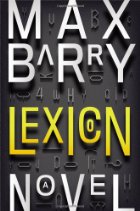
Review: Lexicon

LexiconMax Barry, Lexicon

Emily Ruff is a teenager living on the streets of San Francisco, subsisting on the change she earns by fleecing people at cards. So when she is approached by a mysterious organization that wants to send her to a special boarding school, all expenses paid, she jumps at the chance without asking too many questions. When Emily arrives at the school, she learns that its purpose is to train poets, an elite group of individuals who can use words to “persuade” people to do anything. Emily learns that people can be divided into segments based on their personality type, and each segment responds to a unique set of words. The poets want Emily because they have ascertained that she is more than usually persuasive. Meanwhile, Wil Parte is on the run, accompanied by a renegade poet called Eliot — but he doesn’t know who he’s running from or why they’re looking for him. Both Emily and Wil must eventually face violence and impossible choices as the connection between their stories becomes evident.

I picked up this book because I loved the premise, which is essentially that words have power (something book lovers already know!). Max Barry has imagined a world in which the masses can be controlled by an elite few with words alone — a world that is frighteningly close to our own. For me, the book’s biggest strength is how plausible it is; with our private lives increasingly made public through the Internet, it’s very easy to imagine governments and other powerful groups using that private information for their own ends. The book also reads extremely quickly and is chock-full of action. However, the book was a little too graphic for me, in terms of both sex and violence. And more importantly, I feel like Barry missed a great opportunity to explore some interesting philosophical questions in the novel. Clearly the poets are to some extent sinister, and the villain of the book is quite obviously the villain; but even the so-called heroes do a lot of morally questionable things, and their behavior is never really called to account. The book has a happy(ish) ending, and I just don’t think it’s justified. Still, this is a fun read if you’re interested in the premise, but I’d recommend getting it from the library rather than buying.

Review: Fer-de-Lance

Fer-de-LanceRex Stout, Fer-de-Lance

This novel introduces the famous detective team of Nero Wolfe, an eccentric genius whose skill in detection is rivaled only by his fondness for orchids, and Archie Goodwin, his streetwise secretary. Although they live in comparative luxury, Wolfe and Archie have not been immune to the effects of the Great Depression, and they certainly won’t turn down any opportunity of making some hard cash. So when a worried Italian woman comes to their doorstep asking them to track down her missing brother, they are eager to take the case. Due to Wolfe’s obese build and strange fears of the outside world, he refuses to leave his home; so it’s up to Archie to investigate the man’s disappearance. He soon discovers, however, that the missing Italian man is just one piece of a much larger puzzle involving the sudden death of a prominent university professor. While Archie collects evidence, Wolfe applies his considerable talents to solving the mystery.

This is my first encounter with Nero Wolfe and Archie Goodwin, but it certainly won’t be my last! I loved Archie as the narrator; his wry, amusing voice reminds me of the fast-talking banter of the great screwball comedies of the 1930s. It was great fun to see the investigation through his eyes, as he applies his own special brand of persuasion to the various suspects and interested parties. Nero Wolfe, by contrast, is significantly less interesting, since the inner workings of his mind remain largely mysterious. He did have some funny moments, though, and I liked his extremely formal patterns of speech. He and Archie make a nice contrast in that regard, since Archie is full of contemporary slang and has an almost aggressively casual tone. As for the mystery itself, it is quite well-plotted, even if the solution isn’t very surprising. The only thing I disliked was that the book keeps going after the culprit’s identity is revealed. For me, the fun of reading a mystery is trying to solve it; once the solution is discovered, I don’t want to read a long denouement about how the guilty party was finally caught. So I thought the end dragged a bit; but other than that, I enjoyed this mystery and look forward to reading more in the series.

Tune in Tuesday with Katelyn: You and me, we both got sins

Tune in Tuesday-pinkArgh, it’s getting hard for me to come up with intros for my Tune in Tuesday song choices! Suffice it to say, I wasn’t having a great day, but this song came on the radio and cheered me up. It’s almost too sappy and lovey-dovey, but sometimes that’s just what you need. Also, I’d like to learn this song on guitar so that I could play an acoustic, folky version — can’t you hear it that way in your head? So anyway, here’s the Goo Goo Dolls with “Come to Me”:

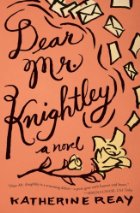
Review: Dear Mr. Knightley

Dear Mr. KnightleyKatherine Reay, Dear Mr. Knightley

Samantha Moore has been in and out of foster homes her whole life. Now, at age 23, she’s living at a group home called Grace House, but she’ll soon have to leave unless she can find a way to go back to school. One day she gets a surprising offer: if she can get into the Medill School of Journalism at Northwestern University, an anonymous donor will pay her tuition and living expenses. The only condition is that she must write regular letters detailing her educational progress to the donor under the name Mr. Knightley. Samantha is reluctant at first, particularly because she feels much more connected to fiction than journalism. Indeed, her closest friends growing up were the classic novels that kept her company through dark times, and she frequently hides in the world of books when real life is confusing or difficult. Still, Sam agrees to the deal, and through her letters to “Mr. Knightley,” she is finally able to face her past — and her future.

Despite what the title might suggest, this book is not a Jane Austen spinoff; rather, it’s a contemporary reimagining of Jean Webster’s novel Daddy-Long-Legs. My overall opinion is that the original is far better, but I can’t get into more depth without SPOILERS for both books, so skip the rest of this review if you don’t want to know how they end! … OK, so if you’re still with me, what happens is that Samantha eventually falls in love with “Mr. Knightley,” who turns out to be the handsome mystery novelist who’s been keeping Sam company throughout the book. He knows everything about Samantha, whose letters to him have been more like a diary, yet he doesn’t confess his true identity until the very end of the book. There’s this huge power imbalance between him and Sam, and the book never really addresses it, and I just couldn’t buy it as a romantic or satisfying ending at all. For some reason I didn’t mind it as much in the original – maybe because of the time period in which it was written? So I had a huge issue with the core of the story, and I also didn’t like the author’s writing style. It’s a very readable book, and if you like Daddy-Long-Legs you may enjoy this one too, but I was disappointed.

Review: Late Nights on Air

Late Nights on AirElizabeth Hay, Late Nights on Air

This novel centers around a small group of people working at a radio station in Yellowknife, Northwest Territories, Canada. Harry is a once-promising radio man who has returned to Yellowknife after a disastrous attempt at television. Eleanor, the station’s receptionist, has no life of her own but is keenly observant of the lives of others. Gwen has recently moved to town and is hoping to learn radio production at the station. And newcomer Dido is a natural on-air talent who catalyzes various shifts in the station’s social atmosphere. All these characters have been drawn to Yellowknife for different reasons, but they are united in their fascination and love for the austere beauty of northern Canada. As they develop new friendships, romances, and animosities, they also discuss the history, mythology, and current concerns of the Canadian frontier — especially as a proposed transnational pipeline threatens its very identity.

I picked up this book for its setting, and I think it does a wonderful job of immersing readers in the unique world of the Canadian North. There are lovingly detailed descriptions of weather, scenery, and wildlife; digressive anecdotes about Canadian history, especially the many European explorers who attempted to survive the brutal winters; discussions about the relationship between white settlers and native peoples; and nostalgia for a fading way of life. Hay cleverly uses the debates and hearings surrounding the Mackenzie Valley Pipeline as a framework for her story; the possible destruction of the northern ecosystem parallels the slow destruction of radio as the primary medium for storytelling due to the arrival of television. The novel is somber and contemplative in tone, and the focus is on character and setting much more than on plot. But for anyone interested in books with a unique and vividly described setting, I would definitely recommend this!