2024 Vintage Mystery Challenge Wrap-Up

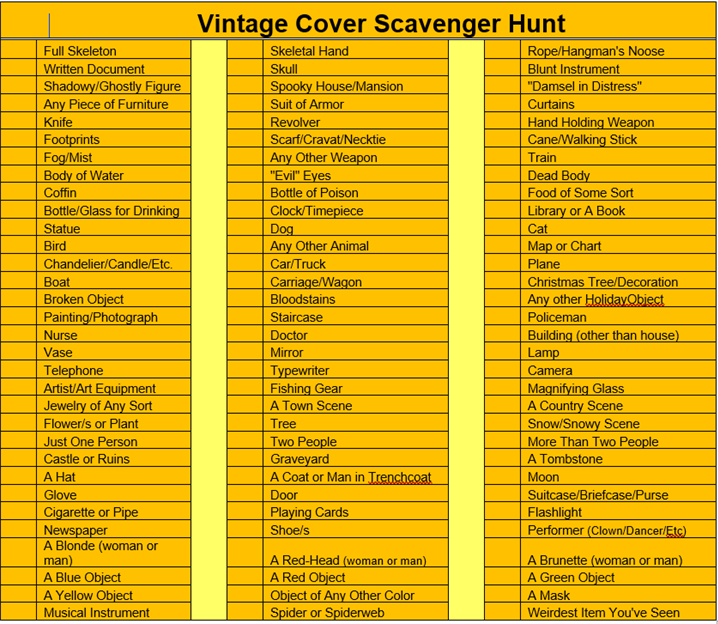
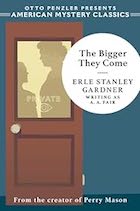
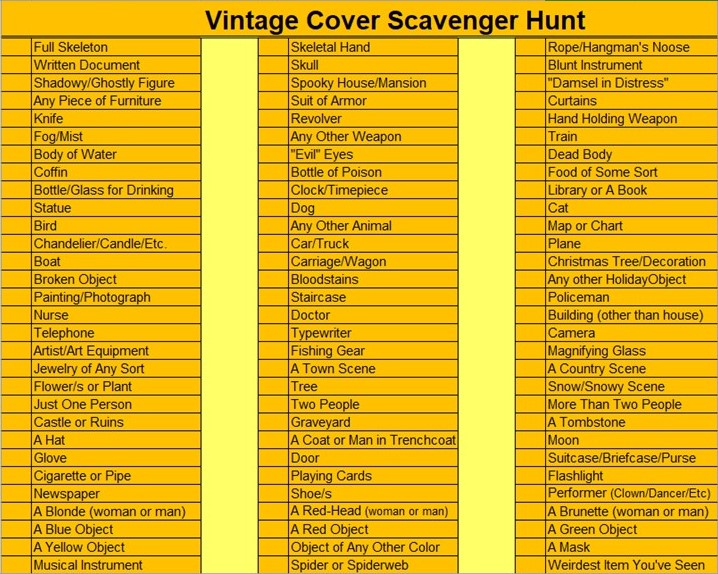
Another year, another Vintage Mystery Challenge completed! The 2024 challenge was a scavenger hunt, in which participants were asked to read at least eight books with specific objects on the covers. I read ten qualifying books for the Golden Age challenge, which dealt with books published before 1960. Here’s what I read:

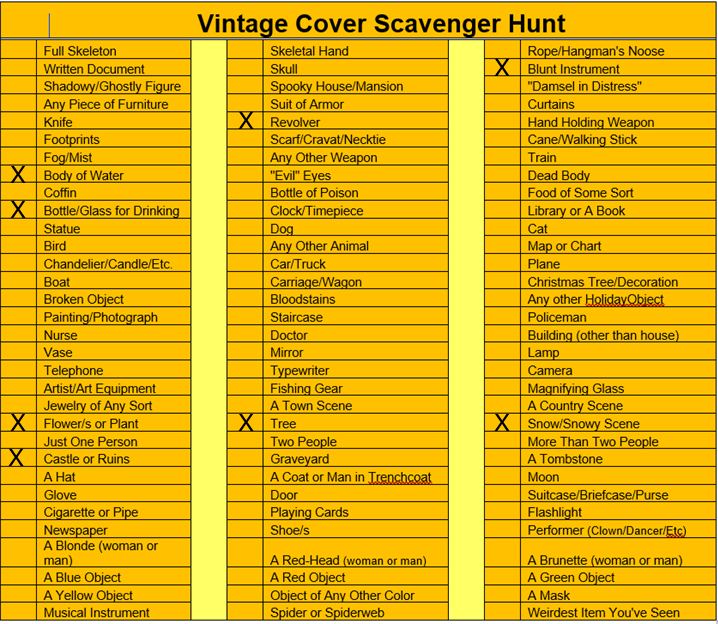
  1. Delano Ames, She Shall Have Murder (1948): shadowy figure
  2. Richard Hull, The Murder of My Aunt (1934): body of water
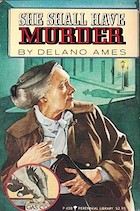
  3. Erle Stanley Gardner, The Bigger They Come (1939): door
  4. Georgette Heyer, A Blunt Instrument (1938): redhead
  5. Ngaio Marsh, Overture to Death (1939): blue object (ball of yarn)
  6. Christianna Brand, Green for Danger (1944): nurse
  7. Mignon G. Eberhart, Murder by an Aristocrat (1932): more than two people
  8. J. Jefferson Farjeon, Thirteen Guests (1936): flower or plant (green plant)
  9. Agatha Christie, And Then There Were None (1939): skull
  10. Cornell Woolrich, The Bride Wore Black (1940): hat

2023 Vintage Scavenger Hunt Wrap-Up

Now that 2023 has come to a close, it’s time to take stock of my 2023 vintage mystery challenge! The goal was to read at least eight Golden Age mysteries, and they each had to have a specific item on the cover. I ended up reading 11 books that qualified:

  1. W. Bolingbroke Johnson, The Widening Stain (1942) — library/books
  2. Ngaio Marsh, Artists in Crime (1938) — just one person
  3. J. Jefferson Farjeon, Seven Dead (1939) — boat
  4. Patricia Wentworth, The Case Is Closed (1937) — shadowy figure
  5. Ngaio Marsh, Death in a White Tie (1938) — timepiece (hourglass)
  6. Baynard Kendrick, The Odor of Violets (1941) — dog
  7. E.C.R. Lorac, Murder by Matchlight (1945) — flowers or plant
  8. Mary Roberts Rinehart, The Red Lamp (1925) — red object
  9. Agatha Christie, Death Comes as the End (1944) — brunette
  10. John Dickson Carr, The Red Widow Murders (1935) — playing cards
  11. Charlotte Armstrong, The Chocolate Cobweb (1948) — spiderweb

Of these, The Chocolate Cobweb was my definite favorite; it’s “domestic suspense” at its best, with characters who behave intelligently and edge-of-your-seat suspense. I also loved Death Comes as the End, a reread for me, and The Case Is Closed. I wasn’t as enamored of The Red Lamp or The Red Widow Murders, but I definitely want to read more by both Rinehart and Carr. Stay tuned for my sign-up post for the 2024 vintage mystery scavenger hunt!

2022 Vintage Scattergories Wrap-Up

As 2022 comes to a close, it’s time to say goodbye to this year’s vintage mystery challenge, hosted by Bev at My Reader’s Block. This year we played Scattergories and had to read at least eight vintage mysteries to correspond with the various categories listed. I chose the Golden Age version of the challenge, which means all the mysteries I read had to be published before 1960, and I ended up reading 11 books:

  1. Genuine Fakes: Nicholas Blake, Thou Shell of Death (1936) — The author’s name is a pseudonym for Cecil Day-Louis.
  2. Staging the Crime: Leo Bruce, Case with Four Clowns (1939) — The book is set in a traveling circus, which is part of the entertainment world.
  3. Repeat Offenders: Georgette Heyer, Death in the Stocks (1935) — Heyer is one of my favorite authors, and this book was a reread for me.
  4. Jolly Old England: Agatha Christie, The Moving Finger (1942) — The novel is set in a quintessential English village.
  5. World Traveler: Ngaio Marsh, Vintage Murder (1937) — The book is set in New Zealand, not the US or UK.
  6. Murder by Numbers: Craig Rice, Eight Faces at Three (1939) — There are two numbers in the title.
  7. Book to Movie: Agatha Christie, Why Didn’t They Ask Evans? (1934) — There’s a recent adaptation by Hugh Laurie, currently available to stream on BritBox, which I very much enjoyed.
  8. Wicked Women: Francis Duncan, Behold a Fair Woman (1954) — The word “woman” is in the title.
  9. Amateur Night: Anthony Berkeley, Jumping Jenny (1933) — Amateur detective and mystery novelist Roger Sheringham is the main sleuth, though he’s actually trying not to catch the murderer.
  10. Things That Go Bump in the Night: John Dickson Carr, Castle Skull (1931) — The spooky word “skull” is in the title.
  11. Calendar of Crime: Mary Kelly, The Christmas Egg (1958) — A holiday is in the title.

Of these, the clear winner for me is Eight Faces at Three, a delightful The Thin Man-esque romp whose wisecracking, hard-drinking protagonists more than make up for any issues with the plot. I also very much enjoyed both of the Agatha Christies, which were rereads for me and which I liked even though I remembered who the bad guys were. The worst book of the challenge was Case with Four Clowns, which is just a slog — the murder doesn’t even happen till the last 30 pages! But I did like most of my picks for this challenge, and I’m excited to explore more vintage mysteries in 2023!

2021 Vintage Mystery Challenge Wrap-Up

One of my favorite reading challenges is the Vintage Mystery Challenge at My Reader’s Block. The 2021 challenge was Vintage Mystery Scattergories, in which participants had to read at least eight books that fit within various categories. I ended up reading nine books, all from the Golden Age era (pre-1960):

  1. Mavis Doriel Hay, Death on the Cherwell — Murder Is Academic
  2. Dorothy L. Sayers, Busman’s Honeymoon — Amateur Night
  3. Elizabeth Daly, Murders in Volume 2 — Murder by the Numbers
  4. Ellery Queen, The Chinese Orange Mystery — Colorful Crime
  5. Charlotte Armstrong, The Unsuspected — Book to Movie
  6. John Rowland, Murder in the Museum — Scene of the Crime
  7. Ngaio Marsh, Death in Ecstasy — Leave It to the Professionals
  8. Francis Duncan, So Pretty a Problem — Jolly Old England
  9. Mavis Doriel Hay, The Santa Klaus Murder — Malicious Men

My favorite of these, by far, was Busman’s Honeymoon, which might even be my favorite of all the Lord Peter Wimsey books. I also really liked The Unsuspected. I didn’t hit any real duds, although I’d probably say Murder in the Museum was my least favorite because I don’t remember much about it now. Anyway, this challenge was a pleasure as always, and I’m looking forward to starting my 2022 challenge soon!

2020 Vintage Mystery Extravaganza Wrap-Up

Is it too late to wish everyone a Happy New Year? I’ve been pretty behind on reviews, so I feel a bit like I’m still in 2020. However, I’ve finally posted all my reviews for the 2020 Vintage Mystery Extravaganza challenge at My Reader’s Block, so it’s time for my wrap-up post! Challenge participants were asked to read at least five books that engaged with the so-called Rules of Murder propounded by Ronald Knox and S.S. Van Dine. I participated in the Golden Age level of the challenge (all books published before 1960) and read the following 10 books:

  1. Nicholas Blake, A Question of Proof — breaks Rule #14, “There must be but one detective.” In this book, the investigating is split pretty evenly between the official detective, Nigel Strangeways, and his friend Michael Evans, who is trying to prove his own innocence.
  2. Craig Rice, Home Sweet Homicide — breaks Rule #11, “There must be no love interest.” Though the main sleuths are children, there is a prominent romantic subplot between their mother and the policeman in charge of the case.
  3. Patricia Wentworth, Grey Mask — breaks Rule #16, “Secret societies, camorras, mafias, et al., have no place in a detective story.” “A professional criminal must never be shouldered with the guilt of a crime in a detective story.” In this book, the villain is the leader of a criminal secret society (not a spoiler; the mystery is the identity of the criminal mastermind).
  4. Georgette Heyer, Detection Unlimited — complies with Rule #12, “The detective novel must have a detective in it.” The detective is a police inspector.
  5. Anthony Berkeley, Not to Be Taken — engages with Rule #4, “No hitherto undiscovered poisons may be used.” Bev clarified that any book that uses poisons would count here, and this novel centers around a murder by poisoning.
  6. Ngaio Marsh, The Nursing Home Murder — breaks Rule #6, “No accident must ever help the detective, nor must he ever have an unaccountable intuition which proves to be right.” “The culprit must be determined by logical deductions–not by accident or coincidence or unmotivated confession.” As I recall, the detective stumbles upon the true culprit by accident, and there’s no particular reason to focus on that person rather than the other suspects.
  7. Anthony Berkeley, The Piccadilly Murder — breaks Rule #10, “Twin brothers, and doubles generally, must not appear unless we have been duly prepared for them.” I can’t really say more without spoilers, but the solution to the mystery hangs upon two people looking very similar.
  8. Elizabeth Daly, Deadly Nightshade — engages with Rule #18, “A crime in a detective story must never turn out to be an accident or a suicide.” The death of a police officer in connection with the mystery appears to be an accident, but that may or may not be the case!
  9. Patrick Quentin, A Puzzle for Fools — breaks Rule #20, which lists a number of overused plot devices, including “the word association test for guilt.” The protagonist of this novel literally uses that exact device to narrow down his list of suspects. Fortunately, the ploy is unsuccessful.
  10. Dorothy L. Sayers, The Nine Tailors — breaks Rule #17, “A detective novel should contain no long descriptive passages, no literary dallying with side-issues, no subtly worked-out character analyses, no ‘atmospheric’ preoccupations.” No disrespect to Sayers, but the passages on bell-ringing in this novel are certainly a side issue, and a fairly tedious one unless you happen to be a campanologist!

As always, I very much enjoyed my reading for this challenge, and I look forward to signing up for the 2021 vintage mystery challenge in the coming days!