Review: Someone to Love

Someone to LoveMary Balogh, Someone to Love

The earl of Riverdale has just died, and his family is putting his affairs in order. Obviously his son will inherit the title, the estate, and the bulk of the money. But the late earl also had an illegitimate daughter, Anna Snow, who grew up in an orphanage and is now a teacher there. The earl’s widow wants to give Anna some money, both as a kind gesture and as a way to forestall any future claims on the estate. But the lawyer she employs for this purpose makes a shocking discovery: Anna is actually the earl’s legitimate daughter, and her existence effectively disinherits his widow and his other children. Anna would like to be close to her newfound family, since she was previously alone in the world, but they all resent her for depriving them of their wealth and status. Her only ally is Avery Archer, a friend of the family, who decides to help her acclimate to her new life. But he never expected to be so drawn to her; and Anna never thought she would be so tempted to lose her heart to a (seemingly) shallow leader of society.

I was craving a good romance novel when I saw a review of this one at Smart Bitches, Trashy Books and decided to give it a try. I’m glad I did, because I really enjoyed this book! First of all, I think the setup is pretty genius; it may not be the most plausible premise, but it certainly sets up some great conflicts, both for this book and (presumably) for future books in the series. I very much liked Anna as a heroine — she’s confident in herself but also has a deep longing for intimacy and connection that she’s not sure how to express. In this respect, Avery is a great match for her, since he also conceals deep loneliness under a bored and detached facade. I really enjoyed his urbane quips and his witty conversations with Anna, and I loved that he’s not a typical alpha-male hero. My only quibble with the book is Avery’s practice of martial arts, because every time Avery engages in violence in the novel, it’s portrayed as being sexually appealing. Additionally, a somewhat stereotypical “Chinese gentleman” is the source of Avery’s knowledge (see the SBTB review and comments for a great discussion of this). Aside from that, though, I liked this book a lot and will definitely seek out more by Mary Balogh when I want a well-written Regency romance.

Review: Between Silk and Sand

Between Silk and SandMarissa Doyle, Between Silk and Sand

As the younger daughter of the king of Thekla, Saraid has always known that it is her duty to marry the ruler of a neighboring country, thus cementing an alliance that will benefit her people. With the help of The Book, a treatise written by a wise courtier to a previous Theklan monarch, Saraid knows she can become the perfect royal wife. When she is betrothed to the Lord Protector of Mauburni, she sets off with a small retinue through the harsh desert land called the Adaiha. En route she is kidnapped by a warlord named Cadel who is determined not to let her reach her destination. At first, Saraid is furious and desperate to escape. But the more time she spends in Cadel’s camp, the more she finds herself drawn to him — and the more conflicted she becomes about where she truly wishes to be.

I want to start off by saying that I didn’t dislike this book; it was a pleasant enough read, and I liked Saraid as a character. But several things about this book really frustrated me! First of all, the premise reminds me of Robin McKinley’s The Blue Sword — which is not necessarily a bad thing, except that The Blue Sword is so much better! Second, the prologue reveals way too much of the plot of the book, which completely killed the dramatic tension for me. And third, I found the romance somewhat problematic because it seems like Saraid is always wrong and Cadel is always right. Not to mention the fact that she is his prisoner; and while Cadel does have legitimate reasons to prevent her from reaching Mauburni, he never shares those reasons with her. So overall, I found myself focusing a lot more on this book’s flaws than its good points. I’ve read and enjoyed other books by Marissa Doyle, but I’d advise people to pass on this one.

Review: Have His Carcase

Have His CarcaseDorothy L. Sayers, Have His Carcase

Harriet Vane, the famous detective novelist and infamous murder suspect (recently acquitted), is on a walking tour of British coastal villages. One afternoon she has a picnic on the beach and drops off to sleep. When she awakens, she is shocked to discover the body of a dead man farther along the beach. The man’s throat has been cut, but there is only one set of footprints (which must belong to the corpse), so suicide is a possibility. But Harriet can’t help thinking it might be murder. She photographs the body — which will be washed away when the tide comes in — and goes for help. But much to Harriet’s chagrin, help eventually arrives in the form of Lord Peter Wimsey, whose eagerness to solve the mystery is compounded by his desire to spend more time with Harriet. As the two join forces to solve the mystery, they also struggle to define the nature and boundaries of their relationship.

The more I read of Dorothy L. Sayers, the more I come to realize that she is emphatically not for everyone. This book is a Golden Age mystery, but it’s far from a typical one. Sayers is unquestionably familiar with the tropes of the genre — indeed, Peter and Harriet have some fun mocking them in this book — but she doesn’t seem particularly interested in following them herself. As with many of her other books, the “whodunit” is not the main concern; rather, she spends most of her time setting up a seemingly impossible crime, then explaining at length how it was possible after all. It’s clever, but I must confess that it didn’t hold my attention. A chapter near the end, where Peter and Harriet decode a letter and painstakingly explain how the code works, is especially dull.

However, I still really liked this book, and the reason is that I’m fascinated by the development of the relationship between Peter and Harriet. There’s one scene in particular, where they leave aside their usual polite banter and express their real emotions, that hit me right in the gut. Much as my romantic heart wants them to get together, I completely understand Harriet’s ambivalence and her struggle to maintain her independence in the face of Peter’s relentless pursuit. I’m extremely eager to read Gaudy Night now, but since I’m going in publication order, I have a couple books in between. I think that when I reread the series (as I undoubtedly will), I’ll group all the Peter-and-Harriet books together.

Review: The Napoleon of Crime

Napoleon of CrimeBen Macintyre, The Napoleon of Crime: The Life and Times of Adam Worth, Master Thief

Ben Macintyre’s enthusiasm for larger-than-life historical figures is evident once again in this biography of Adam Worth, one of the most notorious thieves and con artists of the late 19th century. Worth began his criminal career as a pickpocket but soon established himself as a gang leader, gaining notoriety through planning a series of successful bank jobs. Eventually Worth set up shop in London, where he created a public persona as a wealthy English gentleman, which he was able to maintain for decades even while continuing his criminal activities. His crowning achievement was the theft of Gainsborough’s famous portrait of Georgiana, Duchess of Devonshire. Worth’s criminal genius, plus his short stature, prompted a Scotland Yard detective to dub him the “Napoleon of the criminal world” — a phrase famously used to describe the ultimate fictional criminal mastermind, Sherlock Holmes’s nemesis Moriarty.

I’m a big fan of Ben Macintyre’s books about World War II-era espionage, so I was excited to try this book even though it has a different subject matter. I’m not sure if it was the different focus or the fact that I was extremely busy in real life at the time, but I just couldn’t get into this book the same way I did with Operation Mincemeat, for example. I think Macintyre overstates his thesis, which is that Worth was the real-life inspiration for Moriarty; the evidence that exists really doesn’t seem very conclusive. Also, he focuses a lot on Worth’s theft of the Gainsborough painting and engages in some psychological speculation about Worth’s supposed obsession, which according to Macintyre had a sexual component. In this area, there really seems to be NO evidence supporting the book’s claims! I did find the interactions between Worth and William Pinkerton (yes, one of those Pinkertons) to be very interesting and would have loved the book to focus more on that relationship. Overall, the book is entertaining enough, but I didn’t like it as much as I expected to.

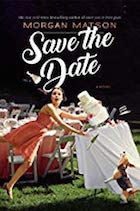
Review: Save the Date

Save the DateMorgan Matson, Save the Date

Charlotte “Charlie” Grant is the youngest of five siblings, and she loves her big, boisterous family more than anything. Now her older sister is getting married — a bittersweet occasion for Charlie, since the wedding will be the last big event in her family home, which is about to be sold. Still, Charlie is thrilled that her siblings will all be coming home for the wedding, and she’s looking forward to a perfect weekend of family togetherness. But, of course, nothing goes according to plan: The wedding planner quits at the last minute, forcing the Grants to scramble for a substitute. The weather refuses to cooperate. The house is overcrowded with unexpected guests. Charlie’s favorite brother brings home an awful girlfriend without telling anyone. And, of course, there are Charlie’s own problems, including a possibly requited crush on the neighbor boy and a tough decision about which college to attend in the fall. As Charlie attempts to cope with these issues, she also begins to realize that her seemingly idyllic family might not be quite so perfect after all.

Morgan Matson is one of my favorite YA contemporary authors, so it’s no surprise that I really enjoyed this book. I love anything wedding-related, so the setting was automatic catnip for me; and I also love books about big families, which seem to be somewhat underrepresented in fiction. I completely bought the family dynamic in this book, especially the loving but complicated bonds between Charlie and her siblings. An interesting aspect of Charlie’s character is that she tends to perceive her siblings in somewhat static categories: Danny, the oldest brother, is her hero; J.J. is the class clown; Mike is the “problem” child. And a lot of her growth comes from recognizing that they can’t be classified so neatly, that they are real human beings who grow and change just as she does. So I really liked that aspect of the book! I will say that the romance, while adorable, doesn’t get much development compared to all the family stuff, so readers who are looking for that might be disappointed. Also, Charlie can be almost irritatingly naive at times. But overall, I liked this one a lot and am eagerly awaiting Matson’s next book!

Review: Ghostly Echoes

ghostly echoesWilliam Ritter, Ghostly Echoes

This third installment of the Jackaby series focuses on Jenny Cavanaugh, the resident ghost of 926 Augur Lane. She was brutally murdered 10 years ago, and now she is finally ready for her friends Jackaby and Abigail to investigate. As they begin to research the case, they realize that Jenny’s murder may be connected to recent disturbing events in New Fiddleham. Their investigation leads them to the eerie pale man who lurked at the edges of Beastly Bones, to a group of scientists with a sinister plan, and even to the Underworld itself. Meanwhile, Jenny continues to grow in confidence, even as she grapples with the question of what will happen to her when her murder is finally solved. Abigail’s mettle is tested as never before, and glimpses of Jackaby’s mysterious past are finally revealed.

I read this book a couple months ago, and I’m afraid I may not be remembering the plot very clearly; no doubt my summary has left some things out. But this is an exciting installment of the series, pulling together some of the plot threads from earlier books and setting the stage for a magical showdown in the fourth and final novel. I liked that we finally get a little insight into Jackaby’s past and some of the more unusual aspects of his personality, and it was also nice to learn more about Jenny, who is a fairly minor character in the first two books. The solution to the murder mystery is very clever, but I’m not sure how I feel about the fact that it ties into a much larger story arc that won’t be resolved until book four. The first two books in the series are much more episodic, but this one definitely can’t be read as a stand-alone novel. However, I’m certainly intrigued enough to pick up The Dire King and see how everything turns out!

Review: The Humans

humans.jpgMatt Haig, The Humans

Professor Andrew Martin, a mathematician at Cambridge University, has just proved the Riemann hypothesis, an action that represents a huge breakthrough with dramatic consequences for the improvement of human science and technology. Unfortunately, his discovery has come to the attention of an alien race that, believing all humans are motivated by violence and greed, will do anything to prevent it from going public. Therefore, one of the aliens is sent to Earth to invade the professor’s body, destroy the proof of the Riemann hypothesis, and kill anyone who might know about the discovery — including the professor’s wife and troubled teenage son. At first, the alien is eager to complete his mission; but the more time he spends on Earth, the more he comes to understand and even love the humans around him.

I went into this book knowing very little about it, and I was pleasantly surprised by how much I enjoyed it! Matt Haig has a light, playful style but doesn’t shy away from more serious moments, as when the alien narrator begins to feel the tension between his growing empathy with the humans and his own cultural values. I liked that the book is a sort of philosophical thought experiment, exploring how the human race might look to an intelligent but emotionally detached outsider, and ultimately considering the question of what it means to be human. Oddly, I found the human culture on display in this book to be a bit off-putting . . . for example, the fact that Andrew Martin’s son is named Gulliver rubbed me the wrong way. But overall, this is a fun read with a good mixture of levity and thoughtfulness.

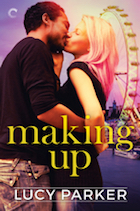
Review: Making Up

making upLucy Parker, Making Up

Trix Lane is a confident, talented circus performer whose daring aerial acrobatics have won her a major role in a popular and long-running London show. But some of her spark has dimmed lately, in the wake of an emotionally abusive relationship that shook her confidence. Now she has the opportunity to get an even bigger role in the show, but she’s not quite sure she can do it. And her anxiety isn’t helped when she learns that Leo Magasiva has just been hired to do makeup for the show. Leo and Trix have a fraught past, and whenever they meet, they can’t seem to help antagonizing each other. But beneath their sarcastic banter is an undeniable attraction, and when they begin to explore their true feelings for one another, Trix is surprised to discover how compatible they really are. But will their fledgling relationship be able to survive new misunderstandings and competing career goals?

I adore Lucy Parker’s contemporary romances, and this one is no exception. I love the enemies-to-lovers trope when it’s done well, which it definitely is here; I especially loved the nods to Much Ado about Nothing (my favorite Shakespeare play, not surprisingly!). I have to admit, though, I didn’t adore this book quite as much as I did Act Like It and Pretty Face. I think it’s because the overall tone is a little more somber, and there isn’t quite as much witty banter. (That’s understandable, of course, given that Trix is recovering from her ex’s abusive treatment.) I also find that I can’t remember very many incidents in the book. Both Leo and Trix do change throughout the novel, but their development is largely internal, not necessarily tied to specific plot events. Don’t get me wrong — I still really liked this book! It’s just a bit quieter than Parker’s previous novels. But I still love her and can’t wait until her next book, The Austen Playbook, comes out!

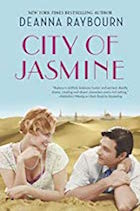
Review: City of Jasmine

city of jasmineDeanna Raybourn, City of Jasmine

Famed aviatrix Evangeline Starke is in the midst of a big publicity stunt, flying her plane over the seven seas of antiquity. This trip is motivated by her need for money, her thirst for adventure, and her subconscious desire to move past the death of her husband, Gabriel, which occurred five years before. But when Evie receives a mysterious — and apparently current — photo of Gabriel, she is determined to discover whether he is still alive, and if so, what really happened to him five years ago. Her search takes her to the ancient city of Damascus, where various European countries are carving up the region into strategically advantageous states, and into the heart of the desert itself. What she finds is a priceless relic, ethnic tensions, life-threatening dangers, and possibly a second chance at love.

Something has happened to me in the way I react to Deanna Raybourn’s books. When I first read Silent in the Grave, I remember really loving it and being eager to read the rest of the series. I loved the combination of 19th century historical detail, mystery, and romance, which, as I recall, was fairly unique in my experience at the time. I think the issue is that, as time has passed, I’ve read a lot more books; I’ve become a more sophisticated consumer and have read more widely in the various genres I like. As a result, Raybourn’s brand of historical fiction no longer seems particularly unique or special to me. She has good plots and some funny lines, but her characters are pretty typical for the genre, and I’m not fond of the rugged alpha males she tends to use as heroes. This particular novel is quite entertaining, and I really can’t point to anything wrong with it; it just didn’t really excite me, and I’ve already removed it from my shelves.

Review: Home by Nightfall

home by nightfallCharles Finch, Home by Nightfall

***Warning: Slight spoilers for previous books in this series.***

In this ninth installment of the Charles Lenox series, the Victorian gentleman-sleuth is happy that his fledgling detective agency is beginning to thrive. He is especially excited about the recent disappearance of a famous German pianist who had been performing in London. Hoping to be hired to assist the police, Charles eagerly reads the newspaper reports and spins theories to explain the disappearance. But his attention is split between this mystery and his brother Edward, who is grieving the recent death of his wife Mary. Charles offers to keep Edward company at his country estate, only to run into more strange occurrences: a break-in, several thefts, and an unsettlingly cryptic drawing. Now Charles must work to solve two mysteries, and he soon realizes that in both cases, nothing is as it seems.

I quite enjoy this series, so I’m not sure why I waited three and a half years to read this book after reading the previous installment! It was nice to revisit these characters and immerse myself in this world after spending some time away. And I think this might be one of the strongest books in the series. I was able to guess some elements of the countryside mystery, but it still held my interest, and I found the resolution to be very thought-provoking and poignant. I also enjoyed the diversion to the village setting — most of the plot takes place there, although Charles does dash up to London every so often to work on the case of the disappearing pianist. In fact, my main complaint is that the dual mystery plots split the reader’s focus; I would have preferred to stay in the country and follow that case, perhaps leaving the pianist for another book. Still, this is a very good installment of an enjoyable series — well worth reading for fans of historical mysteries!