Review: In Milady’s Chamber

In Milady's ChamberSheri Cobb South, In Milady’s Chamber

When Lord Fieldhurst is found murdered in his richly appointed Mayfair home, suspicion immediately falls on his wife. It’s common knowledge in London society that their marriage has been unhappy and that, because of Lady Fieldhurst’s inability to produce an heir, her husband has pursued sexual satisfaction elsewhere. Furthermore, the man was stabbed in the neck with his wife’s own nail scissors. The evidence seems ironclad; but John Pickett, the Bow Street Runner assigned to the case, is immediately enthralled by Lady Fieldhurst’s beauty and becomes determined to prove her innocence. As he investigates other promising suspects, such as Fieldhurst’s heir and his colleagues at the War Office, he uncovers many secrets but comes no closer to finding the killer — that is, until he and Lady Fieldhurst finally join forces to discover the truth.

I love mysteries and the Regency period, so any book that combines them both is something I’m going to want to read! In this case, the book delivered exactly what I wanted: a light, quick-reading, Heyer-esque period piece with a little mystery and a hint of romance. John Pickett is a somewhat unique protagonist for this type of story: most Regency heroes are self-assured and commanding, but John is young, naive, and idealistic to a fault. Nevertheless, he manages to be good at his job, despite being distracted by the beautiful Lady Fieldhurst. I was a little annoyed that he falls for her so quickly, and apparently on the basis of nothing but her looks, but his awkward pining does make for several humorous moments. Julia, Lady Fieldhurst, is also given some dimension and depth as she helps John with his investigation and contemplates her own future. The mystery is wrapped up a little too abruptly, although I did like the subtle hints to one part of the solution that are seeded throughout the book. But overall, I simply enjoyed spending time in this world with these characters, and I definitely plan on continuing with the series!

Review: Under a Dancing Star

Under a Dancing StarLaura Wood, Under a Dancing Star

In 1930s England, 17-year-old Beatrice Langton longs to be a scientist, but her parents have a different plan in mind for her: because she’s their only child, and they no longer have the money to maintain the estate, she must marry a rich aristocrat and restore the family fortunes. But Bea’s “outrageous” behavior at an ill-fated dinner party gives her life a new direction when her parents decide to send her to her uncle’s home in Italy. Far from being chastised, Bea is thrilled — especially when she arrives in Italy to find that her uncle and his bohemian fiancée are essentially living in an artists’ commune. She is soon enjoying the freedom of her new life, with one exception: one of the artists, Ben, is as argumentative and obnoxious as he is handsome. But when their friends dare them to embark upon a summer romance, Bea reluctantly agrees. If nothing else, it will be an interesting experiment, and she’ll gain some much-desired life experience. But when their pretend relationship becomes all too real, will their very different backgrounds keep them apart?

Much Ado about Nothing is my favorite Shakespeare play, so I’m game to read any and all retellings, especially if they’re set in interesting historical periods! This one takes place in the 1930s, so I couldn’t help but compare it with Speak Easy, Speak Love, which is another Much Ado retelling set in the 1920s. I absolutely adored Speak Easy, Speak Love, and I must admit that this book suffers a bit by comparison. It’s a light, fun read, and I enjoyed the chemistry between Bea and Ben, but to me it lacked the substance of Speak Easy, Speak Love. It’s also not as good a retelling of Much Ado — it focuses on the Beatrice and Benedick story but jettisons the Hero/Claudio plot entirely, merely keeping a few of the character names. I did love the way this book subtly paraphrased some of the most famous lines from the play, rather than quoting them outright; I thought that was a great way to pay homage to the original play while still keeping the language appropriate for the characters’ ages and the time period. Overall, I enjoyed this book and would read more by Laura Wood, but if you’re looking for a YA Much Ado retelling set in the early 20th century, I’d definitely recommend Speak Easy, Speak Love instead!

Review: Greenglass House

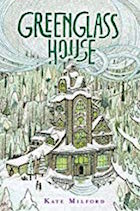
Greenglass HouseKate Milford, Greenglass House

”There is a right way to do things and a wrong way, if you’re going to run a hotel in a smugglers’ town.” Thus begins the story of 12-year-old Milo Pine and his parents, who manage an inn called Greenglass House in a port city that is heavily populated with smugglers. But the smuggling business tends to die down in winter, so Milo is looking forward to an uneventful Christmas vacation with his family. His hopes for a quiet Christmas are dashed, however, when several strangers arrive at Greenglass House for an indefinite stay, and then a bad snowstorm effectively traps them all in the inn together. Then several of the guests’ belongings mysteriously go missing, and it becomes obvious that there’s a thief in their midst. Not only that, but each of the guests seems to have a connection to Greenglass House or to be interested in its history. Milo and Meddy, the cook’s daughter, decide to investigate the guests, uncover the thief, and unearth the secrets of Greenglass House. But their search, while exciting, may turn out to be more dangerous than they ever imagined.

I must admit, I picked up this book primarily because of the gorgeous cover, but I’m pleased to say that the story does live up to it! It’s not quite the story I was expecting; I was picturing a little more action in the plot, when in fact it’s a pretty quiet story up until the last chapter or two. The novel actually contains layers of stories: First, Milo is reading a book in which several travelers meet in a tavern and exchange tales. Second, he and Meddy create fictional alter egos based on a roleplaying game similar to Dungeons and Dragons. And third, the guests of Greenglass House each tell a story and thus reveal their reasons for coming to the inn. I found this structure surprisingly complex for a middle-grade novel, but it does a nice job of bringing together all the threads of the plot. One interesting aspect of Milo’s character is that he’s adopted — he is of Chinese descent, while his parents are not — so he wrestles with questions about his heritage, while also worrying about hurting his beloved parents’ feelings. I don’t have personal experience with adoption, but I think the issue is handled sensitively here. Overall, I’d recommend this to people who want a cozy, atmospheric winter read, or for smart kids who loved The Westing Game and want more.

Review: Miss Grimsley’s Oxford Career

Mrs. Drew Plays Her Hand:Miss Grimsley's Oxford CareerCarla Kelly, Miss Grimsley’s Oxford Career

Miss Ellen Grimsley is the second daughter of a respectable country gentleman, and her destiny is to marry an equally respectable country gentleman and fulfill her womanly duties as wife and mother. But Ellen would much rather be a scholar and an explorer, traveling the world and making maps of far-off places. When her forward-thinking aunt gets her a place at Miss Dignam’s Select Female Academy, in the very town of Oxford, Ellen is thrilled — but she soon discovers that the classes are only in “feminine” subjects like French and embroidery. So when her brother Gordon, who’s flunking his Shakespeare course at Oxford, asks for her help, Ellen can’t resist writing his papers and even dressing as a man to attend lectures at the university. Obviously she can’t continue this charade for long without being caught; but luckily, the person who catches her is the kind and scholarly Jim Gatewood, who encourages her intellectual curiosity and converses with her as an equal. But when Jim professes his love for her and proposes marriage, Ellen is hesitant to give up her dreams, even for love.

Since this book came in the omnibus with Mrs. Drew Plays Her Hand, which I liked, I decided to give this one a try too. Unfortunately, I didn’t enjoy this one quite as much. The plot is rather muddled, and too many of the events strain credibility. For example, how does Ellen manage to fool everyone (or indeed anyone) in her male disguise? The book mentions that Gordon’s tutor is old and practically blind, but were there no other students nearby? Then there’s Ellen’s roommate, Fanny Bland, who is sometimes cruel and sometimes kind, without any real explanation for these fluctuating moods. Finally, the central conflict between Ellen and Jim seems to come down to Ellen’s own obtuseness. Despite her affection for, friendship with, and attraction to Jim, she refuses to see that she’s in love with him and turns down his repeated proposals of marriage. Near the very end of the book, there’s a hint that Ellen turns him down because she fears giving up her dreams of an independent life. That would have been a more interesting conflict to explore, but the book doesn’t dig into it at all, merely giving Ellen an abrupt change of heart just before the novel ends. Overall, a disappointing read — but at least I was able to finish it before the end of the year!

Review: Murder Most Malicious

Murder Most MaliciousAlyssa Maxwell, Murder Most Malicious

It’s Christmas 1918, and England is ready for a little peace on earth after the end of the Great War. But the house party at Foxwood Hall is anything but peaceful: on Christmas night, Lady Phoebe Renshaw hears her older sister Julia arguing with her would-be fiancé, Lord Allerton. The argument ends with Julia breaking off their relationship — and the next day, Lord Allerton is nowhere to be found. Then some of the Foxwood servants receive a gruesome surprise in their Boxing Day gifts, indicating that Allerton is dead. The police believe one of the footmen is responsible, but Lady Phoebe and her maid, Eva Huntford, are convinced of his innocence. In an effort to prove it, Phoebe and Eva do some investigating of their own, and they soon discover that many of Foxwood’s current inhabitants — both above and below stairs — had a reason to want Allerton dead. And if they don’t stop sleuthing, they may be the next to die.

This book has strong Downton Abbey vibes, and I think anyone who enjoyed that show will like this book too. It gives that same upstairs-downstairs picture of English country house life at a time when social mores were beginning to shift dramatically. Phoebe and Eva are both likable protagonists, and despite their class differences, it’s obvious that they truly care for one another. At times they feel a little too much like stock characters, though . . . like every other heroine in historical fiction, they’re intelligent women who seek to transcend their social roles, but they don’t have many other personality traits. The same is true for most of the other characters: there’s the eccentric older relative, the faithful butler, the autocratic matriarch, the handsome lord who’s more than he seems, and so on. Nevertheless, it’s an enjoyable formula, so I didn’t mind too much. The mystery plot was interesting, and while I did guess the culprit, it was fun to follow along. Overall, I’m definitely interested in continuing with the series, and I hope that Phoebe and Eva’s characters will be more fleshed out in subsequent books.

Review: Mystery in White

Mystery in WhiteJ. Jefferson Farjeon, Mystery in White

Six passengers in a third-class train compartment become entangled in a sinister mystery when the train is trapped in a snowdrift on Christmas Eve. The group includes a lively young brother and sister, a chorus girl, an elderly bore, a shy clerk, and a professor with an interest in the supernatural. They all decide to leave the train and seek shelter at a nearby station, but they become lost in the snow and end up at an isolated country house. Desperate for shelter, they enter the house, but no one seems to be home. Yet the teakettle is on, and the table is set for a meal. As the characters try to make sense of these events, one of them reveals that a man was murdered in the train — and when the group is later joined by another “lost” individual, they suspect that he may be the murderer. This chain of events later converges with another mystery concerning the house itself and a murder that happened 20 years ago.

I enjoy Farjeon’s light and humorous writing style, and his characters are well rounded and sympathetic. But plot-wise, I was quite disappointed in this novel. The six characters introduced in the opening chapters of the book are the ones we follow for about two-thirds of the novel, so naturally I assumed that they would be the most important people in the story. But in fact, aside from the professor, who acts as the detective and orchestrates the denouement, none of these six people have any relevance to either of the mysteries in the novel! They provide some humor and some human interest, but they have no actual function in the plot. Instead, two new characters come in late in the game, and they turn out to be central to the story. I can’t understand why Farjeon would structure his story in such a way that it’s totally disconnected from the characters we’ve been following all along. I also felt sorry for several of the characters, who deserved a happier ending than what they got. All in all, this might be entertaining for people who enjoy a witty period piece, but I definitely wouldn’t recommend it for people who want a good mystery!

Review: Discerning Religious Life

Discerning Religious LifeSr. Clare Matthiass, CFR, Discerning Religious Life

This short book, written by a religious sister, is a guide for Catholic women that describes the process of discerning a religious vocation (that is, a call to become a religious sister or nun). It describes various “steps” of this process in detail, from a woman’s first inkling that she might be called to religious life, to the attitudes and habits she should possess before beginning to discern seriously, to what will happen when she starts researching specific convents and communities. The book is peppered with anecdotes from the author and many other religious sisters who share their experiences of being called and of living out their vocations. The book doesn’t spend a lot of time digging into the theological and historical background of religious life, assuming that the reader will already be familiar with the basics. But it does provide very practical advice and reassurance to women who are questioning whether the religious life might be for them.

Obviously this book is going to be useful only for a very small audience: unmarried Catholic women who are still trying to discover God’s plan for their lives. I fall into this category, and while I’ve never particularly felt called to religious life, I found a lot to think about in this book. My favorite aspect of the book is that it spends a lot of time discussing the sacrifices of religious life — particularly the vows of poverty, chastity, and obedience — and the various obstacles and doubts that many women confront as they consider this vocation. It frankly acknowledges that the religious life is difficult and that the sacrifices it requires are significant. At the same time, the personal stories from the author and the other religious sisters clearly demonstrate the joy they find in their calling. I also really appreciated the book’s discussion of prayer and will definitely be applying some of those lessons to my own prayer life. Overall, I got a lot out of this book and would definitely recommend it to any woman in a similar stage of life.

Review: Mrs. Drew Plays Her Hand

Mrs. Drew Plays Her Hand:Miss Grimsley's Oxford CareerCarla Kelly, Mrs. Drew Plays Her Hand

Roxanna Drew is at the end of her rope. After the death of her husband the vicar, she must find a new home for herself and her two young daughters. Her late husband’s brother is willing to provide this home, but only if she agrees to become his mistress. Revolted by the suggestion, Roxanna decides to rent the dower house of a nearby estate instead, but her brother-in-law’s nefarious schemes are far from over. Meanwhile, the estate’s owner, Fletcher Rand, Lord Winn, has problems of his own. He is shunned by most of society because he publicly divorced his wife after discovering her many infidelities. His family urges him to marry again and produce an heir, but Winn is reluctant to trust another woman — that is, until he meets Roxanna while on a tour of his estates. Winn is immediately attracted to her and quickly befriends both herself and her children. But when circumstances force them into a marriage of convenience, they must learn whether they can truly rely on each other.

As I’ve become more familiar with the romance genre, I’ve encountered Carla Kelly’s name multiple times as a respected author of traditional Regencies, and this particular novel is often praised as one of her best. I wasn’t quite as impressed as I wanted to be, but I did enjoy this book very much and have already begun another of Kelly’s novels. Both Roxanna and Winn struck me as mature adults who are doing their best in their respective difficult situations. I especially liked Winn because, while he’s slightly curmudgeonly at first, he’s not brooding or selfish like many other romance heroes. He shows his love for Roxanna by always putting her and her family’s needs before his own, but his sense of humor keeps him from being annoyingly perfect. There’s not much plot beyond the initial setup, and I found the writing style a bit clunky and some of the dialogue anachronistic. I also wasn’t convinced by the evil brother-in-law’s repentance in the end. But overall, I did like this one and will definitely read more by the author.

Review: Snowspelled

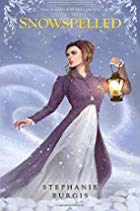
SnowspelledStephanie Burgis, Snowspelled

In a fantasy world analogous to 19th-century England, upper-class men are expected to be magicians, while upper-class women are destined to be politicians. But Cassandra Harwood has always had a thirst for magic, and her passionate determination got her all the way to the Great Library, the premier training ground for young magicians. She even found love there with the equally passionate and hardworking Wrexham. But a spell gone horribly wrong has deprived Cassandra of her ability to cast magic, not to mention her social standing and her fiancé. Now, four months after this tragic incident, Cassandra is snowed in at a house party with the high-society people she’s been trying to avoid, including her ex-fiancé. To make matters worse, the snowstorm seems to be magical in origin, and Cassandra is tricked into making a bargain with an arrogant elf-lord to discover who is causing it. If she fails, the consequences will be dire for both herself and her nation, as the age-old treaty between humans and elves will be broken. Can Cassandra discover the culprit and sort out her personal life before it’s too late?

I’ve read and enjoyed books by Stephanie Burgis before, and I’m a sucker for anything that can be described as “Jane Austen plus magic,” so this novella seemed right up my alley. And I did enjoy it overall, but now I find myself remembering more of its flaws. I think the main problem, for me, was the heroine. Cassandra is one of those protagonists who is incredibly stubborn, convinced of her own rightness, and unwilling to compromise. All of her problems in the story are of her own making, particularly the mess of her relationship with Wrexham. I did like Wrexham, and I enjoyed the banter between them, but it frustrated me that they’re both such poor communicators, especially since they were once engaged to each other. Cassandra does grow and change in the course of the story, but it was too little, too late for me. Also, as with many novellas, the short length doesn’t leave much room for nuance in the plot or characters. The world of the story is interesting, and I actually wouldn’t mind reading a full-length novel in this setting, but I feel like I didn’t get to see enough of the world. All in all, I’m not giving up on this author, but I think I’ll stick to her full-length novels instead.

Review: A Summer to Remember

Summer to RememberMary Balogh, A Summer to Remember

Kit Butler, Viscount Ravensberg, was once a respectable army officer, but now he’s one of London’s most notorious rakes. His father wants him to come home, accept his responsibilities as heir, and marry the woman his family has chosen for him. Kit rebels from this fate and decides to choose his own wife; but she must be so thoroughly respectable that his family couldn’t possibly object to her. Lauren Edgeworth fits the bill nicely: she’s not only beautiful but a perfectly proper lady. She finds Kit’s behavior shocking, yet she’s also intrigued by his mischievous attempts to provoke her. She won’t consent to a real marriage — ever since she was left at the altar a year ago, she’s been determined to remain a spinster — but eventually she agrees to a fake engagement. She’ll accompany Kit to his home and help to heal the estrangement between him and his family. But in return, she wants a summer to remember. Of course, the longer Kit and Lauren spend together, the fonder they grow of each other. But their love may not be enough to overcome past wounds and present insecurities.

Mary Balogh has quickly become one of my go-to historical romance authors, but I must confess that I didn’t love this book quite as much as some of her others. I think it’s largely because I didn’t find Kit remotely charming or fun in the beginning; rather, I thought he was pushing Lauren out of her comfort zone far too aggressively, almost to the point of harassing her. Balogh does course-correct fairly early in the novel, making Kit realize that he’s been treating Lauren as an object rather than as a fellow human being, but I felt that the transition was abrupt and the motivation for the change was unclear. The premise of the book is a bit thin as well — I didn’t understand what Lauren was actually hoping to get out of her summer with Kit, given that she was planning to live in Bath as a spinster afterwards. However, I liked that both characters are dealing with a lot of emotional pain, but they react in completely opposite ways, Lauren by adhering strictly to society’s rules and Kit by breaking them altogether. So I did warm up to both main characters eventually, and I ended up enjoying this opposites-attract romance quite a bit. I’ll definitely continue to read more by Balogh!