Review: The Winter Long

Winter Long, TheSeanan McGuire, The Winter Long

***Warning: SPOILERS for previous books in this series!***

Things finally seem to be looking up for October Daye. Now that the malevolent, usurping Queen of the Mists has been dethroned and the true queen reinstated, Toby’s biggest problem is having to dress up for court functions. But of course, this pleasant state of affairs can’t last, as Toby learns when Simon Torquill — the man whose spell once turned her into a fish for 14 years — suddenly re-enters her life. Shockingly, he doesn’t seem to want to harm Toby this time; in fact, he claims that he’s only trying to protect her from another, more powerful enemy. Toby knows she can’t trust Simon, but the more she investigates his allegations, the more it seems he’s actually telling the truth. Someone from Toby’s past is out to get her, and it’s the last person she would ever expect. Can Toby once again protect her loved ones, defeat the bad guys, and live to fight another day?

Seanan McGuire actually wrote a little intro to this book in which she said, “Everything I have done with October’s world to this point has been for the sake of getting here.” And indeed, this book is a game-changer for the series, shedding a whole new light on the events of previous books. I love the fact that McGuire has plotted this series so meticulously, and it really shows in this installment. Now I want to go back and re-read the entire series, so I can pick up on all the little clues I missed the first time around! So plot-wise, I really loved this book, and I’m very intrigued to see what’s next for Toby and the gang. At the same time, though, I’m a little nervous about the future of this series. With every new installment, it seems that the stakes get higher and higher, and Toby becomes more and more important in her Fae world. In the first few books, she seemed refreshingly ordinary, but now it seems that she’s some kind of Chosen One, which is a trope that often bugs me in fantasy novels. I’m definitely still hooked on the series for now, but I hope that I will still be enthusiastic after future installments!


Review: Jane Austen Cover to Cover

Jane Austen Cover to CoverMargaret C. Sullivan, Jane Austen Cover to Cover: 200 Years of Classic Covers

This is a book that delivers exactly what it promises: AustenBlog editrix Margaret C. Sullivan has compiled a large (though not exhausitve) collection of covers of Jane Austen’s novels, from the earliest published editions of the Regency period to the movie tie-in editions of today. The covers are arranged chronologically, giving Sullivan the opportunity to discuss related topics such as the publishing industry in Austen’s day, the waxing and waning of Austen’s popularity in both the U.K. and the U.S., and the Janeite resurgence that began in the 1990s with the iconic image of a wet-shirted Colin Firth as Mr. Darcy. The covers themselves are a delightful hodgepodge of different styles, from the somber scholarly editions to the far-out art of the 1970s. Overall, I enjoyed the book but found it rather insubstantial; it doesn’t really have anything to say about the broader cultural relevance (if any) of Austen cover art. Still, it would make a great gift for Janeites or for anyone who judges a book by its cover!

Review: Silence

SilenceShusaku Endo, Silence (trans. William Johnston)

This novel is set in 17th-century Japan, at a time when Christianity has been outlawed, and Christians are imprisoned and tortured so that they will renounce their faith. Nevertheless, various missionary groups from Europe, both Catholic and Protestant, continue to arrive in Japan in hopes of spreading the Christian religion there. One such missionary is Sebastian Rodrigues, a Portuguese priest who believes that God is calling him to minister to His church in Japan. Rodrigues also hopes to find his former teacher and mentor, Father Ferreira, who is rumored to have renounced Christianity and adopted a traditional Japanese lifestyle. When Rodrigues arrives in Japan, his enthusiasm for his mission slowly declines as he sees Christian peasants being tortured and executed for their faith. For the first time, he experiences serious doubts in the face of God’s silence: if He exists, why does He allow his faithful disciples to suffer? As Rodrigues struggles with this question, he must eventually decide whether his faith is truly worth defending at any cost.

This book is laser-focused on a single issue: God’s silence in the face of suffering, and the implications of that for a person of faith. If this is an issue that interests you at all, I would definitely recommend this book! The writing style is sparse and direct, enhancing the nature of the stark choice that confronts Sebastian Rodrigues. The character’s struggle really rang true for me, and there are certainly no easy answers in this book. For me the most compelling character was Kichijiro, the Japanese guide who shelters Father Rodrigues and his companions but later betrays them. He is a weak, pathetic, utterly despicable character, yet Rodrigues comments that “Christ did not die for the good and beautiful. It is easy enough to die for the good and beautiful; the hard thing is to die for the miserable and corrupt….” In sum, this book isn’t a particularly fun or quick read, but I think it’s an important one for anyone interested in questions of faith or in the clash between Western religion and Eastern culture.

Review: Murder at the Brightwell

Murder at the BrightwellAshley Weaver, Murder at the Brightwell

Amory Ames and her husband Milo are having marital difficulties. They met just a few years ago and married quickly after a whirlwind romance. But now Milo is spending most of his time in various fashionable European cities — and gaining quite a reputation as a playboy — while Amory sits at home. Then one day Amory receives a visit from Gil Trent, a longtime friend and former fiancé, who needs her help: Gil’s sister has just gotten engaged to a thoroughly unsuitable man, and Gil hopes that Amory can persuade her not to go through with the wedding. Intrigued by Gil’s reappearance in her life, and angry at her husband, Amory agrees to help. She accompanies Gil to the fashionable Brightwell hotel, where Gil’s sister, her fiancé, and a small group of friends have gathered. But Amory gets more than she bargained for when the fiancé is murdered, and the culprit must be someone she knows….

This is one of those books that you’ll enjoy if the summary sounds interesting to you. I really like traditional English mysteries set in the first half of the 20th century, and this novel is a solid addition to that tradition. Amory is a likeable narrator and protagonist, and even though her amateur sleuthing seems a bit unnecessary (given the presence of a competent police inspector on the case), at least she’s not obnoxious or too stupid to live. The mystery plot is reasonably satisfying; it’s not particularly original or shocking, but the killer’s identity did surprise me. There’s a strong romantic subplot in the novel as well, as Amory must choose between Gil and Milo. I’m a fan of romance in my fiction, so I enjoyed this plotline, although I was never really in any doubt about whom Amory would choose. All in all, I enjoyed the book and would certainly read a sequel if one materializes.

N.B. I received an ARC of this novel at Book Expo America. The US publication date, per Amazon, is October 14.

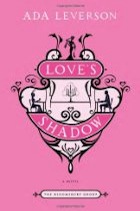
Review: Love’s Shadow

Love's ShadowAda Leverson, Love’s Shadow

Edith Ottley, a pretty and intelligent young woman, has begun to be bored with her life. Her husband Bruce is pompous, condescending, and unaware of his intellectual inferiority to his wife. Edith’s only solace is the companionship of her friend Hyacinth Verney, a young heiress who is living a dashing and unconventional life in London. Hyacinth has just begun to explore the possibility of getting married, and she is strongly attracted to the handsome but aloof Cecil Reeve. But Cecil, in turn, is hopelessly in love with a widow ten years his senior, although she doesn’t return his affections. In short, this novel is a comedy of manners about a social circle in which everyone is in love with the wrong person. Amidst all their tangled romances and unrequited loves, can any of the characters find true happiness?

I read this novel a couple weeks ago, and I find that I don’t have much to say about it now. The book is quite witty in places, and some of the situations and characters strongly reminded me of Jane Austen. (Bruce Ottley, for example, is a slightly more sympathetic Mr. Collins if ever there was one — which makes me wonder why Edith married him in the first place!) But this book never really goes below the surface or allows the reader to sympathize with any of the characters. All the conflicts in the book came across as trivial to me, and in the end I didn’t much care how all the various romances resolved. If you enjoy stylish, witty comedies of manners, you’ll find something to enjoy in this novel; but if you need a strong plot or sympathetic characters, you’ll end up feeling frustrated, as I did.

Review: Do Androids Dream of Electric Sheep?

Do Androids Dream of Electric Sheep?Philip K. Dick, Do Androids Dream of Electric Sheep?

Sometime in the early 21st century, World War Terminus has resulted in widespread destruction and nuclear fallout, so everyone who can afford it has emigrated to Mars. To help these emigrants establish a new civilization, androids were created to be servants and laborers. As time went on, the androids became more sophisticated until they were virtually indistinguishable from humans — except for a complete lack of empathy. Now some of these androids have returned to Earth, where their presence is illegal, and policeman Rick Deckard is charged with hunting them down and “retiring” them. In fact, he is authorized to kill them on sight; but as he pursues the rogue androids, he must confront his own feelings and beliefs, including what it means to be human.

When I started this book, I was expecting the main issue to be the nature of the androids themselves: If they have the same intelligence and (mostly) the same emotions as humans, aren’t they also human? But oddly enough, the book leaves no doubt on this issue — the androids are not human, and Rick Deckard’s struggle with this fact gets him into trouble on several occasions. Even though the androids are machines, Deckard can’t help but see them as human beings, due to his own empathetic response. He feels pity for them, recognizes their contributions to society, and even falls in love with one of them. Ultimately, the real issue of the book is not the humanity of the androids, but rather the humanity of the humans: Can Deckard do his job and still retain his humanity? As such, I found the book a fascinating read, even though it wasn’t quite what I expected.

Blade Runner final cutAfter reading this book, I decided to rent the movie “Blade Runner” so that I could compare and contrast the film adaptation with the original. Basically, the movie is VERY different from the book, and I was bewildered by most of the changes. The movie is visually stunning — I loved the vision of a post-apocalyptic Los Angeles — but I just didn’t understand Deckard’s relationships with the androids in the movie at all. It’s hard to say more without spoiling, but let me just say that the final confrontation scene goes VERY differently in the movie versus the book. The movie also suggests (and Ridley Scott confirmed that this was his intention) that Deckard himself is an android, which is 100% NOT the case in the book. So while “Blade Runner” is an interesting movie in its own right, it’s definitely not a faithful adaptation of the book!

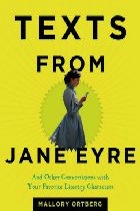
Review: Texts from Jane Eyre

Texts from Jane EyreMallory Ortberg, Texts from Jane Eyre: And Other Conversations with Your Favorite Literary Characters

Mallory Ortberg, popular writer for websites such as The Hairpin and The Toast, has expanded her ingenious “Texts From” series into a book. What if the various authors, poets, and characters you studied in school had the ability to text? Hamlet would probably be a whiny teenager who refuses to come out of his room for dinner. William Carlos Williams would be constantly bugging his wife to bring home more plums from the grocery store. And Mrs. Bennet certainly wouldn’t miss an opportunity to urge her daughters to snag rich husbands! From Achilles to Virginia Woolf, Wuthering Heights to Sweet Valley High, nothing is safe from Ortberg’s satirical (and often punctuation-less) eye.

It’s hard to review humor because it’s so subjective: You either think it’s funny or you don’t. I’m definitely a fan of Ortberg’s style — the texts from Jane Eyre had me ROLLING the first time I read them! — so I enjoyed this book. I definitely think it helps to be familiar with the source material; most of the literary references are to pretty famous works, but there are also sections on The Hunger Games and The Baby-Sitters Club, so it’s a rather random, eclectic mix. The biggest criticism I have about the book is that it’s kind of one-note. The premise is funny, but there’s really nothing more to it. Basically, I don’t think it’s a book that I’d need to read over and over again, but it would be a great gift for someone who loves literature!

N.B. I received an ARC of this book through the LibraryThing Early Reviewers program. The publication date, per Amazon, is November 4.

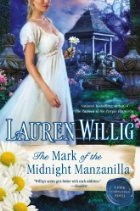
Review: The Mark of the Midnight Manzanilla

Mark of the Midnight Manzanilla, TheLauren Willig, The Mark of the Midnight Manzanilla

In the autumn of 1806, a popular novel called The Convent of Orsino (written by none other than Miss Gwen!) has sparked a vampire craze in fashionable society. Rumors swirl around one man in particular — Lucien, Duke of Belliston — whose long absence from society is seen as evidence that he is a creature of the night. Practical, outspoken Sally Fitzhugh is determined to prove this rumor false, so she seeks out an acquaintance with the duke. For Lucien, the rumor escalates from inconvenient to dangerous when a young woman is murdered at a society ball, with what appear to be fang marks on her throat. Lucien and Sally quickly realize that someone is framing Lucien for the murder, so together they decide to find the real killer. Is it someone with a personal grudge against Lucien, or could the nefarious French spy known as the Black Tulip be at work again? The more time Lucien and Sally spend together, the more they are drawn to each other; but before they can be together, they must defeat a cunning killer.

This 11th novel in the Pink Carnation series once again combines romance, historical fiction, and a touch of intrigue for a very enjoyable read. I wasn’t totally enthused about the plot of this installment beforehand, since vampires aren’t really my thing, but fortunately they’re not a big part of the story. I also didn’t completely warm up to Lucien or Sally, both of whom seem like types rather than characters…Sally in particular just seems like a younger version of Miss Gwen. But there’s still an awful lot to enjoy in this book! I was pleasantly surprised by the resolution of the mystery, which is quite clever and hangs together well. And as always, I adore the light, tongue-in-cheek tone of the series; it doesn’t take itself too seriously and aims to be entertaining above all else. I should mention that the contemporary story takes some significant steps forward in this installment, with Eloise facing important decisions both personally and professionally. So I’m really looking forward to the next (and last!) Pink Carnation novel, which will finally tell the story of the Carnation herself!

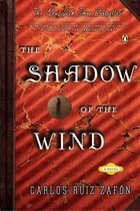
Review: The Shadow of the Wind

Shadow of the Wind, TheCarlos Ruiz Zafón, The Shadow of the Wind (trans. Lucia Graves)

When Daniel Sempere is ten years old, his father takes him to the Cemetery of Forgotten Books for the first time. There he must choose one book that calls to him, and it will be his job to protect it forever. Daniel chooses a novel called The Shadow of the Wind by Julián Carax, unaware that this simple decision will alter the entire course of his life. Daniel reads the book and loves it, so he tries to find other novels by Carax, only to discover that there are none. Someone is systematically destroying every copy of every book Julián Carax ever wrote, and he is calling himself Laín Coubert, one of Carax’s names for the devil. As Daniel comes of age in mid-20th-century Barcelona, he makes it his mission to discover who is destroying Carax’s books and why. His quest leads him to a long-buried secret involving friendship, passion, madness, and true love. But the more deeply Daniel digs into Carax’s mysterious background, the more he discovers parallels to his own life, and the more danger he finds himself in.

This is one of those books that just didn’t grab me, for some reason. I found myself able to put it down for days at a time, and when I finally did power through it, my mind kept wandering. But I don’t quite understand why, becasue I honestly liked a lot of things about this book! First of all, I’m now dying to visit Barcelona because of the vivid descriptions of its streets, neighborhoods, and restaurants. I also enjoyed the almost Dickensian depictions of the secondary characters, like this one:

His mouth was glued to a half-smoked cigar that seemed to grow out of his mustache. It was hard to tell whether he was asleep or awake, because he breathed like most people snore.

The plot is fairly melodramatic, but it’s undeniably interesting and full of event. Maybe I was a bit put off by the staggering number of coincidences connecting Daniel’s story to Carax’s, or maybe I didn’t like the portrayal of the female characters (who are basically nothing more than male fantasies). Ultimately, I just didn’t connect that much to the story or characters, so it was an effort for me to finish the book.

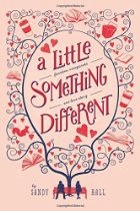
Review: A Little Something Different

Little Something Different, ASandy Hall, A Little Something Different

When Gabe and Lea meet in a creative writing class at their university, sparks begin to fly instantly. Everyone can see it, from the creative writing professor to their fellow students to the baristas at Starbucks — everyone, that is, except Gabe and Lea themselves. They’re both shy and a little awkward, and Gabe is dealing with some trauma from his past, so it’s unsurprising that they have a hard time interpreting each other’s mixed signals. Still, everyone else can see that they’re crazy about each other, and that’s why this novel is told from everyone else’s point of view. Parts of the story are variously told by Gabe’s brother, Lea’s roommate, the aforementioned baristas, a waitress at the local diner, and even a squirrel who lives on campus; in fact, the only characters who don’t address the reader directly are Lea and Gabe. Despite their mutual crush, will they ever be able to get together? And if not, how will their friends, acquaintances, and random observers cope with the disappointment?

This book is a sugary confection that I devoured in one sitting. At bottom it’s a classic boy-meets-girl story, but the various narrators provide an interesting twist on the tale. Overall, I was impressed with the author’s ability to switch between voices so skillfully. A couple characters were difficult for me to distinguish (particularly Gabe’s group of friends), but it was generally easy to keep everyone straight. (It doesn’t hurt that each new perspective is clearly marked with the character’s name and function, such as “Inga, Creative Writing Professor.”) I didn’t love every single perspective — the narratives from “squirrel” and “bench,” in particular, seemed unnecessary — but the author interview at the back of the book revealed that she had about twice as many narrators in the initial draft! So at least she cut back a little. 🙂 I also found it interesting to tell a love story in this way, giving everyone a voice except the two main characters; it seems to reflect a voyeuristic element in our culture (reality TV, social media, etc.). Ultimately, this is an adorable little romance with a cute gimmick attached, and I really enjoyed it!