Review: The Welsh Girl

The Welsh GirlPeter Ho Davies, The Welsh Girl

Set in North Wales just after D-Day, this novel weaves together the stories of three people who are all struggling with the ways in which the war has made them question their identity. Esther is the eponymous Welsh girl who works as a barmaid but dreams of life outside her tiny village. When an English soldier takes advantage of her, Esther has to face her future and determine what kind of woman she will become. Karsten is a young German soldier who has surrendered to the English and must now live with the shame of being a coward; as he sees the Allies reclaim more and more of Europe, he also questions his belief in German supremacy. Meanwhile, Rotheram is a German man with a Jewish father who fled Germany in the early days of the war. He now works as a translator for the British and interrogates German prisoners, but he is conflicted about where his loyalties truly lie.

Lately I’ve been really interested in books that are set during World War II, so I had high hopes for this novel. Unfortunately, it didn’t live up to my expectations, which is largely the fault of the cover blurb. I thought the book would mostly focus on the relationship between Esther and Karsten and the obstacles they’d have to face being on opposite sides of a war. But while a relationship does grow between them, it doesn’t actually happen until well after the halfway point of the novel. Most of the book is just setting up the conflict, as Esther’s background, the Welsh attitude toward the war, and Karsten’s military career are described in plodding detail. I wouldn’t actually call the book romantic at all — which is not a problem, except that the blurb led me to believe otherwise! I do think that the novel raises some interesting thoughts relating to World War II and war in general, so it was probably worth reading for those insights. (There was also a line near the end of the book about the liberation of Bergen-Belsen that got me right in the gut.) But overall, although I wanted to like this book, it just didn’t do anything for me.
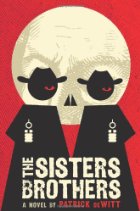
Review: The Sisters Brothers

The Sisters BrothersPatrick deWitt, The Sisters Brothers

The eponymous Sisters brothers are Charlie and Eli, two of the most notirous hired gunmen in the West. Eli narrates the story of their adventures as they set out to perform a job for their boss, the Commodore. They have orders to kill a man named Hermann Kermit Warm, who is reported to be in San Francisco. As Eli and Charlie travel towards their target, they encounter many strange and interesting people, including a boy who is determined to get to California despite all his relatives being dead or gone; a pretty bookkeeper who is dying of consumption; and a dentist who introduces Eli to the wonders of toothbrushes. Eli also ponders the nature of life and begins to wonder whether he really wants to continue his career of violence. Will the Sisters brothers ever catch up with Hermann Kermit Warm, and if so, will Eli be able to finish the job?

I’m happy to say that I can add to the large number of positive reviews I’ve seen for this book. Even though I wouldn’t call myself a fan of Westerns, I enjoyed the setting of this book because it provided a perfect backdrop for Eli’s interior journey. Although he and Charlie encounter other people from time to time and even stay in towns occasionally, the bulk of the action seems to take place when they’re alone with each other. This gives Eli plenty of time to reflect on his bond with Charlie and discover what links them together, as well as what makes them different. The plot is definitely secondary to this central relationship. I also really liked the moral complexity of the characters. Even though Eli is the main protagonist, the book never quite lets you forget that he is accustomed to killing people in cold blood; in fact, he and Charlie do some pretty despicable things in the novel. I’m very impressed that the book managed to make the Sisters brothers likeable despite their many faults. Overall, I’m definitely glad that I read this book and will look forward to seeing what deWitt writes next.

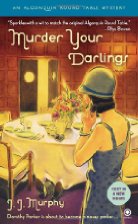
Review: Murder Your Darlings

Murder Your DarlingsJ.J. Murphy, Murder Your Darlings

Dorothy Parker is famous for her elegant quips, biting wit, and copious consumption of alcohol, but this novel also imagines her as an amateur sleuth. When Dorothy shows up at the Algonquin for lunch with her fellow literati, she sees a man’s feet sticking out from under the Round Table. But he’s not dead drunk, as Dorothy first assumes — just dead. Dorothy and her friends soon learn that the corpse is Leland Mayflower, a famous critic with many professional rivals. The police are intent on arresting a shy young Mississippi writer named Billy Faulkner, but Dorothy thinks they’ve got the wrong man. Along with Robert Benchley and the rest of the Algonquin’s “vicious circle,” Dorothy sets out to find the real killer, tossing off jokes and martinis with equal speed along the way.

I don’t know too terribly much about Dorothy Parker, but when I saw the premise of this book, I knew I had to check it out. It’s an extremely fun read, mostly because of the rapid-fire dialogue between Dorothy and her literary friends. I especially loved Robert Benchley’s character, whom I pictured as a slightly more intelligent Bertie Wooster. The mystery itself is definitely secondary to the setting and all of the famous characters, but it’s still well-plotted. My only complaint is that the ending dragged on for too long. After the guilty party’s identity is revealed, there are several more chapters in which Dorothy, the police, and a mob boss all chase the murderer around New York City. It got a bit tedious for me; I don’t enjoy a long denouement once the villain is unmasked. But overall I enjoyed this book a lot, and it’s inspired me to finally read some Dorothy Parker!

Review: Warm Bodies

Warm BodiesIsaac Marion, Warm Bodies

In this unusual take on the zombie novel, the protagonist is one of the walking dead. Sometime in the near future, civilization has collapsed, and the world is a perpetual battleground between the living and the undead. “R” and his fellow zombies live in an abandoned airport, where they shuffle around mindlessly and occasionally hunt the living to satisfy their desire for human brains. But “R” is different; though he can’t speak or move like a living person, he is a thoughtful and sensitive soul who can’t help wondering why the world is in such terrible shape. Then he meets Julie, a living girl who sparks an unusual desire in him: instead of eating her brain, he wants to protect her. As “R” and Julie slowly get to know one another, they decide that it’s time to heal their damaged world — and maybe heal each other in the process.

I am emphatically not a reader of zombie novels, but so many people have raved about this one that curiosity got the better of me. Overall I thought the portrayal of zombies was very clever. In the world of this novel, they’re not necessarily mindless monsters; they just can’t communicate with the living (and, of course, they eat brains). But some things did confuse me: for example, “R” says he can’t remember anything about his former life, yet he’s able to make complex literary references (he mentions Moby Dick at one point). Why can he remember these details but not the bigger picture of his life? But speaking of literary references, I don’t think it’s a coincidence that the characters’ names are “R” and Julie — there’s even a balcony scene! The book also mentions John Lennon’s “Imagine,” which got me to thinking…in a sense, this book hypothesizes what kind of world might exist if the lyrics of “Imagine” came true. Imagine there’s no countries, no religion, no possessions…and you might get a world close to this one. (Of course, Lennon also imagines world peace, so it’s not exactly identical.) Anyway, I have mixed feelings about this book, but I did find it quite thought-provoking.

Review: Eleanor & Park

Eleanor & ParkRainbow Rowell, Eleanor & Park

Eleanor is a chubby new girl with out-of-control red hair and weird clothes. Park is a quiet half-Korean boy who clings to his position at the edge of the cool group. In the normal course of things, they would have no reason to speak to each other. But the first day that Eleanor gets on the bus, she is immediately taunted and ostracized by the other students — and Park surprises himself by letting her sit next to him. Tentatively, Eleanor and Park begin to build a friendship, which gradually deepens into an intense love. But the odds are stacked against them: Park’s parents don’t warm to the prickly Eleanor, and Eleanor’s family life is such a disaster that Park can’t even come to her house. Plus, they’re both smart people and know that high school relationships rarely last forever. Will their relationship be able to survive these obstacles, or will love ultimately tear them apart?

After loving Rowell’s debut novel, Attachments, I naturally had to check out this book too…and happily, it is equally awesome! Both Eleanor and Park are wonderful, likable characters, and it was lovely to see each of them through the other’s eyes. I completely believed in their passionate love for each other, which is unusual for me with teen romance. I tend to scoff at happily-ever-after endings in YA, because very few high school relationships actually work out over the long term. But this book swept me away with its giddy intensity, and I found myself happily rooting for Eleanor and Park to make it. I also really enjoyed the pop culture references that are sprinkled throughout the book; it’s set in the 1980s, so there are many mentions of New Wave and cassette tapes and feathered bangs. I would definitely recommend this book to fans of romance or chick lit, even those who don’t normally read YA.

Review: Luckiest Man

Luckiest ManJonathan Eig, Luckiest Man: The Life and Death of Lou Gehrig

This well-researched biography of Lou Gehrig follows his life and baseball career in vivid detail, from his humble beginnings playing high school ball to his stellar performance as first baseman and power hitter for the New York Yankees. Along the way, Eig discusses some of the broader social developments in America in the 1920s and ’30s, but the focus remains on baseball and how it evolved throughout the early 20th century. The book uses a wealth of primary sources, particularly the many newspaper stories that covered Gehrig’s remarkable career. Most importantly, though, this biography illuminates Gehrig’s personality — humble, modest, conscientious, hardworking, and determined to do his best in life both on and off the field.

I don’t particularly follow baseball (or any other sport, frankly), but for some reason I’ve always been interested in Lou Gehrig — probably because he was left-handed, like me, and because he died tragically young. So I decided to check out this biography, and I’m glad I did because it is fantastic. I felt like I really got a sense of Lou Gehrig as a person, and it was a pleasure to read about someone so admirable. I also loved learning more about the other legendary players of that era: Babe Ruth figures prominently in the book, and there are plentiful references to other greats like Ty Cobb and Joe DiMaggio. Eig discusses Gehrig’s baseball career in great detail, sometimes describing almost every play of a game. I suppose this might be boring for some, but I really appreciated all the information since I knew basically nothing coming in. Overall, I would highly recommend this book to anyone, although it will probably be most appealing to baseball fans.

Review: Lessons in French

Lessons in FrenchHilary Reyl, Lessons in French

In 1989, Kate is a fresh-faced college graduate who dreams of becoming an artist someday. So she’s overjoyed when she is hired as an assistant to Lydia Schell, a famous American photographer currently living in Paris. Kate is excited to make the most of this opportunity, but she soon discovers that Lydia is an extremely demanding boss. For example, Kate not only coordinates Lydia’s schedule and runs her errands, but she is also expected to help Lydia’s husband Clarence with the book he is writing about 19th-century French fashion. The longer Kate stays with the Schells, the more she realizes that their seemingly successful family is fraught with dysfunction. As Kate tries to please all parties, she is pulled in so many conflicting directions that she begins to lose her own identity in the process.

I liked the basic idea of this book — naive American girl moves to Paris and learns about herself and the world — but overall it fell far short of my expectations. My biggest problem was that every single character, including the heroine, is absolutely insufferable. Kate is a total doormat, doing every single thing the Schells tell her to do regardless of how demeaning (and how unrelated to her job description). She’s also too stupid to see some really obvious things about the Schells that are going on right under her nose. I spent the whole book wishing she’d grow a spine, and while she sort of does at the end, it’s definitely too little, too late. As for the Schells, they’re pretentious pseudo-intellectual snobs with no redeeming qualities whatsoever. I did like the 1989 setting, with the Berlin Wall coming down and the Gulf War about to begin, but it didn’t play a very big part in the novel. Basically this book made me feel angry and frustrated, and only the somewhat competent writing style kept me reading until the end.

Review: The Winter of Her Discontent

The Winter of Her DiscontentRosie Winter and her best pal Jayne are struggling actresses trying to make it in New York City in the middle of World War II. But between the recent murder of Paulette, a fellow actress who lived in their boardinghouse, and their mobster friend Al’s confession that he did the deed, Rosie and Jayne aren’t exactly focused on chasing their dreams of fame. Rosie is convinced that Al’s innocent, so she gets herself cast in the show that Paulette was starring in before she died. She soon learns that the show seems plagued by bad luck: dancers slip and injure themselves, actresses are hit by cars, and even Rosie’s nemesis Ruby suddenly falls ill. As Rosie investigates Paulette’s murder and tries to find out what’s behind all the “accidents,” she eventually discovers a lot more than she bargained for — all while trying to survive rationing, blackouts, and not knowing whether her ex-boyfriend Jack is dead or alive.

I really liked the first book in this series, The War Against Miss Winter, so I immediately set out to acquire the rest of them! This is book 2, and it largely met my expectations, though I don’t think it’s quite as good as book 1. I enjoy Rosie’s blunt voice, which is littered with 1940s slang, and I think that both she and her best friend Jayne are very interesting characters. The mystery aspect of this book is definitely secondary to the character development and the WWII setting, but I thought it was rather clever. I also liked the showbiz setting of much of the novel, but obviously that won’t be appealing to everyone. At this point, I’m curious to see what’s next for Rosie, especially in her romantic relationships. She’s still carrying a torch for Jack and trying to find out where he is, but it’s a little hard for me to be invested since Jack hasn’t been “on page” yet. I’m also intrigued to follow her career, since it seems she’s bound for the South Pacific with the USO in book 3. I’m looking forward to continuing with Rosie’s adventures!

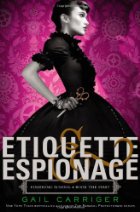
Review: Etiquette & Espionage

Etiquette & EspionageGail Carriger, Etiquette & Espionage

Fourteen-year-old Sophronia Temminnick is the despair of her mother due to her disheveled appearance and unladylike fascination with mechanical objects. In desperation, her mother decides to send her to finishing school — a prospect that fills Sophronia with dismay. But she soon discovers that Mademoiselle Geraldine’s Finishing School is much more than meets the eye. For one thing, it’s located on a giant dirigible; for another, lessons include weaponry and poisoning as well as dancing and the proper way to drink tea. Sophronia is delighted with her unexpected education, which proves to be useful when the school is attacked by foes who are looking for a valuable prototype. Along with her newfound friends both above- and belowdecks, Sophronia decides to learn more about the prototype and its significance, but her investigation may endanger her family as well as herself.

I very much enjoyed Gail Carriger’s Parasol Protectorate series, so I was eager to read this new book that is set in the same universe, but a few decades earlier. I’m happy to say that I liked it even more than the Parasol Protectorate books! The concept of a finishing school that teaches young ladies how to be dangerous secret agents is absolutely fascinating, and I was absorbed by the world of the novel. I really enjoyed the combination of Victoriana, steampunk, and humor that Carriger does so well; I especially loved the occasional bits of pure silliness, such as the existence of “flywaymen” (highwaymen that travel by hot air balloon) and a villainous society of Picklemen whose leader is known as the Great Chutney. There are also some wonderful secondary characters and a few potential love interests for Sophronia, so I definitely look forward to reading more books in this series!

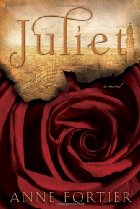
Review: Juliet

JulietAnne Fortier, Juliet

Julie Jacobs and her twin sister, Janice, have lived with their Aunt Rose ever since their parents died tragically when they were babies. When Aunt Rose dies, her will stipulates that Janice will inherit her entire fortune, including the house. Julie is shocked and angered by this slight, until she discovers that Aunt Rose has left her some old documents that belonged to her mother — documents that hint at a treasure hidden somewhere in Siena, Italy. Julie immediately goes to Siena in hopes of discovering this hypothetical treasure, but she soon finds that her inheritance — and indeed her whole identity — is bound up in the story of Romeo and Juliet. Far from being the fictional creation of William Shakespeare, their story is based on true events that occurred in Siena in the 1300s. As Julie digs deeper into the medieval legend of Romeo and Juliet, she eventually discovers some priceless artifacts connected to the lovers and finds her own destiny in the process.

Though Romeo and Juliet is by no means my favorite Shakespeare play (that would be Much Ado About Nothing, in case you were wondering!), I was excited to read this book for its combination of literary detection and romance. Unfortunately, I ended up not liking it very much! My main problem is that the heroine, Julie, is too whiny. She constantly complains about Janice’s poor treatment of her growing up, and she’s always bemoaning her “unattractive” appearance, even though she immediately catches the eye of a handsome Italian. I also hated her narrative style, which is completely stilted and unrealistic. The dialogue is almost uniformly terrible. As for the actual story, parts of it were interesting, especially in the historical chapters. But as events unfolded, I grew more and more irritated at the supernatural elements of the plot, which I was not expecting at all. Basically there’s this Ancient Curse ™ that hangs over Julie and her paramour, who are sort of reincarnations of the original Romeo and Juliet, and they need to break it in order to live happily ever after. The farther I got through the book, the more I went from “not great, but still readable” to “I can’t wait for this mess to end!” Overall, not recommended.